

Most boat rental cancellation policies fall into one of three windows: cancel more than a few days out and you usually get a full refund, cancel inside that window and you're often looking at a partial refund or credit, and no-shows almost always forfeit the full payment. Deposits and rebooking fees are standard practice across the industry, and severe weather or documented emergencies may shift the outcome in your favor. Before you book anywhere, including with Goldenwatersports, read the exact cancellation clause and deposit terms in the rental agreement.
TL;DR:
- Refunds for cancellations made more than 14 days in advance are generally full, but shorter notice usually results in partial refunds or credits.
- No-shows almost always forfeit the entire payment, regardless of weather or emergency circumstances.
- Deposit policies often combine reservation and damage deposits, with refunds depending on the exact cancellation window and whether the refund is issued as cash or credit.
- Documented severe weather or emergencies can warrant full refunds, but routine weather disruptions rarely qualify without proof.
- Cancellation protection is valuable mainly for multi-day charters or nonrefundable travel, and it must be purchased at booking for coverage.
Table of Contents
- What Are the Common Boat Rental Cancellation Timeframes?
- How Do Deposits, Rebooking Fees, and No-Shows Work?
- Do Weather or Owner Cancellations Get You a Refund?
- How Do You Cancel or Request a Refund?
- Is Cancellation Protection or Insurance Worth Buying?
- What Should You Verify Before You Book?
- Our Take on Cancellations and Refunds
- Ready to Book on Lake Coeur d'Alene or Liberty Lake?
- Sources
- FAQ
What Are the Common Boat Rental Cancellation Timeframes?
Cancellation policies for boat rentals generally sort into three tiers, and which one applies to you often depends on how long the rental is. Hourly and single-day bookings tend to carry the most forgiving terms, while multi-day charters lock in stricter windows because the operator has fewer chances to rebook that inventory.
- Flexible tier: full refund if you cancel more than 24 to 48 hours before the trip, common on hourly jet ski or pontoon bookings.
- Moderate tier: full refund if you cancel more than 14 days out, typical for full-day rentals.
- Strict tier: full refund only if you cancel more than 30 days ahead, standard on weekly or multi-day charters.
AllSail's terms of service lay out this exact structure. A booking canceled inside the flexible window might still return a partial refund, while canceling inside a strict window on a weekly charter usually means forfeiting most or all of the payment. Some operators also require a 72 hour notice specifically for a full refund and apply a partial refund or a flat rebooking fee if you cancel inside that period, according to S&S Boat Rentals' rental agreement page. Refunds also don't always come back as cash. Several operators issue account credit instead, particularly for cancellations made close to the trip date, and prorate the refund based on how much notice you gave.
How Do Deposits, Rebooking Fees, and No-Shows Work?
Two different deposits usually show up on a boat rental invoice, and mixing them up is where a lot of confusion starts.
- Reservation deposit. Paid at booking to hold your date, and it's typically applied toward the total rental cost rather than refunded separately.
- Security or damage deposit. Collected at pickup or check-in to cover potential damage, and it's refunded after the boat comes back undamaged. S&S Boat Rentals notes that reservation deposits often convert into security deposits once you check in, so read the fine print on which one you're actually paying.
- Rebooking or administrative fee. Some operators charge a flat fee (around $25) for cancellations inside the notice window, while others use a percentage rescheduling fee, with Your Boat Club's policy citing a 10% fee for changes made inside 14 days.
- No-shows. Simply not showing up almost never qualifies for a refund. S&S Boat Rentals states plainly that no-shows forfeit payment, though rescheduling may be possible depending on availability.
Keep a written or emailed confirmation of every change you request. If a dispute comes up later, that trail is your evidence.
Do Weather or Owner Cancellations Get You a Refund?
Routine weather, a light drizzle or some wind, generally doesn't guarantee a refund on its own. Most boat rental terms and conditions treat that as a normal risk of outdoor recreation. Severe weather is a different story. Boatsetter's cancellation policy recognizes extenuating circumstances, including severe weather or a cancellation made within eight hours of the booking start, and can grant a full refund when the situation is documented.
Extenuating circumstances that platforms commonly honor include:
- Government-declared emergencies or evacuation orders
- Documented medical emergencies affecting the renter or a household member
- Official small craft advisories or storm warnings issued by weather authorities
- Marina or waterway closures ordered by local authorities
If the owner cancels on you, most platforms require them to issue a full refund or help you rebook, and repeat cancellations can trigger owner penalties on peer-to-peer marketplaces. That protects you as the renter, but only if you keep records.
Pro Tip: Screenshot the weather advisory or emergency notice the same day it's issued. Waiting a week to gather documentation weakens your claim, even when the circumstances were completely legitimate.
How Do You Cancel or Request a Refund?
Canceling a boat rental usually comes down to five steps, and skipping any of them slows down your refund.
- Locate your booking confirmation number, sent by email at the time of reservation.
- Contact the operator or platform through their official booking portal, phone line, or support email, not a general inbox.
- Include your booking ID, the original rental date, your reason for canceling, and proof of payment.
- Specify whether you're requesting a cash refund or account credit.
- Ask for a written confirmation of the cancellation and expected refund timing.
For extenuating circumstances, attach supporting documents right away: a doctor's note, a government advisory, or an official weather bulletin all strengthen the claim. Once approved, refunds typically process back to your original payment method within 5 to 10 business days. If that window passes with no movement, follow up by referencing your confirmation email and ask for a specific processing update rather than a general status check.
Is Cancellation Protection or Insurance Worth Buying?
Paid cancellation protection add-ons exist for a reason: they're often the only way to recover your deposit if you need to cancel last minute for a personal emergency. The catch is timing. You almost always have to purchase this protection at the moment of booking, not after you've already reserved the boat.
Standard renter liability insurance covers a different risk entirely. It typically protects against damage to the vessel or liability for injuries, not your own trip cancellation, unless you've added a specific trip-cancellation rider. Insurance Spain's coverage articles go into more detail on where weather and travel disruptions fit into typical boat insurance policies.
- Worth buying: large security deposits, multi-day charters, or nonrefundable travel bundled with the trip
- Skip it: short hourly rentals with a low deposit and a flexible cancellation tier already in place
What Should You Verify Before You Book?
A few minutes reviewing the contract before you pay saves you from arguing about it later. Run through this checklist every time:
- Confirm the exact cancellation window and whether the refund comes back as cash or credit.
- Note the deposit amount and exactly what triggers its return.
- Read the weather and force majeure language, so you know what counts as an exception.
- Ask what happens on a no-show, in writing.
- Find out whether the platform or the individual owner processes refunds, and get a direct contact for disputes.
Our guide on what to look for in a watercraft rental agreement breaks down the clauses that matter most, including fuel charges and damage waivers that often get buried in the fine print.
Pro Tip: Save your confirmation email and set a calendar reminder two days before your cancellation deadline. Missing that window by a few hours is the single most common way renters lose a refund they were otherwise entitled to.
Our Take on Cancellations and Refunds
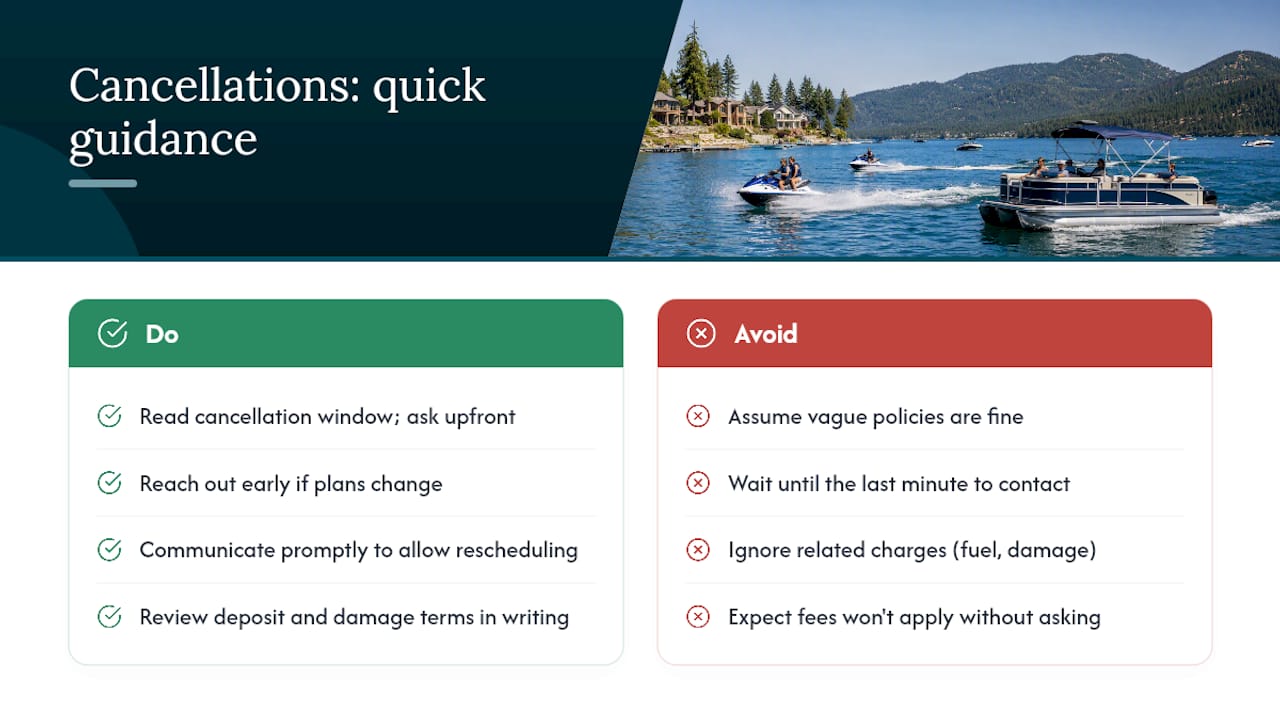
Golden Water Sports keeps deposit and damage terms in writing before you ever step on a jet ski or pontoon, because vague policies are where most renter frustration starts. We'd rather a customer read the cancellation window and ask a question up front than get surprised by a rebooking fee later. If something goes wrong on your end, weather, a family emergency, a change in plans, reach out early. The sooner you communicate, the more options we have to work with you on rescheduling instead of enforcing the strict end of a policy.
For details on charges that often intersect with deposits, our posts on fuel policy and damage charge disputes cover what to expect beyond the cancellation clause itself.
— Life is better on water.
Ready to Book on Lake Coeur d'Alene or Liberty Lake?
Deposit and cancellation terms are published directly on the booking pages, so you're never guessing what happens if your plans change. Compare that to marketplace platforms where the fine print lives in a separate legal document you have to dig for. Here, the numbers sit right next to the rental you're about to reserve.
Check the Jet Ski Rental Liberty Lake page or the Jet Ski Rental Newman Lake page to see current rates and deposit requirements before you commit to a date. Both list the damage deposit amount and the additional hourly rate if you decide to extend your time on the water. If you're planning a full day out with a pontoon, paddleboards, or wakeboards and tubes, the pricing page lays out every option available around Coeur d'Alene. Pick your date, review the policy details on the booking page, and reserve your spot before the summer weekends fill up.
Sources
These policy pages informed the cancellation windows, deposit rules, and refund timelines cited throughout this guide.
- Cancellation Policy | Boatsetter
- Terms of Service | AllSail
- Rental Agreements & Cancellation Policies – S&S Boat Rentals
- Cancellation Policy | Your Boat Club
- Boat
FAQ
What Is a Typical Cancellation Policy for Boat Rentals?
Most policies fall into flexible, moderate, or strict tiers, with full refunds ranging from a 24 to 48 hour notice on hourly bookings up to a 30 day notice on weekly charters, as outlined in AllSail's terms.
What Is Boatsetter's Cancellation Policy?
Boatsetter applies time-based refund tiers but grants exceptions for documented extenuating circumstances, such as severe weather or a medical emergency, when supporting evidence is provided.
What Is Getmyboat's Refund Policy for Cancellations?
Refund terms on peer-to-peer boat marketplaces vary by individual owner and booking type, so always check the specific listing's cancellation window and refund terms before you pay a deposit.
Does My Insurance Cover Boat Rental Cancellation?
Standard renter liability insurance typically covers damage or injury liability, not trip cancellation, unless you've purchased a separate trip-cancellation rider or add-on protection at booking, as detailed in Insurance Spain's boat coverage guides.
How Long Does a Boat Rental Refund Take to Process?
Refunds typically return to your original payment method within 5 to 10 business days once the cancellation is approved.