

Most boat rentals do not include fuel in the base price. The standard is pay-for-what-you-use: the boat leaves the dock full, you return it, and you settle the fuel bill based on gallons burned. A handful of operators offer prepaid or flat-fee fuel instead. Before you book, ask which model applies and get the posted per-gallon rate in writing.
TL;DR:
- Most boat rentals do not include fuel, and the cost can vary significantly based on the policy model, with full-to-full, pay-on-return, or prepaid options.
- Regional marina prices are typically higher than gas station rates, and operators often add a per-gallon surcharge to cover handling and measurement.
- Precise measurement and documentation of the starting fuel level are crucial to resolving disputes over fuel charges, which often stem from unclear initial readings.
- Fuel consumption varies by boat type, engine size, passenger load, speed, wind, and chop, with half-day trips usually burning 4 to 8 gallons.
- Clear, written communication of fuel policies, rates, and measurement methods in advance prevents most disagreements and ensures better trip budgeting.
Table of Contents
- The Three Fuel Policy Models You'll Run Into
- How Fuel Charges Get Calculated
- How Operators Measure Fuel and What to Do If You Disagree
- What to Expect to Pay by Boat and Trip Length
- Why Operators Control Who Pumps the Gas
- Booking, Pickup, and Return: Your Fuel Checklist
- Fuel Rules, Emissions, and What You Can't Pump
- The Case for Simpler, More Transparent Fuel Policies
- Check Your Fuel Options Before You Book
- Sources
The Three Fuel Policy Models You'll Run Into
Every boat rental fuel policy on the market boils down to one of three setups, and knowing which one you're dealing with changes how you plan your trip.
Full-to-full is the classic rental-car approach. You get the boat with a full tank, and you're expected to return it full. If you don't, the operator tops it off and bills you, often adding a handling fee above the local marina rate. EquipDash's breakdown of provisioning practices points out that full-to-full shifts the refueling errand onto you, which is fine on a three-day trip but a hassle on a two-hour outing.
Pay-on-return, sometimes called measured-on-return, is the model most day renters actually experience. You start with a full tank, run the boat however you like, and at the end the operator measures what's gone and charges you for those gallons, eliminating the need to refuel yourself before returning. This is the boat rental fuel policy you'll see most often at lake rental counters, and it's why Boat Rental Seekers' policy page describes customers receiving the boat full and settling fuel costs at the end.
Prepaid or flat-fee fuel means you buy an assumed number of gallons at booking, no matter how much you actually burn. It's convenient. It's also a gamble. Run light and you overpaid; run long and you might still owe more. EquipDash's research notes this model tends to work best on short rentals where the fuel bill is modest enough that overpaying by a gallon or two barely registers.
A fourth variation worth knowing: some operators build a base fuel allowance into the rental price, sized to the motor's horsepower and the rental length, then charge only for anything you burn past that allowance. Gilligan's Boats uses this structure, and it's a useful example of how "fuel included" claims sometimes mean partially included, not free.
- Full-to-full: you refuel before return; best for multi-day trips
- Pay-on-return: operator measures usage and bills you; standard for day rentals
- Prepaid/flat-fee: fixed cost upfront; convenient but can overcharge light users
- Base allowance plus overage: a set amount is bundled in, extra usage is billed
How Fuel Charges Get Calculated
Marina fuel almost always costs more than the gas station down the road. That premium covers dock staff, fuel delivery to remote marinas, and the simple fact that a fuel dock on a lake has a captive audience. On top of that base marina price, many operators add their own per-gallon handling surcharge to cover the time spent measuring, documenting, and processing the charge.
A useful budgeting frame: EquipDash's guide to fuel provisioning fine print describes operators commonly pricing this surcharge in the range of a dollar or two above the dock's posted pump price, though the exact number varies by operator and region. Treat any number you see as an example, not a universal rate, and always check the specific rental agreement for the posted figure.
Here's how that plays out with rough consumption numbers. A half-day pontoon outing might burn somewhere in the range of 4 to 8 gallons, based on the consumption ranges commonly cited by rental operators. A full day might run 10 to 15 gallons. If the posted rate is a few dollars per gallon, that puts a half-day fuel bill in the ballpark of $15 to $25, and a full day somewhere between $35 and $60. Your actual number depends on engine size, how many people are on board, and how hard you push the throttle.
- Marina pump price is usually higher than road gas
- Operator surcharge is layered on top to cover handling
- Half-day pontoon: roughly 4 to 8 gallons
- Full-day pontoon: roughly 10 to 15 gallons
- Regional prices and boat-specific engines shift every number above
How Operators Measure Fuel and What to Do If You Disagree
Fuel disputes almost always come down to one thing: nobody wrote down the starting number. The fix is simple, and it takes thirty seconds at the dock.
Operators measure fuel using methods like photographing the gauge needle, manual dipping or gauge readings by dock hands, or digital fuel monitors on newer boats. Ask which method your operator uses before you leave the dock, because it tells you exactly what kind of evidence matters.
- Photograph the fuel gauge at pickup, with a timestamp visible if your phone supports it.
- Ask the staff to write the starting fuel level on the rental agreement and initial it.
- Do the same at return, before anyone touches the throttle or the fuel line.
- Keep any fuel-dock receipts if you refueled yourself during the rental.
- If the operator's number doesn't match your photos, ask to see the digital monitor reading or the dip measurement side by side with your evidence.
Most reputable operators will split a small discrepancy rather than argue over a gallon or two. EquipDash's guide notes that operators who document readings well resolve disputes faster because there's no he-said-she-said, just two photos and a signed agreement.
Pro Tip: Ask the staff to write the exact per-gallon rate directly on your rental contract at check-in, not just verbally quote it. A number on paper settles more arguments than a number you remember.
What to Expect to Pay by Boat and Trip Length
Consumption depends heavily on engine size, hull type, and how many people and coolers you've loaded aboard, but a few reference points help you plan.
Small outboard-powered boats sipping along at cruising speed for a half-day trip typically burn less than a pontoon of similar size, because pontoons are wider, heavier, and push more water. A full-day outing roughly doubles the half-day number, though not always exactly, since idle time at anchor barely uses fuel while cruising at speed uses far more.
Jet skis behave differently. Short bursts of acceleration and slower cruising between coves sip fuel compared to continuous high-speed running, which can drain a tank fast. If you're planning a jet ski trip, Golden Water Sports' guide to jet ski fuel consumption walks through realistic range planning so you're not stranded mid-lake.
Three factors push consumption up more than most renters expect:
- Passenger load. More weight means the hull sits lower and the engine works harder to maintain speed.
- Speed. Fuel burn on most boats does not scale in a straight line. Pushing from a moderate cruise to a fast run can burn noticeably more fuel per mile, not just per hour.
- Wind and chop. Running into a headwind or choppy water forces the engine to work harder for the same speed.
A simple budgeting formula covers most trips: estimated gallons times the posted per-gallon rate, plus any flat service fee, equals your expected fuel charge. To reduce fuel consumption, it helps to maintain a steady moderate speed, avoid frequent throttle changes, minimize idling, and plan efficient routes to avoid unnecessary backtracking. Golden Water Sports' pricing guide breaks down how fuel fits alongside other common rental charges if you want the full cost picture before booking.
Why Operators Control Who Pumps the Gas
Most rental operators either handle refueling themselves or set strict conditions if they let you do it. That's not arbitrary. It comes down to two things: safety and billing accuracy.
Marine engines generally run on non-ethanol gasoline, which behaves differently than the fuel in your car and isn't sold at every pump. Fuel docks also follow venting and spill-containment rules that a first-time renter typically doesn't know, and a spill on the water is a genuinely bigger problem than a spill in a parking lot. Staff-controlled refueling also means the reading everyone agrees on comes from one trained hand, not from a renter who may not know how to read the gauge correctly.
If self-refueling is allowed, expect these conditions:
- Keep every fuel-dock receipt as your proof of what you added.
- Follow the specific pump and fuel-grade instructions the operator gives you.
- Expect a handling fee in some cases even when you did the pumping yourself.
- Follow the exact return-location instructions for where refueling is permitted.
Golden Water Sports' guide on refueling a rented jet ski between lakes covers what this looks like in practice for personal watercraft specifically, where fuel access points are more limited than for larger boats.
Booking, Pickup, and Return: Your Fuel Checklist
A little prep at each stage of the rental saves you an argument at the end of it.
- Before you book: Ask which fuel policy model applies, request the posted per-gallon rate, find out where the nearest fuel dock is and its hours, and ask if a prepaid option exists for your trip length.
- At pickup: Photograph the fuel gauge, get the starting reading written and initialed on the contract, and confirm exactly where and when you're expected to refuel or return.
- On return: Follow the operator's refueling instructions, hand over any fuel-dock receipts, and get a final signed fuel tally before you leave the counter.
- If something's off: Collect your timestamped photos and receipts, ask to speak with a manager rather than front-line staff, and be open to splitting a small discrepancy rather than escalating over a gallon or two.
None of these steps take more than a minute or two, and together they cover almost every dispute scenario an operator sees.
Fuel Rules, Emissions, and What You Can't Pump
Lakes carry their own environmental rules that shape how rental operators handle fuel, and it's worth knowing the basics before you assume you can fill up however you like.
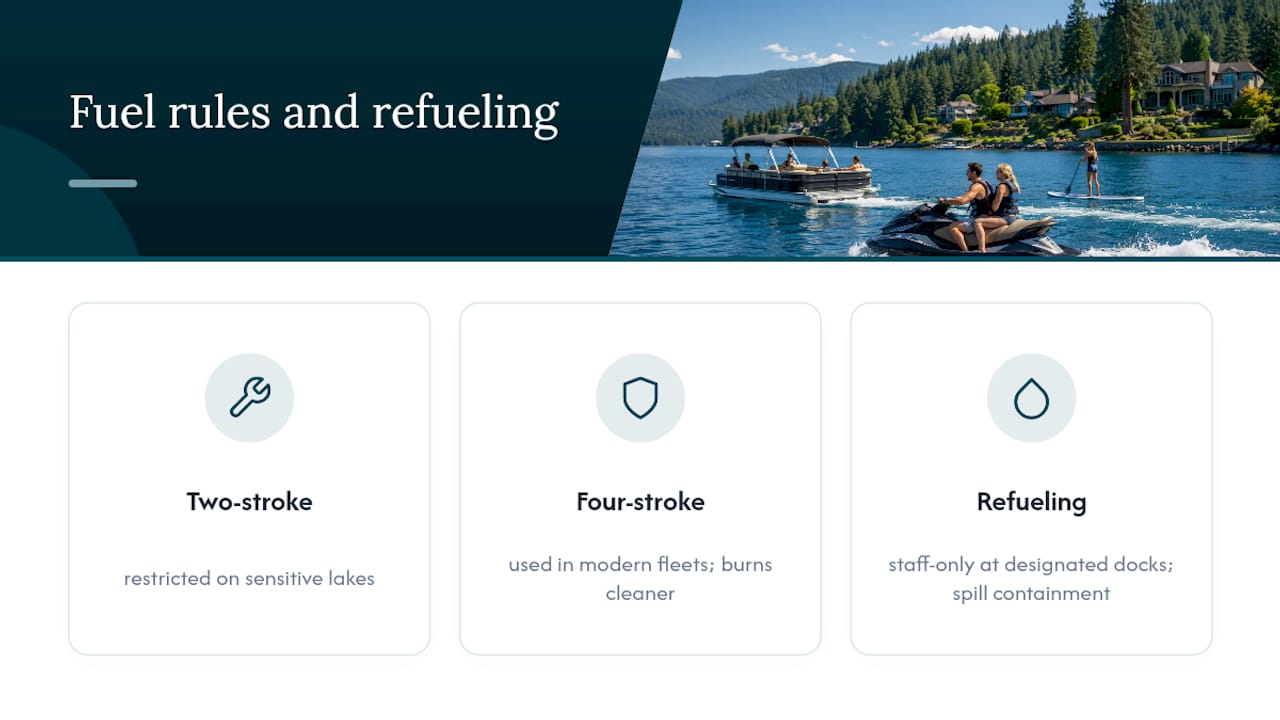
Two-stroke engines that burn oil along with gas are increasingly restricted or discouraged on smaller, more sensitive lakes because they leave more unburned fuel in the water. Most modern rental fleets, including jet skis and pontoons, now run four-stroke engines specifically because they burn cleaner and meet stricter regional emissions expectations. This is part of why operators are particular about which fuel grade goes into their equipment. Standard ethanol-blended road gasoline can damage certain marine engines over time and isn't always what the manufacturer specifies, which is another reason operators prefer to control refueling themselves rather than let renters pick whatever's at the nearest gas station.
Spill prevention rules also affect the policy you'll encounter. Many marinas require fuel to be dispensed only at designated docks with spill containment equipment, which is a big part of why self-refueling out on open water is rarely allowed. If you're renting near a lake with stricter water-quality protections, expect the operator's fuel policy to lean toward staff-controlled refueling rather than a self-serve arrangement, simply because the regulatory risk of a spill falls on the business holding the rental license.
The Case for Simpler, More Transparent Fuel Policies
The biggest problem with boat rental fuel policy today isn't the pricing. It's the vagueness. Too many rental agreements bury the fuel terms in a paragraph of fine print instead of stating the model, the rate, and the measurement method in plain language at the counter.
Conventional advice tells renters to "ask about fuel before booking," which is true but incomplete. The better move is asking for the rate in writing and the measurement method by name, gauge photo, dip, or digital monitor, because vague verbal assurances are exactly what turns into a dispute later. Framing matters more than most renters assume: research on rental fuel provisioning found that positioning fuel handling as a customer choice, return full and pay nothing or pay a clear per-gallon rate, produces better outcomes than punitive language buried in a contract.
What should you prioritize first? Not the cheapest posted rate, but the clearest one. A slightly higher per-gallon charge with a written rate and a photographed gauge beats a lower rate with no documentation, every time a disagreement comes up.
— Life is better on water.
Check Your Fuel Options Before You Book
Golden Water Sports lists fuel policy details right on its prices page, so you're never guessing about per-gallon rates or how charges get calculated before you commit to a rental. That transparency is the real advantage here: you see the numbers upfront instead of finding them buried in fine print after you've already paid a deposit.
Whether you're planning a jet ski run out of Newman Lake or a day on the water from Liberty Lake, the fuel terms are laid out the same way every time, so you can budget your trip without surprises. If you're still working out logistics for a longer trip, the team can also talk you through options similar to what you'd plan for a boating outing on the water elsewhere, just adapted to a Northwest lake day. Check pricing and fuel details, then book your dates directly through the prices page to lock in your spot for the season.
Sources
- Boat Rental Fuel Provisioning & Fine Print Guide | EquipDash
- Do Boat Rentals Include Fuel? (Pittsburgh Boat Rental blog)
- Policies & Procedures | Boat Rental Seekers
- Boat Rental FAQs (Gilligan's Boats example)