
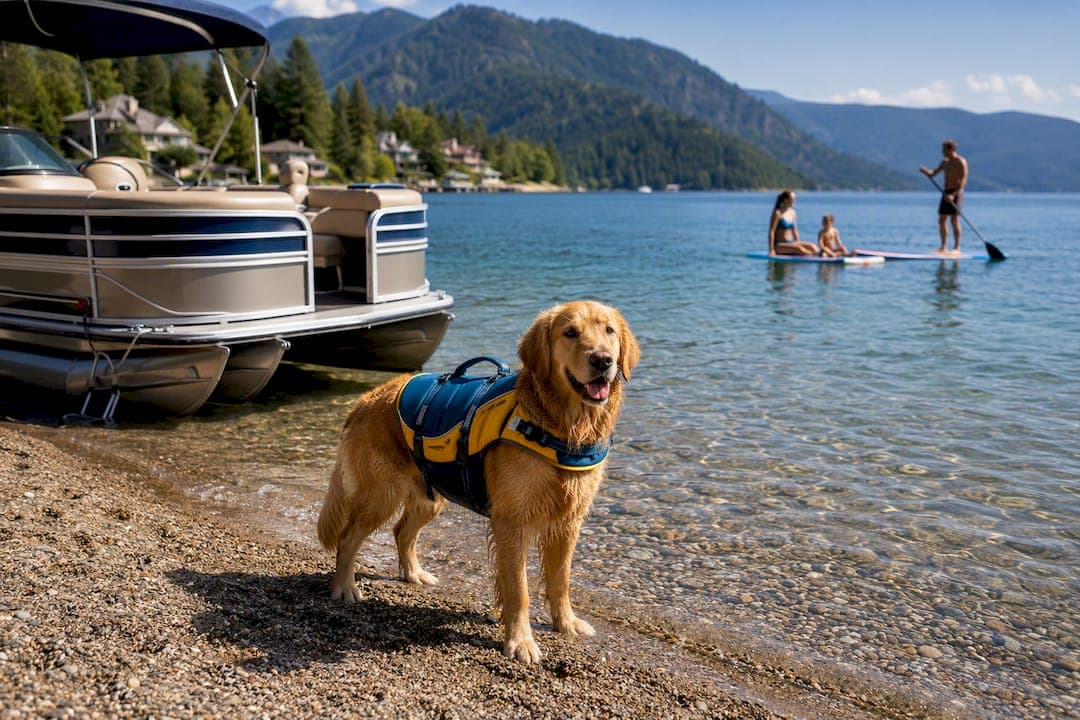
Yes — you can boat with your dog; the three non-negotiables are a properly fitted canine life jacket, continuous supervision, and fresh water, plus shade. Most dogs, from confident labs to nervous rescues, can join boating outings safely once you handle the prep work. That prep isn't complicated, but skipping it is where trips go wrong.
The essentials break down to:
- A properly fitted canine life jacket (PFD), checked with the two-finger rule
- Active, uninterrupted supervision, even for dogs that swim well
- Fresh water offered regularly, plus shade to help prevent overheating
The rest of this guide walks through fitting that PFD correctly, acclimating your dog to the boat step by step, setting up the deck, and handling the moment a dog goes overboard.
Key Takeaways
Boating with dogs is safe and enjoyable when owners commit to a properly fitted PFD, constant supervision, staged acclimation, and a boat setup built around shade, grip, and water access.
| Point | Details |
|---|---|
| Fit the PFD correctly | Use the two-finger rule and re-check snugness after your dog gets wet. |
| Acclimate in stages | Start on dry land, then docked, then short calm-water trips before longer outings. |
| Offer fresh water regularly | Offer fresh water on a schedule, not just when your dog seems thirsty. |
| Practice reboarding | Guide your dog up using the PFD handle rather than lifting them fully. |
| Start with stable craft | Golden Water Sports' pontoon rentals give dogs a flat, low-freeboard deck ideal for first outings. |
Table of Contents
- Choosing and Fitting a Canine Life Jacket
- Getting Your Dog Ready Before You Leave the Dock
- Setting Up the Boat for a Comfortable, Safe Ride
- Preventing Dehydration, Heatstroke, and Seasickness
- What to Do If Your Dog Goes Overboard
- Matching Your Dog to the Right Boat
- Marina Etiquette and What to Carry
- What Trainers and Rental Operators Actually See on the Water
- Planning Meals and Bathroom Breaks Around Your Trip
- Picking Routes and Water That Work for Dogs
- A Captain's Quick Checklist Before Casting Off
- Bring Your Dog Along on a Golden Water Sports Rental
- Sources
Choosing and Fitting a Canine Life Jacket
A life jacket is the one piece of gear you shouldn't improvise on. Skip the leftover kids' PFD or a jacket that "should fit" based on your dog's weight class alone. Fit and function are two different things, and both matter.
Start with the two-finger rule: you should be able to slide two fingers under every strap, snug but not tight. This is the same standard trainers and fitting guides use for checking a life jacket's fit, and it's worth repeating throughout the day, not just at the dock. Wet fabric stretches, and a jacket that fit fine at 9 a.m. can loosen by noon after your dog's first swim.
- Fit the PFD on dry land first, buckling from the belly up.
- Check the two-finger gap at the neck, chest, and belly straps.
- Have your dog walk, sit, and lie down in it to confirm no chafing.
- Get the dog in shallow water briefly, then re-check every strap once soaked.
- Repeat the wet check every hour or two during longer outings.
Beyond the jacket itself, a well-fitted body harness with a sturdy top handle beats a collar for containment and lifting. A collar puts pressure on the neck if you need to grab your dog quickly; a harness distributes it across the chest and shoulders.
Round out your gear bag with a few things that seem minor until you're on the water without them: pet-safe sunscreen for exposed skin (nose, ear tips, belly on short-haired breeds), booties or paw wax for hot decks, and a collapsible water bowl that packs flat. Add a basic first-aid kit with vet wrap, saline, tweezers, and a muzzle (even calm dogs bite when hurt), plus a waterproof pouch holding your dog's ID tag info and rabies vaccination record.
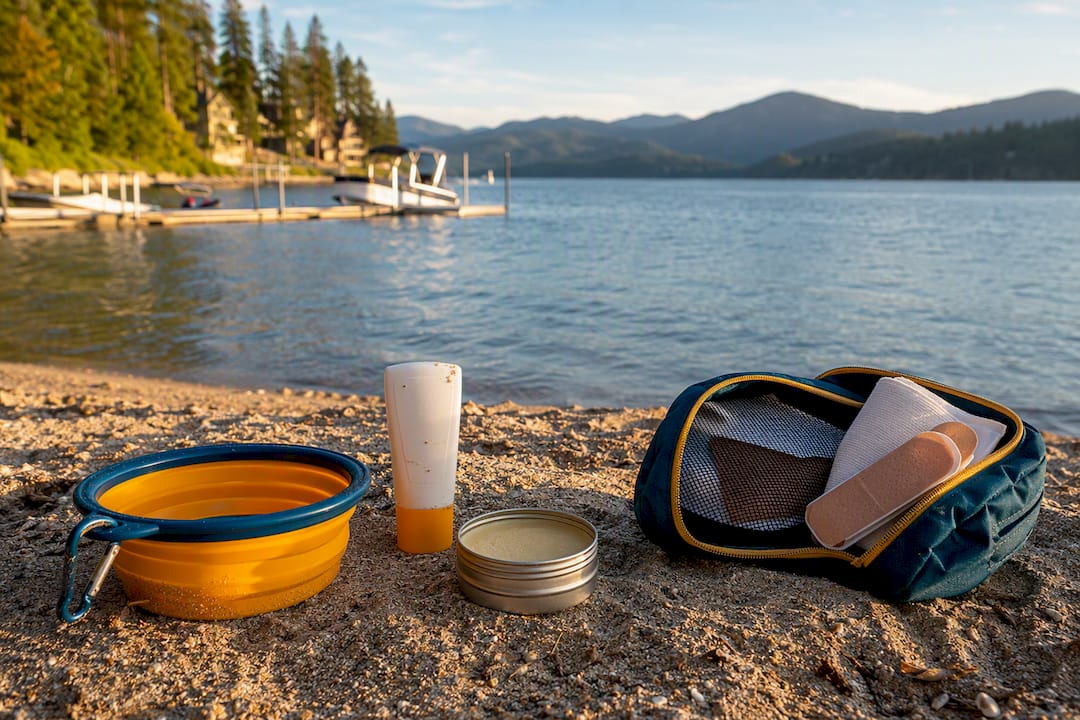
Pro Tip: Snap a photo of your dog's microchip number and vet contact info to your phone before you launch. If a marina staffer or rescue swimmer needs it, you won't be digging through a bag.
Getting Your Dog Ready Before You Leave the Dock
Rushing a nervous dog straight from the driveway to open water is how you end up with a dog frozen in the bottom of the boat for the whole trip. Acclimation works better in stages, and it doesn't take long for most dogs to come around.
- Start on dry land. Let your dog wear the PFD around the yard or house for short stretches, rewarding calm behavior with treats.
- Move to the docked boat. Let your dog step aboard while it's tied up and still, sniffing around at their own pace.
- Run a short session with the engine idling, still docked, so the vibration and sound aren't a surprise later.
- Take a brief trip on calm, flat water, five or ten minutes, then head back in.
- Practice reboarding in shallow water near shore, using the PFD handle to guide your dog back up rather than lifting them.
This staged approach lines up with what trainers and boating guides recommend for reducing anxiety, and it's also why testing a rental boat on a short trip before committing to a full day makes sense for a dog's first time out.
While you're building comfort, reinforce a handful of commands specifically for the boat: "sit" and "stay" for boarding and docking, "come" for recall if you're doing supervised swim breaks, and a "place" command that teaches your dog to hold one spot on deck instead of wandering near the edge.
Pro Tip: Watch for stress signals, not just obvious ones like whining. Yawning, lip licking, pinned ears, and a tucked tail all mean your dog needs a break, not more boat time.
Setting Up the Boat for a Comfortable, Safe Ride
A boat deck that's fine for people can be a hazard for a dog. Wet fiberglass and vinyl get slick fast, and a dog with splayed legs scrambling for grip burns nervous energy that shows up as anxiety or exhaustion later in the trip.
- Lay down non-slip marine matting, or budget-friendly yoga mats and suction-cup bath mats, in the spot where your dog will spend most of their time.
- Set up a shaded area using a bimini top, umbrella, or simply positioning your dog's spot out of direct sun for a few hours.
- Pack a cooling vest or a few wet towels to drape over your dog during peak afternoon heat.
- Stow hooks, fishing line, bait, and tackle boxes in closed compartments well away from curious noses.
- Bring an artificial grass pad or absorbent pad for bathroom breaks on longer trips, plus bags and cleaning wipes.
- Designate one containment zone, whether that's a tethered exercise pen section or simply the leash clipped to a fixed point while docked (never underway).
None of this needs to be elaborate. A rubber-backed bath mat from home and a beach umbrella clipped to a rail solves most of the deck-surface and shade problem for a fraction of what marine-branded gear costs.
Preventing Dehydration, Heatstroke, and Seasickness
Dogs don't pace themselves on the water the way they might in the shade of your backyard, and the combination of sun, engine heat, and excitement adds up fast.
- Offer fresh water regularly, not just when your dog seems thirsty, since dogs can dehydrate quickly from sun exposure and saltwater or lake water intake.
- Watch for heatstroke signs: heavy panting that doesn't slow down, bright red gums, wobbliness, or collapse. Move the dog to shade immediately and apply cool (not ice cold) water to the belly and paw pads.
- Recognize seasickness: drooling, lip licking, restlessness, or vomiting in choppy conditions. Feeding a light meal two to three hours before departure, rather than a full one right beforehand, helps. For dogs that get sick regularly, ask your vet about motion sickness medication before the season starts.
- Limit access to lake or saltwater as drinking water. Saltwater ingestion causes vomiting and diarrhea, and drinking large amounts of freshwater during extended swimming can lead to water intoxication (hyponatremia), which is rare but serious in dogs that swim obsessively for long stretches.
If your dog shows repeated vomiting, disorientation, or seizure-like symptoms after time in the water, treat it as an emergency and get to a vet, not just a rest break.
What to Do If Your Dog Goes Overboard
Even a well-prepared dog can slip or jump unexpectedly, and having the sequence memorized beats figuring it out in the moment.
- Cut the engine immediately, or at minimum drop to idle, to eliminate propeller risk.
- Keep your eyes locked on your dog. Don't look away to grab gear or call for help first.
- Circle back slowly rather than reversing straight at your dog.
- Use the PFD's top handle to guide your dog back toward the boat and up, rather than trying to haul them fully out of the water by their body.
- On a pontoon or boat with a ladder or swim platform, guide your dog toward it and let them use their own legs to climb, supporting with the handle as needed.
Bright colored PFDs make a real difference here. A red or orange jacket against dark water is far easier to track than a black or navy one, especially in choppy conditions or fading light.
Even with a jacket on, a panicked dog's head doesn't always stay clear of the water, since most flotation sits around the torso rather than the head. That's exactly why supervision has to stay active the entire trip, not just during swim breaks. If your dog seems disoriented, isn't breathing normally, or ingested a lot of water after a fall, get to a vet promptly. This isn't the moment to wait and see.
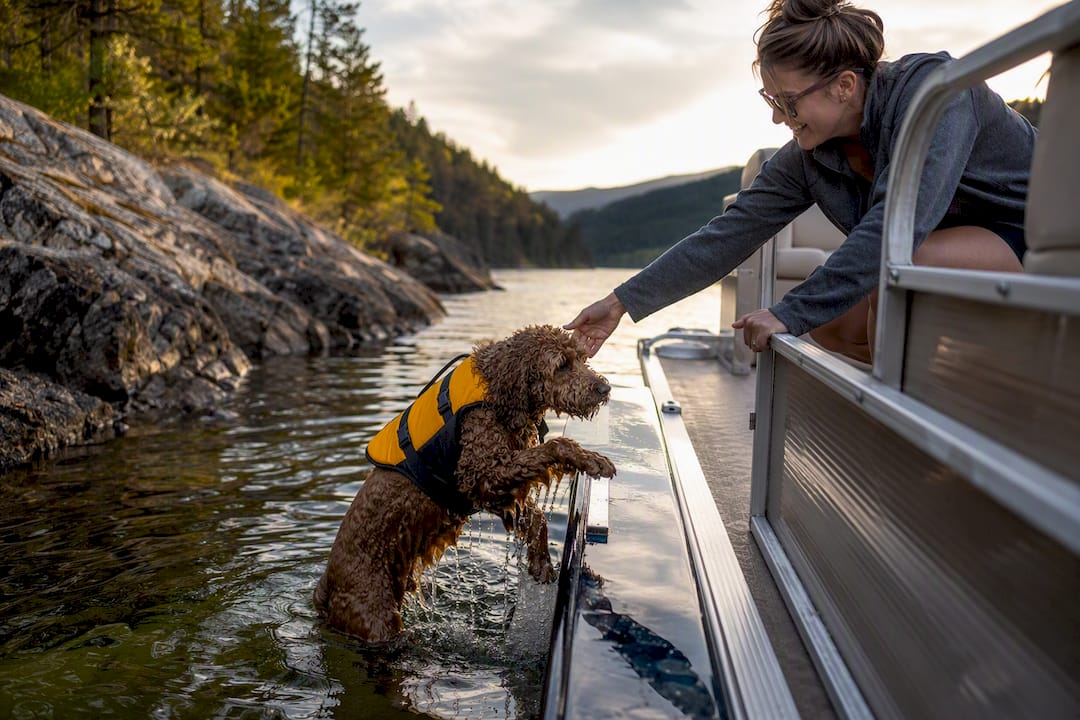
Pro Tip: Practice the reboarding sequence in shallow, calm water near shore before you ever need it for real. A dog that's done it once calmly will handle it far better under actual stress.
Matching Your Dog to the Right Boat
Not every craft suits every dog, and picking the right one for a first outing makes the whole experience easier.
- Pontoon boats are usually the best starting point. Flat, open decks and low freeboard mean less climbing, less falling risk, and more room for your dog to settle without feeling cornered.
- SUP and kayak outings need a board sized for two. Look for boards at least 10 feet long and about 32 inches wide, with weight capacity covering you, your dog, and roughly 20 extra pounds of buffer. Keep your dog centered and low, and practice climbing back on before you paddle away from shore.
- Small motorboats demand attention to weight distribution. A large dog shifting suddenly can rock the boat more than you'd expect, so seat them centered and low, not perched on a bow or gunwale.
- Sailboats bring hazards dogs don't anticipate, mainly the boom swinging across the deck. Keep dogs harnessed and positioned away from the boom's swing path, particularly during tacks.
Marina Etiquette and What to Carry
Good manners at the dock matter as much as good behavior on the water, especially at busy public launches.
- Pick up and pack out all waste, and rinse muddy paw prints off shared dock surfaces when you can.
- Keep food sealed and stored, since marina wildlife and other people's dogs will find an open bag fast.
- Manage barking around crowded docks, and keep your dog leashed during loading and unloading even if they're solid off leash on open water.
- Check launch-specific pet rules before you go. Some public ramps restrict dogs during peak season.
- Carry proof of rabies vaccination and ID whenever you're boating across county or state lines.
What Trainers and Rental Operators Actually See on the Water
Reboarding is where most dog boating mishaps happen, and it's also the easiest thing to get right with a little practice. Trainer guidance on this point is consistent:
Guide a wet dog back onto the board or boat using the life jacket's top handle rather than trying to lift them by the body. Let the dog use its own legs and momentum to climb; you're steering, not hauling.
That single adjustment reduces both strain on your back and the risk of tipping a small craft. Golden Water Sports built its own pre-departure checklist around the same logic: fitted PFD, secured loose gear, fresh water on board, and a stable, low-freeboard craft for any dog's first outing. Renters consistently do better on pontoons and larger, flatter boats than on anything with high sides or a narrow beam.
Planning Meals and Bathroom Breaks Around Your Trip
Timing food and bathroom breaks poorly is a common reason dogs get sick or uncomfortable on longer outings, and it's easy to fix with a little planning.
Feed a light meal two to three hours before departure rather than a full portion right before you launch. A full stomach combined with boat motion is the fastest route to seasickness, and an empty stomach for too long can cause its own stomach upset, so aim for that middle window.
For bathroom breaks, dogs need a stop roughly every three to four hours on a moving boat, longer than that and accidents or discomfort become more likely. If you're anchoring near shore, a quick beach break works well. For longer stretches without a shoreline stop, an artificial grass pad secured on deck gives your dog a familiar surface to use, and most dogs adapt to it within a trip or two if you introduce it at home first.
Pack more water than you think you'll need and offer it on the same schedule as bathroom breaks, since the two tend to go together. Bring an extra collapsible bowl as backup, since one gets knocked overboard eventually.
Picking Routes and Water That Work for Dogs
Not every stretch of water suits a dog outing, and the right choice depends more on conditions than scenery.
Calm, protected water beats open, choppy water for a dog's comfort and your control. Coves, no-wake zones, and lake sections away from heavy boat traffic give your dog a steadier ride and you fewer variables to manage. Avoid routes that cross busy shipping channels or areas with strong current, since both increase risk if your dog ends up in the water unexpectedly.
Look for stops with gradual, sandy entry points rather than rocky drop-offs. A beach where your dog can wade in slowly beats a dock with a six-foot jump to water, especially for older dogs or those still building confidence. Shaded coves also help you manage heat during midday stops.
Check water quality before letting your dog swim freely. Algae blooms, especially blue-green algae, can be toxic if ingested and aren't always obvious from the shore. When in doubt, keep your dog out of water with visible scum or unusual color, and rinse your dog off with fresh water after any swim in water you're unsure about.
A Captain's Quick Checklist Before Casting Off
Before every trip, run this fast: PFD fitted and two-finger tested, water and shade packed, hooks and lines stowed, and a quick sit-stay run on deck to reset your dog's focus.
If it's your dog's first time out, keep the trip short. A calm 20 minute outing that ends well beats a three-hour trip that overwhelms your dog before you've even reached the good part of the lake.
— Life is better on water.
Bring Your Dog Along on a Golden Water Sports Rental
Golden Water Sports makes it easy to test everything covered here before committing to a full day on the water. Our pontoon rentals give dogs the flat, stable deck space that makes a first outing go smoothly, and our team can point you toward the calmer stretches of the lake for a dog's early trips.
Every rental comes with safety equipment on hand and flexible hourly or multi-day booking, so you can start with a short trial run before planning a longer outing. Check current rental prices and availability to find the right craft for your dog's comfort level, or look into our jet ski rental options near Liberty Lake if you're planning a mixed group trip. Give us a call or book online to lock in a time that works, and bring your dog's PFD, we'll handle the rest.
Sources
- How to choose a paddleboard for dogs | Paddling Magazine
- Fitting your dog's life jacket | PetPlace
- Paddling with dogs — ISUP World