
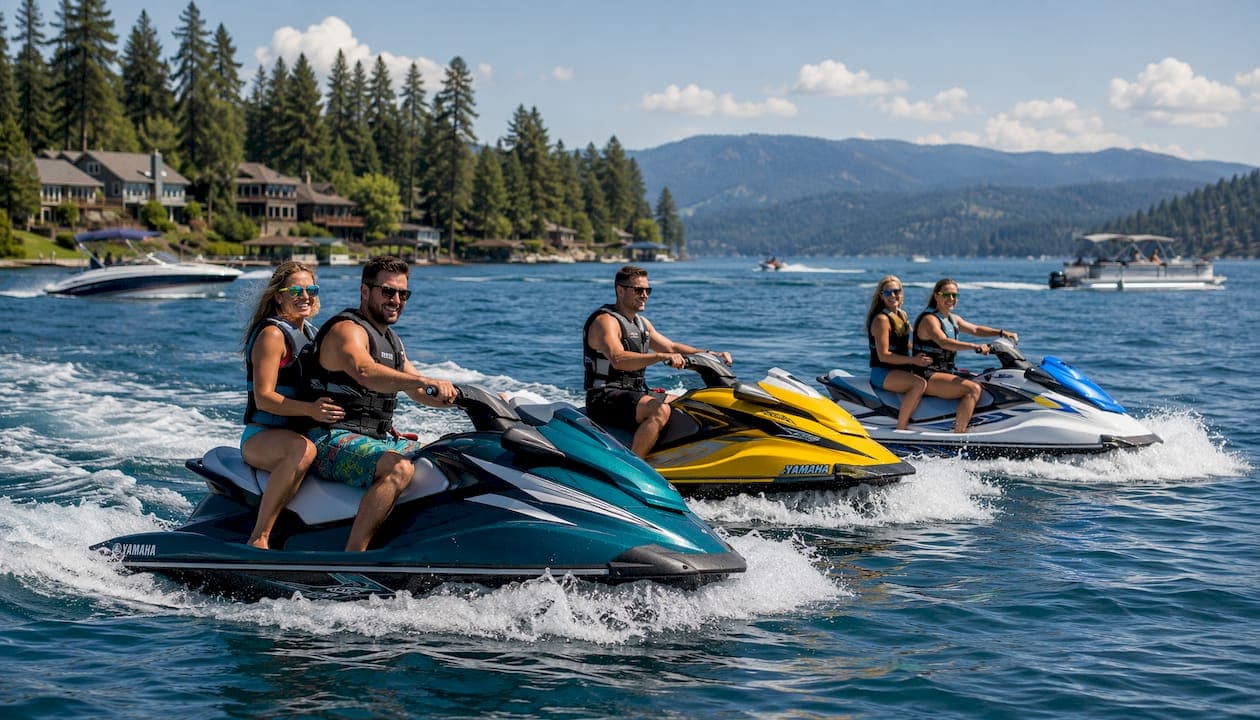
Getting a Yamaha WaveRunner underway safely comes down to five things you do before you ever touch the throttle: attach the kill switch lanyard to your wrist or PFD, confirm the craft is in neutral or learning mode, start the engine in the water, let it idle for a moment, then squeeze the throttle gently to move away. That sequence, done in order, is what separates a confident first ride from a panicked one.
Here's the shortest version you can memorize before you launch:
- Clip the lanyard to your PFD or wrist before anything else
- Wear a USCG-approved life jacket, properly fitted
- Confirm neutral or activate learning mode if your model has it
- Start the engine only while the craft is in the water
- Let it idle, check for water circulation, then test the stop switch
- Squeeze the throttle slowly to pull away from the dock
- Use throttle to steer: releasing it reduces your ability to turn
- Keep 360° awareness at all times, especially near other boats
The U.S. Coast Guard requires every PWC rider to wear a life jacket, and the kill switch lanyard is your single most important safety device. If you fall off, it cuts the engine instantly. The Yamaha Marine Academy offers a free orientation video that walks through these steps on an actual WaveRunner before your first ride. Watch it. It takes less than 15 minutes and answers questions you didn't know you had.
Table of Contents
- What do all the WaveRunner controls actually do?
- What's on the pre-ride safety checklist for U.S. riders?
- How do you start, launch, and get underway safely?
- How does steering actually work, and what maneuvers should you practice first?
- How do you approach a dock or beach without panicking?
- What are the rules for carrying passengers on a WaveRunner?
- What do you do in an emergency on the water?
- What are the most common beginner problems and how do you fix them?
- What practice drills build confidence in one rental session?
- What Yamaha-specific features should beginners know about?
- Why does boater education matter, and what U.S. rules apply to you?
- Key Takeaways
- What first-time riders get wrong at check-in
- Ready to ride? Goldenwatersports makes your first WaveRunner day easy
- Useful sources and further reading
What do all the WaveRunner controls actually do?
Before you start the engine, spend five minutes sitting on the craft at the dock and touching each control. Boating safety educators consistently point out that the most common beginner mistake is searching for controls while already underway. That moment of confusion is when accidents happen.
Throttle lever
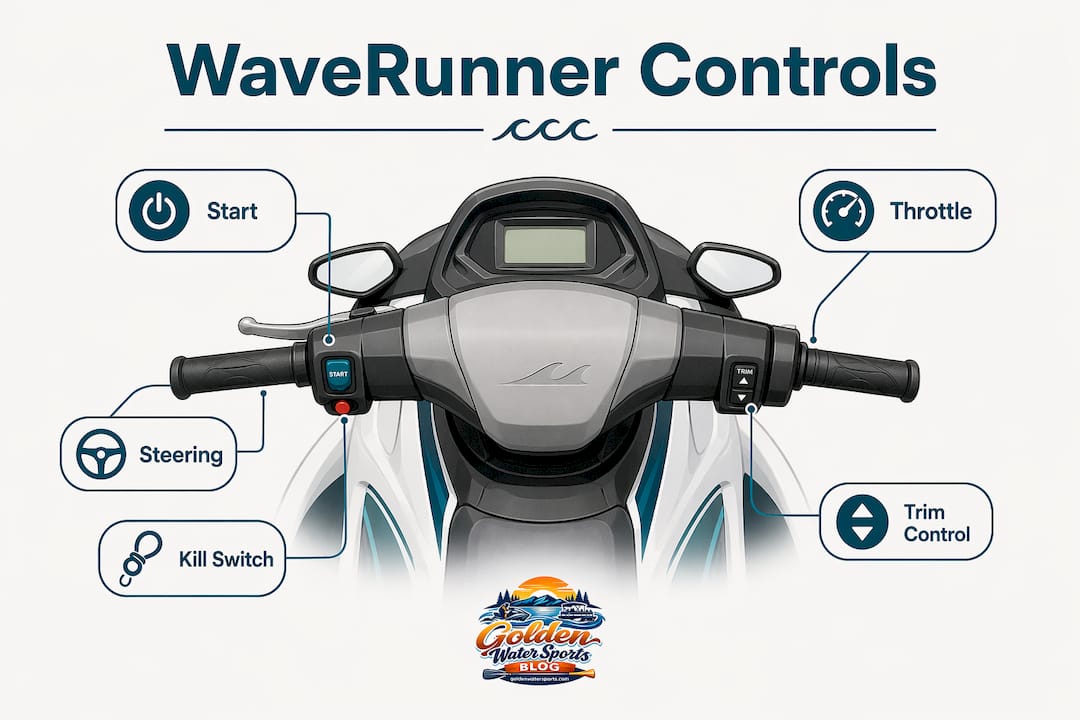
The throttle is on the right handlebar, operated by your thumb or fingers depending on the model. Squeeze it to accelerate; release it to slow down. Here's the part most beginners miss: the throttle also controls your steering. The WaveRunner steers by directing thrust from the jet nozzle, not through a rudder. Releasing the throttle reduces steering ability significantly. You can still turn the handlebars, but the craft won't respond the way you expect without power behind it.
Handlebars
Turn them left to go left, right to go right. Simple enough, but remember: they work with the throttle, not independently of it. At low speeds with minimal throttle, steering feels sluggish. That's normal.
Kill switch and lanyard
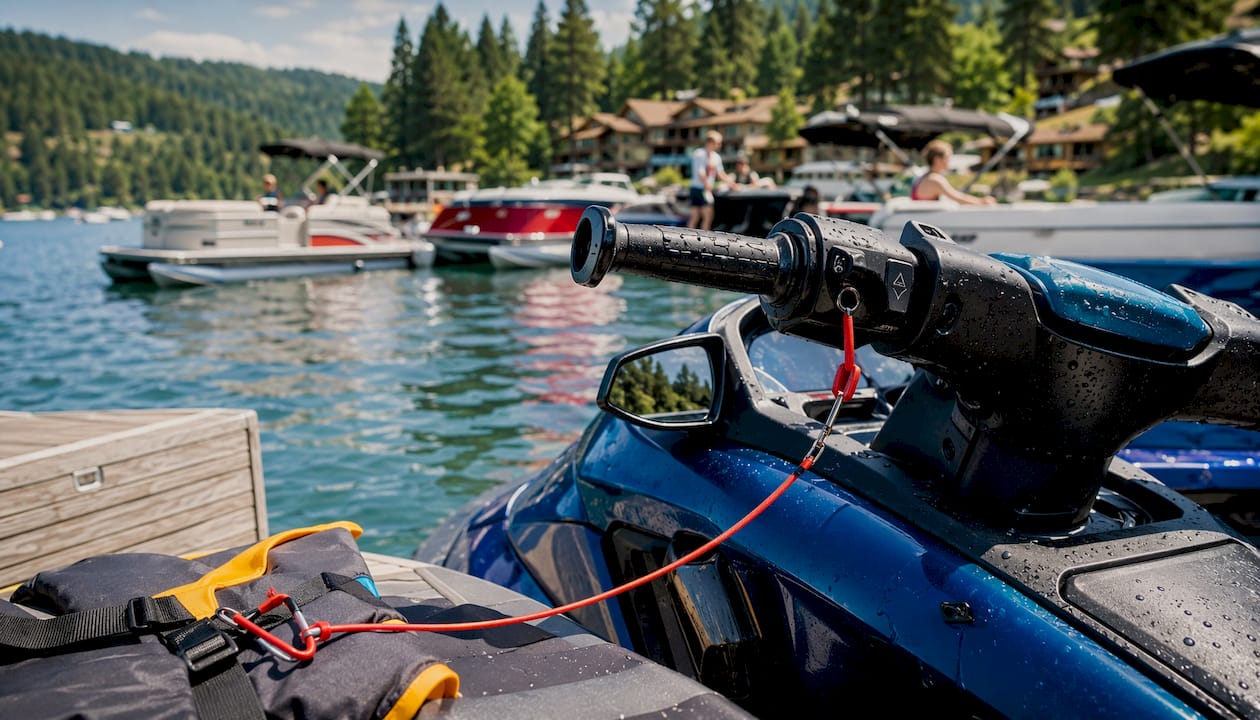
The kill switch is a red button or lever near the right handlebar. The lanyard clips from the switch to your PFD or wrist. If you fall off, the lanyard pulls free and the engine stops. Attach it before you start the engine, every single time, without exception. Clip it to a spot on your PFD where it won't snag on the handlebars.
Trim and ride-mode controls
Many Yamaha models include a trim button that adjusts the bow angle and a learning mode that electronically caps engine power. As a beginner, leave the trim alone and activate learning mode if it's available. It limits acceleration and top speed, giving you time to build confidence before the craft's full power is available.
Electronic F-N-R vs. mechanical reverse
Late-model Yamaha WaveRunners often include electronic forward-neutral-reverse controls, usually a paddle or lever near the left handlebar. Older models use a mechanical reverse gate you engage manually. Ask the rental staff which system your assigned craft has before you leave the dock. The electronic version is more intuitive; the mechanical gate requires a deliberate physical action to engage.
Pro Tip: Do a dry run on land or at the dock before starting the engine. Touch the throttle, find the kill switch, locate the neutral control, and practice clipping and unclipping the lanyard. Thirty seconds of muscle memory prevents a lot of confusion on the water.
Yamaha Marine Academy's orientation video shows exactly where each control sits on current WaveRunner models. Watching it once before your rental is the fastest way to feel prepared — and it's free on the Yamaha WaveRunners website.
What's on the pre-ride safety checklist for U.S. riders?
A pre-ride check isn't optional. It's the difference between a full day on the water and a tow back to the dock. Yamaha's own guidance recommends removing the seats before launch to let any accumulated fuel vapors escape, then inspecting the engine compartment visually before replacing them.
| Item | Why It Matters | Legal Note |
|---|---|---|
| USCG-approved PFD (Type III) | Required by federal law for every rider | Must be worn, not just on board |
| Kill switch lanyard | Stops engine if you fall off | Required on most PWC by state law |
| State boater education card | Proves legal eligibility to operate | Required in most U.S. states for PWC |
| Fuel level | Running out mid-lake is a real hazard | Use the 1/3 out, 1/3 back, 1/3 spare rule |
| Engine compartment inspection | Catches fuel leaks before they become fires | Yamaha-recommended pre-launch step |
| Jet intake grate | Debris clogs the pump and kills steering | Check visually before every launch |
| Throttle and steering function | Confirms controls respond correctly | Test at idle before leaving the dock |
| Weather and water conditions | High winds and heavy wakes are hazardous for beginners | Check NOAA marine forecast for your lake |
Registration is also required in every U.S. state. Keep the registration card on board. If you're renting, the operator handles registration, but you're still responsible for carrying the card during your ride.
A float plan is worth two minutes of your time: tell someone on shore where you're going, how long you'll be out, and when to call for help if you haven't returned. It's not a legal requirement, but the U.S. Coast Guard recommends it for every outing.
How do you start, launch, and get underway safely?
Follow this sequence exactly on your first ride. It's designed so each step confirms the previous one before you add more power or distance.
- Attach the lanyard to your PFD or wrist before touching the ignition.
- Put on your PFD and confirm it's buckled and snug.
- Check neutral or learning mode. On electronic F-N-R models, confirm the display shows neutral. On older models, make sure you have clear water ahead before starting.
- Launch the craft into the water before starting the engine. Starting on dry land can damage the water-cooled engine within seconds.
- Start the engine and let it idle for 30–60 seconds.
- Check water circulation. Most Yamaha models have a small water indicator stream near the stern. If it's not flowing, shut down and investigate before riding.
- Test the stop switch. Tap it once to confirm it kills the engine, then restart.
- Look around 360° before applying any throttle. Check for swimmers, other boats, and dock obstacles.
- Squeeze the throttle gently to pull away from the dock at idle speed. Keep rpm low until you're clear of the launch area.
- Accelerate gradually once you're in open water, building speed in stages rather than going full throttle immediately.
Pro Tip: Ask a spotter to stand on the dock during your first departure. They can watch your blind spots and signal if another boat is approaching from behind. One person on shore costs nothing and prevents a lot of close calls.
If you're renting from a local operator, the staff will typically walk you through the specific model's start sequence during check-in. Take that briefing seriously. Even if you've ridden before, model-specific quirks matter.
How does steering actually work, and what maneuvers should you practice first?
Throttle-based steering is the concept that trips up almost every first-time rider. The WaveRunner has no rudder. The jet nozzle at the stern directs thrust, and turning the handlebars redirects that nozzle. When you release the throttle, thrust drops to near zero, and so does your ability to steer. The craft will continue in roughly the same direction it was heading, but you can't meaningfully redirect it without power.
This means: if something appears in your path and your instinct is to release the throttle and turn, you'll lose steering at exactly the wrong moment. The correct response is to maintain or briefly increase throttle while turning, then reduce speed once you're clear.
Mastering throttle control is the single most important concept for safe PWC steering. Riders who understand this before their first ride avoid the most common collision scenario: releasing throttle in a panic and losing the ability to steer away from an obstacle.
Turning technique
For a standard turn, maintain steady throttle through the arc. To execute a tighter turn, momentarily release the throttle to plant the bow in the water, then immediately reapply throttle to power through. This technique appears in Yamaha's own owner materials and works well once you've practiced it at moderate speed.
Stopping
If your craft has electronic reverse or a braking system, use it: engage reverse briefly to slow your approach. Without it, gradual throttle reduction and water resistance will bring you to a stop, but it takes more distance than most beginners expect. Practice stopping from moderate speed in open water before you need to do it near a dock.
Posture and balance
Keep your knees slightly bent and your feet planted on the footwells. Lean into turns the way you would on a motorcycle. Sitting rigidly upright makes the craft feel unstable; a relaxed, athletic stance absorbs chop and keeps you centered.
Pro Tip: Many WaveRunner models can reach high speeds. You don't need to ride fast to enjoy your first experience. Stay at moderate speeds until turns and stops feel natural, then build up gradually.
How do you approach a dock or beach without panicking?
Close-quarters maneuvering is where most beginner anxiety lives, and it's almost always caused by approaching too fast. The fix is simple: slow down earlier than you think you need to.
The most common docking mistake is arriving with too much speed and no plan. Decide your approach angle before you commit to it, communicate it to anyone on the dock, and if something goes wrong, abort and circle back rather than forcing a bad approach.
Dock approach
Come in at a shallow angle, not straight on. This gives you room to correct if you drift. If your craft has neutral or reverse, use it to bleed speed as you close the final 20–30 feet. Keep the engine at idle once you're within a few boat lengths. Have a line ready to hand to someone on the dock, or be prepared to step off and tie up quickly.
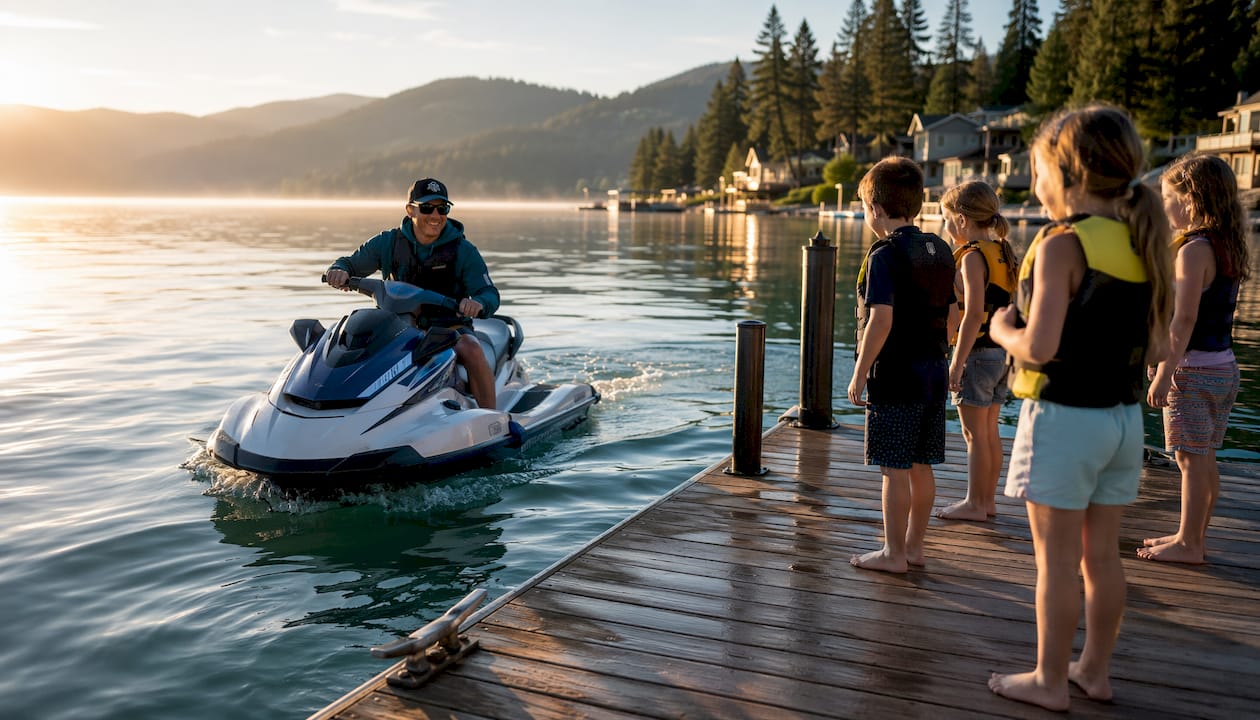
Use a spotter on shore whenever possible. One person watching from the dock can see angles and obstacles you can't from the seat.
Beaching on sand
Approach slowly, perpendicular to the shoreline. When you reach knee-deep water, shut the engine off and let momentum carry you the last few feet. Spin the craft so the bow faces out before you step off. This makes re-launching much easier and protects the intake from sand.
Pro Tip: Before you leave the rental dock, ask staff to demonstrate the specific model's neutral and reverse controls one more time. Watching someone else use them takes 60 seconds and makes your first real docking attempt far less stressful.
What are the rules for carrying passengers on a WaveRunner?
Every WaveRunner has a capacity plate that lists the maximum number of riders and the weight limit. Those numbers are not suggestions. Overloading degrades stability, increases stopping distance, and raises the risk of flipping, especially in choppy water.
Seat order matters. The operator sits at the front. Passengers sit behind, with heavier riders positioned closer to the center of the craft. Passengers should hold the designated grab handles, not the operator's waist, which can interfere with steering. Keep knees low and feet planted in the footwells.
Brief your passengers before you leave the dock. Tell them to stay seated at all times, hold the handles, lean with the craft during turns, and let you know if they feel unsafe. A passenger who knows what to expect is a passenger who doesn't grab the handlebars in a panic.
Pro Tip: If you're riding with children, check your state's age restrictions for PWC passengers. Many states require passengers to be at least a certain age or height to ride safely. Goldenwatersports staff can confirm the rules for your specific lake and model during check-in.
If a passenger falls off
Release the throttle immediately. Keep the person in sight. Approach slowly from the downwind side so the craft doesn't drift over them. Stop the engine before they attempt to reboard. Help them use the rear footwell as a step, and make sure they're fully aboard and seated before restarting.
What do you do in an emergency on the water?
Calm, rehearsed responses beat improvised ones every time. Run through these scenarios mentally before you launch so the steps are already in your head.
Man overboard
- Release the throttle immediately.
- Keep the person in sight — never take your eyes off them.
- Circle wide and approach from the downwind side so the craft doesn't drift toward them.
- Stop the engine completely before they touch the craft.
- Help them reboard using the rear footwell; take your time.
WaveRunner flips
Shut the engine off if it's still running. Rotate the craft upright clockwise as viewed from the stern. This is Yamaha's specific guidance for their models and prevents water from entering the carburetor or engine intake. Once upright, wait a moment before attempting to restart.
If you flip a Yamaha WaveRunner and rotate it the wrong direction, water can enter the engine. Always right the craft clockwise from the stern view — there's usually a sticker on the hull reminding you.
Injury or fuel leak
If anyone is injured or you smell fuel in the hull, do not restart the engine. Remove the seat, ventilate the hull, and call 911 or the U.S. Coast Guard on VHF Channel 16. Follow local emergency procedures and stay with the craft until help arrives.
Pro Tip: Practice the man-overboard sequence once in calm, shallow water before you take passengers out. Have a friend "fall off" at low speed and run through the full approach and reboarding drill. One rehearsal makes the real thing automatic.
What are the most common beginner problems and how do you fix them?
Most issues that strand riders at the shore have simple causes. Here's what to check before you call for help.
- Engine won't start: Verify the lanyard is attached and the kill switch is in the run position. Check that the craft is in neutral or start mode. If the battery is weak, you'll hear a slow crank — contact the rental operator.
- Loss of steering or sluggish response: The most likely cause is debris in the jet intake grate. Shut down, tilt the craft slightly, and clear any weeds, rope, or plastic from the grate. Restart and test steering before proceeding.
- Overheating warning: Check that the water circulation indicator is flowing. If the warning light stays on after a minute of idling, shut down and call for service. Riding an overheating PWC causes serious engine damage.
- Fuel smell in the hull: Do not restart. Remove the seat, ventilate for several minutes, and inspect visually for leaks or loose fuel lines. If you find a leak, call the rental operator or a technician.
- Craft pulls to one side: Check that the trim is centered. On models with adjustable nozzle trim, a setting that's too far left or right creates a persistent pull. Reset to neutral and retest.
When a quick fix isn't obvious or safe, stop riding. A rental operator would far rather retrieve a craft than deal with a preventable accident.
What practice drills build confidence in one rental session?
A 2–3 hour rental gives you enough time to run through a full beginner progression if you use the first hour deliberately instead of just riding around. Here's a plan that works.
- Idle control (10–15 minutes). Stay in calm, open water near the launch area. Practice starting, idling, and stopping. Get comfortable with how the throttle feels at very low speeds before adding any distance.
- Straight-line throttle control (15 minutes). Pick two points about 200 yards apart and ride between them at moderate speed. Focus on smooth throttle inputs and keeping the craft tracking straight.
- Simple left-right turns (20 minutes). Make wide, gradual turns in both directions. Notice how the craft responds differently at different throttle levels. Practice maintaining steady throttle through the arc.
- Figure-8s (20 minutes). Set two reference points and ride a figure-8 pattern between them. This is the best drill for understanding throttle-based steering because it forces you to manage speed through both directions of turn continuously.
- Simulated dock approach (15 minutes). Pick a buoy or a calm shoreline and practice approaching slowly, stopping, and backing off. Repeat until the approach feels controlled rather than rushed.
Pro Tip: Choose calm water for your first session. Busy boat wakes add unpredictable chop that makes every drill harder. Early mornings on Lake Coeur d'Alene or Liberty Lake are typically the calmest windows. If you're renting for the first time, ask Goldenwatersports staff which areas near the launch are best for beginner practice that day.
Take a 10-minute break between drills to review what felt off and what felt natural. Most beginners find that steering clicks after the figure-8 drill, once the throttle-steering connection becomes physical rather than just conceptual.
What Yamaha-specific features should beginners know about?
Yamaha builds several features into their WaveRunners that directly help beginners, and knowing about them before you ride makes a real difference.
Learning mode electronically limits engine output, capping acceleration and top speed. It's available on many current models and is exactly what it sounds like: a mode designed for riders who are still building confidence. If your rental craft has it, use it for at least the first hour.
Electronic F-N-R (forward-neutral-reverse) replaces the older mechanical reverse gate with a handlebar-mounted control that's far more intuitive. You can shift to neutral at any time, which is useful for docking, reboarding, and any moment you need to stop the craft from moving without shutting the engine off.
Yamaha's guidance on flipping is specific: rotate the craft upright clockwise as viewed from the stern. This protects the engine from water intrusion. There's typically a sticker on the hull showing the correct direction — check for it before you need it.
The Yamaha Marine Academy provides free orientation videos that cover model-specific controls, pre-ride checks, and basic maneuvers. These aren't generic PWC tutorials; they're built around actual WaveRunner hardware. Watching the relevant video for your model before your rental is one of the most useful 15 minutes you can spend.
Pro Tip: Before you leave the dock, ask the rental staff whether your assigned craft has learning mode and electronic neutral. These two features change how you approach your first hour on the water. If the craft has them, use them. If it doesn't, you'll want to be extra deliberate about speed management early on.
For more background on what makes Yamaha WaveRunners distinct from other personal watercraft, the Yamaha WaveRunner brand overview covers the key engineering and safety features worth knowing.
Why does boater education matter, and what U.S. rules apply to you?
Most U.S. states now require a boater education card to legally operate a PWC. The specific age cutoff and course requirements vary by state, but the trend is clear: informal self-teaching is no longer enough to stay legal in most jurisdictions. Check your state's requirements through the National Association of State Boating Law Administrators (NASBLA) or your state's fish and wildlife agency before you ride.
Beyond the legal requirement, a boater education course teaches right-of-way rules, navigational markers, and emergency procedures in a structured way that a YouTube video simply can't replicate. Most courses are available online and take 3–6 hours to complete.
Key U.S. rules every PWC rider must know:
- Age restrictions: Most states prohibit riders under 16 from operating a PWC without adult supervision; some states set the minimum at 14 with a boater education card.
- No-wake zones: These are legally enforced speed limits, typically within 200 feet of shore, docks, or marked areas. Violating them carries fines and can result in loss of operating privileges.
- Right-of-way: PWC are treated as motorized vessels under federal law. You must yield to human-powered craft (kayaks, canoes) and follow standard navigation rules.
- Registration: Every PWC must be registered in its state of primary use. Display the registration numbers on the hull as required.
- Life jacket requirement: Federal law requires every rider to wear a USCG-approved PFD. Children under 13 must wear one at all times on any vessel in most states.
- Alcohol: Operating a PWC under the influence of alcohol or drugs is a federal offense with the same legal consequences as drunk driving.
For a deeper look at on-water etiquette and right-of-way specifics, the jet ski etiquette guide covers no-wake zones and courtesy rules that keep everyone safer on busy lakes.
This article is general information, not legal advice. Confirm current state requirements with your state boating authority or a qualified professional before you ride.
Key Takeaways
Safe, confident WaveRunner riding starts with one non-negotiable habit: attach the kill switch lanyard before you touch the ignition, then use the throttle to steer, not just to go fast.
| Point | Details |
|---|---|
| Lanyard first, always | Clip the kill switch lanyard to your PFD or wrist before starting the engine, every single time. |
| Throttle controls steering | Releasing the throttle reduces steering ability; maintain power through turns and obstacles. |
| Practice progression matters | Run idle control, straight lines, turns, figure-8s, and dock approaches in order during your first session. |
| Know your Yamaha features | Ask staff whether your craft has learning mode and electronic F-N-R before leaving the dock. |
| Goldenwatersports for beginners | Goldenwatersports staff provide a model-specific orientation and safety gear with every rental on Lake Coeur d'Alene and nearby lakes. |
What first-time riders get wrong at check-in
The pattern we see most often at Goldenwatersports check-in isn't recklessness. It's overconfidence about controls. Riders who've watched a few videos assume they know where everything is, then spend the first ten minutes of their rental looking down at the handlebars instead of watching the water ahead. That divided attention is where close calls happen.
The fix is genuinely simple: before you leave the dock, point to the throttle, the kill switch, and the neutral control out loud. Say what each one does. It takes 90 seconds and it moves that knowledge from your head into your hands, which is where it needs to be when something unexpected happens at speed.
The other thing worth saying plainly: there's no shame in asking for a second walkthrough at check-in. Every staff member at Goldenwatersports has seen experienced riders ask for a refresher on a new model, and they'll give you the same patient demo they'd give a first-timer. The rental check-in process is designed specifically to get you comfortable before you're on the water alone.
For a broader look at what to expect on your first ride, the what to expect on your first jet ski ride guide covers the sensory and practical surprises that catch beginners off guard.
Ready to ride? Goldenwatersports makes your first WaveRunner day easy
Goldenwatersports rents Yamaha WaveRunners by the hour with safety gear included, and every rental starts with a staff-led orientation on the specific model you're taking out. You don't need prior experience. You need to show up, pay attention during the briefing, and follow the steps in this guide.
The fleet covers Lake Coeur d'Alene, Liberty Lake, and nearby lakes, with flexible hourly windows that work for solo riders, couples, and family groups. Calm-water mornings are the best time for a first ride, and the team can point you toward the quietest launch areas when you book.
Check current availability and view rental pricing to book your session. If you're planning a family outing, the weekend WaveRunner rental guide covers group logistics and what to bring for a full day on the water.
First-time riders planning a visit to the Coeur d'Alene area can also find a full rundown of water activities and lake access points in the show-up-ready boat tour guide, which explains how operators prepare guests for a safe and enjoyable day on the water.
Useful sources and further reading
The sources below are the most authoritative references for Yamaha WaveRunner operation, U.S. boating safety, and beginner riding technique.
- Yamaha WaveRunner Orientation — Free video walkthrough of WaveRunner controls and pre-ride procedures. Best for model-specific control locations and start sequences.
- Yamaha Boating Resources — Checklists, operation posters, owner's manuals, and the WaveRunner Life Hacks eBook. Best for maintenance schedules and owner reference.
- Yamaha Pre-Ride Check Guide — Step-by-step pre-launch inspection specific to Yamaha models. Best for fuel system checks and engine compartment inspection.
- Yamaha Maintenance Matters — Complete maintenance guide covering oil changes, flushing, battery care, and corrosion prevention.
- Discover Boating: How to Drive a PWC — Broad PWC operation guide with strong coverage of throttle-based steering and learning mode. Best for general beginner operation concepts.
- BoaterExam: Mastering Turns and Stops — Practical technique guide for turns, stops, and control memorization. Best for maneuver drills and beginner skill-building.
- Yamaha Motor: Things to Keep in Mind — Yamaha's official guidance on man-overboard procedures and correct flip-recovery rotation. Primary source for emergency procedures.
- Better Boat: How to Drive a Jet Ski — Beginner-friendly starting sequence and first-ride checklist. Good corroborating reference for launch procedures.
- Goldenwatersports Rental Pricing and Booking — Current rates, availability, and booking for Yamaha WaveRunner rentals on Lake Coeur d'Alene and nearby lakes.
- Open Water Jet Ski Safety Guide — Goldenwatersports guide to reboarding, awareness, and hazard management in open water. Best for emergency preparation and advanced safety practices.