
Most jet skis burn between 3 and 4 gallons per hour (GPH) at a comfortable cruise, though that number climbs fast once you open the throttle. Performance machines can hit 20–25 GPH at wide-open throttle, which is a completely different budget conversation. The planning rule is simple: divide your tank capacity by your expected GPH to get hours on the water, then multiply by your average speed to get miles.
- Efficient rec models (entry-level, 900cc class): roughly 2–4 GPH at cruise
- Mid-range recreational skis: roughly 4–8 GPH in mixed real-world riding
- Performance/supercharged models at WOT: up to 20–25 GPH
Before any ride, budget GPH first, not MPG.
Quick planning rule: Hours available = tank capacity ÷ expected GPH. Miles available = hours × average cruise speed. Always keep 20–30% in reserve.
Key Takeaways
| Point | Details |
|---|---|
| Plan by GPH, not MPG | Divide tank capacity by cruise GPH to get hours; multiply hours by speed for miles. |
| Efficient vs. performance gap | Entry-level skis burn 2–4 GPH at cruise; supercharged performance models can hit 20–25 GPH at WOT. |
| Always carry a buffer | Keep 20–30% fuel in reserve; gauges can read empty before the tank is fully dry. |
| Marina fuel costs more | Marina dock fuel typically runs $1–$2/gal above road-station prices; build that into your trip budget. |
| Check rental fuel policy | Ask your provider whether fuel is included or billed separately before you launch. |
Table of Contents
- How is jet ski fuel consumption measured?
- What do real model numbers look like?
- What actually changes how much fuel you burn?
- How do you estimate range and cost for a planned ride?
- Practical tips to stretch your fuel and your ride
- Safe refueling practices every PWC rider needs to know
- What renters should expect on a jet ski rental
- The number most riders get wrong about fuel planning
- Sources
How is jet ski fuel consumption measured?
The marine world uses GPH rather than MPG because ride time, not distance, is the real constraint on a PWC. You book a two-hour rental or plan a two-hour loop, so knowing you burn 4 gallons per hour tells you more than knowing you get 8 miles per gallon.
That said, MPG is useful for comparing models. The conversion is straightforward:
MPG = speed (mph) ÷ GPH
So a ski cruising at 30 mph while burning 4 GPH returns 7.5 MPG. Two other formulas cover everything else you need:
- Gallons needed = hours × GPH
- Miles covered = hours × average speed
Average PWCs burn roughly 3–4 GPH at best cruise, but that figure assumes a steady, moderate throttle. Three operating states change the number dramatically:
- Idle/low throttle — minimal fuel use, often under 2 GPH; useful for no-wake zones.
- Best-cruise speed (~25–30 mph on many mid-range models) — the sweet spot where you cover the most miles per gallon.
- Wide-open throttle (WOT) — worst-case fuel use; treat it as a short burst, not a travel mode.
Manufacturer test figures are measured under controlled conditions. Real-world riding with two passengers, choppy water, and frequent acceleration runs higher than the spec sheet suggests.
Pro Tip: Use WOT GPH as your worst-case ceiling when planning a route, and cruise GPH as your working estimate. If the real ride falls somewhere in between, you still make it back.
What do real model numbers look like?
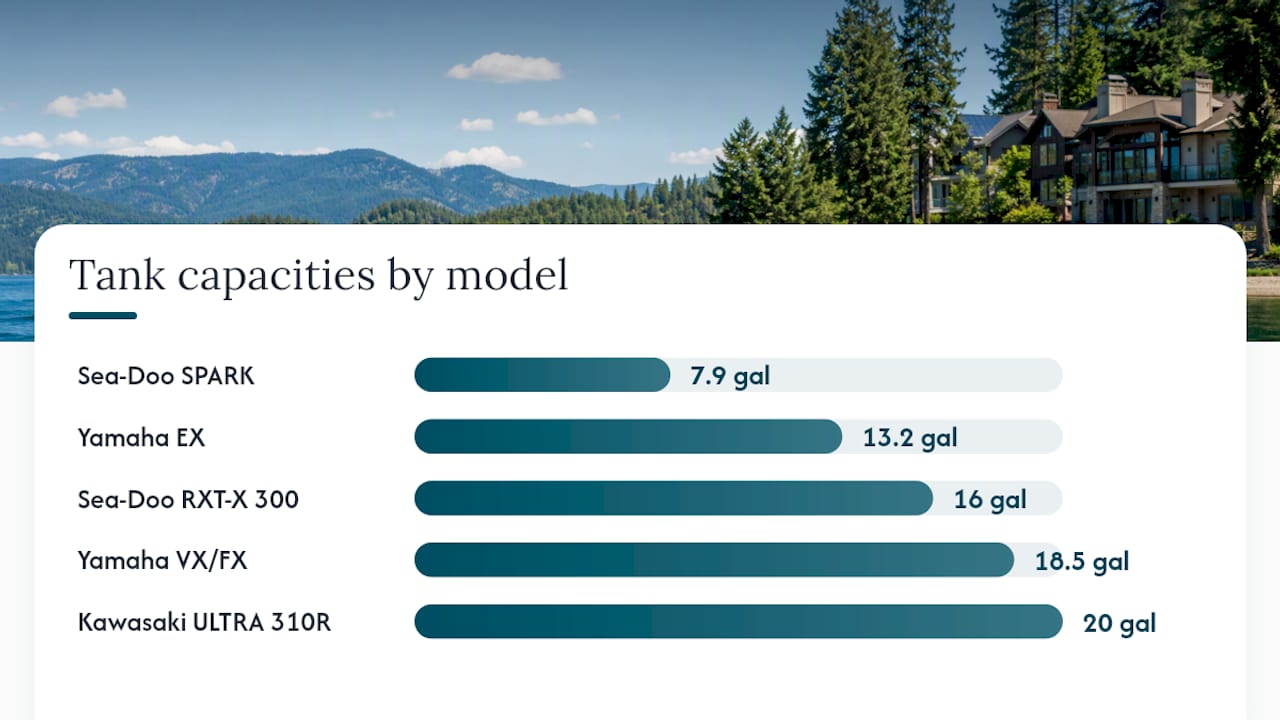
Tank capacity is the multiplier that turns GPH into range. Tank sizes across common models range from roughly 7.9 gallons on the Sea-Doo SPARK to 18.5 gallons on the Yamaha VX/FX class, which means two skis burning the same GPH can have wildly different ranges.
| Model | Tank (gal) | Cruise GPH | WOT GPH | Cruise MPG (est.) | Hours at cruise | Miles at cruise (est.) |
|---|---|---|---|---|---|---|
| Sea-Doo SPARK (90 HP) | 7.9 | ~2–3 | ~8–10 | ~10 | ~3–4 hrs | ~70–100 mi |
| Yamaha EX | 13.2 | ~3–4 | ~10 | ~7–8 | ~3.3–4 hrs | ~95–130 mi |
| Yamaha VX / VX Cruiser | 18.5 | ~3–4 | ~12–14 | ~7–8 | ~4.6–6 hrs | ~130–150 mi |
| Yamaha FX Cruiser | 18.5 | ~5–7 | ~15–17 | ~5–7 | ~3–3.7 hrs | ~90–125 mi |
| Yamaha GP1800 / GP 1800R | 18 | ~6–8 | ~18–20 | ~4–6 | ~2.2–2.8 hrs | ~80–110 mi |
| Sea-Doo RXT-X 300 | 16 | ~7–8 | ~20–25 | ~3–5 | ~1.8–2.2 hrs | ~70–100 mi |
| Kawasaki ULTRA 310R | 20 | ~7–8 | ~20–25 | ~3–5 | ~2.3–2.8 hrs | ~80–110 mi |
| Kawasaki ULTRA LX | 20 | ~4–6 | ~14–17 | ~5–7 | ~3.4–5 hrs | ~120–150 mi |
These are planning estimates compiled from manufacturer specs and real-world owner reports. Your actual numbers will vary with throttle habits, load, and conditions. Use them as a baseline, not a guarantee.
To read the table: pick your model's cruise GPH, divide the tank size by that number to get hours, then multiply by your average speed. A Yamaha VX with an 18.5-gallon tank at 4 GPH gives you about 4.6 hours before empty. At 30 mph average, that's roughly 138 miles.
Typical cruise-time ranges across average models run about 4–7 hours, with a rough miles-per-tank window of 70–150 miles. The SPARK sits near the low end of that range on hours (small tank) but near the high end on efficiency per gallon.
What actually changes how much fuel you burn?
Throttle position is the single biggest variable. Mid-range recreational skis often have moderate to higher gallons per hour in mixed or aggressive riding, well above their cruise-spec figures, because most riders don't hold a steady 28 mph for two hours straight.
Rider behavior and load
- Frequent WOT bursts, wake-jumping, and hard acceleration spikes fuel use sharply.
- A second passenger adds weight and drag; towing a tube or skier can push consumption even higher.
- Smooth, steady throttle at cruise speed is the single easiest way to extend range.
Engine type
- Supercharged engines (RXT-X 300, GP1800R, ULTRA 310R) are built for power. At WOT they can reach 20–25 GPH. Even at cruise they burn more than a naturally aspirated 900cc engine.
- Entry-level, non-supercharged models typically have the best fuel efficiency.
Conditions
- Headwinds and chop force higher throttle to maintain speed, burning more fuel on the outbound leg and leaving less for the return.
- Saltwater drag is slightly higher than freshwater, though for most inland lake riders this is a non-issue.
Maintenance
- A fouled intake grate, damaged impeller, or worn spark plugs all reduce efficiency.
- Ethanol-blended fuel (E10) is widely available and generally approved by manufacturers, but it delivers slightly less energy per gallon and can degrade older rubber fuel-system components over time.
Pro Tip: If your model has an ECO or cruise-control mode, use it. Holding a steady throttle electronically is more consistent than doing it by hand, and consistency is what keeps GPH low.
How do you estimate range and cost for a planned ride?
Four steps cover everything. Use them before every outing.
- Pick your cruise GPH. Use the table above or your owner's manual. If you ride mixed (some bursts, some cruise), add 20–30% to the cruise figure as your working estimate.
- Calculate hours available. Divide tank capacity by your working GPH. A 13.2-gallon Yamaha EX at 4 GPH gives 3.3 hours.
- Calculate miles available. Multiply hours by your average speed. At 30 mph, 3.3 hours = about 99 miles. Apply your 20–30% buffer: safe planning range is roughly 70–75 miles out-and-back.
- Calculate fuel cost. Multiply gallons used by local price per gallon. Using $4/gal as a working example (label it as approximate; marina fuel often runs $1–$2/gal higher than road stations), a full 13.2-gallon tank costs about $53 to fill.
Worked example 1 — Sea-Doo SPARK (efficient rec ski) Tank: 7.9 gal. Cruise GPH: 2.5. Hours: 3.2. Miles at 28 mph: ~90. Fuel cost at $4/gal: ~$32 per fill. A 2-hour session burns roughly 5 gallons, about $20.
Worked example 2 — Yamaha VX Cruiser (mid-range rec ski) Tank: 18.5 gal. Cruise GPH: 3.5 (per rental-operator data). Hours: ~5.3. Miles at 30 mph: ~158. Fuel cost at $4/gal: ~$74 per fill. A 2-hour session burns roughly 7 gallons, about $28.
Per-ride cost snapshot (2-hour session at $4/gal): Efficient rec ski (2–3 GPH): roughly $16–$24 Mid-range rec ski (4–6 GPH): roughly $32–$48 Performance ski (8–10 GPH cruise): roughly $64–$80
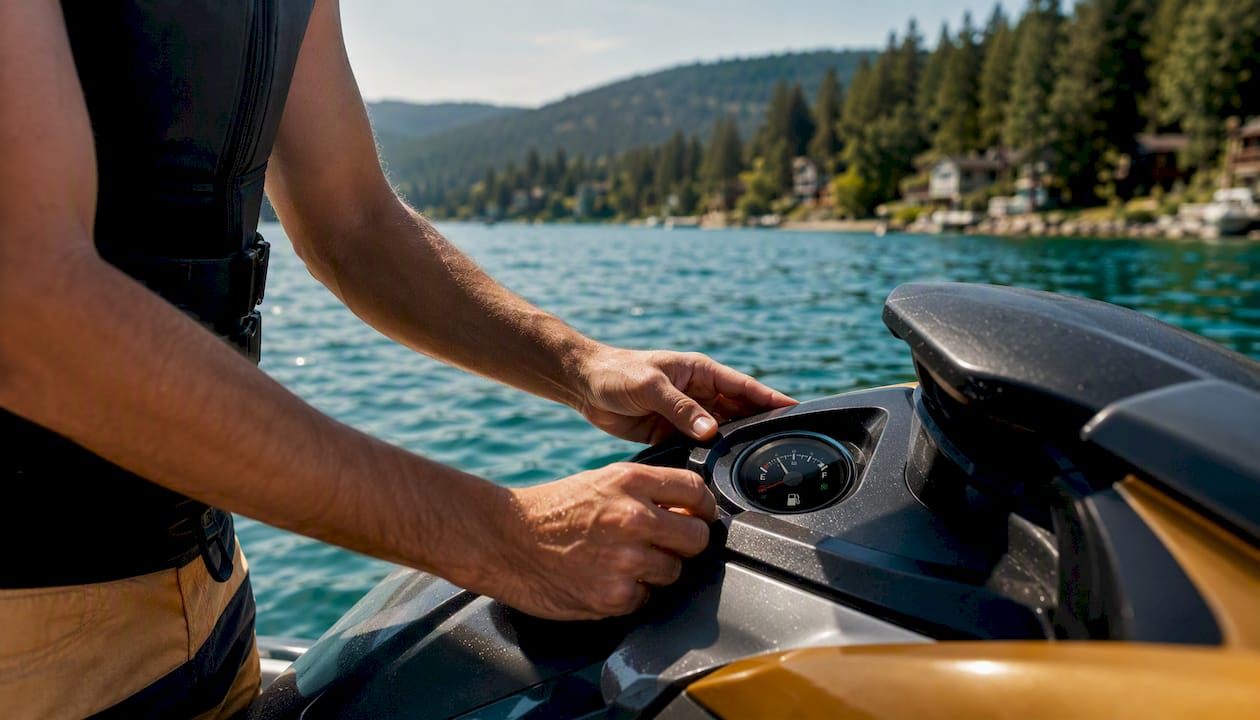
One practical safety note: fuel gauges on PWCs can read "empty" before the tank is actually dry, but you should never count on that margin. Plan your buffer before the gauge moves, not after.
Practical tips to stretch your fuel and your ride
Small habits add up faster than any single upgrade.
Riding behavior
- Accelerate smoothly from a stop rather than pinning the throttle.
- Find your model's best-cruise speed (usually 25–30 mph) and hold it.
- Limit WOT runs to short bursts; each one burns as much fuel in 30 seconds as several minutes of cruise.
- Unload gear you don't need. Every extra pound costs fuel.
Route planning
- Ride into the wind on the outbound leg so the return is easier and faster.
- Plan refuel stops rather than carrying extra fuel on board.
- On longer outings, use the 1/3 rule: one-third of the tank out, one-third back, one-third reserve.
Maintenance
- Inspect and clean the intake grate before each season; debris reduces pump efficiency.
- Check the impeller for nicks or damage. Even minor damage raises fuel use noticeably.
- Use the octane rating your manufacturer recommends. Higher octane in an engine not designed for it wastes money without improving efficiency.
- If storing the ski for more than a few weeks, use fuel stabilizer or drain the system to prevent ethanol-related deterioration.
Pro Tip: Freshwater lakes like those around Coeur d'Alene are gentler on fuel systems than saltwater. Still, post-season flushing and fresh fuel at the start of each season keep your consumption numbers where they should be. See why freshwater lakes suit jet skiing for more on local conditions.
Safe refueling practices every PWC rider needs to know
Refueling a jet ski is straightforward, but the risks of doing it carelessly are real.
Basic refueling checklist
- Shut the engine completely and wait for it to cool before opening the fuel cap.
- Dock at a fuel dock or stable shore point. Never refuel while drifting.
- Remove any passengers from the ski before fueling.
- Keep the nozzle in contact with the filler neck to prevent static buildup.
- Avoid overfilling. Stop when the tank is full, not when fuel backs up into the filler.
- After fueling, close the cap, wipe any spills, and ventilate the storage compartment for at least four minutes before restarting.
Carrying extra fuel Carrying spare fuel on a PWC is genuinely risky. The storage compartments are not designed for fuel containers, and a loose container near a hot engine or electrical components is a fire hazard. The safer options are:
- Plan your route around marina fuel docks.
- Use a support boat to carry a spare approved marine container.
- Arrange a shore-based transfer at a known point on your route.
If you do need to carry a small amount of extra fuel, use only an approved, sealed marine fuel container and secure it externally in a ventilated location, following all local marina and state regulations.
Pro Tip: Marina fuel typically costs $1–$2 more per gallon than road stations. Factor that into your trip budget, especially for longer outings. For step-by-step guidance on refueling between lakes, see Goldenwatersports' jet ski refueling guide.
What renters should expect on a jet ski rental
Rental providers handle fuel differently, and knowing the policy before you launch saves surprises at checkout.
Common rental fuel practices
- Most providers send you out with a full tank and expect the ski returned full. If you return it short, expect a refueling surcharge, often at marina rates.
- Range limits are common. Providers typically restrict how far offshore or around the lake you can ride, partly for safety and partly because a ski that runs dry far from the dock creates a recovery problem.
- Weight limits and passenger rules affect fuel use. A two-up ski with two adults burns more than a solo rider, which affects how far a 2-hour rental actually takes you.
A practical scenario on Lake Coeur d'Alene Lake Coeur d'Alene is about 25 miles long and up to 3 miles wide, with a fuel dock at the Coeur d'Alene Resort marina. On a Yamaha WaveRunner at cruise, a 2-hour rental covers roughly 50–60 miles of riding distance, well within the lake's geography for a relaxed loop. Aggressive riding shortens that range noticeably. Goldenwatersports provides Yamaha WaveRunners with safety equipment included, and their team walks you through fuel policy and route guidance at check-in.
Check Goldenwatersports' rental pricing and fuel policies before booking, and review what a jet ski rental includes so you know exactly what's covered. For families weighing options, a guided boat tour removes the fuel-planning burden entirely if that's a concern.
The number most riders get wrong about fuel planning
Most articles on jet ski fuel consumption lead with MPG. That's the wrong unit to plan around, and it quietly causes more stranded skis than any other mistake.
MPG matters when you're comparing models on paper. But on the water, you're managing time, not distance. You booked two hours. The wind picked up. You're riding two-up. None of that changes your miles-per-gallon figure in a useful way, but all of it changes how many gallons you burn per hour, which is the number that actually determines whether you make it back.
The conventional advice also undersells how much throttle behavior matters. On a supercharged machine, it can be three or four times the consumption rate. That's the difference between a $30 fill-up and a $120 one for the same two-hour window.
What actually matters, in order: throttle discipline first, model choice second, tank size third. A SPARK ridden smoothly will outlast a GP1800R ridden hard on every metric that matters for a day on the lake. The performance machines are genuinely impressive, but they're built for a specific kind of riding that burns fuel accordingly.
For renters, the practical priority is simpler: ask your provider what GPH to expect on their specific fleet, confirm the fuel policy, and plan your route with a buffer. Goldenwatersports operates Yamaha WaveRunners, which sit in the efficient mid-range of the consumption spectrum. A 2-hour session on Lake Coeur d'Alene at cruise is well within the tank's range with fuel to spare, provided you're not riding it like a race course.
The riders who run out of fuel are almost never the ones who didn't know the MPG figure. They're the ones who didn't account for the headwind home.
Sources
The model figures, GPH ranges, and planning formulas in this article draw from the following sources. For your specific ski, always cross-check with your owner's manual, which lists the manufacturer's tested consumption figures and recommended fuel grade.
- Jet Ski Fuel Consumption: How Far Can a Jet Ski Go? – PowerSportsGuide
- How Much Gas Does a Jet Ski Actually Use Per Ride?
- How much gas will I use? | Blog | Smoky Mountain H2O Sports
For rental-specific fuel guidance, check your provider's policy directly. Goldenwatersports' rental pricing page lists current fuel policies for Lake Coeur d'Alene and Liberty Lake bookings.