
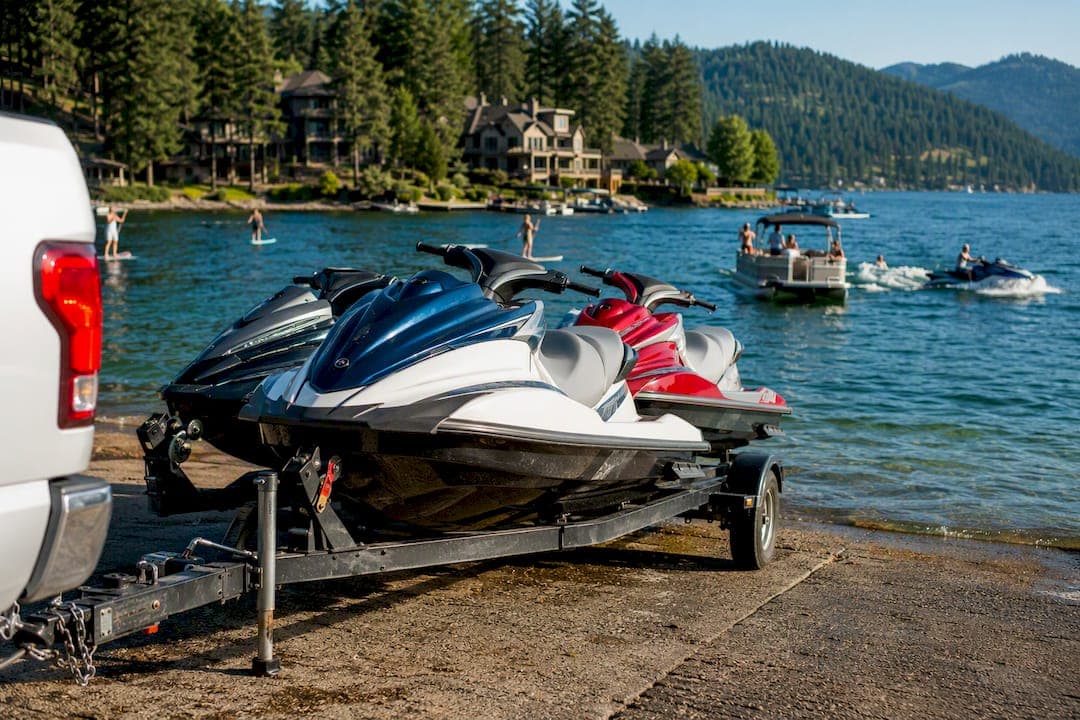
Your vehicle can tow a jet ski if its tow rating exceeds your total trailered weight, which usually means jet ski plus trailer plus fuel plus gear. Most single-ski setups land between the lower hundreds and over one thousand pounds once everything is loaded. The only real next step is math: weigh or calculate your actual trailered total, then check it against your vehicle's tow rating, hitch class, and GVWR before you hook up.
TL;DR:
- The total trailered weight of a jet ski, trailer, fuel, and gear often ranges from 700 to over 1,500 pounds, depending on the model and trailer type.
- Checking the trailer’s GVWR plate is crucial, as it frequently limits towing capacity more than the vehicle's own tow rating.
- Trailer tongue weight should be between 8 and 12 percent of the total trailer weight to prevent sway and overloading issues.
- State laws may require brakes on trailers over 1,500 to 3,000 pounds, and proper wiring and maintenance are essential for safe towing.
- Accurate weight calculation, proper load placement, and pre-trip checks significantly reduce the risk of towing accidents or mechanical failures.
Table of Contents
- Step-By-Step: How To Calculate Your Total Trailered Weight
- Matching Your Number To Vehicle Tow Ratings, Hitch Class, And GVWR
- Braked Vs. Unbraked Trailers And What The Law Requires
- What A Jet Ski And Trailer Actually Weigh, By Category
- Pre-Trip Trailer, Hitch, And Ramp Checklist
- How Golden Water Sports Verifies Towing Safety For Rentals
- Legal Towing Limits You Need To Know
- How Speed And Driving Conditions Change The Math
- The Towing Mistakes That Cause The Most Trouble
- What Most Towing Advice Gets Backwards
- Sources
Step-By-Step: How To Calculate Your Total Trailered Weight
Guessing gets people stranded on the shoulder with a sagging trailer and a hitch that's working way harder than it should. The fix is a short math exercise you can finish in ten minutes with your owner's manual and a calculator.
- Find the jet ski's dry or curb weight. This number lives in the owner's manual or on the manufacturer's spec sheet. Dry and curb weights typically run 300 to 1,100 pounds depending on whether you own a stand-up model or a full-size luxury three-seater.
- Add fuel weight. Gasoline weighs about 6.1 pounds per gallon. A jet ski with an 18-gallon tank filled to the top adds roughly 110 pounds you won't find on any spec sheet.
- Add gear weight. Life jackets, a dock line, a cooler, a spare prop, maybe a set of skis. Ten to thirty pounds, easy to overlook, and it adds up over a season of "just one more thing" in the storage compartment.
- Add the trailer's empty weight. Single-PWC trailers typically weigh from the low hundreds to mid-hundreds of pounds, with aluminum frames on the lighter end and galvanized steel models running heavier.
- Total it up and verify on a scale. Add every number above. Then, if you can, drive to a certified truck scale or a farm supply store with a platform scale and weigh the whole rig. Certified scale verification is the recommended final check because manufacturer specs almost always understate what you're actually pulling once fuel and gear are in the mix.
A single jet ski, trailer, fuel, and gear commonly totals in the moderate hundreds to over a thousand pounds depending on the ski class and trailer construction, according to weight comparisons across popular models. That range is wide enough that you genuinely cannot eyeball it. A rec-lite ski on an aluminum trailer might hit 750 pounds. A luxury three-seater on a heavier galvanized trailer with a full tank can push past 1,250.
Tongue weight matters just as much as the total. Aim for 8 to 12 percent of the total trailered weight resting on the hitch ball. For a 1,000-pound rig, that's 80 to 120 pounds. Too little tongue weight and the trailer can start swaying at highway speed. Too much, and you're overloading the hitch and squatting the back of your vehicle.
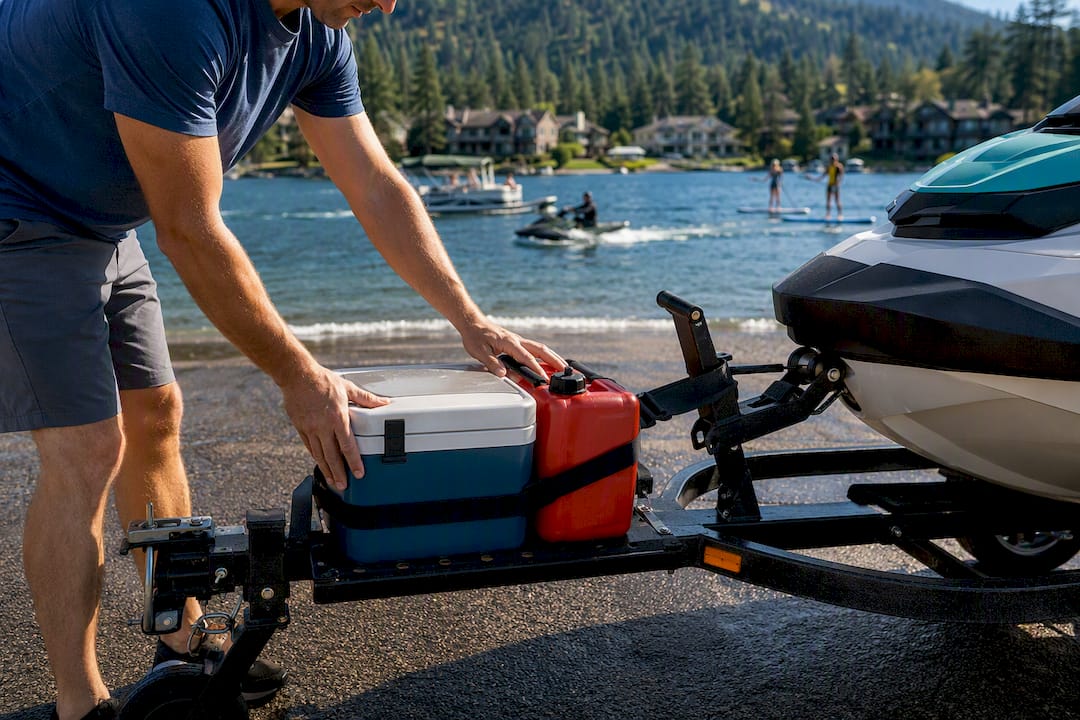
Pro Tip: Load your cooler, gas can, and loose gear toward the front third of the trailer, over or just ahead of the axle. A few inches of forward shift can pull tongue weight into the safe range without adding a single pound.
Matching Your Number To Vehicle Tow Ratings, Hitch Class, And GVWR
Once you know your total trailered weight, you need four numbers from your vehicle and trailer to confirm you're actually within limits. Mixing these up is one of the most common ways people end up towing legally gray or mechanically unsafe.
- Tow rating (GCWR minus curb weight, roughly): the maximum weight your vehicle's engine, transmission, frame, and brakes are rated to pull. Found in the owner's manual, not on a sticker.
- GCWR (Gross Combined Weight Rating): the max combined weight of your loaded vehicle plus loaded trailer together.
- GVWR (Gross Vehicle Weight Rating): the max your vehicle alone can weigh, including passengers and cargo, separate from anything it's towing.
- GAWR (Gross Axle Weight Rating): the max weight each axle can carry, which matters more on the trailer side than most people realize.
- Hitch class and ball rating: hitches are rated Class I through Class V, and the ball itself carries its own weight limit stamped on the ball or the mount.
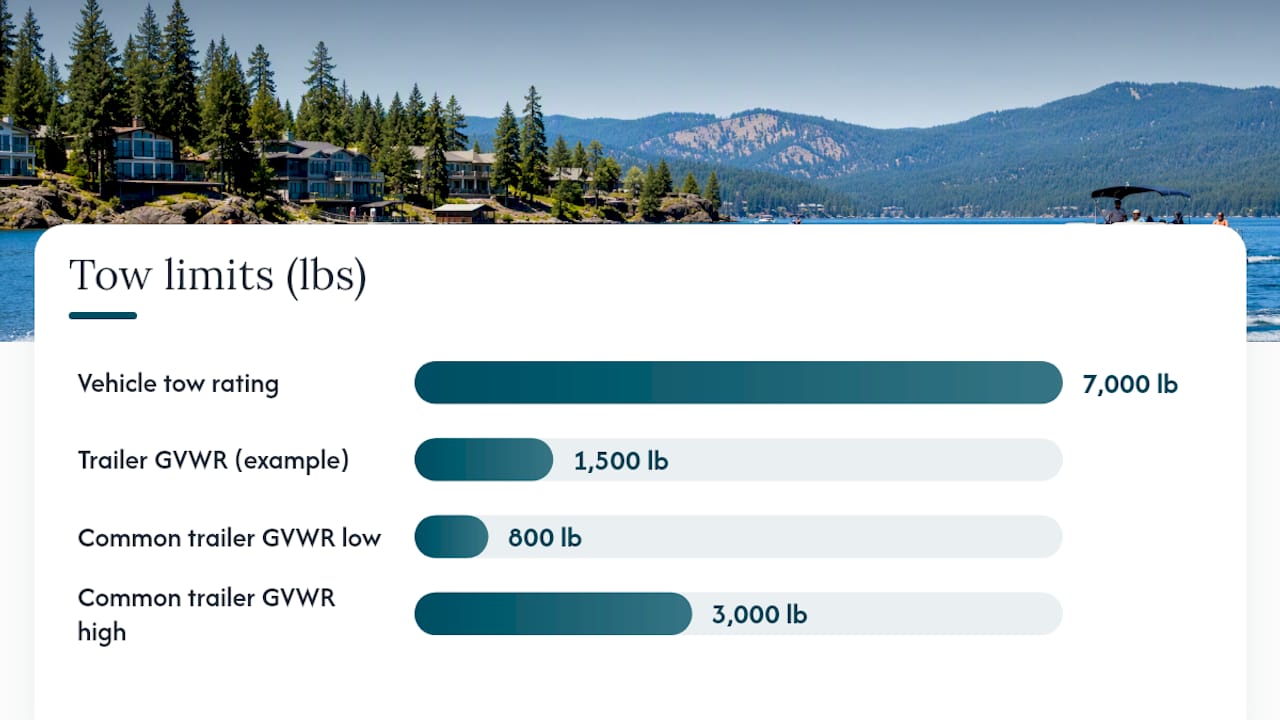
Check four physical locations before you tow: the owner's manual for the tow rating, the hitch receiver sticker for hitch class, the trailer's VIN plate for its GVWR, and the axle housing for GAWR. CURT's trailer weight guide shows jet ski trailer GVWR ratings commonly range from 800 to 3,000 pounds even though the trailer itself might only weigh 300 pounds empty, so an underrated trailer can become the limiting factor even when your truck has plenty of headroom.
Here's the number that trips people up: the trailer's GVWR plate, not your vehicle's tow rating, is sometimes the real ceiling. A capable half-ton truck rated to tow 7,000 pounds does nothing for you if your trailer's own GVWR plate caps out at 1,500. Exceeding any single rating, whether it's the vehicle's, the hitch's, or the trailer's, is unsafe regardless of what the other three numbers say. The lowest number in the chain wins.
Braked Vs. Unbraked Trailers And What The Law Requires
Most single-jet-ski trailers are often light enough to legally run without brakes in many states, but "legal" and "smart" standards can differ as total trailered weight grows.
- States set their own thresholds for when trailer brakes become mandatory, commonly somewhere between 1,500 and 3,000 pounds of gross trailer weight, so check your specific state's DMV site or AAA's towing resources before assuming you're exempt.
- Surge brakes activate through hydraulic pressure created when the tow vehicle slows down; they're simple and common on boat and PWC trailers but require zero input from the driver.
- Electric brakes activate through a controller mounted in the tow vehicle, giving you adjustable, proportional braking that syncs with your truck's own brakes, which most trucks and SUVs need a wiring harness and controller installed to support.
- If your trailered total sits above roughly 1,500 pounds, a braked trailer paired with a properly wired brake controller stops noticeably shorter and reduces sway risk on wet boat ramps.
- Basic pre-trip maintenance: grease the bearings at the start of the season, check that trailer lights sync with your vehicle's turn signals and brakes, and inspect the coupler and safety chains for rust or wear before every long tow.
What A Jet Ski And Trailer Actually Weigh, By Category
Numbers mean more with a frame around them. Here's how the math plays out across the categories you'll actually find on a dealer lot.
- Stand-up models run about 300 to 550 pounds dry. Paired with a light aluminum trailer around 180 pounds, plus fuel and gear, you're often looking at a total trailered weight under 800 pounds.
- Rec-lite skis weigh roughly 410 to 650 pounds. Add a 200-pound trailer and a half tank of fuel, and you land somewhere between 700 and 950 pounds.
- Recreational three-seaters typically weigh 650 to 800 pounds dry. With trailer, full fuel, and gear, expect a total closer to 1,000 to 1,150 pounds.
- Performance models run heavier, 730 to 900 pounds, and often get paired with sturdier trailers. Totals commonly reach 1,150 to 1,300 pounds.
- Luxury and touring skis top the range at 800 to 1,100 pounds dry. With a heavier trailer and full tank, these setups can approach or exceed 1,200 to 1,500 pounds, which is exactly why so many owners of vehicles rated around 1,500 pounds end up asking whether that number is actually enough for their specific ski.
Match those totals against rough vehicle tow bands: a compact sedan typically tows 1,000 to 1,500 pounds, a midsize crossover often handles 2,000 to 3,500 pounds, and a full-size truck or body-on-frame SUV commonly clears 5,000 pounds without strain. A sedan rated at 1,500 pounds has real margin for a stand-up or rec-lite setup but almost no cushion for a luxury ski on a heavier trailer with a full tank. That's the calculation worth doing before you buy either the ski or the trailer.
Pre-Trip Trailer, Hitch, And Ramp Checklist
Run this before you leave the driveway and again before you back down the ramp. It takes five minutes and it's the single best habit for avoiding a roadside or ramp-side disaster.
- Check that trailer lights, turn signals, and brake lights sync correctly with your tow vehicle before pulling out.
- Inspect the coupler, hitch pin, and safety chains for proper engagement and no visible wear or rust.
- Verify tire pressure on both trailer tires and the spare, matched to the load index stamped on the sidewall.
- Confirm bow and transom straps are tight and the engine is secured against shifting on rough roads.
- Recheck your calculated tongue weight is still in the 8 to 12 percent range after loading gear.
- Do a short test drive around the block, then stop and recheck every fastener and light before getting on the highway.
Pro Tip: At the ramp, back down slowly and stop before the trailer wheels touch water. Release the transom strap first, then the bow strap last, so the ski doesn't drift free while you're still lining up the winch.
How Golden Water Sports Verifies Towing Safety For Rentals
Golden Water Sports checks trailered weight and hitch compatibility before any customer leaves with a jet ski in tow, which is the same habit we're recommending you build into your own routine. Our team confirms the loaded trailer weight against the customer's hitch class and vehicle tow rating before hookup, not after, because catching a mismatch in the parking lot beats catching it on the highway.
For load stability, we position gear and fuel forward of the axle before the tie-down straps go on, matching the same tongue weight target of 8 to 12 percent we recommend above. Bow and transom straps get checked twice: once at load and again after the first few minutes of driving, since straps often need a slight retightening once everything settles.
If you're renting rather than towing your own, our pickup and delivery options let you skip the entire calculation. Staff handle the hitch matching, the weight verification, and the ramp launch, which is worth considering if your vehicle's tow rating is sitting right at the edge of what your ski and trailer actually weigh. For anyone browsing rental rates before deciding whether towing your own setup even makes sense, our Coeur d'Alene rental pricing page breaks down hourly and multi-day options.
Legal Towing Limits You Need To Know
Towing laws for jet ski trailers vary by state, and the rules that trip people up most are speed limits while towing, license or endorsement requirements, and brake thresholds. Some states cap towing speed below the posted highway limit regardless of your vehicle's capability, often somewhere around 55 to 65 miles per hour for combinations over a certain weight.
A handful of states also require a specific trailer endorsement on your driver's license once combined vehicle and trailer weight crosses a set threshold, usually in the 10,000 to 26,000 pound range, which realistically won't affect most single-ski setups but matters if you're towing multiple jet skis on a tandem trailer.
Lighting and reflector requirements apply almost everywhere: trailers need functioning brake lights, turn signals, and rear reflectors, and many states require a visible license plate light on the trailer itself. Registration requirements for the trailer itself also vary. Some states require annual registration and a separate trailer VIN plate inspection, while others fold light trailers into a one-time title process.
Because these rules shift state by state, your best move is checking your own state's DMV site or a resource like AAA's towing guidance before a long trip, especially if you're crossing state lines with the ski in tow. Manufacturer riding guidance also stresses checking local rules for on-water towing activities, which is a separate but related set of regulations from highway trailer law.
How Speed And Driving Conditions Change The Math
Towing capacity numbers assume ideal conditions: dry pavement, flat roads, calm wind. Real driving rarely offers all three at once, and speed is the variable that amplifies every other risk factor.
Trailer sway becomes more likely as speed increases, especially above 60 miles per hour, because small steering corrections get magnified by the trailer's momentum. Crosswinds make this worse. A gusty day on an open highway can push a lightly loaded trailer sideways enough to feel unsettling even well under your vehicle's rated tow capacity.
Wet or gravel boat ramps change the calculation too. A ramp that's fine at a crawl becomes a traction problem the moment you add speed, particularly with a loaded trailer pushing extra weight onto the tow vehicle's rear axle. Braking distance also increases substantially with a loaded trailer, more so with unbraked setups, which is part of why states set lower speed thresholds for towing combinations over certain weights.
The practical rule: drop your highway speed by 5 to 10 miles per hour below what you'd normally drive, increase following distance, and avoid towing in high wind advisories when you can reschedule. None of that shows up on a spec sheet, but it matters more than the tow rating number once you're actually on the road.
The Towing Mistakes That Cause The Most Trouble
Most jet ski towing problems trace back to a handful of repeat mistakes, and nearly all of them are avoidable with the checks already covered above.
Skipping the scale check tops the list. Owners eyeball the weight, assume the manufacturer's dry weight is close enough, and end up 200 pounds over their estimate once fuel and gear are loaded. Ignoring tongue weight is a close second. Loading all the gear toward the back of the trailer feels natural but pushes tongue weight too low, which is a leading cause of trailer sway at highway speed.
Trusting the vehicle's tow rating alone without checking the trailer's own GVWR plate causes people to assume they have more margin than they actually do. Forgetting the brake controller wiring after adding a braked trailer to a vehicle that's never towed one before means the trailer brakes simply don't activate when you need them.
Rushing the ramp launch rounds out the list. Releasing straps in the wrong order, backing down too fast, or skipping the post-load strap recheck are small errors that turn into expensive ones. Building the checklist habit from the section above into every single trip, not just the first one, is the fix for nearly every item on this list.
What Most Towing Advice Gets Backwards
Most guides treat towing capacity as a single lookup: find your vehicle's max number, confirm your ski weighs less than that, done. That's backwards. The vehicle's tow rating is usually the easiest number to find and the least likely to be your actual limit. The trailer's GVWR plate, the one nobody checks, is far more often what catches people off guard, especially with older or budget trailers rated well below what they can physically hold.
The 1,500-pound question that keeps showing up in owner forums isn't really about whether 1,500 pounds is enough. It's about whether anyone did the fuel-plus-gear-plus-trailer math before assuming it was. Do that math first, weigh the rig if you can, and the vehicle-rating question mostly answers itself. Skip the math, and even a truck rated for 7,000 pounds won't save you from a trailer plate that says 1,200.
— Life is better on water.
Sources
- How Much Does a Jet Ski Weigh? 300–1,100 lb Guide + Dry, Curb, and Trailer Weights - Wind Surfing Lessons
- Engineerskill
- A Guide to Trailer Weights by Trailer Type - CURT Manufacturing
- How Much Does a Jet Ski and Trailer Weigh? (Chart) – PowerSportsGuide
- Towing a tube or skier with a Personal Watercraft - Sea-Doo