

Yes, every jet ski has a maximum load capacity, and it covers more than just body weight. The weight limit typically ranges in the 350 to 600 pounds range depending on the model, including every rider, their personal flotation device, the full fuel tank, and any gear stashed on board. The safest move is to load well under the number printed on the capacity placard, not right up to it, especially if you're heading into wind chop or towing a tuber.
TL;DR:
- Most jet skis have a weight limit between 350 and 600 pounds, including riders, gear, and fuel, with capacity closely linked to the model size.
- Exceeding the weight limit reduces handling, speeds, and steering responsiveness, increasing the risk of capsizing or taking on water in choppy conditions.
- Accurate load calculation requires weighing each rider, accounting for PFDs, fuel, and gear, then subtracting a safety buffer to stay within the rated capacity.
- Overloading voids insurance, risks hydrolock or swamping, and makes emergency control and turning more difficult, especially in waves or turns.
- Building in extra space and following safety guidelines helps prevent overload issues, and asking rental staff for confirmation ensures proper boat selection.
Table of Contents
- What is the typical jet ski weight limit by category?
- How does extra weight change the way a jet ski handles?
- How do you calculate your total load before heading out?
- What happens if you exceed the weight limit?
- Practical tips for loading and riding near capacity
- What about towing, kids, and multiple passengers?
- How do you choose the right craft for your group?
- How Golden Water Sports matches guests to the right machine
- Three rules worth remembering about jet ski capacity
- Ready to book the right jet ski for your group?
- Sources
What is the typical jet ski weight limit by category?
Jet ski capacity tracks pretty closely with the craft's size class, and knowing which category you're renting or riding tells you almost everything you need to know before you count heads.
Entry-level, compact models, often called Rec-Lite, typically top out around 350 to 450 pounds of combined load. These are the nimble, lighter hulls built for one or two riders who want speed over cargo space. Step up to a standard recreation model and that ceiling usually rises toward the mid-500-pound range, enough for two average adults plus a modest amount of gear. Full-size touring or luxury three-seat machines usually have a higher capacity, often above 600 pounds once you add fuel and storage.
- Rec-Lite models typically have lower weight capacity
- Recreation models offer moderate total capacity
- Touring or three-seat models generally support heavier loads
Here's where a lot of riders get tripped up: seat count is not the same thing as weight capacity. A machine advertised as a three-seater, like Yamaha's VX Limited HO, which lists seating for one to three riders alongside a dry weight of 866 pounds and an 18.5-gallon fuel tank, can still be unsafe for three people if their combined weight, gear, and full fuel load exceed the placard rating. Three seats describe physical space, not a green light for three linebackers plus a cooler. Rental guides built specifically for renters make the same point: capacity ranges shift by class, and matching your group to the right one matters more than counting available seats.
How does extra weight change the way a jet ski handles?
A heavier load doesn't just slow you down. It changes how the craft responds when you actually need it to respond.
More weight means more drag, and drag eats into both acceleration and top speed. A jet ski that feels snappy with one rider can feel sluggish and hesitant off the line with three adults and a full tank aboard. Worse, when the stern sits lower in the water under a heavy load, the steering nozzle loses some of its bite. Since PWCs steer using directed thrust rather than a rudder, and that thrust has to fight gravity and displacement first, a loaded-down craft turns wider and reacts slower exactly when quick correction matters most.
A loaded jet ski can lose meaningful cornering response and wake recovery capability compared to the same craft near its ideal load, which is why manufacturers and rental operators consistently recommend staying under the placard rather than riding right up to it.
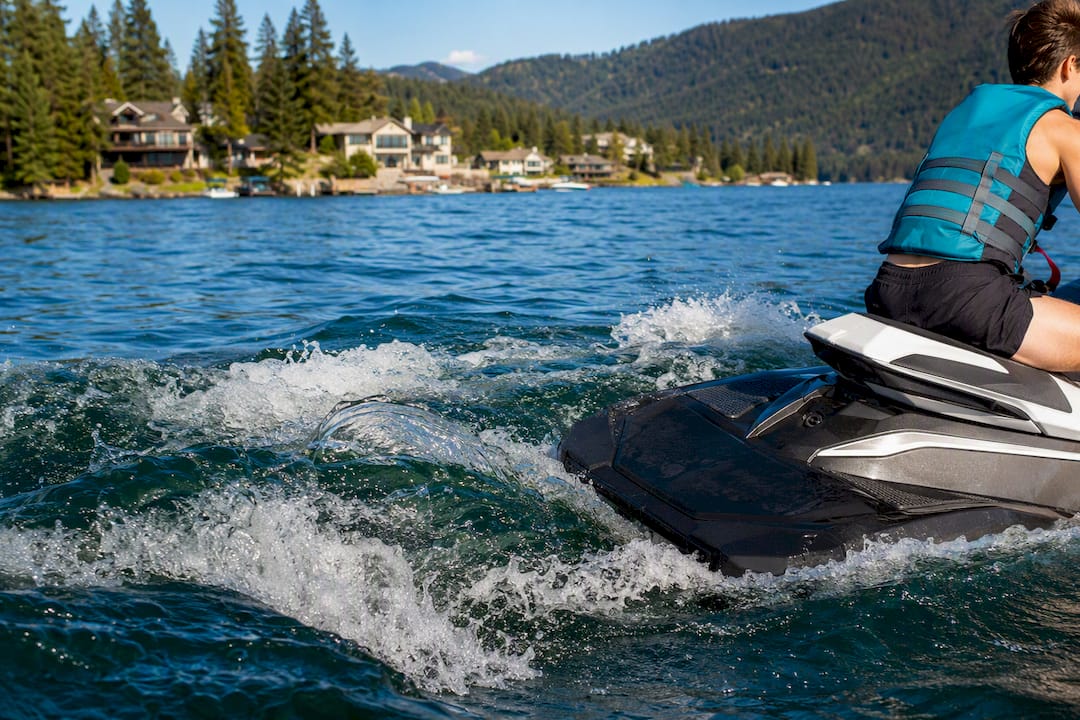
That sluggish handling becomes a real hazard in chop. A jet ski riding low absorbs waves differently than one sitting at its designed waterline. Instead of skimming over a wake, an overloaded craft can plow into it, taking on water over the bow or getting knocked off balance during a turn. Combine that with slower steering response and you've got a recipe for a spill in conditions that would barely register on a properly loaded machine.
How do you calculate your total load before heading out?
Most riders underestimate their total load because they only count body weight and forget everything else riding along with them.
- Weigh every rider individually. Don't estimate. Round up, not down.
- Add the weight of each PFD. A soaked life vest weighs more than a dry one, so factor that in for longer rides.
- Add a full tank of fuel. Gasoline weighs about 6 pounds per gallon, so an 18 to 20 gallon tank adds well over 100 pounds on its own.
- Add gear weight. Coolers, dry bags, tow ropes, and extra clothing all count.
- Compare your total against the placard rating, then subtract a safety buffer before you call it good.
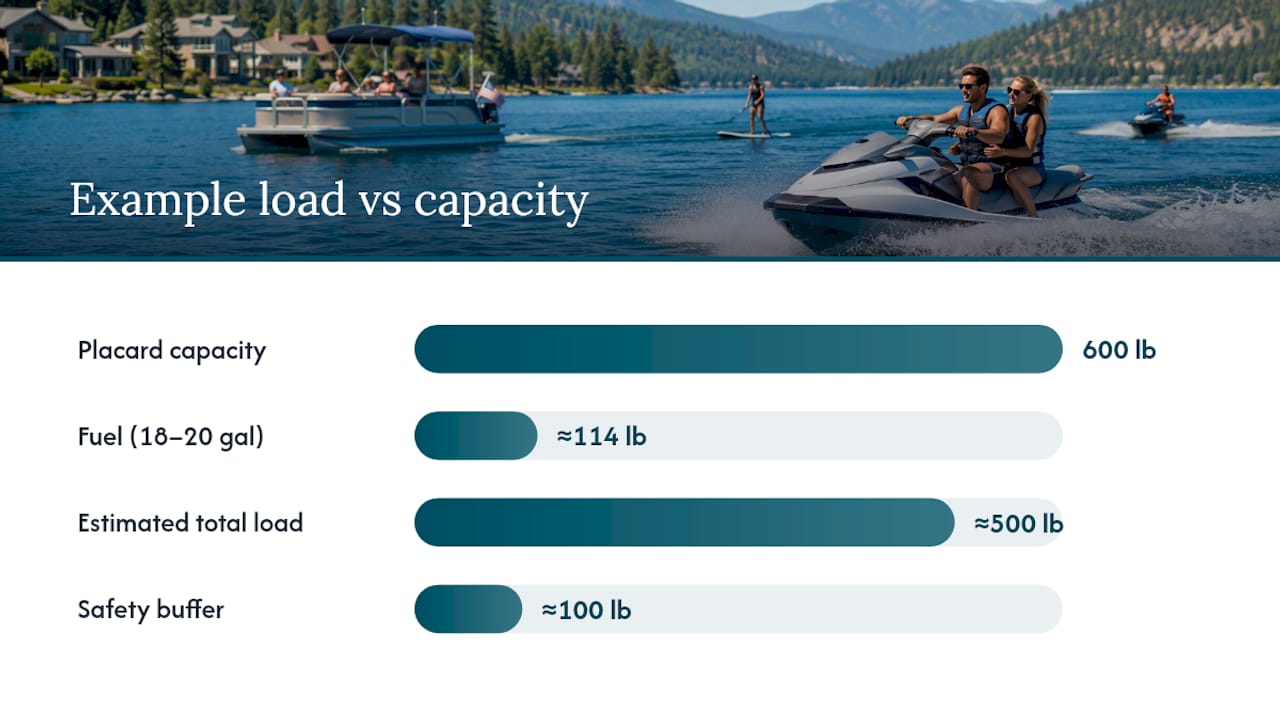
Here's what that looks like in practice for a common scenario, two adults heading out for an afternoon with a cooler and full tank:
If that jet ski carries a 600-pound capacity rating, you're sitting at roughly 100 pounds under the limit, which is a reasonable cushion. A general rule of thumb worth following: build in a buffer, and lean toward the larger cushion if you expect any chop on the water.
What happens if you exceed the weight limit?
Overloading a jet ski isn't a gray-area risk. It creates specific, well-documented failure points that can end a good day fast.
- Swamping and hydrolock. A craft sitting too low can take on water through intakes or the engine compartment, and water reaching the engine can cause hydrolock, a mechanical failure that's expensive and sometimes catastrophic.
- Capsize risk in turns or waves. Reduced buoyancy and sluggish steering make tip-overs more likely, especially in choppy conditions or aggressive maneuvers.
- Voided insurance or rental liability. Many rental agreements and insurance policies exclude coverage for damage or injury tied to an overloaded craft, which means you could be personally on the hook for repair costs.
- Reduced control during emergencies. Slower acceleration and wider turning radius cut into your ability to avoid another boater, a swimmer, or sudden wake.
Pro Tip: If you're not sure whether your group is within limits, ask before you launch. The capacity placard near the handlebars or seat, along with the owner's manual, lists the official number, and rental staff can confirm it on the spot if you're renting rather than riding your own.
Practical tips for loading and riding near capacity
A few small adjustments make a real difference when your group is pushing toward the upper end of a craft's rating.
- Keep heavy gear low and centered rather than piled on the back deck.
- Seat passengers close together near the center of the craft instead of spread toward the rear.
- Skip rear-deck cargo entirely if you're towing, since gear back there can tangle with tow ropes.
- Confirm whether your craft uses a tow eyelet or a ski pylon before attaching anything, since they're built for different towing purposes.
- Throttle up more gradually and take turns wider when you're near the top of the weight range.
Small changes in where weight sits on the hull affect balance more than most riders expect.
What about towing, kids, and multiple passengers?
Towing changes the math, and manufacturers are specific about it for good reason. Sea-Doo's owner guidance recommends a dedicated spotter facing backward, USCG-approved PFDs for the driver, the spotter, and the person being towed, and using the correct attachment point, the tow eyelet for tubing, the ski pylon for skiing.
- Kids count toward total weight just like adults do, and their placement affects balance even though their weight is lower.
- A spotter seat adds another body to your total load calculation, so factor that in before you plan a tow.
- Ask rental staff whether the specific craft you're booking is rated and equipped for towing before you plan tube time, since not every model or rental setup supports it.
How do you choose the right craft for your group?
Matching your group to the correct machine starts with the numbers, not the vibe of the rental fleet.
- Bring your rough headcount and gear list when booking, and ask what each available model is rated for.
- If your total load pushes close to a machine's upper limit, step up to a touring model or split your group across two rentals instead of maxing out one craft.
- For larger families or groups with a lot of gear, a pontoon boat often makes more sense than stacking people onto a single PWC. Our guide on choosing between a jet ski and a pontoon boat breaks down when each option fits better.
- Always double check PFD requirements too. Our life jacket safety guide covers what counts as USCG-approved and why that matters for towing specifically.
How Golden Water Sports matches guests to the right machine
At check-in, our team walks through the capacity placard with every guest and asks about expected group weight before anyone gets on the water. It's a two-minute conversation that prevents a lot of headaches later.
The most common mistake we see isn't malice, it's math. Guests often forget that a soaked PFD, a full tank, and a packed cooler add up fast, and that combination can push a group over the line even when everyone looks like they'd fit fine on paper. Our staff flags that early and recommends a larger model or a second craft when the numbers are tight. If you're booking ahead, come with your group's approximate weight and gear list ready. It speeds up check-in and gets you on the water with the right machine the first time.
Three rules worth remembering about jet ski capacity
Weigh your people, add your gear and fuel, then leave a buffer. That single habit prevents most of the overload problems riders run into, and it takes less time than loading the cooler.
Be more conservative than you think you need to be when towing or riding in chop. Both situations demand handling margin that a fully loaded craft simply doesn't have. And when in doubt, ask. Rental staff and owner's manuals exist precisely because the placard number isn't always intuitive once you start adding PFDs and full tanks into the mix.
— Life is better on water.
Ready to book the right jet ski for your group?
Our team helps match your group to the right WaveRunner, checks capacity, confirms your expected load, and provides safety gear before you leave the dock. That's the advantage of renting from a local outfitter over showing up somewhere with no one walking you through the numbers first.
Whether you're planning a family afternoon on Lake Coeur d'Alene or a weekend towing session with friends, browse our current rental rates and available WaveRunner classes to find the right fit for your group size and gear. We also offer location-specific rentals at Liberty Lake and Newman Lake, with flexible hourly and multi-day options. Reach out or book online, and our team will help you pick the right craft before you ever hit the water.
Sources
- Towing a tube or skier with a Personal Watercraft - Sea-Doo
- VX® Limited HO | VX® Series | Yamaha WaveRunners
- Jet Ski Weight Limits: What You Need to Know Before Renting — Ship O'Hoi
- Jet Ski Weight Limits Explained | Action Water Sportz