
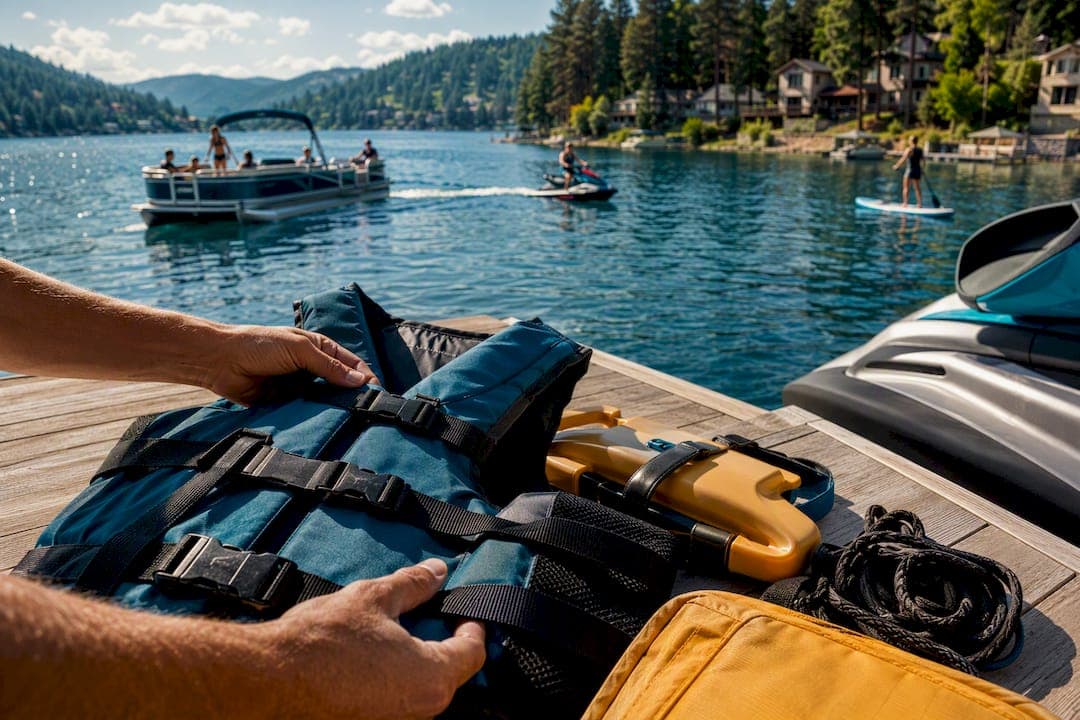
Get the boat, the safety gear, and the route right, and everything else on a multi-day trip falls into place. That means choosing a vessel with real berths and a working galley, confirming every piece of USCG safety equipment is serviceable rather than just present, mapping fuel stops and safe harbors before you cast off, and reading the rental agreement closely enough to know who eats the cost of a mechanical issue. Outfits like Golden Water Sports and reciprocity standards from NASBLA exist precisely because these details trip up first-timers more than weather ever does.
TL;DR:
- Choose a vessel with sufficient berths, a galley, freshwater tank, head, and shore power to support multi-day travel, not just a day-trip boat.
- Plan route distances based on cruising speed, and identify safe harbors within two to three hours of travel for weather and fuel stops.
- Verify all safety gear is functional and properly checked before departure, including life jackets, fire extinguishers, flares, navigation lights, and radio.
- Understand rental policies on fuel, deposits, damage waivers, territorial limits, and insurance to avoid unexpected costs or coverage issues.
- Pack enough water, food, spare electronics, and weather-appropriate clothing, and establish routine safety and operational checks for each day aboard.
Table of Contents
- Choose the Right Boat for a Multi-Day Trip
- Plan Route, Daily Distances, and Fuel Stops
- Safety and Legal Requirements for Multi-Day Rentals
- Rental Agreements, Insurance, and Deposits Explained
- Provisioning and Packing for Multi-Day Rentals
- Daily On-Water Routine and Emergency Basics
- Pickup and Inspection Checklist
- Practical Operator Tips From Golden Water Sports
- Overnight Anchoring and Marina Options
- Waste Disposal and Environmental Considerations
- Engine and Mechanical Basics for Troubleshooting
- Communication Plan and Emergency Contacts
- Crew Management and Watch Scheduling
- Author Perspective: Why Planning Makes Multi-Day Trips Relaxing
- Book a Multi-Day Rental With Golden Water Sports
- Sources
Choose the Right Boat for a Multi-Day Trip
The single biggest planning mistake is picking a boat sized for a day trip and expecting it to work for four days. Berth count matters more than deck space once the sun goes down. A boat that comfortably seats eight for an afternoon cruise might only sleep two or three, and cushions in a cockpit don't count as a berth if there's no shelter from wind and dew.
Multi-day travel depends on systems that a day-rental boat often skips entirely:
- Freshwater tank: needed for dishes, hygiene, and drinking backup, typically ranging from 20 to 60 gallons depending on boat size
- Galley: even a two-burner stove and a cooler with drainage beats trying to eat cold food for three days straight
- Head (marine toilet): a holding tank changes where and how often you can stop, and it factors into waste disposal planning later in the trip
- Shore power and battery bank: phones, marine electronics, and refrigeration all draw down a battery faster than people expect
Hull type shapes the whole experience, too. A pontoon rides flat and stable, which makes it forgiving for families and calm-water cruising, but it handles chop poorly and burns more fuel fighting wind resistance because of its boxy profile. A deep-V hull cuts through waves better and extends your comfortable operating window on breezier days, at the cost of a rougher ride at idle speed. Trawler-style boats trade speed for fuel efficiency and range, which matters if your route covers real distance rather than looping the same cove. Match the hull to the water you're actually planning to cross, not the water you wish you had.
Plan Route, Daily Distances, and Fuel Stops
Route planning for a multi-day rental comes down to converting your boat's cruising speed into a daily mileage budget you can actually sustain, not just a top speed you saw once on flat water.
- Calculate cruising speed, not top speed. If your boat cruises comfortably at 20 mph, don't plan a day around 30 mph bursts. Cruising speed is the number that holds up for hours.
- Multiply by available daylight, then cut it by 20%. Eight hours of daylight at 20 mph looks like 160 miles, but wind, wakes, and fuel stops eat into that. Budget for roughly 128 miles and treat anything beyond that as a bonus, not the plan.
- Mark safe harbors every two to three hours of travel. A safe harbor is a place you could pull in and wait out weather, not just a scenic anchorage. Identify at least one option per leg before you leave the dock.
- Reserve marina slips ahead of holiday weekends. Popular stops fill up fast in summer, and showing up at 6 p.m. with no reservation on a Saturday in July is a bad way to end a long day.
- Budget fuel per leg, not per trip. A rough rule: know your boat's gallons-per-hour at cruising speed, multiply by the hours in that day's leg, then add a reserve of at least 20%. In remote stretches with no fuel dock for miles, that reserve is what keeps a fuel stop from becoming an emergency.
Longer, multi-day rentals typically lower the per-hour cost compared to single-day bookings, but they raise the stakes on this kind of planning since fuel, marina fees, and logistics compound over several days rather than resetting each morning.
Safety and Legal Requirements for Multi-Day Rentals
Every recreational boat has to carry federally mandated safety gear that scales with the vessel's length, and the requirement isn't just that the gear exists. It has to be serviceable. The Coast Guard's minimum equipment standards don't care whether a fire extinguisher is sitting in the cabin if its gauge shows it's discharged.
Before you leave the dock, physically check:
- Life jackets: one per person on board, correctly sized, not just present in a bag
- Fire extinguishers: check the gauge needle, not just whether one is bolted in place
- Flares or visual distress signals: confirm the expiration date printed on the casing
- Throwable flotation device: should be accessible, not buried under gear
- Navigation lights: test them before dusk, not after you need them
Statistic Callout: Hosts frequently hand over sealed safety-gear bags without opening them first, according to the PickRV rental guide, which means an expired flare or a discharged extinguisher can sit unnoticed until the moment it actually matters.
Boater education adds a second layer. NASBLA coordinates reciprocity across states, but the rule that governs you is the state where you're operating the boat, not your home state or where the vessel is titled. Confirm your card or certificate is accepted for the water you're renting on before you show up expecting to take the wheel.
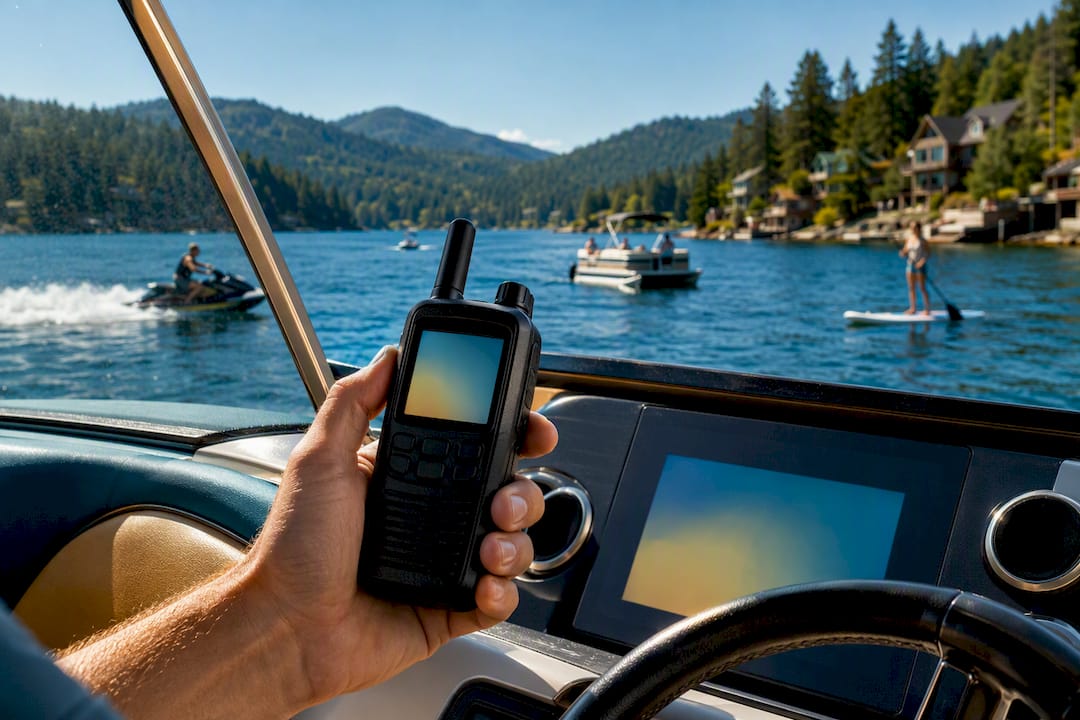
Last, run a VHF radio test on channel 16 before departure. It takes thirty seconds, and it's the single most skipped check on a pickup list. A dead or misconfigured radio is a recoverable problem at the dock and a genuinely dangerous one three hours from the nearest marina.
Rental Agreements, Insurance, and Deposits Explained
Fuel policy is the clause that surprises renters most. Some agreements require you to return the boat with a full tank and charge a steep flat fee if you don't; others charge current market rate per gallon plus a service fee for topping it off themselves. A multi-day trip burns enough fuel that this difference can swing your final bill by a meaningful amount, so ask which policy applies before you sign anything.
Deposits and damage waivers work as a pair. A refundable deposit protects the owner but ties up your money until after return inspection, while an optional damage waiver reduces your deposit exposure in exchange for a daily fee. Neither replaces documentation.
- Photograph every panel, hull scratch, and interior surface before departure, with a timestamp visible
- Get the host to initial any pre-existing damage in writing, not just verbally acknowledge it
- Keep a copy of the signed agreement and photos accessible on your phone throughout the trip, not just at pickup
Territorial limits define which water you're legally allowed to operate on, and crossing them, even accidentally, can void coverage entirely. Trailer and transport rules typically prohibit moving the boat by road unless the agreement explicitly allows it. Your personal insurance may or may not extend to rental use, which is worth checking before you assume you're covered, and the rental agreement itself usually spells out exactly what's excluded.
Provisioning and Packing for Multi-Day Rentals
Water is the number that trips people up most. Plan on at least one gallon per person per day for drinking and basic hygiene, and that's before you factor in dish washing or a hot afternoon that makes everyone drink more than usual. Non-perishable meals should make up the bulk of your food plan since refrigeration space is limited and often runs on battery power that has other jobs to do.
Power management deserves its own checklist:
- A spare battery bank or solar charger for phones and handheld electronics
- Extra fuses and a basic tool kit for minor fixes
- A 12-volt adapter if the boat's outlets don't match your devices
- A backup phone charging cable, because someone always forgets theirs
Pro Tip: Pack a dry bag for phones, wallets, and car keys even if the forecast looks perfect. A wake from a passing boat can soak a cockpit in seconds, and electronics don't forgive that mistake.
Weather on a lake can shift faster than a coastal forecast, so pack layers even in summer. For cooler-packing strategy and food organization that survives multiple days without a full galley, a dedicated packing guide covers the details worth getting right before you leave the dock.
Daily On-Water Routine and Emergency Basics
A short routine at the start and end of each day catches most problems before they become expensive ones.
- Morning check: bilge pump function, fuel level against the day's planned distance, engine fluid levels, and a quick VHF radio test.
- Evening check: secure lines, confirm anchor set (or slip fees paid), check battery charge levels, and log fuel used against fuel remaining.
- Man-overboard drill: assign one person to point continuously at the person in the water while the operator circles back. Practice this once on day one, calm water, no emergency, so nobody's improvising under stress later.
- VHF distress call: know the mayday format before you need it. Channel 16, vessel name, position, nature of emergency, number of people aboard.
- Abort criteria: agree in advance on what conditions turn the boat around. Wind over a set threshold, visibility dropping, or anyone feeling seriously unwell are all valid reasons to cut a leg short.
Sober-operator rules aren't optional on a multi-day trip. Alcohol and boat operation don't mix, and fatigue compounds the risk after a long day on the water. Night passages should be avoided unless the operator has real experience navigating in the dark. Unlit hazards, other boat traffic, and disorientation on open water are a much bigger problem after sunset than most renters expect.
Pickup and Inspection Checklist
Treat the pickup inspection as the moment that protects your deposit, not a formality to rush through. Walk the exterior first: hull, motor, propeller, and any existing scratches or dings, photographing each one with a timestamp visible in frame. Move inside next and photograph upholstery, flooring, and storage compartments.
Open every safety bag rather than trusting it's fully stocked:
- Count life jackets against headcount and check sizing
- Check extinguisher gauges and flare expiration dates directly
- Confirm the throwable device is accessible, not stowed under gear
- Test navigation lights and the VHF radio on channel 16 before leaving the dock
Confirm the fuel gauge reading matches what's written on the agreement, and test electronics like the chartplotter or depth finder while you're still at the dock where help is nearby. Ask the host to initial any pre-existing damage on the spot. A verbal "yeah, that scratch was already there" means nothing if a dispute comes up at return.
Practical Operator Tips From Golden Water Sports
Renters most often forget sunscreen reapplication, a dry bag for electronics, and enough non-perishable snacks for a full day. Golden Water Sports helps multi-day bookings by walking through provisioning needs during the pickup briefing rather than leaving renters to guess. On fuel and territorial policy, ask for any agreed exceptions in writing at pickup, not as a verbal aside. And always ask the host directly: "Where do locals avoid, and why?" That question surfaces hazard knowledge no map shows.
Overnight Anchoring and Marina Options
Anchoring overnight costs nothing and gives you flexibility, but it requires picking a spot with adequate holding ground, protection from wind shift, and enough swing room that you won't drift into another anchored boat by 3 a.m. Sand and mud bottoms hold an anchor far better than rock or grass, and checking a chart for bottom composition before you drop anchor saves a restless night.
Marinas cost more but offer security, shore power, and a working shower. Reserving ahead matters most during peak summer weekends, when popular docks fill by early afternoon. A hybrid approach, anchoring most nights and booking a marina slip every third day for power and provisioning, works well for trips longer than three or four days.
Whichever you choose, set a clear anchor watch routine, at least a quick check before bed and once overnight if conditions are unsettled. Pontoon boats in particular need a properly set anchor given their flat hull's tendency to swing with wind, and anchoring technique is worth practicing in daylight before you rely on it after dark.
Waste Disposal and Environmental Considerations
A boat's holding tank needs a plan before it becomes a problem. Most marinas offer pump-out stations, and using them is both a legal requirement and basic courtesy to the water everyone else is swimming and boating in. Dumping raw sewage in most lakes and near-shore waters is prohibited, and the fines for it are real.
Trash management matters just as much on a multi-day trip since there's no dock nearby to toss a bag into each evening. Bring extra trash bags, and pack out everything you bring in, including food scraps that seem harmless but attract wildlife to campsites and anchorages. Fuel and oil spills deserve their own care: top off fuel slowly and watch the vent, since even a small overflow spreads a sheen across the water that's difficult to contain once it starts.
Algal blooms are worth checking for specifically. Harmful algal blooms show up as thick green or blue-green scum on the surface, often in warm, calm coves, and swimming or letting pets drink from affected water can cause real illness. If you see it, move on rather than anchoring nearby.
Engine and Mechanical Basics for Troubleshooting
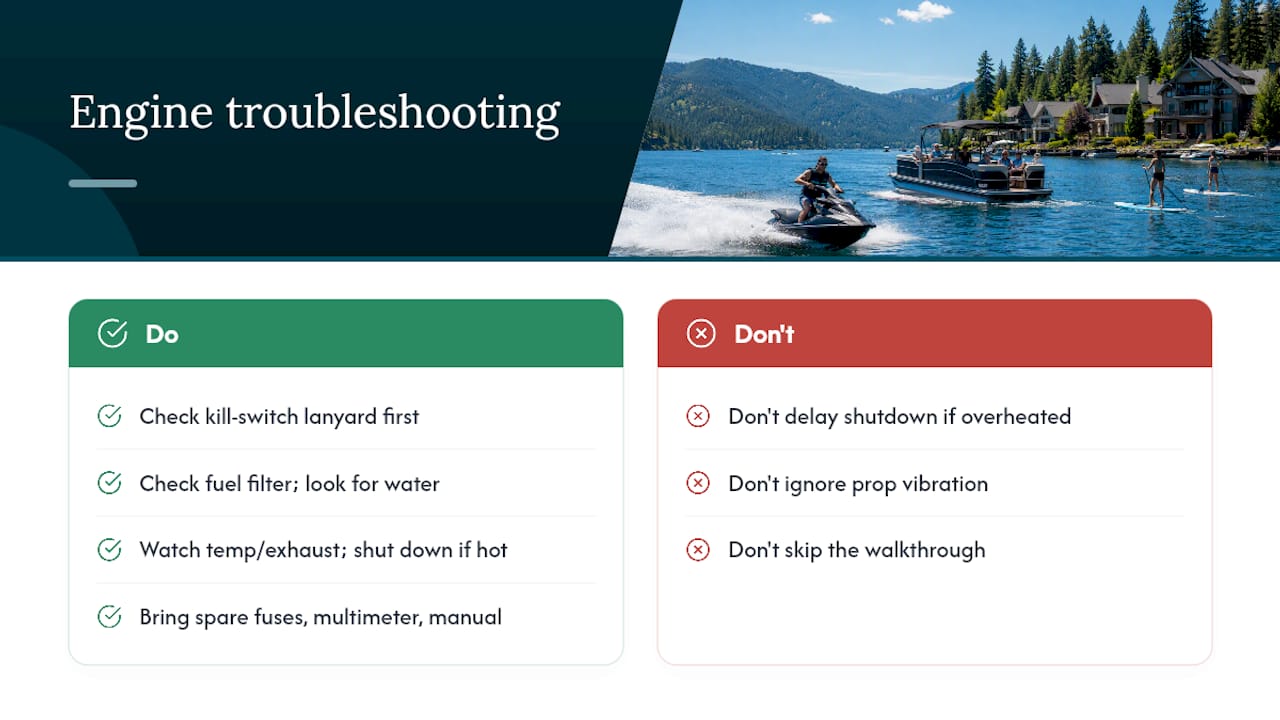
Most on-water engine problems fall into a short list of usual suspects. If the engine won't start, check the kill switch lanyard first, since it's the single most common reason a perfectly good engine refuses to turn over. If it starts but runs rough, a fouled fuel filter or water in the fuel is a common cause, especially on a boat that's been sitting.
Overheating shows up as a rising temperature gauge or a change in the exhaust water stream, and it usually traces back to a clogged water intake, often from weeds or debris. Shutting down promptly when you notice it prevents a much more expensive problem. A propeller that suddenly vibrates or underperforms may have picked up a line or debris around the shaft, worth checking any time performance drops without an obvious cause.
Keep a basic tool kit aboard: spare fuses, a multimeter if you're comfortable using one, and the boat's owner's manual if the rental agency provides one. Most rental agencies, including Golden Water Sports, walk renters through basic troubleshooting steps at pickup specifically so a minor issue doesn't turn into a wasted day waiting for help that a five-minute fix could have solved.
Communication Plan and Emergency Contacts
Before departure, share your full route and expected return time with someone on land who isn't on the trip. That person should know your planned stops, your boat's description, and what to do if they don't hear from you by an agreed check-in time.
Cell coverage disappears fast once you're away from shore on most lakes, so don't rely on it as your primary safety net. VHF channel 16 is monitored for distress calls and should be your default communication tool once you're underway. Save the local marine authority's non-emergency number and the nearest marina's contact information before you leave the dock, not while you're trying to find them under pressure.
Check NOAA's marine forecast for your specific operating window each morning, since lake weather can shift faster than a general regional forecast suggests. If conditions turn, having already identified your abort criteria and safe harbors makes the decision to turn back far less stressful than debating it in the moment.
Crew Management and Watch Scheduling
Multi-day trips run smoother when everyone aboard has a defined role rather than a boat full of passengers and one exhausted operator. Rotate who's responsible for navigation, who's on anchor watch overnight, and who handles galley duties, so no single person carries the whole trip.
A simple overnight watch, even just one person checking conditions and the anchor line every couple of hours, catches problems like a slipping anchor or approaching weather before they become emergencies. For trips with more than one experienced operator aboard, rotating who runs the boat each day keeps everyone sharp and reduces fatigue-driven mistakes, which tend to cluster on the last day when everyone's tired and eager to get home early.
Talk through expectations before day one: who's comfortable at the helm, who gets seasick, who wants to fish versus who wants to swim. A multi-day trip plan that accounts for group dynamics upfront prevents the friction that shows up on day three when everyone's slightly sunburned and opinions start clashing.
Author Perspective: Why Planning Makes Multi-Day Trips Relaxing
The renters who have the best trips aren't the ones with the fanciest boat. They're the ones who spent an extra twenty minutes at pickup checking gear and asking questions. Skipping that step doesn't save time, it just moves the problem to a worse moment, usually three hours from the dock. Build in the buffer, plan conservatively, and the trip runs itself.
— Life is better on water.
Book a Multi-Day Rental With Golden Water Sports
Golden Water Sports gives you a straightforward alternative to piecing together a multi-day trip from scratch: multi-day pricing that beats booking single days back to back, safety equipment included and verified before you leave the dock, and a pickup briefing where the team walks you through provisioning needs, local hazards, and boat-specific quirks before you ever untie the line.
If you're weighing a pontoon for a family trip or a jet ski setup for a faster-paced few days, the team can talk through which vessel actually fits your group size and route. Check current multi-day rental prices and availability to see what fits your dates, or look at jet ski rental options near Liberty Lake if a faster, lighter trip is more your speed. Book online now to lock in your dates before peak summer weekends fill up.
Sources
- Renting a boat through PickRV — the operational, legal, and safety mega-guide · PickRV Wiki
- USCG boating safety course resources
- 7 tips for planning a multi-day boat rental adventure - Swimmer Living
- Renting a Boat: Boat Rentals Guide | Discover Boating