
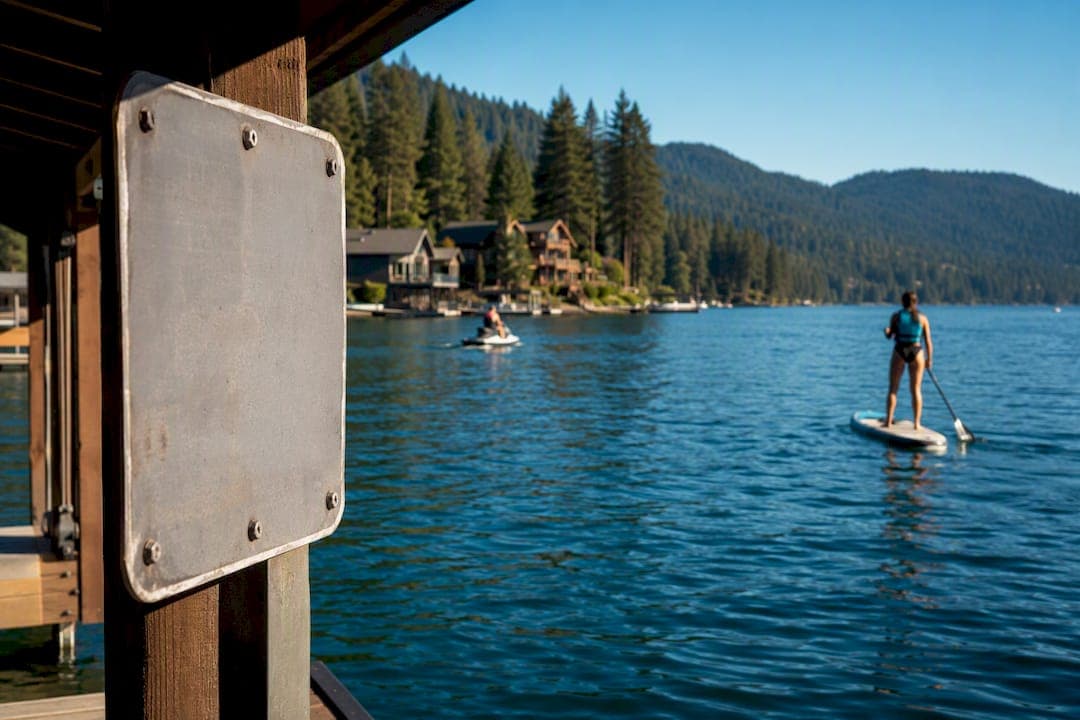
A no wake sign marks a stretch of water where boats must run at idle, or the slowest speed that still lets them steer, so they leave no real wake behind them. Buy a reflective aluminum sign, sized and worded to match your local rules, and mount it where approaching boats can actually see it. For most docks and private shorelines, that means .080 to .125 aluminum with 3M reflective sheeting in a 12x18 or larger format.
TL;DR:
- Larger signs, at least 12 by 18 inches, are necessary near shorelines and in channels to ensure readability at approach speeds.
- Proper placement involves signs every 150 to 200 feet on straight shores or before bends, with buoys marking the zone boundaries for better visibility.
- Purchasing from trusted vendors with clear details on reflectivity, material, size, and warranty ensures signs meet legal and durability standards.
- Routine season checkups for fading, corrosion, and hardware looseness are essential to keep signage effective and compliant year after year.
Table of Contents
- Best No Wake Signs and Buoy Markers Compared
- How to Pick the Right No-Wake Sign for Your Dock
- What "No Wake" Actually Means Under the Law
- Placing Signs and Buoys So Boaters Actually See Them
- Where to Buy No-Wake Signs Without Overpaying
- Keeping Your No-Wake Sign Compliant Season After Season
- Operator Perspective: Why Clear Signage Matters for Rentals and Neighbors
- Skip the Signage Headache: Rent Supervised Watercraft Instead
- Sources
- FAQ
Best No Wake Signs and Buoy Markers Compared
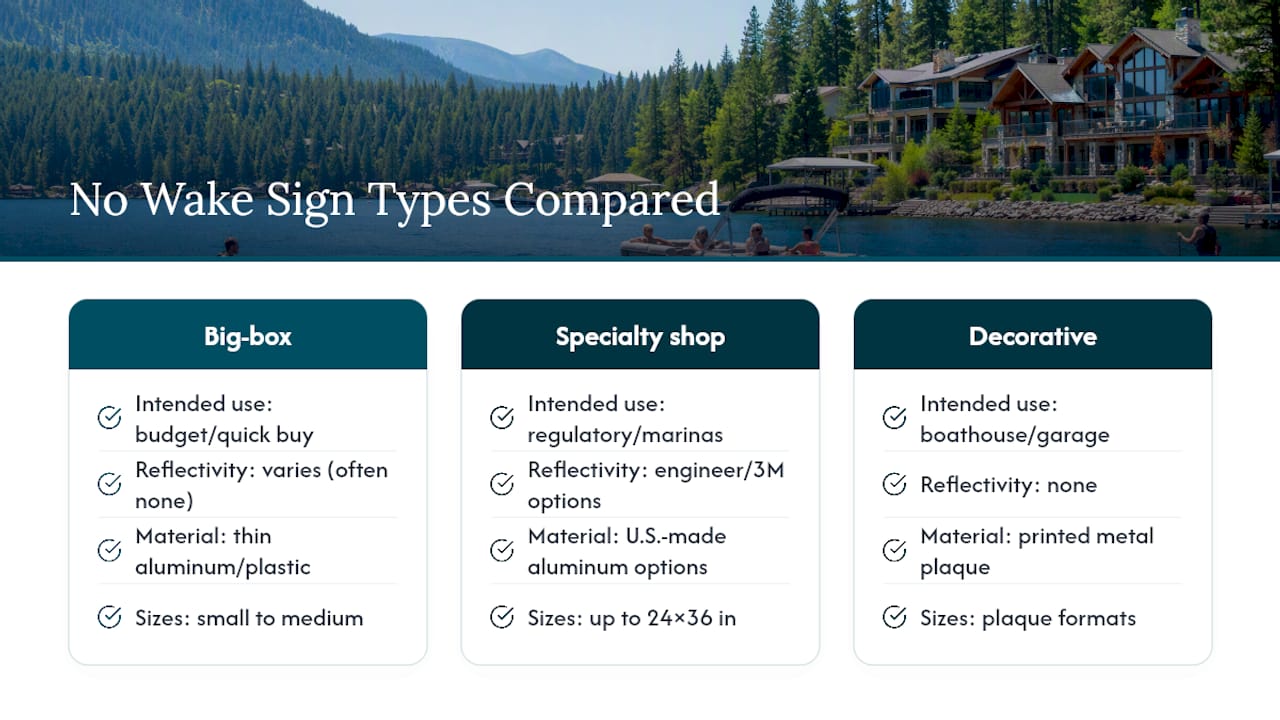
The market splits into three buckets: big-box marketplace signs, specialty sign-shop products, and decorative or novelty pieces meant for a garage wall rather than a shoreline. Knowing which bucket a product falls into saves you from mounting a $15 wall plaque where the state expects a regulatory marker.
For standard dock and shoreline reminder signage, the Municipal Supply & Sign Co Slow No Wake Sign hits common municipal specs and often ships with a multi-year warranty. The Joffreg Slow Down No Wake Zone Sign is built for private dock owners who want something reflective and easy to mount without shopping a specialty catalog. If you already have buoys in the water, the Tatuo Slow No Wake Buoy Decal is a waterproof label made to stick directly on an existing float rather than replace it.
Marinas and longer shorelines need more visible signage, which is where the Colingmill Slow No Wake Zone Sign earns its keep with sizes running up to 24x36 inches. For buyers who care about reflectivity grade specifically, the SmartSign No Wake Zone Sign uses 3M engineer-grade sheeting and offers a choice of substrates. The ComplianceSigns No Wake Zone Sign NHE-17062 goes further still, with U.S.-made aluminum, plastic, magnet, and label versions sold through its product page.
The CampgroundSigns No Wake Zone Signs line starts cheap, with small aluminum signs priced from around $28 to $35, which makes it the go-to when you need several signs for a campground shoreline. The Idle Speed No Wake Sign from Municipal Signs and Supply is a 36x48 reflective aluminum panel built to CG-6 style specs, the kind you see posted at channel entrances rather than tacked to a dock post. A No Wake Zone Idle Speed Sign adds a typical advisory some property owners prefer, even though the actual legal standard rarely hinges on a specific number.
Then there's the decorative tier: Vintage Metal Slow No Wake sign variants, the Vintage Metal Sign Slow No Wake, No Wake Zone Sign Wake Zones Slow Vintage Metal Aluminum Signs Posters, and the Slow No Wake Sign Home Wall Decor Aluminum Printed Plaque. These are fine for a boathouse wall or a garage, but they skip the reflective sheeting and hole spacing that make a sign readable at 200 feet after dark. If you need a buoy-mounted label instead of a full buoy, the Taylor Made Sur-Mark Buoy Label and a generic No Wake Zone Sign (SI-64426) fill that niche without the cost of a new buoy body.
How to Pick the Right No-Wake Sign for Your Dock
Buying the wrong sign usually means one of two mistakes: too thin to survive a season outdoors, or too small to read before a boat is already on top of it. Work through these criteria in order.
- Material and thickness. Stick with .080 to .125 aluminum. Anything thinner warps in a season of sun and lake spray, and plastic labels fade faster than most owners expect.
- Size and lettering height. A boat approaching at 15 mph covers ground fast. A 12x18 sign works for a close dock post; a channel entrance or marina approach needs 24x36 or larger so the wording is legible from a real distance.
- Reflective grade. 3M HIP or engineer-grade sheeting holds up to UV and abrasion far better than a printed, non-reflective panel, and it's the difference between a sign that reads at dusk and one that disappears.
- Mounting type. Pre-drilled holes suit post or piling mounts. Magnetic backing works for temporary placement on metal structures, and adhesive labels fit buoys or flat panels where drilling isn't an option.
Pro Tip: If your sign needs to double as an official marker with a permit number, order it with that number pre-printed rather than adding it later. A sign missing required permit information can be treated as unofficial and pulled by local authorities.
What "No Wake" Actually Means Under the Law
Regulatory markers in U.S. waters generally follow the Uniform State Waterway Marking System: an orange circle on a white background signals a controlled area, which includes speed and no-wake zones, while an orange diamond flags a hazard. Shore-mounted signs typically mirror that palette, white background, orange trim, black lettering, so boaters recognize them at a glance regardless of state.
The legal standard behind the wording is simpler than most boaters assume. A no-wake zone requires idle or steerage speed that produces no appreciable wake, and while 5 mph gets cited constantly as a rule of thumb, it isn't a universal statute. Enforcement typically comes down to the wake trailing the boat, not the number on a speedometer.
- Oregon's marine board, for example, applies slow-no-wake rules within 200 feet of certain docks, marinas, and floating homes, with violations carrying penalties.
- A sign or buoy that skips the official color, shape, or placement standard often isn't legally enforceable on its own.
- Before installing anything meant to carry legal weight, check with your county or state marine authority, not just the sign vendor's catalog.
Placing Signs and Buoys So Boaters Actually See Them
A single sign at the entrance to a cove rarely does the job on its own. Mark the start and end of a zone with either shore-mounted signs at eye level for a slow-moving boat, roughly 4 to 6 feet above the water line, or a line of buoys spaced so no gap lets a boater miss the zone.
- On a straight shoreline, one sign every 150 to 200 feet is a reasonable sightline for approach speeds.
- On a bendy channel, add a marker before the bend, not just after it, since that's where a boat is still on plane.
- Use buoy decals on existing floats for a quick fix; useful buoys or shore signs when you're marking a permanent, official zone.
- Check with your county or lake management authority before placing anything meant to function as an official marker, since unpermitted buoys can be removed.
Where to Buy No-Wake Signs Without Overpaying
Marketplace listings win on speed. Order from Amazon or a general retailer and a standard aluminum sign shows up in a few days, which works fine for a private dock reminder that doesn't need to be a legally recognized marker. Specialty sign shops and compliance vendors take longer but let you specify permit numbers, custom text, or a reflectivity grade the marketplace listing doesn't offer.
Before checkout, check the product page for four things: reflective grade (3M HIP or engineer-grade beats a generic "reflective" label), material thickness (.080 minimum for aluminum), hole pattern (does it match your mounting posts), and whether the vendor states a warranty. A ComplianceSigns product listing usually spells out substrate, size, and origin clearly, which is more than some marketplace listings bother to do.
- Confirm the size matches your approach distance, not just what looks good in a photo.
- Confirm substrate: aluminum for permanent posts, magnet or adhesive for temporary or curved surfaces.
- Confirm whether you need a permit number printed on the sign before it ships.
- Check for a stated warranty, since several vendors offer 3 to 5 years against fading and cracking.
Keeping Your No-Wake Sign Compliant Season After Season
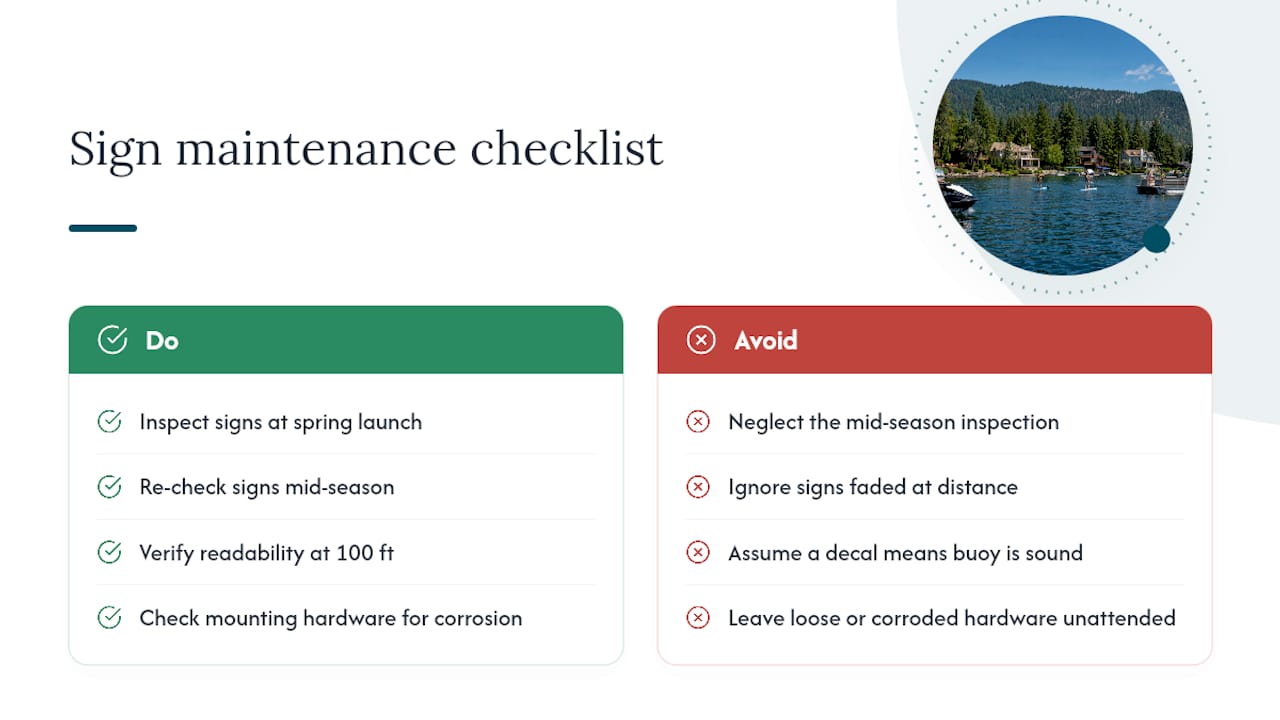
A reflective aluminum sign doesn't stay reflective forever. UV exposure fades sheeting over several seasons, and lake spray plus freeze-thaw cycles loosen mounting hardware faster than most owners check for it. Walk your signage at the start of each boating season and again mid-summer.
Look for three failure points: fading or delamination of the reflective layer, corrosion or looseness at the mounting holes, and physical damage from ice or debris over winter. A sign that's still legible up close but hard to read at 100 feet in daylight has likely lost enough reflectivity to fail its job at dusk, which is exactly when wake damage and near-misses spike.
For buoys and floating markers, check the anchor line and float integrity separately from the sign face itself. A decal can peel off a buoy that's otherwise fine, and a drifted buoy is worse than no marker at all since it teaches boaters to ignore the zone's actual boundary.
Most marina managers find a twice-yearly check, spring launch and mid-season, catches problems before they become liability issues. If a sign is meant to serve as an official marker with a permit number, note the inspection date somewhere you can reference it if a compliance question ever comes up.
Operator Perspective: Why Clear Signage Matters for Rentals and Neighbors
We brief every renter before launch, and we tell them to slow down before they see a marker, not after, because the biggest wake often forms during the drop off plane, not at cruising speed. Signage backs up that conversation. Property managers should run both: a visible sign and a five-second verbal reminder every time someone leaves the dock.
— Life is better on water.
Skip the Signage Headache: Rent Supervised Watercraft Instead
Managing your own no-wake signage means buying the right sign, permitting it correctly, and inspecting it twice a year, work most lake property owners never signed up for. A local rental service is the alternative for anyone looking for lake time without becoming a part-time compliance officer: rent a boat or personal watercraft that already comes briefed on local no-wake zones, with safety gear included and flexible hourly or multi-day booking.
A jet ski rental at Liberty Lake runs $250 to $425 for the day, with additional hours available at $75 per hour, and the same setup is available at Newman Lake if that's closer to home. If you'd rather cruise as a group, boat, paddleboard, and water toy rentals are booked the same way, no sign shopping, no permit calls, no spring inspection. Check availability and book your day on the water directly through the site.
Sources
- What is a No Wake Zone? | Discover Boating
- No-Wake Zones: Rules, Speed Limits, and Where They Apply | BestBoating
- Oregon State Marine Board: Wakes
- No Wake Zone Sign for Boating / Marine | ComplianceSigns
FAQ
What do no wake signs mean?
A no wake sign tells boaters to slow to idle speed, the slowest speed that still lets a boat steer, so the vessel leaves no appreciable wake behind it. The rule targets the wake itself, not a fixed number on a speedometer, according to Discover Boating.
How do you know when a no wake zone ends?
The zone ends at the next shore sign or buoy marking the boundary, so watch for a matching marker on the opposite side of the area rather than assuming a fixed distance. Some states, like Oregon, define proximity rules such as 200 feet from certain docks or marinas, which gives a rough sense of how zones are typically drawn.
What symbol is a no wake zone?
Regulatory markers use an orange circle on a white background to indicate a controlled area, which covers speed limits and no-wake zones under the Uniform State Waterway Marking System. Shore signs typically echo that scheme with orange borders and black lettering on white.
What is the no wake law in Michigan?
Michigan follows the same general standard as most states: vessels in a no-wake zone must run at idle or steerage speed producing no appreciable wake, with local sheriffs and marine patrols enforcing based on observed wake rather than a strict speed number. Always confirm specific distances and postings with your local county marine division before assuming a blanket rule applies.
Where can I buy a compliant no-wake sign?
Marketplace retailers and specialty vendors like ComplianceSigns and CampgroundSigns both sell reflective aluminum no-wake signs, with prices for small aluminum signs starting around $28 to $35 at CampgroundSigns. If you'd rather skip signage altogether and rent supervised watercraft instead, current pricing for Goldenwatersports rentals is listed on its booking page.