
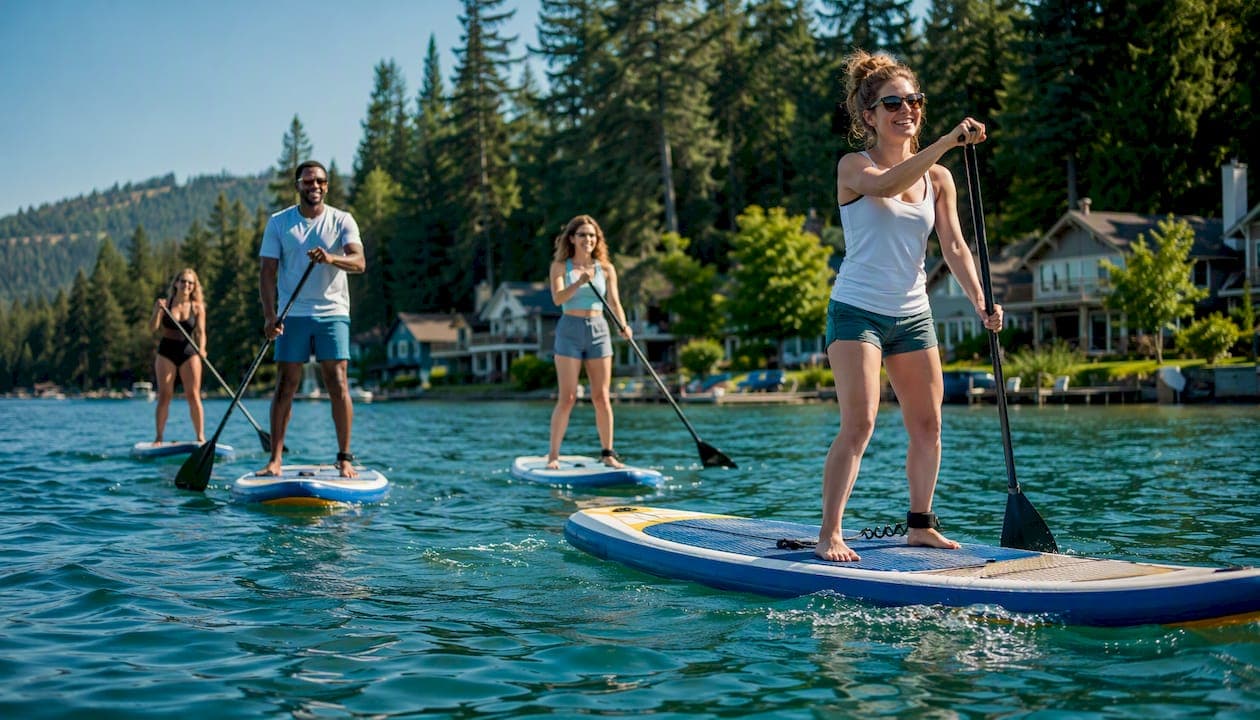
Most adult beginners do best on a board 10 to 11 feet long, 32 to 34 inches wide, and about 5 to 6 inches thick. That combination gives you enough volume to float comfortably, enough width to stay upright while you find your balance, and manageable handling for calm lakes and slow rivers. Adjust up in length or width if you're carrying gear, paddling with a dog, or a heavier rider. If you're not sure yet, rent before you buy.
TL;DR:
- Most beginners should choose a board between 10 to 11 feet long and 32 to 34 inches wide for an optimal balance of stability and maneuverability.
- Inflatable boards around 5 to 6 inches thick offer the best volume and stiffness for beginner use without feeling bulky underfoot.
- Boards over 11 feet six inches excel at tracking and distance but are harder to store and turn, making the 10 to 11-foot range preferable for most beginners.
- A board's volume should be roughly 1.5 times the rider's weight in pounds, with higher capacity recommended for paddling with gear, children, or dogs.
- Renting a 10 to 11 foot inflatable all-round board allows beginners to test different sizes and styles before committing to a purchase.
Table of Contents
- What Size Paddleboard Should a Beginner Get?
- How Does Board Length Affect Handling and Storage?
- Why Do Width and Thickness Matter So Much?
- Sizing by Weight and Height: A Few Real Examples
- Inflatable, Solid, or Something in Between?
- Buying Checklist and Mistakes to Avoid
- Getting the Paddle and Accessories Right
- Simple Rules for Your First Sessions
- Why We Recommend Renting a 10 to 11 Foot Inflatable First
- Try Before You Buy: Paddleboard Rentals at Golden Water Sports
- Sources
What Size Paddleboard Should a Beginner Get?
The 10 to 11 foot, 32 to 34 inch range shows up again and again in buying guides from paddleboard retailers, and for good reason: it's the sweet spot where stability and maneuverability meet. Go shorter and you sacrifice the float that keeps new paddlers dry. Go much longer and the board gets harder to turn, store, and strap to a roof rack.
Thickness matters just as much as length, even though it gets less attention. Most inflatable boards run 5 to 6 inches thick, which adds volume without making the board feel bulky underfoot. A thin board might look sleek, but a beginner standing on one will notice it flexes and dips with every shift in weight.
Here's a starting chart based on rider weight. Treat it as a baseline, not gospel. Your paddling location, whether you carry gear, and how confident you feel on unstable surfaces all shift the numbers.
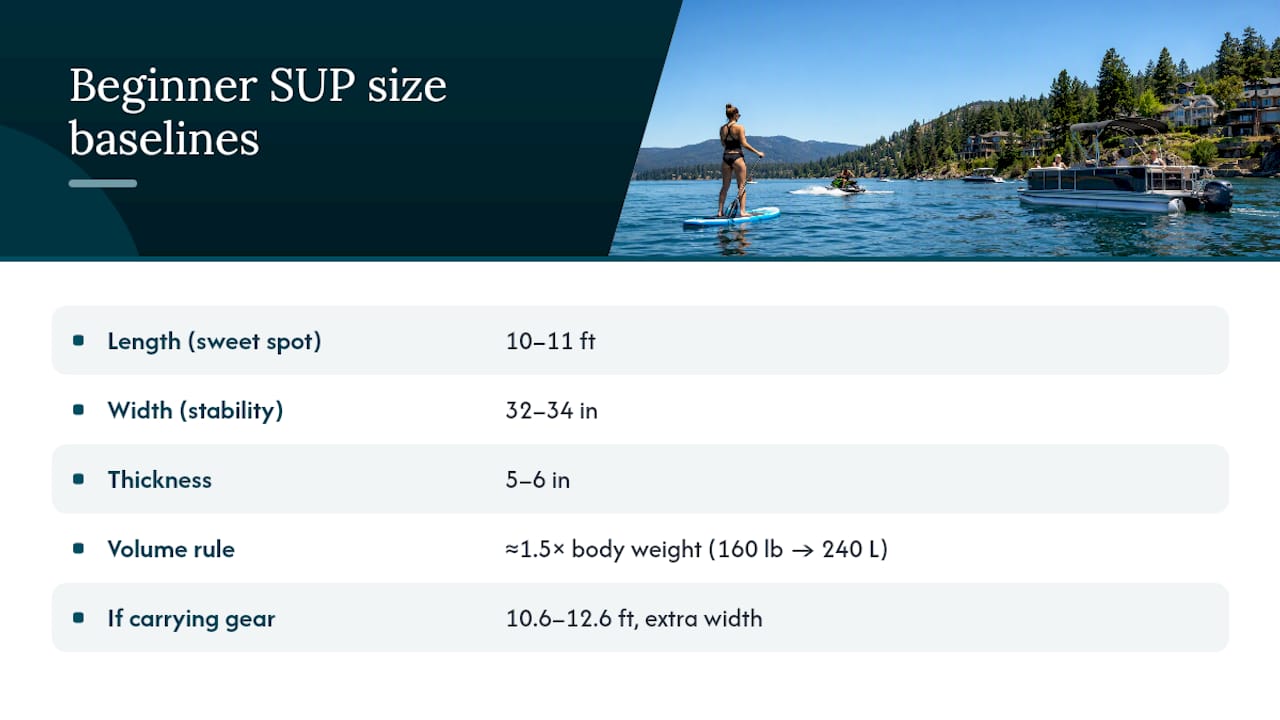
A useful rule of thumb: aim for board volume roughly equal to 1.5 times your body weight in pounds. If you weigh 160 pounds, you're looking for a board rated around 240 liters of volume as a comfortable starting point, not a bare minimum. Manufacturers list a maximum weight capacity on every board, and beginners should stay well under that number rather than treating it as a target. A board rated for 250 pounds isn't the right pick for a 240 pound paddler who's still finding their balance.
If you plan to bring a dog, a kid, or a cooler and dry bag, bump both length and width up a notch. The 10.6 to 12.6 foot range with extra width handles the added, shifting weight far better than a board sized only for your own body.
How Does Board Length Affect Handling and Storage?
Length is the single biggest factor in how a board feels on the water, and it's also the one beginners most often get wrong.
- Boards under 10 feet are nimble and quick to turn, which makes them popular for surf-style SUP, but they're twitchy underfoot and less forgiving for someone still learning to balance.
- Boards in the 10 to 11 foot range hit the beginner sweet spot: enough length to track in a reasonably straight line, enough stability to build confidence, and still short enough to carry solo.
- Boards over 11'6", often called touring boards, glide farther per paddle stroke and hold a straight line better, which matters if you're covering distance or hauling gear. The tradeoff is a longer, heavier board that's harder to turn and awkward to store in a garage or car.
Length, width, and thickness together determine a board's volume and weight capacity, and longer boards generally track straighter and move faster through the water, while shorter boards turn more easily. For a first board, that tradeoff usually favors the 10 to 11 foot range unless you already know you want to cover long distances.
Storage is the practical detail people forget until moving day. An 11'6" solid board needs wall space, padded racks, or a dedicated corner of the garage. An inflatable in the same length range rolls down to the size of a duffel bag, which is one more reason inflatables dominate the beginner market.
Why Do Width and Thickness Matter So Much?
Width does more work than most first-time buyers realize. A 32 to 34 inch wide board gives you a stable platform without forcing your shoulders and paddle stroke wider than they need to be.
- Narrower boards (28 to 31 in) reward good balance with speed and glide, but they punish wobbly beginners.
- Standard beginner width (32 to 34 in) balances stability with a paddle stroke that still reaches the water efficiently.
- Extra-wide boards (35 in and up) feel like a dock underfoot, which sounds ideal until you realize your paddle now has to reach farther out to clear the rails, making every stroke less efficient.
That last point trips up a lot of newcomers. Going wider than 34 inches doesn't just add stability. It also changes your stroke mechanics, and a paddle that has to angle out around a wide hull wastes energy with every pull. Beginners often assume the widest board is automatically the safest choice, when in practice a modest width increase, not a dramatic one, solves most stability concerns without sacrificing stroke efficiency.
Nine out of ten beginner-recommended boards across major sizing guides land in the 32 to 34 inch width window, which tells you how narrow the real consensus is despite the wide range of boards on the market.
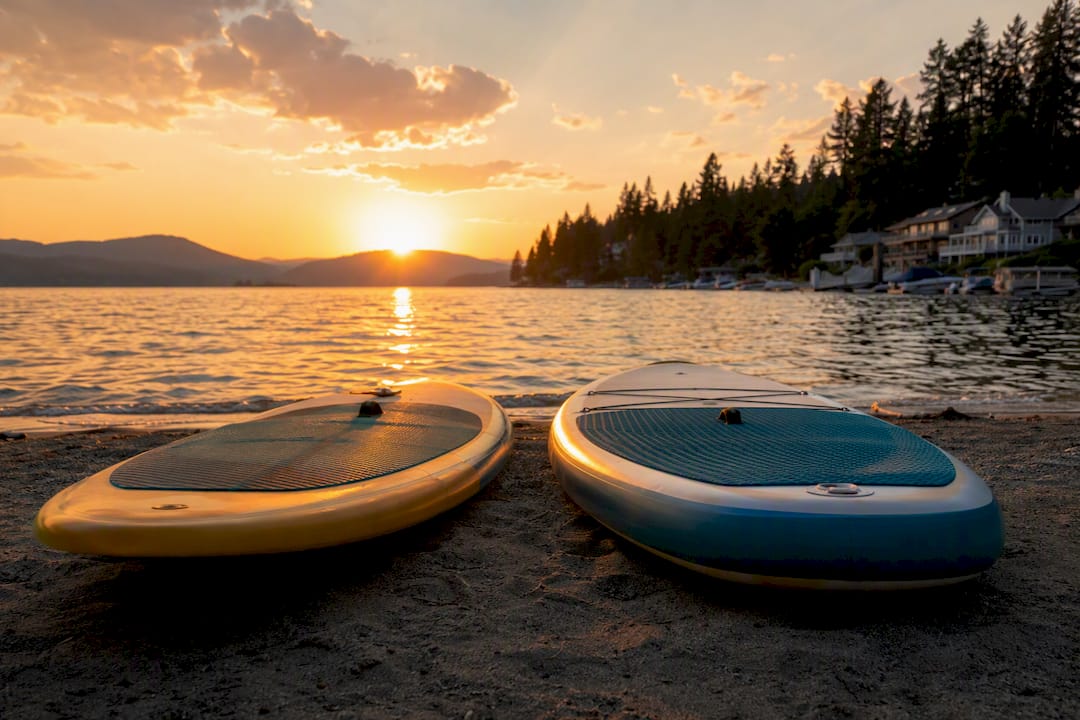
Thickness works alongside width to build volume. A 6 inch thick board holds more air (or more foam, on a solid board) than a 4.5 inch board of the same length and width, which translates directly into how much weight it floats and how stiff it feels underfoot. If you want to add yoga, fishing, or a second rider to the mix, prioritize width and thickness together over adding more length.
Sizing by Weight and Height: A Few Real Examples
Charts help, but seeing how the numbers apply to actual bodies makes the decision easier.
A light adult under 125 pounds can comfortably ride a 9'6" to 10'6" board at 30 to 31 inches wide. There's no need to size up just because most "beginner" boards default to 10'6"; a smaller board at this weight still floats plenty of volume and turns more easily.
An average adult at 150 to 180 pounds, which covers a huge share of first-time buyers, fits the classic 10'6" board well. A 10.6 foot board balances stability, glide, and manageable handling better than almost any other single length for this weight range, which is why it shows up so often as the default recommendation in buying guides.
A heavier or taller adult over 200 pounds should look at 11 to 11'6" boards with width at the upper end of 33 to 34 inches. Stepping up to 11.6 feet also improves the board's ability to carry distance and extra load, which matters if a longer paddle session or gear is part of the plan.
For tandem paddling, or paddling with a dog and a dry bag, treat the combined weight, not just your own, as the number that drives sizing. A 200 pound paddler with a 60 pound dog needs a board rated well above 260 pounds of capacity, not one sized to the person alone.
| Scenario | Combined Weight | Suggested Board |
|---|---|---|
| Light adult solo | Under 125 lbs | 9'6"–10'6", 30–31 in wide |
| Average adult solo | 150–180 lbs | 10'6", 32–33 in wide |
| Heavier or taller adult | 200+ lbs | 11'–11'6", 33–34 in wide |
| Adult with dog or child | well above 260 lbs combined | 10'6"–12'6", 33–35 in wide |
Stay 50 to 75 pounds under a board's stated maximum capacity rather than sizing to the exact limit. That margin isn't just about safety in rough water. It's about how the board handles day to day: a board pushed near its max capacity sits lower and feels sluggish, which is the opposite of what a beginner needs while learning balance. Height mostly matters for your center of gravity and paddle length rather than board choice itself. A tall paddler on a short, narrow board will feel top-heavy faster than a shorter paddler on the same setup.
Inflatable, Solid, or Something in Between?
Inflatable all-round boards are the default recommendation for most beginners, and for reasons that go beyond convenience. Inflatable SUPs are commonly recommended for new paddlers because they're portable, more affordable than solid boards of comparable size, and far more forgiving when they bump a dock or a rock.
- Inflatables roll up small enough for a car trunk or closet, cost less than solid boards at the same size, and shrug off minor impacts that would ding or crack a hard shell.
- Solid (hard) boards flex less, respond faster to paddle strokes, and generally perform better for surfing or racing, but they need dedicated storage, a roof rack or truck bed to transport, and a bigger upfront budget.
- All-round hulls, flat and wide with a rounded nose, are the standard beginner shape, built for stability on flat water rather than speed.
- Touring hulls, with a pointed nose that slices through water, favor distance and straight-line tracking over easy turning.
- Surf-style hulls, shorter with more rocker (upward curve at the nose), turn quickly in waves but sacrifice the flat-water stability beginners need most.
Pro Tip: If you're torn between an inflatable and a solid board for your first purchase, rent an inflatable all-round board for a full season before buying anything. It tells you whether you'll actually use it often enough to justify a solid board's higher cost and storage demands.
For nearly every beginner, an inflatable all-round board is the right starting category. It matches the forgiving learning curve new paddlers need with a price and storage footprint that makes sense before you know how often you'll actually get out on the water.
Buying Checklist and Mistakes to Avoid
Whether you're renting for an afternoon or buying your first board, a few checks separate a good day on the water from a frustrating one.
- Confirm the weight capacity and volume rating, not just the length, since two boards of the same length can carry very different loads.
- Check the thickness and stiffness, especially on inflatables, since a properly inflated board (usually 12 to 15 PSI) feels noticeably firmer underfoot than an underinflated one.
- Look at the fin setup. A single large fin suits flat water and beginners; multi-fin setups favor surf conditions.
- Test-carry the board before committing, particularly if you're buying solid rather than inflatable, since a heavy board you can't comfortably carry to the water defeats the purpose.
- Confirm what's included, since a paddle, leash, and pump (for inflatables) aren't always bundled with the board itself.
The most common mistake is choosing the widest board available on the assumption that wider always means safer. As covered above, that often just makes the paddle stroke less efficient without adding meaningful stability. A close second mistake: ignoring the paddle entirely and grabbing whatever's on the rack, which brings us to sizing that piece of gear correctly.
If you're still unsure between two sizes, renting multiple boards on calm water before buying is the fastest way to feel the difference in stability and glide firsthand, rather than guessing from a spec sheet.
Getting the Paddle and Accessories Right
A paddle sized wrong will tire you out faster than almost any board mismatch. For flatwater paddling, the paddle should extend 8 to 10 inches above your head while you're standing on the board. That length keeps your stroke closer to vertical, which reduces the torso twisting that causes fatigue and wobble in new paddlers. Surf paddling calls for a slightly shorter paddle to match a lower, more athletic stance.
Beyond the board and paddle, a handful of accessories make a real difference for beginners:
- Ankle or calf leash, so the board doesn't drift away the first time you fall
- A properly fitted PFD, required in most locations and simply smart on open water
- A pump, for inflating and topping off an inflatable board before each session
- Carry straps or a handle, since dragging a board by its rails gets old fast
- A textured deck pad, which keeps bare or wet feet from sliding during your stroke
Simple Rules for Your First Sessions
Your first outings go smoother if you stack the conditions in your favor rather than fighting them.
- Pick a calm, wind-free morning and a protected launch spot, away from boat traffic and chop.
- Start on your knees to find the board's balance point, then stand up slowly with feet shoulder-width apart and eyes on the horizon, not your feet.
- Wear your leash and PFD every time, even on a calm pond.
- Know how to climb back on from the water before you paddle out past wading depth.
Pro Tip: If you tip over, swim to the center of the board and pull yourself up sideways rather than trying to climb over the nose or tail. It's far more stable and saves your arms.
Why We Recommend Renting a 10 to 11 Foot Inflatable First
Most people who walk into a rental shop asking for size advice end up on a 10 to 11 foot inflatable, and it's not because that's the only option on the rack. It's because that range absorbs the most common beginner mistakes: standing too far forward, paddling with poor stroke technique, or misjudging how wind affects a lightweight board. A slightly forgiving size covers for those errors while you're still learning.
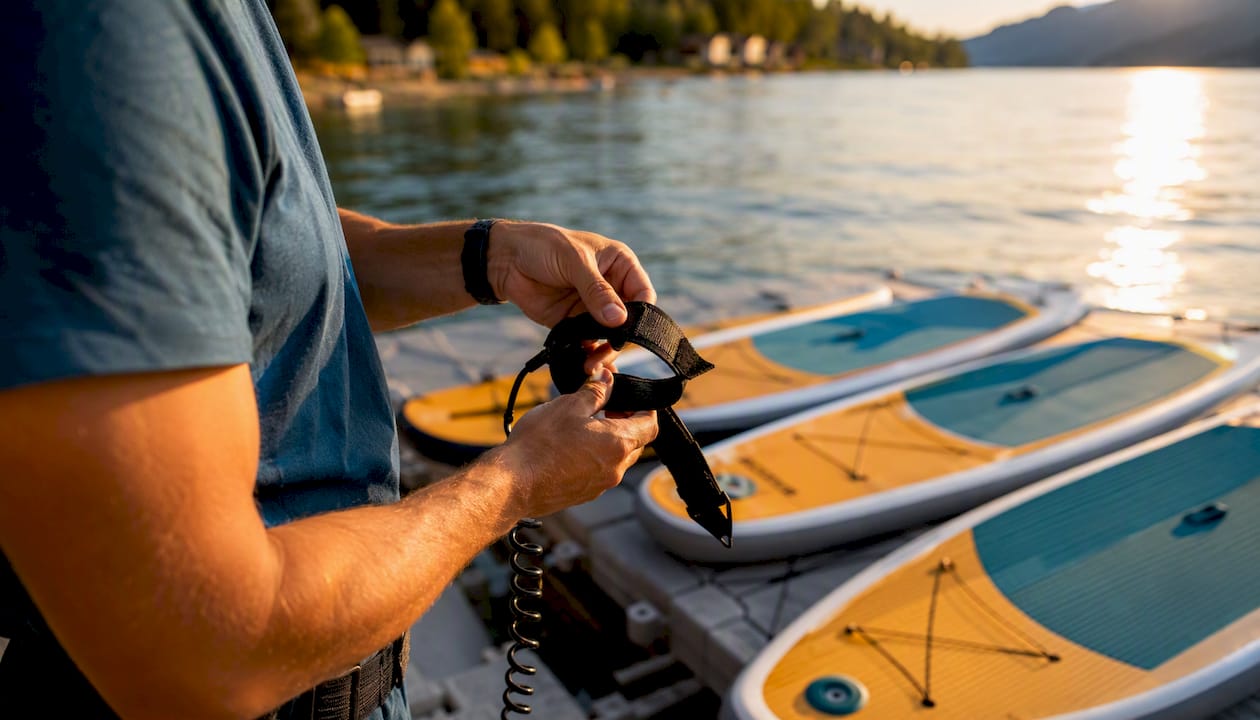
Rental staff also do something a spec sheet can't: they watch how you carry yourself on the dock and adjust your paddle length on the spot, or point you toward a wider board if you mention paddling with a dog or a kid. That kind of real-time feedback is worth more than another hour reading comparisons of board dimensions.
If you have the chance, rent two different sizes on the same calm day. The difference in how they turn and glide will teach you more about your own preferences than any chart can.
— Life is better on water.
Try Before You Buy: Paddleboard Rentals at Golden Water Sports
Renting a board before you buy is the fastest way to skip the guesswork this guide just walked through, and it costs a fraction of what a wrong purchase does. Golden Water Sports stocks beginner-friendly inflatable all-round paddleboards in the 10 to 11 foot range that this guide recommends, each one set up with a properly sized paddle, a leash, and a PFD included.
Our team on the water near Coeur d'Alene and Liberty Lake will size your paddle to your height and point you toward a wider board if you're bringing a kid or a dog along, the same kind of hands-on adjustment described above. Rentals run flexible hourly and multi-day options, so you're not locked into a single afternoon if you want to compare how a 10 foot board feels against an 11 foot one on the same trip. Every rental includes a quick safety briefing before you launch, covering re-boarding and basic handling if you're new to it. Check current pricing and availability or browse our local pickup details on Liberty Lake to book your session and find the size that actually fits you, not just the one you guessed at online.
Sources
For deeper detail on the numbers covered here, the REI paddleboard buying guide breaks down how length, width, and thickness interact. PumpedUpSUP's sizing guide offers a closer look at weight-based charts, and Paddlesesh's buying guide explains the volume-to-weight rule of thumb in more depth. For regional context on where certain sizes get used most, this Panama City Beach paddleboarding guide is worth a look.
- Paddle Board (SUP) Buying Guide
- What Size SUP Board Is Right For You? - 2026 Update
- How to Choose a Stand-Up Paddleboard (2026 Guide)
- Stand-Up Paddleboard Buying Guide: Board Sizes, Lengths & Types