
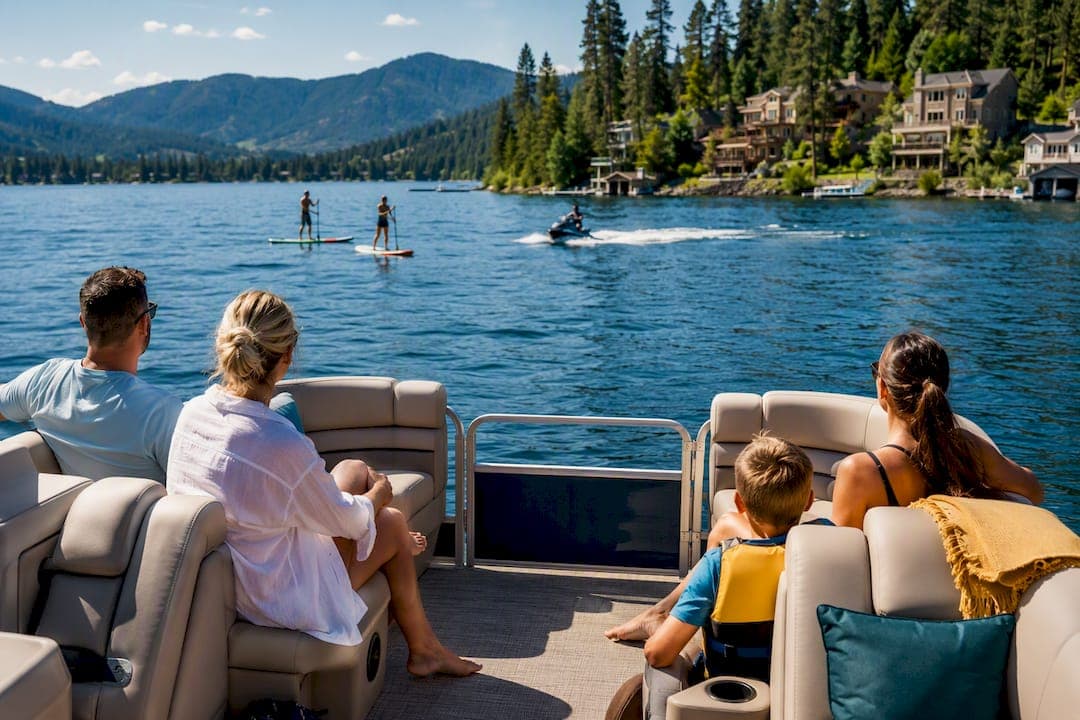
Most pontoons in the 16 to 19 foot range carry 6 to 8 people, 20 to 22 footers handle 9 to 13, and 23 to 28 foot models seat 12 to 16 or more. Those numbers shift with tube configuration and options, so the real answer always lives on the boat's capacity plate. Every builder rates capacity using the U.S.
TL;DR:
- Capacity varies significantly based on tube configuration, deck layout, and engine weight, even within the same length band.
- The US Coast Guard formula provides a safe passenger estimate by multiplying boat dimensions and dividing by 15, then rounding down.
- Payload capacity includes gear, fuel, and equipment, and should be limited to 80 percent of the rated capacity to maintain safety and stability.
- Different boat designs, such as tritoons and wider beams, can support more weight and passengers without increasing boat length.
- Rental companies enforce capacity limits strictly, requiring accurate headcount, life jacket counts, and awareness of gear weight before departure.
Table of Contents
- Pontoon Boat Capacity by Length: A Quick-Reference Table
- How to Calculate Pontoon Capacity Without a Plate
- Weight, Payload, and the 80% Safety Rule
- What Changes Pontoon Capacity Beyond Length
- Planning a Group Outing: What to Check Before You Book
- Golden Water Sports' Take: Enforcing Capacity Isn't Optional
- Book the Right Size Pontoon With Golden Water Sports
- Sources
Pontoon Boat Capacity by Length: A Quick-Reference Table
Pontoon boat capacity isn't a single number you can memorize and apply across every boat you step onto. Two 22 foot pontoons from different builders can carry noticeably different loads depending on tube diameter, deck framing, and how the manufacturer configured seating. Still, length bands give you a solid starting point for matching a boat to your guest list before you ever check a specific plate.
Here's how typical maximum passenger counts and payload capacity break down across the sizes most rental fleets and private owners run:
| Length Band | Typical Max Persons | Typical Max Payload | Example/Note |
|---|---|---|---|
| 16–19 ft | 6–8 | 1,300–1,800 lbs | Entry-level twin-tube models, common for small family outings |
| 20–22 ft | 9–13 | 1,800–2,600 lbs | Most popular rental size; dry weight often 2,000–3,000 lbs |
| 23–28 ft | 12–16+ | 2,600–3,600 lbs | Larger decks, often available with tritoon upgrades |
| 28 ft+ | 15–18+ | 3,500 pounds or more | Party and cruiser-class layouts, frequently tritoon-only |
These ranges line up with the pontoon capacity tables published by boat weight calculators, which also note that most pontoons weigh between 2,000 and 3,000 pounds dry before you add fuel, passengers, or gear. A 24 foot pontoon sits right in the middle of that spread, and depending on the manufacturer, its dry weight can range from 2,000 to 3,500 pounds with passenger capacity landing anywhere from 8 to 12 people.
Manufacturer specs make the variation obvious. Princecraft's Quorum 23 RL, for instance, lists NMMA-approved capacity figures that shift between 9 and 12 persons depending on the exact configuration and engine package chosen. A 23 foot boat isn't a fixed number. It's a range that depends on what's actually bolted to the deck.
A few things push these numbers up or down within a length band:
- Tube count and diameter. A tritoon with a third center tube generally out-carries a twin-tube boat of the same length.
- Deck and furniture packages. Heavier lounge seating, wet bars, or Bimini tops eat into payload that would otherwise go to passengers.
- Engine size. A bigger outboard adds weight at the transom, which reduces the payload left over for people and gear.
- Certification standard. Boats sold under NMMA certification sometimes carry different published numbers than a builder's internal spec sheet for the same hull.
If you're comparing rental options for a bigger group, it's worth reading through why pontoon boats suit large groups on the lake before you settle on a length. The right size often comes down to how many people you're bringing plus how much gear, not just a headcount.
How to Calculate Pontoon Capacity Without a Plate
Every pontoon built for sale in the United States has to display a capacity plate near the helm, and that plate is the final word on how many people and how much weight the boat can legally carry. But older boats, some private sales, or boats where the plate has worn off leave you without that reference. That's where the U.S. Coast Guard's fallback formula comes in.
Here's how to use it:
- Measure length and width. Take the boat's total length and its beam (width) in feet, both measured at their widest points.
- Multiply length by width. For a 20 foot pontoon that's 8 feet wide, that's 20 × 8 = 160.
- Divide by 15. That gives you 160 ÷ 15 = 10.66.
- Round down. Never round up on a safety calculation. Your safe passenger estimate is 10 people, not 11.
Pro Tip: Always round down when applying the USCG formula, even if the decimal is close to the next whole number. That extra 0.66 of a person isn't a rounding error you can absorb once gear and fuel are on board.
Once you know your passenger limit, convert it to a weight figure by multiplying by 150 pounds, the standard average adult weight the Coast Guard uses for these calculations. Ten persons at 150 pounds each comes out to 1,500 pounds of passenger weight, which you then compare against the boat's rated payload capacity. If your passenger count times 150 pounds already exceeds the payload rating, the weight limit becomes your binding constraint, not the headcount.
Online pontoon weight calculators automate this by taking the minimum of three separate numbers: theoretical buoyancy based on tube diameter and displacement, the capacity plate's weight limit, and the capacity plate's person limit. Whichever number is smallest wins. According to the methodology behind these safe-load calculators, that's intentional. The plate is designed to be the binding constraint for legal and safe operation, not a theoretical ceiling you can push past because the math on paper looks more generous. If you can't find a plate at all, the safest move is contacting the manufacturer or a marine surveyor rather than estimating your way into a guess.
Weight, Payload, and the 80% Safety Rule
Passenger count and payload capacity are two different numbers, and confusing them is how boats get overloaded even when everyone did the headcount math correctly. Payload is the total weight your pontoon can safely carry beyond its own hull weight, and that figure has to cover a lot more than just the people standing on deck.
Before you load passengers, payload has to account for:
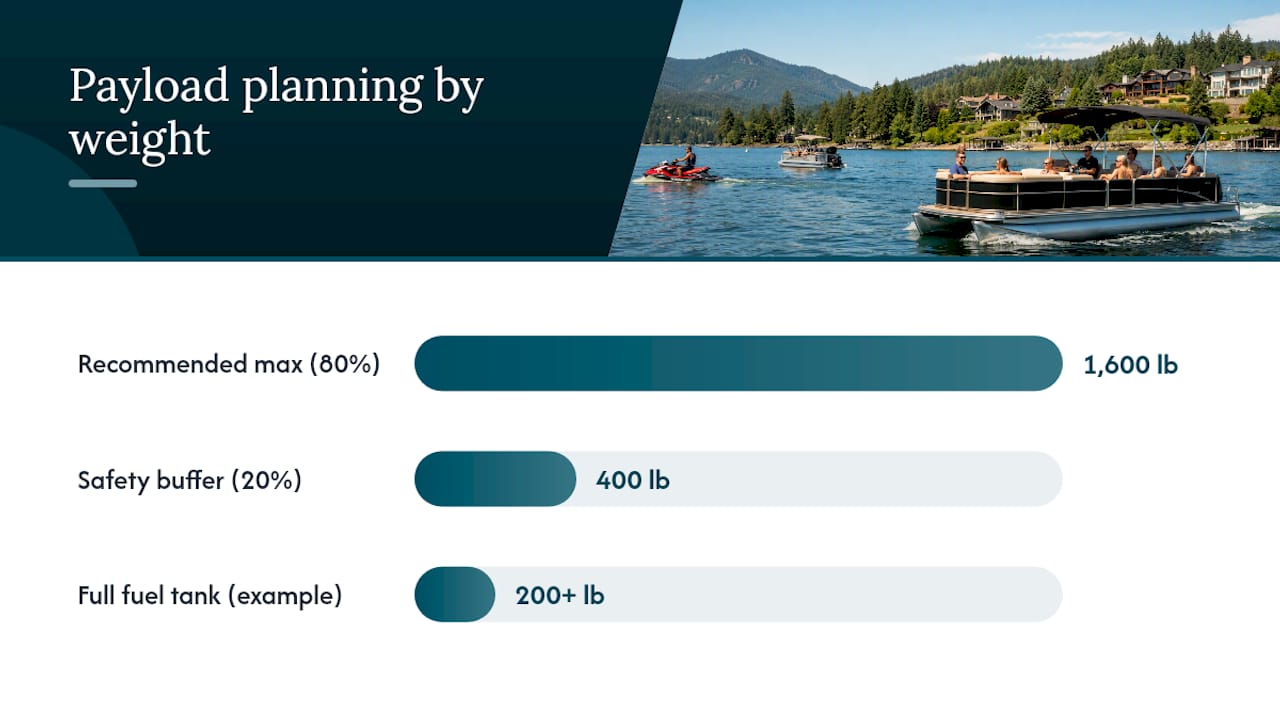
- Fuel (a full tank on a larger pontoon can weigh 200 pounds or more)
- The outboard engine itself, if it's not already factored into the base hull weight
- Coolers, food, and drinks for the day
- Water toys, tubes, wakeboards, and paddleboards
- Anchors, ropes, and safety gear
Say your pontoon's capacity plate rates it for 2,000 pounds of total payload. That 20% buffer isn't overcaution for its own sake. It's there to preserve freeboard and stability when waves roll in, passengers shift position, or someone stands up to grab a drink cooler. Boating industry guidance consistently points to this 80% threshold as the number experienced operators plan around rather than treating the plate's max rating as a target to hit.
Weight distribution matters as much as the total. A pontoon loaded correctly on paper can still handle poorly if everyone clusters on one side to watch a wake boarder or crowds the bow for photos. Uneven loading tips the deck, reduces maneuverability, and in choppy water can let water splash over the low side. Spread passengers across the deck, keep the heaviest gear low and centered, and ask standing passengers to sit once you're underway rather than moving around while the boat is in motion.
What Changes Pontoon Capacity Beyond Length
Two pontoons at the same length can have meaningfully different capacity ratings, and the reason almost always traces back to how the tubes and deck are built rather than anything about the deck's footprint.
- Tube diameter and count. A tritoon, which runs a third tube down the center, typically adds somewhere between one and four persons of capacity compared to a twin-tube boat of the same length, according to manufacturer brochure data on tritoon configurations. That third tube adds buoyancy without adding deck length, which is why tritoons dominate the higher end of most capacity charts.
- Beam width. A wider deck spreads weight over a larger footprint, which factors directly into the length times width formula and generally raises the theoretical maximum.
- Seating layout. Manufacturer-rated capacity assumes a specific seating arrangement. A custom layout with extra lounge furniture might look roomier but can carry fewer rated passengers because the furniture itself eats into payload.
- Engine weight. A 150 horsepower outboard weighs considerably more than a 60 horsepower model, and that difference comes directly out of the payload available for people and gear.
If you're trying to understand how tube shape and diameter actually affect displacement, how to measure the draft of a boat is a useful primer on how hull geometry translates into how much weight a hull can support before it sits too low in the water. For readers weighing deck layout against seating comfort, the pontoon boat deck layout planning guide breaks down how manufacturers balance comfortable capacity against rated capacity.
Planning a Group Outing: What to Check Before You Book
Matching a pontoon to your guest list takes more than picking the biggest boat available. A few questions before you book save you from showing up with more people than the boat, or the rental company's policy, actually allows.
- Ask for a photo of the capacity plate. A reputable rental company should show you this without hesitation. It's the single most reliable number you'll get.
- Confirm life jacket counts and sizes. A boat rated for 12 people needs 12 properly sized life jackets on board, including child sizes if kids are coming.
- Ask about the fuel policy and typical tank weight. This affects how much of the rated payload is actually available for your group and gear.
- Estimate your gear weight honestly. Coolers, tubes, and paddleboards add up faster than most groups expect.
- Consider a tritoon if your group is large or gear-heavy. The extra buoyancy gives you a real margin instead of loading right up to the line.
For groups planning a full day on the water with tubing or water toys included, the pontoon tubing safe ride checklist covers what else to check before towing anyone behind the boat.
Golden Water Sports' Take: Enforcing Capacity Isn't Optional
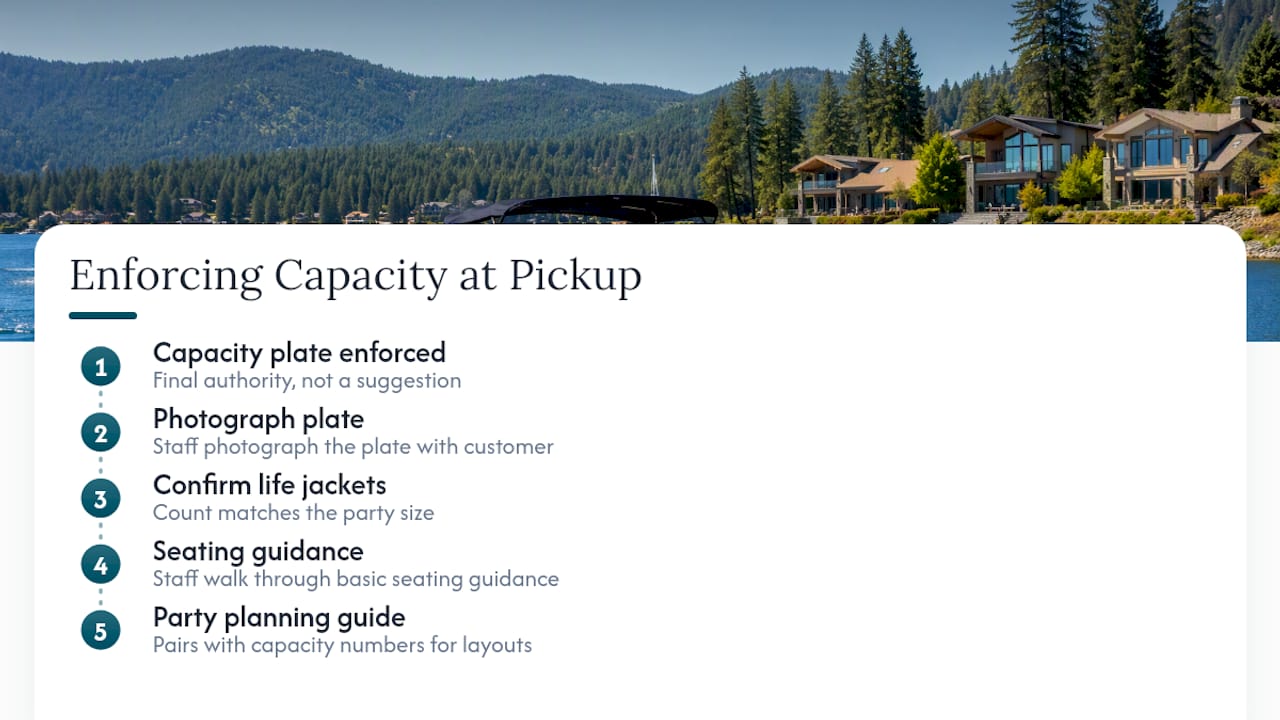
Golden Water Sports treats the capacity plate as the final word, not a suggestion, every time a pontoon leaves the dock. At pickup, staff photograph the plate with the customer, confirm life jacket counts match the party size, and walk through basic seating guidance before anyone boards. That handoff routine exists because the gap between "technically rated for 12" and "comfortable and safe with 12" is where most overloading mistakes happen.
Groups planning a party layout or deciding between deck configurations can find more detail in the pontoon party planning guide, which pairs well with the capacity numbers covered here.
— Life is better on water.
Book the Right Size Pontoon With Golden Water Sports
Pontoon rentals are available across various sizes, and the rental team can assist in matching a boat to your guest list and gear plans to help with your selection. Tell staff how many people are coming, whether you're planning to tube or swim, and how much cooler and toy weight you're bringing, and they'll point you toward a size that carries your group with real margin to spare.
Before you book, gather four things: your headcount, planned activities, gear list, and preferred date. That's everything Golden Water Sports needs to recommend the right boat and confirm availability. Check current pontoon rental prices and availability to reserve a boat sized correctly for your day on the water, whether that's a quiet afternoon near Liberty Lake or a full group outing on Coeur d'Alene.
Sources
- How Many People Can Fit On A Pontoon Boat? - J.D. Power
- Pontoon Weight Capacity Calculator - Determine Your Safe Load
- 2024 JC TriToon Marine Pontoon Boats Brochure - JC Pontoon