
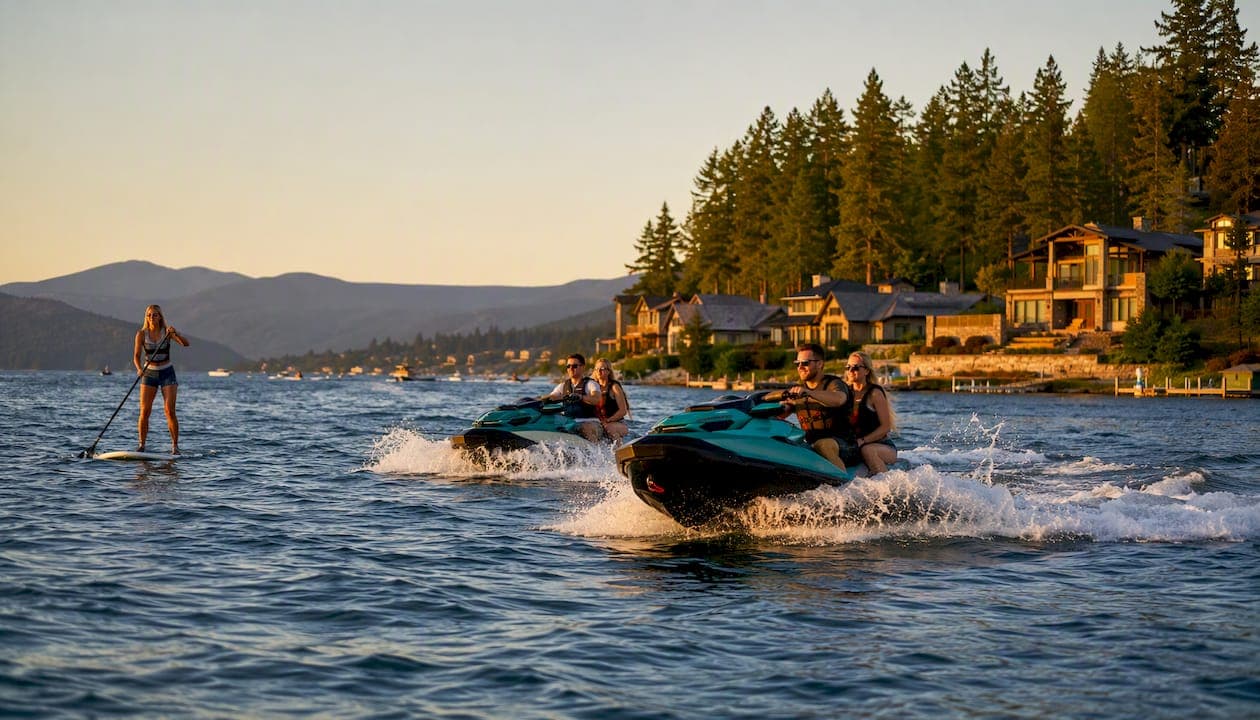
Wind is the single biggest environmental factor in water-sports safety, and it works through three variables you can check in under a minute: speed, gusts, and direction. Get those three right and you can make a solid go or no-go call before you ever touch the water.
Here's the simple version. Calm to light wind with no advisory in effect is generally considered a go for most craft and skill levels. Moderate wind or any noticeable gusting means caution, slower speeds, and a shorter range from shore. Strong, gusty, or offshore wind, especially when a Small Craft Advisory is active, is a no-go regardless of confidence level.
Before you load the truck or grab a paddle, do three things:
- Check the marine or local wind forecast, including the gust number, not just the sustained speed.
- Check wind direction relative to your launch point. Offshore wind pushes you away from safety.
- Decide using the go/caution/no-go rule above, and tell someone your plan if you're heading out solo.
Small Craft Advisories issued by the National Weather Service are a hard line, not a suggestion. When one is active, kayaks, paddleboards, and small rented craft are expected to stay ashore, because conditions have already crossed the threshold where these vessels lose reliable handling.
Key Takeaways
Wind speed, gusts, and direction together determine whether a water-sports outing is safe, and checking all three before launch prevents most on-water emergencies.
| Point | Details |
|---|---|
| Check three variables | Sustained wind speed, gust speed, and wind direction all need checking before every launch. |
| Respect the advisory | A Small Craft Advisory is a hard no-go for kayaks, paddleboards, and small rental craft. |
| Watch the gust delta | If gusts run significantly higher than sustained wind, it is advisable to downgrade your go-decision by one category. |
| Offshore wind is the danger zone | Offshore wind pushes you away from shore faster than most paddlers can compensate. |
| Golden Water Sports briefs every renter | Staff review the day's wind conditions at check-in and provide leash-equipped SUPs and fitted life jackets with every rental. |
Table of Contents
- What Role Does Wind Play in Water Sports Safety?
- What Wind Speed Is Safe for Each Water Sport?
- How Do You Read a Marine Forecast Before Heading Out?
- What Should You Check Before Launching Into Windy Conditions?
- What Do You Do if Wind Picks Up While You're Already Out?
- What Do Experienced Water-Sports Instructors Say About Wind Risk?
- What Golden Water Sports Tells Every Renter About Wind
- How Golden Water Sports Keeps Your Day on the Water Safer
- Where to Check Wind and Marine Conditions Before You Go
- Frequently Asked Questions
- Sources
What Role Does Wind Play in Water Sports Safety?
Wind changes the water itself and changes how your craft behaves on it, and both effects stack the moment speed picks up. Understanding the mechanics behind that is what separates a rider who reads a forecast number and reacts correctly from one who just gets surprised.
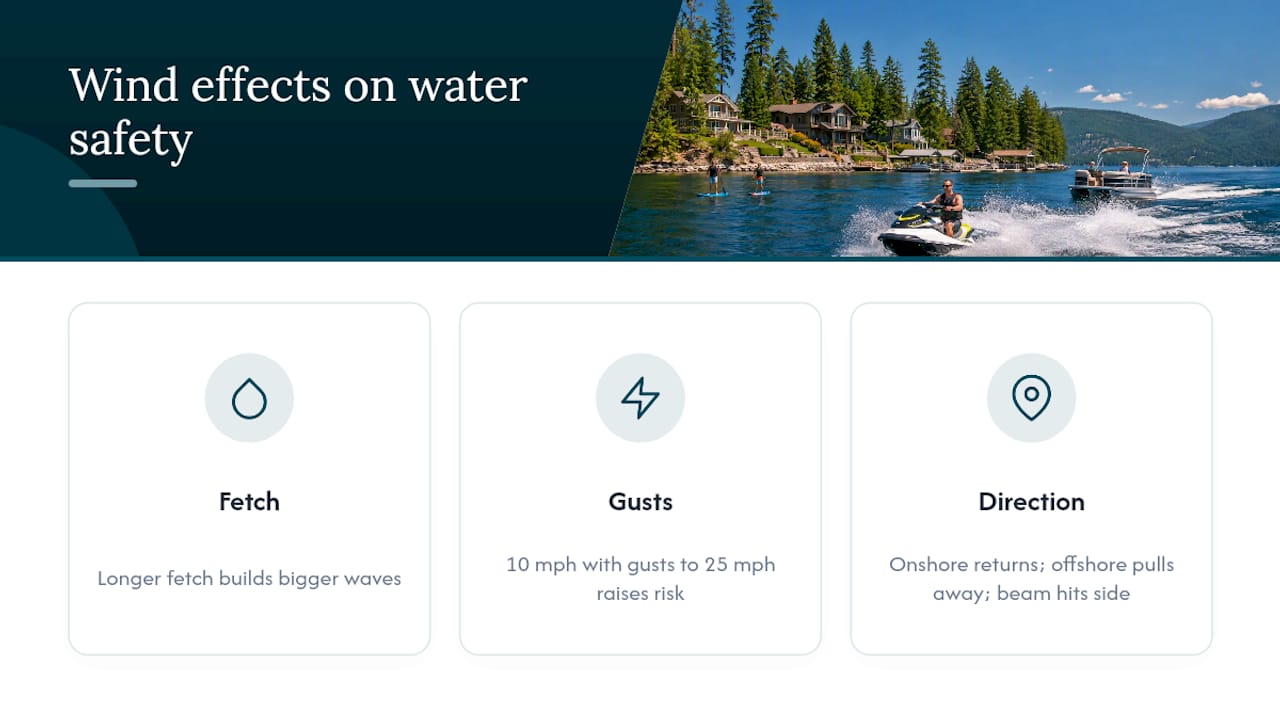
Chop, waves, and fetch. Wind blowing across open water builds waves through a simple relationship: the longer the distance the wind travels uninterrupted across the surface (called fetch), the bigger the waves get, even at moderate speeds. A moderate wind on a small, tree-lined cove barely ripples the surface, but the same wind crossing a longer open stretch of water can build significant chop that challenges stability on low-sitting craft. This is why the same wind number means something different on Lake Coeur d'Alene's open main body compared to a sheltered inlet.
Sustained wind versus gusts. A forecast describing sustained winds indicates an average, while gusts are short bursts well above that average that pose additional risks. The NWS wind and sea safety rules treat gust-driven wave buildup as a distinct risk category from steady wind, because gusts hit with no warning and disrupt balance, steering, and sail trim faster than a rider can compensate. A 10 mph forecast with gusts to 25 mph is a meaningfully more dangerous day than a steady 15 mph with no gusting, even though the average sounds calmer.
Direction matters as much as speed. Onshore wind (blowing toward land) is forgiving. If you get tired or lose control, the wind pushes you back toward shore. Beam wind (hitting you from the side) makes steering harder but is manageable with experience. Offshore wind, blowing away from land, is the one that turns a minor mistake into a rescue call, because it accelerates your drift away from safety at the exact moment you're trying to paddle or motor back. Following wind, coming from behind, can build unexpected boat speed and complicate stopping or turning, especially on tow-sport runs.
Writer note for the published page: a simple graphic showing fetch distance, a gust spike on a wind line graph, and an arrow diagram of onshore/offshore/beam direction would help readers visualize all three mechanics at once.
What Wind Speed Is Safe for Each Water Sport?
Different craft handle wind very differently, and the same 15 mph day that's a non-issue for a pontoon boat can end a paddleboard session. These ranges are conservative starting points, not guarantees, and every one of them should be adjusted down for beginners.
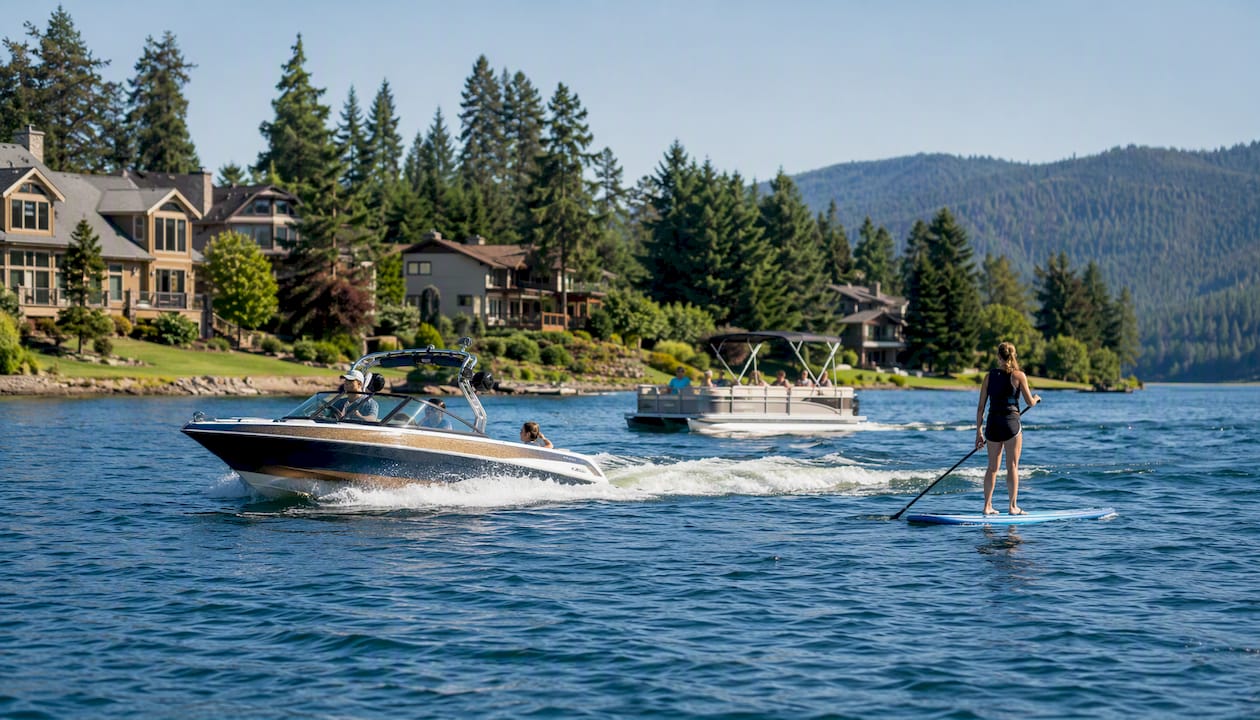
Adjust these numbers for local conditions. Long, open fetch adds risk at the same wind speed, so subtract 3 to 5 mph from your personal comfort threshold on big open water compared to a sheltered cove. Cold water tightens your margin further, since a capsize in 55-degree water is a very different problem than one in 75-degree water, even in identical wind. Local topography around lakes ringed by hills or ridgelines can also funnel and accelerate wind unpredictably through gaps and channels.
You'll know a threshold has been crossed when you see it, not just when you read it:
- Whitecaps forming on open water, even small ones.
- Spray visibly blowing off wave tops.
- Tree branches bending steadily, not just rustling.
- Waves breaking onto shore where there weren't any an hour earlier.
Craft manuals and rental operators often set their own tighter limits than these general ranges, and beginners should default to the more conservative number every time.
How Do You Read a Marine Forecast Before Heading Out?
Checking "the weather" on your phone isn't the same as checking a marine forecast, and the gap between the two causes more bad go-decisions than any other single mistake. A general weather app gives you land-based conditions. A marine forecast, buoy observation, or advisory tells you what's actually happening on the water surface, which behaves differently than the air over a parking lot.
Start with the products that matter for small craft:
- The NWS/NOAA marine forecast for your specific water body, checked for both sustained wind and gust ranges, not just the daily high/low.
- Real-time buoy and coastal station observations where available, which show you what's happening right now rather than a model's prediction for later.
- Your local NWS forecast office, since regional offices often add notes about local wind funneling or afternoon buildup that national models miss.
- The Storm Prediction Center's severe weather outlooks when a system is approaching, since fast-developing wind events can appear well before a marine advisory catches up.
Learn to actually read the advisory language, because the wording carries real operational meaning. A Small Craft Advisory means sustained winds or seas have reached a level that creates hazardous conditions for small boats, typically in the 25 to 38 mph range depending on the local forecast office, though the exact trigger varies by region. A Gale Warning is a step up, signaling sustained winds in the 39 to 54 mph range, well beyond anything a rental craft or recreational paddler should ever be near. A Special Marine Warning is issued for sudden, often short-fused hazards like a fast-moving thunderstorm cell with a wind gust spike, and it can appear with very little lead time.
If forecasts from different sources disagree, treat the more conservative one as correct and cross-check against the nearest buoy observation before deciding. When tropical systems are anywhere in the regional picture, defer entirely to National Hurricane Center guidance, since standard thresholds don't apply.
What Should You Check Before Launching Into Windy Conditions?
A five-minute pre-launch routine catches most of the mistakes that turn into rescue calls; for a detailed practical guide, see our Ocean Safety Checklist: Beach and Water Activity Guide. Run through it every time, even on a lake you've paddled a hundred times before, because conditions change faster than familiarity does.
- Check the forecast for both sustained wind and gust speed, not just one number.
- Check wind direction relative to your planned route, and specifically whether it's blowing offshore.
- Confirm your personal flotation device fits snugly and is rated for your activity.
- Attach a leash if you're on a paddleboard, and bring a whistle or phone in a waterproof case.
- Identify at least one bailout point along your route where you could get to shore quickly if needed.
- Tell someone on land your route and expected return time, or paddle with a buddy.
- If you're renting, ask staff about the day's recommended limits before you leave the dock.
Once you're on the water, keep checking, because forecasts describe averages and the water will tell you the truth in real time. Watch for whitecaps that weren't there ten minutes ago, a noticeable jump in how hard gusts hit versus the steady breeze, faster drift than you expect when you stop paddling, or spray that's suddenly reaching your face instead of just the bow. Any one of those is a signal to turn back early rather than push forward and hope conditions hold.
A rough decision-flow: sustained wind under 10 mph with minimal gusting is a go for most craft. Sustained wind of 10 to 15 mph, or gusts running more than 25% above the sustained number, is caution territory, meaning shorter range, closer to shore, experienced paddlers only. Anything past that, or any active Small Craft Advisory, is a no-go regardless of craft type. Golden Water Sports staff walk every renter through these same limits at check-in, along with a briefing on the day's specific conditions and gear.
What Do You Do if Wind Picks Up While You're Already Out?
Conditions can shift in the time it takes to paddle out and back, and having a clear action sequence beats improvising under stress. If wind and chop start building while you're on the water, work through this order:
- Reduce speed or stop paddling momentarily to reassess rather than pushing harder into building waves.
- Turn toward the nearest safe shore or the lee side of any point, island, or breakwater, even if it's not your planned landing spot.
- Stay with your craft if you capsize. A paddleboard, kayak, or PWC is far easier for rescuers to spot than a swimmer alone, and it usually still floats.
- Use a whistle, waterproof phone, or marine radio to signal or call for help early, rather than waiting to see if things improve.
- Attempt a self-rescue re-boarding only if you've practiced it; otherwise, signal for buddy or professional assistance right away.
Formal training matters here. Self-rescue technique, cold-water re-entry, and buddy-assisted recovery are skills that go far beyond what this article can teach, and a short course through a certified instructor pays for itself the first time you actually need it.
What Do Experienced Water-Sports Instructors Say About Wind Risk?
Instructors and safety researchers consistently point to the same overlooked truth: gusts and direction cause more incidents than raw wind speed ever does. A steady 15 mph breeze is predictable and you can plan around it. A 10 mph breeze that gusts unpredictably to 22 mph is the one that catches people off guard, because balance and steering corrections that work fine in steady air fail when a gust hits sideways with no warning.
Wind chill is the other factor riders consistently underestimate. Wind dramatically increases heat loss from skin and wet clothing, and the CDC's cold-exposure guidance makes clear that wind-driven spray and evaporative cooling accelerate hypothermia risk after any immersion, even when the air temperature feels comfortable. A capsize on a sunny 75-degree day with a stiff breeze can chill you faster than the same capsize on a calmer, slightly cooler day.
The most common mistakes instructors report, over and over:
- Trusting a single forecast source instead of cross-checking a buoy observation or a second model.
- Not identifying an escape point or bailout shore before launching.
- Launching directly into offshore wind because it feels calm standing on the beach.
- Underestimating fetch, especially on lakes that look small on a map but have long open stretches.
Pro Tip: Check the gust forecast specifically, not just the sustained number. If the gust delta, meaning gusts minus sustained speed, is more than 10 mph, downgrade your go-decision by one full category. A "manageable" day with a big gust delta should be treated as "caution," and a "caution" day should be treated as a no-go.
What Golden Water Sports Tells Every Renter About Wind
We build our rental limits around the same conservative thresholds outlined throughout this guide, because a fun afternoon on the water depends on never having to test what "too windy" actually means. Every renter who checks in at one of our locations near Spokane Valley, Liberty Lake, or Coeur d'Alene gets a safety briefing that covers the day's specific wind conditions, not a generic script, and staff will tell you plainly if we think conditions call for a shorter route or a different day entirely.
Our fleet includes Yamaha WaveRunners, ski boats, pontoon boats, and paddleboards, and each comes with the safety equipment appropriate to that craft, from properly fitted life jackets to leashes on our SUPs. If you're new to any of these and want a deeper walkthrough of what to expect, our guide on jet ski rental check-in covers the briefing process in detail, and our paddleboard rental guide walks through gear specifics for first-timers. Ask any staff member about the day's wind outlook before you head out. We'd rather answer that question five times a day than have a guest find out the hard way.
How Golden Water Sports Keeps Your Day on the Water Safer
You don't need to become a meteorologist to enjoy a safe afternoon on Lake Coeur d'Alene or Liberty Lake. Golden Water Sports handles the equipment side of wind safety before you even step on the dock, so the only decision left on windy days is whether staff are recommending you wait an hour or reroute to a more sheltered stretch of water.
Every rental comes with properly sized life jackets, a safety briefing tailored to that day's conditions, and leash-equipped paddleboards for anyone heading out solo. Our team checks the local forecast before your booking window and will flag it honestly if wind or gusts are trending toward caution territory, rather than sending you out and hoping it works out. Renting a Yamaha WaveRunner or a pontoon boat from us means you get equipment that's maintained, appropriately rated, and backed by a staff briefing, instead of guessing alone with borrowed gear. If you're planning a trip out to Liberty Lake specifically, our local rental tips cover how the lake's size affects wind buildup through the day.
Check current rates and availability for jet skis, pontoons, and paddleboards, or book directly for Liberty Lake or Newman Lake rentals, and ask our team about the day's wind outlook when you arrive.
Where to Check Wind and Marine Conditions Before You Go
Bookmark these before your next trip, and check them the morning of, not the night before, since conditions shift fast.
- NOAA marine forecasts for sustained wind, gusts, and official advisories for your specific water body.
- The NWS wind and sea safety rules for understanding how wind and wave conditions combine to raise capsize risk.
- NOAA's marine warning types to know the difference between a Small Craft Advisory, Gale Warning, and Storm Warning.
- The NWS glossary entry for gale and similar terms so advisory language makes sense at a glance.
- CDC guidance on cold exposure to understand how wind accelerates hypothermia risk after any immersion.
Frequently Asked Questions
What wind speed is too dangerous for kayaking or paddleboarding? Most paddleboarders should treat anything over 13 mph sustained as a no-go, and kayakers should use roughly 17 mph as their upper limit, adjusted down for open water, cold temperatures, or offshore direction.
Is a Small Craft Advisory the same as saying conditions are dangerous? Yes. A Small Craft Advisory means conditions have already exceeded safe handling thresholds for small vessels, and it should be treated as a firm no-go rather than a judgment call.
Why is offshore wind more dangerous than onshore wind at the same speed? Offshore wind pushes you away from land, so any fatigue, equipment failure, or loss of control gets worse the longer you're out, while onshore wind naturally pushes you back toward safety.
Do gusts matter more than average wind speed? Often, yes. A forecast showing a large gap between sustained wind and gust speed, sometimes called the gust delta, signals unpredictable bursts that disrupt balance and control more than steady wind ever does.
Can I still get on the water if it's warm but windy? Warm air temperature doesn't cancel out wind chill risk after a capsize. Wind-driven spray and wet clothing accelerate cooling regardless of how warm the air feels, so immersion-appropriate clothing still matters.
What should I do if wind picks up while I'm already out on the water? Stop, reassess, and head toward the nearest safe shore or lee side immediately, stay with your craft if you capsize, and use a whistle or phone to call for help early rather than waiting to see if conditions improve.