
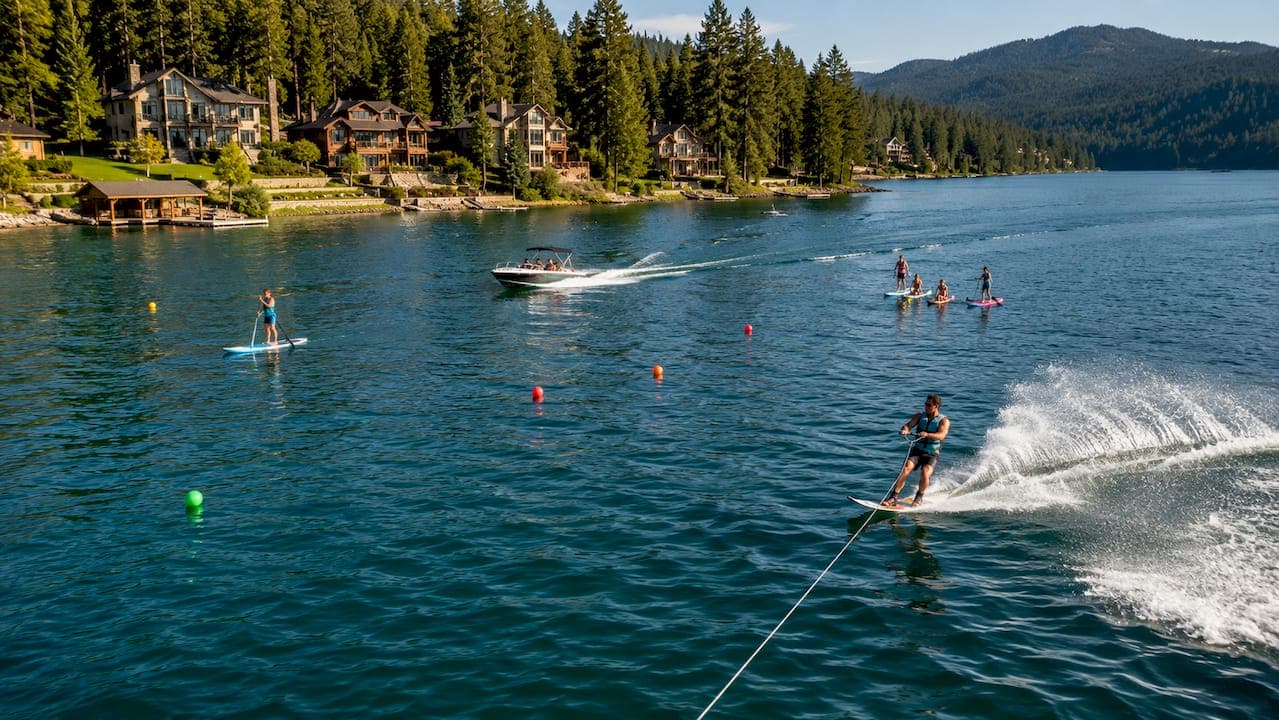
A ski boat slalom course is a precisely marked waterway consisting of 26 buoys, including 6 turn buoys arranged in a zigzag pattern that skiers navigate between entrance and exit gates at increasing speeds or shortened rope lengths. The industry standard term is "slalom course," and it forms the backbone of competitive water ski events worldwide. Tournament courses follow International Waterski & Wakeboard Federation (IWWF) specifications, requiring professional land surveying for any record-capable competition. Understanding the course layout, rules, and physical demands separates casual skiers from those who can run a full pass cleanly.
What is a ski boat slalom course and how is it laid out?
A standard slalom course contains 26 buoys total: 6 turn buoys that the skier rounds in a zigzag pattern, plus 20 entrance, exit, and guide buoys that define the boat path and course boundaries. The turn buoys sit 11.5 meters (38 feet) from the course centerline on alternating sides. That offset is what creates the zigzag challenge every skier must solve at speed.
The course runs approximately 850 feet long. Including the entrance and exit sections, a skier travels around 1,145 feet per pass. The boat follows a straight path through 8 sets of gates, keeping the pull consistent and fair for every run.
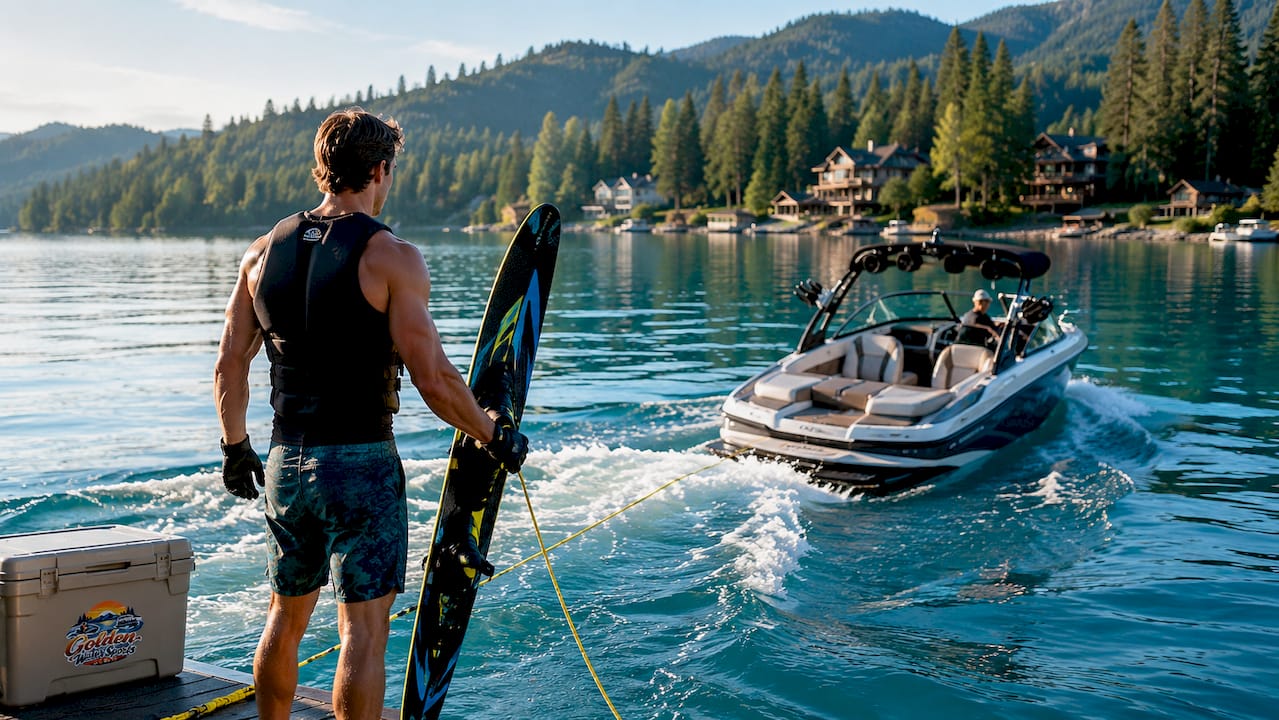
IWWF-certified courses require a professional land surveyor to confirm buoy and boat path positions before any records can be recognized. That standard exists because even a few inches of misplacement changes the geometry of every turn.
| Buoy type | Count | Distance from centerline | Function |
|---|---|---|---|
| Turn buoys | 6 | 11.5 m (38 ft) | Skier rounds each one in zigzag |
| Entrance/exit gates | 8 | On centerline | Mark boat path entry and exit |
| Guide buoys | 12 | Variable | Define course boundaries |
Pro Tip: If you are scouting a course on a public lake, count the buoys before your first run. A full course has 26. Anything less means the layout is incomplete or damaged.
What rules govern slalom skiing and how is scoring determined?
Slalom skiing rules follow a clear progression of difficulty. The skier enters through the entrance gate, rounds all 6 turn buoys in order, and exits through the exit gate to complete one pass. Each successfully rounded buoy scores one point. Missing a buoy or falling ends the run immediately, and the skier's score is the total buoys rounded up to that point.
Boat speed increases progressively up to the division maximum. Women's maximum is 55 kph; men's maximum is 58 kph. Once the skier reaches their division's top speed, the rope shortens instead of the boat speeding up. That rope shortening is where the real difficulty begins.
Key rules every slalom skier needs to know:
- The skier must pass through the entrance gate before the first turn buoy counts.
- Touching a buoy does not disqualify a pass, but failing to round it does.
- Rope shortening increments follow set measurements, with elite competitors reaching rope lengths as short as 11.25 meters.
- The highest buoy count wins the event. Ties go to the skier who completed the pass at a shorter rope length.
- A fall at any point ends the run, regardless of how many buoys remain.
The scoring system rewards consistency. A skier who runs 6 buoys cleanly at a shorter rope length beats one who falls on the fifth buoy at a longer rope.
How do boat drivers and skiers work together for a successful run?
The boat driver's role is as technical as the skier's. Precise speed control is mandatory. Modern tournament boats use cruise control systems accurate to within 1/100th of a second, removing human error from speed management. That level of accuracy means the skier gets the same pull on every pass.
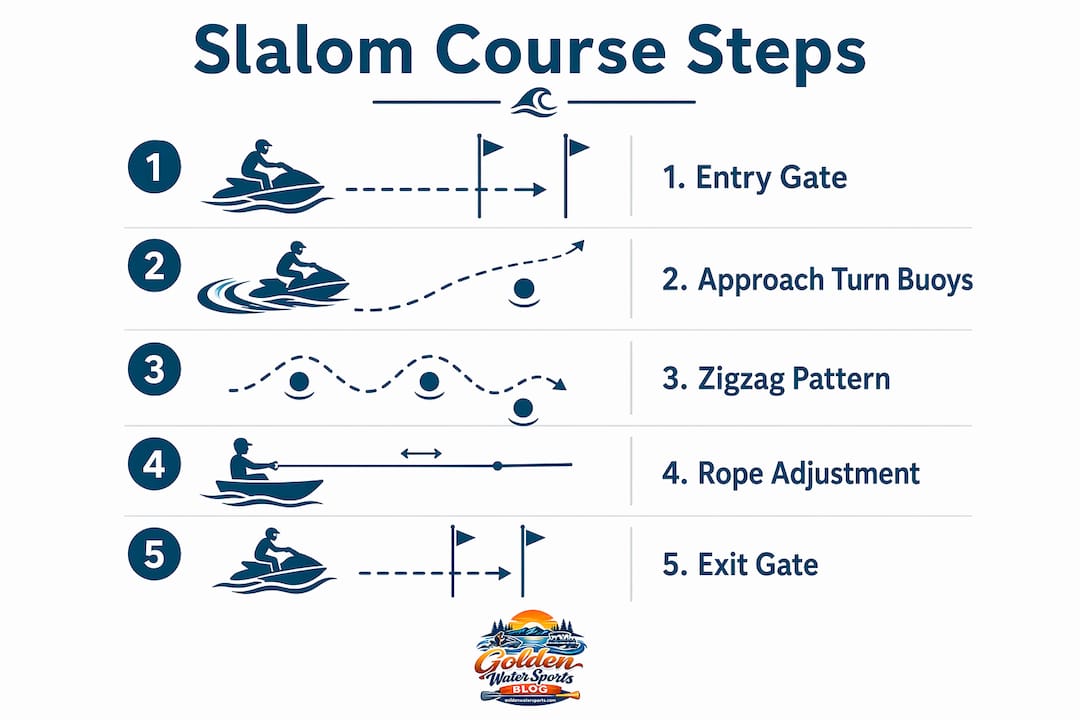
The driver must navigate straight through all 8 gate sets without drifting. Any lateral movement changes the pull angle on the rope and throws off the skier's timing. A driver who wanders even slightly left or right can cost a skier a buoy.
Practical tips for boat drivers on slalom courses:
- Approach the entrance gate at the correct speed before the skier signals ready.
- Hold the throttle steady through the entire course. Do not adjust speed mid-pass.
- After a fall, stop completely and idle back to the skier. Do not circle at speed.
- Avoid creating large wakes when returning to the start. Rollers on the water surface affect the next skier's run.
Pro Tip: If you are new to driving a ski boat on a slalom course, practice your straight-line entry through the gates without a skier first. Consistency through the gates is a skill that takes repetition.
What physical demands does slalom skiing on a course require?
Slalom skiing is one of the most physically demanding water sports. Skiers use a single ski with both feet mounted forward, one behind the other. During tight turns at short rope lengths, forces reach up to 4 g and 600 kg of load on the body. That is comparable to what fighter pilots experience during sharp maneuvers.
As rope length shortens, the skier cannot rely on the boat's speed to carry momentum through the turn. Instead, the skier uses the "human lever" technique, dropping the hips low and driving the body outward against the rope tension to generate swing. Core strength and timing become the deciding factors, not raw athleticism.
Key physical demands at each stage of a slalom pass:
- At full rope length, speed and edge control dominate. The skier rides wide arcs with manageable forces.
- At mid-length ropes, the skier must initiate turns earlier, before the buoy is even reached.
- At elite rope lengths around 10.25 meters, the skier's body acts as a counterweight, and the margin for error is measured in centimeters.
- Grip strength, shoulder stability, and hip mobility all limit how short a skier can go.
The sport rewards athletes who train the full kinetic chain, not just leg strength.
How should newcomers prepare and respect etiquette on slalom courses?
Slalom courses on public lakes like Lake Coeur d'Alene are shared resources. Respecting the course protects it for every skier who follows. Driving parallel to the course at high speed creates rollers that degrade water conditions and can dislodge buoys. Slow down and give the course a wide berth when you are not actively skiing it.
First-time slalom skiers should follow these preparation steps:
- Start at the lowest speed for your division and get comfortable with the entrance gate before worrying about turn buoys.
- Never pull personal watercraft or tubes through a slalom course. The wakes and rope angles can damage buoy anchors.
- Read up on lake rider etiquette before your first session. Shared water requires shared responsibility.
- Wear a properly fitted life jacket on every run, regardless of skill level.
- If you are renting a ski boat for the first time, ask the rental provider about local course locations and any posted rules for the water body.
Goldenwatersports recommends that first-time renters review ski boat rental basics before heading out, especially if they plan to use a marked course on a busy summer day.
Key Takeaways
A ski boat slalom course is a 26-buoy, IWWF-standardized layout where skier success depends equally on course knowledge, driver precision, and physical technique.
| Point | Details |
|---|---|
| Course layout | 26 buoys total, with 6 turn buoys set 11.5 m from centerline in a zigzag pattern. |
| Scoring system | One point per rounded buoy; missing a buoy or falling ends the run immediately. |
| Speed and rope rules | Boat speed increases to division max, then rope shortens to as little as 11.25 m. |
| Driver precision | Cruise control accurate to 1/100th of a second keeps pulls fair for every skier. |
| Etiquette on public lakes | Drive parallel to the course slowly, stop after falls, and never pull tubes through the course. |
The part most skiers underestimate
Most newcomers focus entirely on the skier and forget the course is a system. The driver, the water conditions, and the buoy layout all determine whether a run is fair. I have watched technically skilled skiers lose buoys because the driver drifted two feet off line through the gates. That is not a skier problem. It is a system problem.
The physical forces involved at short rope lengths are genuinely surprising to people who have not felt them. Dropping to 13 meters of rope feels manageable. Dropping to 11.25 meters feels like a different sport entirely. The body has to commit to the turn before the buoy is even in sight. That kind of anticipatory movement takes months to build.
What I find most compelling about slalom is the cooperation it demands. The skier and driver have to trust each other completely. On lakes like Lake Coeur d'Alene, where recreational boaters and competitive skiers share the same water, that trust extends to every person on the lake. Etiquette is not optional. It is what keeps the course usable for everyone.
— Life is better on water.
Get on the water with Goldenwatersports
Slalom skiing starts with the right boat and the right lake. Goldenwatersports serves Spokane Valley, Liberty Lake, and Coeur d'Alene with ski boats, Yamaha WaveRunners, and full safety equipment for every skill level.
Whether you are trying slalom for the first time or looking to sharpen your technique on a marked course, Goldenwatersports boat rentals give you access to well-maintained ski boats and knowledgeable staff who know these lakes. Check out local rental options near Coeur d'Alene and plan your next day on the water with a crew that takes both safety and fun seriously.
FAQ
What is a slalom course made of?
A slalom course consists of 26 buoys: 6 turn buoys the skier rounds in a zigzag pattern, plus 20 entrance, exit, and guide buoys that mark the boat path and course boundaries.
How long is a standard water ski slalom course?
The course itself is approximately 850 feet long. Including the entrance and exit sections, a skier travels around 1,145 feet per complete pass.
What speeds do slalom skiers reach on the course?
Boat speeds increase progressively up to division maximums of 55 kph for women and 58 kph for men. After that, the rope shortens to increase difficulty rather than the boat speeding up further.
How does rope shortening change slalom difficulty?
Shorter ropes reduce the arc a skier can swing through, forcing earlier turn initiation and requiring intense body leverage. Elite competitors ski on ropes as short as 10.25 meters, where forces can reach 4 g per turn.
Can recreational skiers use a slalom course on a public lake?
Yes, but course etiquette applies. Drive parallel to the course slowly to avoid rollers, stop completely after a fall, and never pull tubes or personal watercraft through the course.