
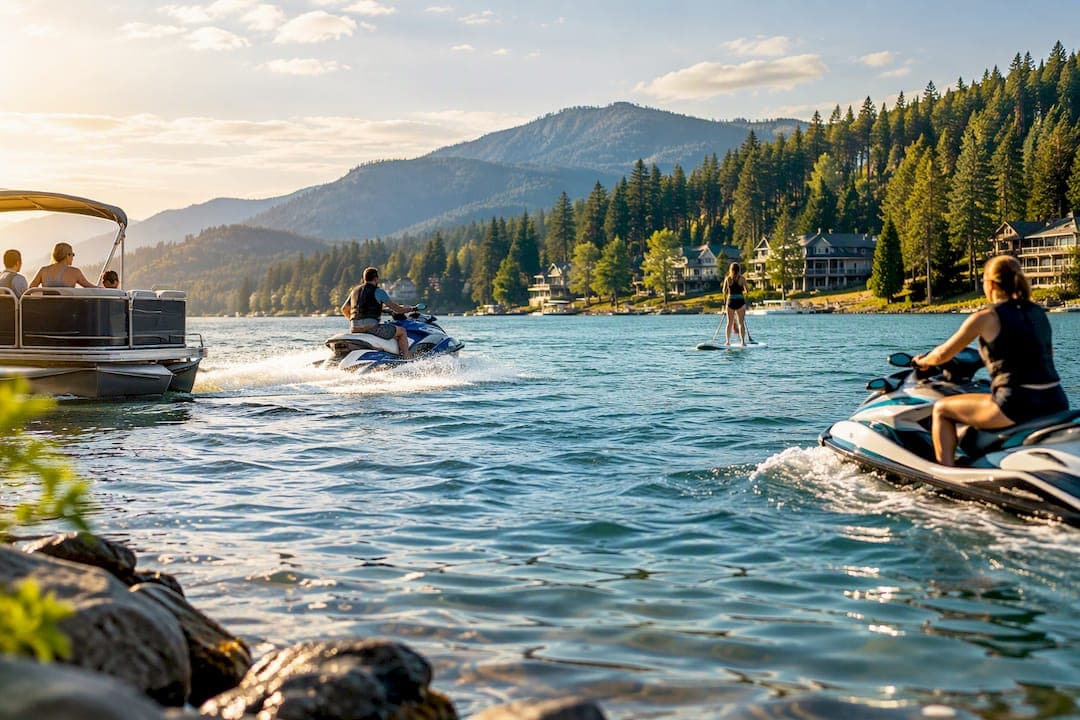
You do not need a traditional boating license to run a boat near Spokane. What you likely need is a Washington State Boater Education Card, required for most operators born after January 1, 1955 who run a motor-driven vessel with 15 horsepower or more. Jet skis carry stricter age rules, and renters have a separate, simpler path to compliance.
TL;DR:
- Operators born after January 1, 1955, must have a Boater Education Card to operate boats with 15 horsepower or more, regardless of vessel size.
- Age restrictions limit personal watercraft operation to those 14 and older, with rentals to those 16 and above, and require life jackets and functional engine lanyards.
- Exemptions include individuals born before 1955, Coast Guard license holders, and government vessel operators, with a 60-day grace period for nonresidents and recent boat buyers.
- The card can be obtained online, through classroom courses, or via exams from NASBLA-approved providers, with certification needed as temporary proof during processing.
- Rental companies must review safety checklists with all operators and confirm every driver before departure to ensure compliance and safety.
Table of Contents
- Spokane Boating License Requirements: Who Needs a Card
- Age Limits and Personal Watercraft Rules
- Exemptions, Temporary Proof, and the 60-Day Rule
- How to Get the Boater Education Card
- Renting in Spokane: What Renters and Operators Must Do
- Operator Education vs. Vessel Registration
- Replacement Cards, Enforcement, and Penalties
- Spokane-Area Resources and Local Class Options
- A Safety-First Note From Golden Water Sports
- Sources
- FAQ
Spokane Boating License Requirements: Who Needs a Card
Washington skips the driver's-license model entirely. Instead, state law ties the requirement to horsepower and birth date. Under RCW 79A.60.640, anyone born on or after January 1, 1955 must hold a Boater Education Card to legally operate a motor-driven boat with 15 horsepower or more. The minimum operating age is 12, and kids between 12 and the card-eligible age can often operate under direct adult supervision rather than holding the card themselves.
The horsepower threshold matters more than the boat's size. A 14-foot aluminum fishing boat with a 20-horsepower outboard triggers the requirement. A 22-foot pontoon with a small 9.9-horsepower trolling motor does not. Paddleboards, canoes, and kayaks without motors never need a card because they are not "motor-driven" under the statute. According to Washington State Parks, the card must be carried onboard and shown to an enforcement officer on request, so keeping it in your truck instead of the boat won't help you if you get stopped.

Age Limits and Personal Watercraft Rules
Jet skis play by a different, tighter rulebook. RCW 79A.60.190 bans anyone under 14 from operating a personal watercraft at all, and no rental company can lease or rent one to anyone under 16, regardless of what the Boater Education Card rules allow elsewhere. Every rider aboard a PWC must wear an approved personal flotation device, and the craft's engine-cutoff lanyard has to be attached and functional whenever it's running.
These PWC age limits stack on top of the general education-card requirement rather than replacing it. A 16-year-old renting a jet ski still needs to meet the card rule if born after 1955 (which, at 16, they obviously are), unless a rental exemption applies. For a deeper look at how age restrictions play out at the dock, see this guide on jet ski age restrictions.
Exemptions, Temporary Proof, and the 60-Day Rule
A handful of people are exempt outright. If you were born before January 1, 1955, you're grandfathered in and never need the card. Holders of a valid U.S. Coast Guard operator's license, government vessel operators, and people running boats in a permitted event under direct supervision also fall outside the requirement, per RCW 79A.60.640.
Nonresident visitors get a 60-day grace window before the card requirement kicks in. If you just bought a boat, your bill of sale works as temporary proof for that same 60-day stretch while your paperwork catches up. Rental and charter operations have their own shortcut: a completed motor-vessel rental safety checklist satisfies the requirement in place of the card, but it has to be filled out fresh for every single rental, not just the first time you show up at a dock.

How to Get the Boater Education Card
Getting the card usually takes one of three paths: an approved online course, a classroom session, or an equivalency exam for experienced boaters who'd rather test out than sit through a class. All routes funnel through NASBLA-approved providers, which Washington State Parks lists directly.
Providers vary more than most people expect:
- BoatUS Foundation runs a no-fee course, a solid pick if budget is the deciding factor.
- America's Boating Course runs $34.95.
- Boater Exam Washington runs $39.95.
- Boat-Ed runs $44.95.
- Boat-Ed+ runs $79.50 and includes extra features some boaters prefer.
Prices shift, so confirm current rates before enrolling. The bigger difference isn't cost, it's whether the provider files your state application for you. Some do; others hand you a completion certificate and expect you to mail the Boater Education Card Application with a $10 payment yourself. Either way, print that certificate. It's your temporary proof of compliance for 60 days while the permanent card, which typically takes three to four weeks to arrive, makes its way through the mail.
Pro Tip: Before you pay for any course, check the provider's page on the State Parks site to see whether they file the application on your behalf. It's the difference between being done in five minutes and mailing a check yourself.
Renting in Spokane: What Renters and Operators Must Do
Rental companies carry real responsibility here, not just the renter. State rules require them to review the required safety checklist with every person who intends to operate the boat or jet ski, not just the primary renter. That means if your brother-in-law wants a turn at the wheel, he needs to be named and briefed before you leave the dock, not after you're a mile offshore.
Before you launch, run through this:
- Bring your printed Boater Education Card, temporary certificate, or be ready to complete the rental safety checklist on-site.
- Bring a photo ID that matches whoever's named as an operator.
- Ask the rental company directly whether they file your card application or expect you to mail it.
- Confirm life jackets are aboard for every passenger.
- Check that the engine-cutoff lanyard is attached before you leave the dock.
Pro Tip: Disclose every intended driver when you book, not when you arrive. Rental staff at Golden Water Sports need to brief each operator individually, and adding names last-minute slows down your launch time.
Operator Education vs. Vessel Registration
A Boater Education Card proves you're qualified to operate. It has nothing to do with whether the boat itself is legally registered. Washington's Department of Licensing requires most motorized vessels to carry title, registration, and decals, and the registration card has to be onboard whenever the boat is in use. Nonmotorized craft and boats with very small motors on certain non-federal waters are commonly exempt from registration, along with short-term nonresident visits. For background on how registration differs from documentation more broadly, this yacht registration guide breaks down the distinction well. Bottom line: carry both your operator proof and the boat's registration paperwork, since one doesn't substitute for the other.
Replacement Cards, Enforcement, and Penalties
Lost your card? Washington State Parks handles replacements through a mailed affidavit application, no need to retake the course. If an officer stops you on the water, expect them to ask for your card, your 60-day temporary certificate, or a bill of sale if you recently bought the boat. Operating without required proof is an infraction, and the fine, commonly cited around $99, can be waived if you show proof you obtained a card within 60 days of the stop, per RCW 79A.60.640. Keep copies of everything you mail. If a dispute comes up later, that paper trail is what saves you.
Spokane-Area Resources and Local Class Options
Spokane County's Marine Unit has run free boater-education classes in past seasons, advertised through the county's own class notice archive. Because that page reflects prior scheduling, confirm current dates before building a trip around it, an in-person class that filled up last spring may not repeat this year.
If in-person classes aren't running when you need one, an approved online course remains a reliable fallback. A few practical habits go a long way locally:
- Print your completion certificate the moment you finish a course, don't rely on a phone screenshot.
- Ask your rental company directly whether they submit the card application for you.
- Confirm every operator's name and ID before you leave the dock, not after.
- Review Spokane's lake speed limits and no-wake zones before you launch, since local enforcement watches these closely on busy summer weekends.
A Safety-First Note From Golden Water Sports
Checklists and cards aren't paperwork for paperwork's sake. Every operator name we confirm before a rental, every life jacket we check, every engine-cutoff lanyard we verify is attached, exists because boats and jet skis don't forgive carelessness the way a car in a parking lot does. Following Washington's education rules and completing the rental checklist properly catches problems before they happen, not after.
Respect no-wake zones, wear your life jacket even when the water looks calm, and rinse your gear between lakes to keep invasive species from hitching a ride. Responsible boating protects the water we all come back for, and it starts with knowing exactly what's required before you ever untie from the dock.
— Life is better on water.
Ready to get on the water this season? Golden Water Sports rents jet skis at Liberty Lake starting at $250 to $425, with additional hours available at $75 per hour, along with jet skis at Newman Lake at the same rate. Our full lineup, including boats, paddleboards, and water toys, makes it easy to plan a family outing or a weekend on the water near Spokane Valley, Liberty Lake, and Coeur d'Alene without wrestling with your own equipment or paperwork.
Sources
- Boater Education Card - Washington State Parks
- RCW 79A.60.640 - Requirements to operate motor-driven boats/vessels—Exemptions—Penalty
- RCW 79A.60.190 - Operation of personal watercraft
- FREE 2026 Washington State Boater Education Classes - Spokane County
FAQ
What Are the Requirements to Get a Boat License in Washington State?
Washington doesn't issue a conventional boat license. Instead, most operators born after January 1, 1955 need a Boater Education Card to run a motor-driven vessel with 15 horsepower or more, earned through an approved course or equivalency exam.
What Is the 1/3 Rule in Boating?
The "1/3 rule" is a load and stability guideline for planning trips, not a licensing threshold. For legal compliance, follow your boat's capacity plate and Washington's official boating regulations rather than any informal rule of thumb.
Is My Boater's Education Card Valid in All States?
Washington's card generally satisfies reciprocity agreements with many other states, since most follow similar NASBLA-approved course standards. Always check the destination state's specific rules before you travel with a boat, since exemptions and age thresholds differ.
How Big of a Boat Can You Drive Without a License?
Size isn't the deciding factor, horsepower is. A motor-driven boat below the state horsepower threshold doesn't trigger Washington's Boater Education Card requirement regardless of the boat's length, while any motor-driven boat at or above that threshold does.