
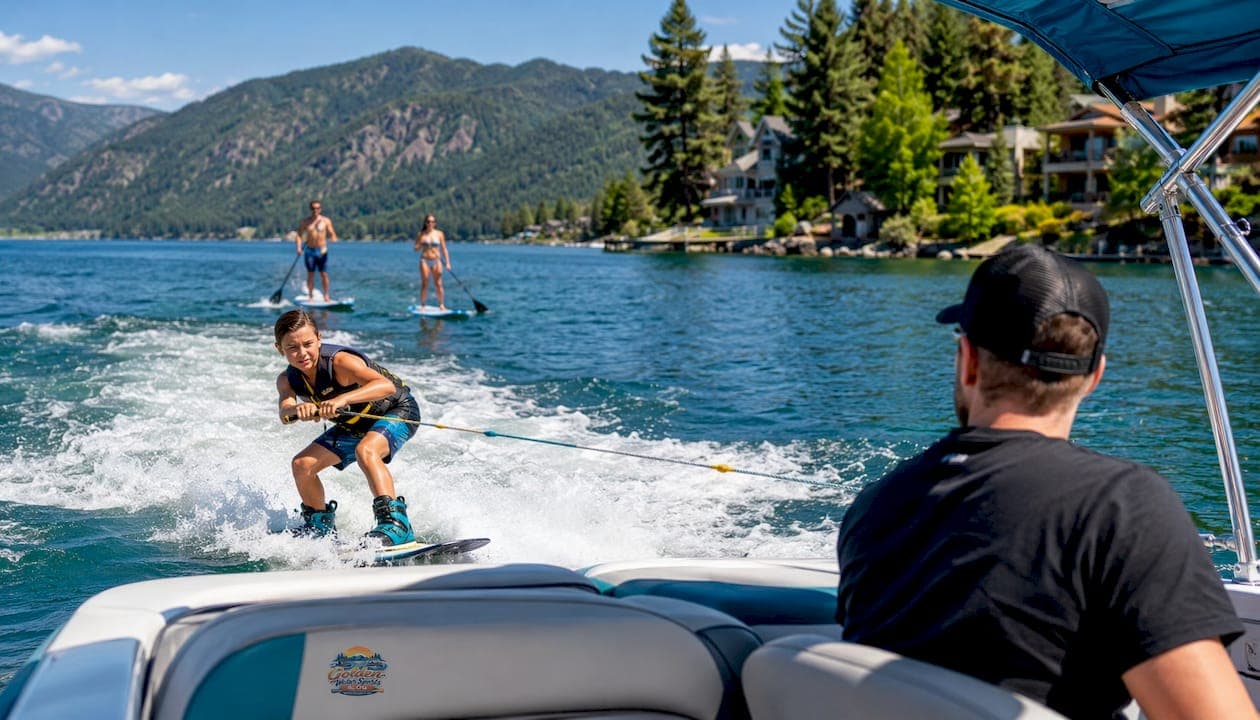
You can reliably get up on a wakeboard behind a ski boat as a beginner by using a short tow rope (around 15 meters / 50 ft), keeping a compact "crunched" start position with your knees pulled to your chest and arms straight, and asking the driver for a smooth, steady pull. That's the whole formula. Everything else is just making sure you don't accidentally work against it.
Before you get in the water, run through this quick checklist:
- Short rope first: Start with a short rope. A shorter line produces more upward pull, which is exactly what you need on your first attempts.
- U.S. Coast Guard–approved life jacket: Sized for active watersports, snug but not restrictive.
- Stable bindings: Snug enough that your feet don't shift, but you can still wiggle your toes.
- Briefed driver: They need to know "smooth and steady throttle, no sudden surges."
- Spotter on board: Someone watching you at all times, separate from the driver.
Pro Tip: Tell the driver you're a first-timer before you get in the water. A driver who knows what to expect will ease into the throttle far more gently than one who assumes you've done this before.
Table of Contents
- What gear and boat setup should you request for your rental?
- How do you actually get up on a wakeboard behind a boat?
- What mistakes do most beginners make, and how do you fix them?
- What should you practice after your first successful ride?
- What should you ask your rental company before you get on the water?
- What safety rules apply to wakeboarding on U.S. lakes?
- Key Takeaways
- What the water actually teaches you
- Ready to get on the water with Goldenwatersports?
- Useful sources and further reading
What gear and boat setup should you request for your rental?
The right equipment cuts your learning curve in half. When you call or show up at the rental desk, ask specifically for a longer beginner board with a continuous (smooth) rocker. Longer boards with continuous rocker prioritize stability over speed, giving you a predictable platform while you're figuring out balance. Pair that with stiffer bindings so your ankles stay locked in place.
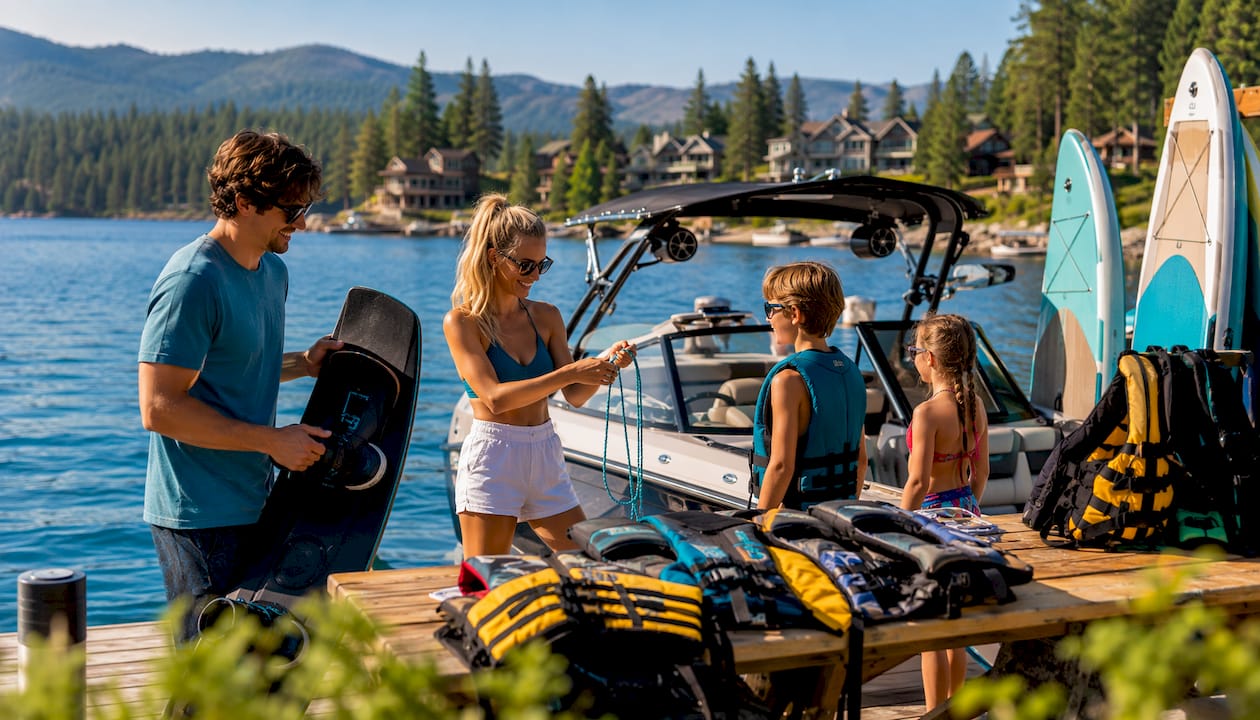
For the rope, ask the operator to rig a short line first, around 15 m / 50 ft. Some instructors even start students at 25 ft to teach the motion quickly, then extend to about 20 m / 65 ft after consistent success. A low-stretch, coated line helps too — it transfers the boat's pull cleanly instead of bouncing.
On the boat side, confirm these before you launch:
- Tower or elevated tow point: A higher attachment angle lifts you up rather than dragging you forward.
- Manual throttle, no cruise control: A human driver modulating throttle gently produces far smoother starts than cruise control. Ask explicitly.
- Target speed range: Mercury Marine recommends roughly 18–20 mph for beginner starts. That's your driver's target once you're up.
- Spotter confirmed: Not optional. Someone needs eyes on you the entire time.
Not sure which boat type fits tow sports versus general cruising? That's worth sorting out before you book.
How do you actually get up on a wakeboard behind a boat?
Follow this sequence exactly. Rushing any step is the most common reason beginners fall on the first pull.
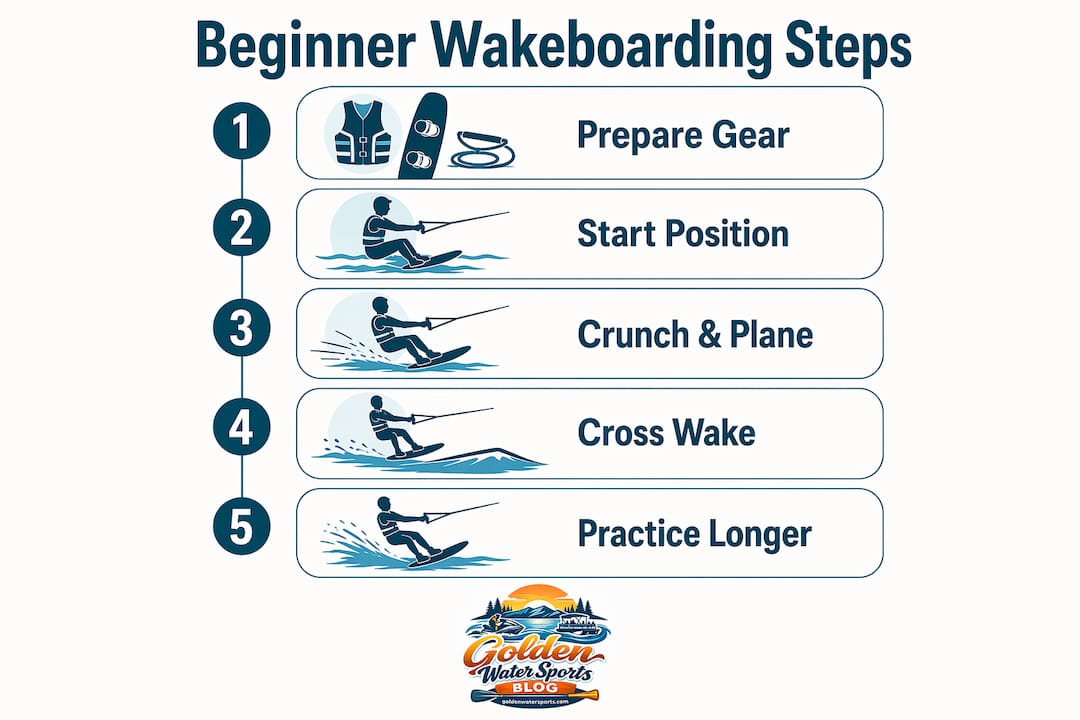
- Gear up on the swim platform. Strap into your bindings while seated on the platform. Slide into the water from the platform rather than jumping — jumping can send you back into the boat.
- Float on your back, board perpendicular to the boat. Knees pulled to your chest, arms straight out in front of you holding the handle, resting on your knees.
- Signal the driver. Both hands on the handle, raise it to signal "go." Keep both hands on it — letting go with one hand at this stage usually ends the attempt.
- Let the boat pull you, don't fight it. As the rope tightens, stay completely crunched. Knees to chest, arms straight. Hold that position until you feel the board plane under you and your weight shift over the top of it.
- Stand up slowly. Only once you feel balanced over the board. Rushing this is the single most common beginner mistake.
- Rotate your back foot away from the boat. Gently turn your dominant foot back, bring the handle to your leading hip, and look straight ahead — not down at the board.
Driver checklist to match each step
- Steps 1–3: Boat in neutral, slack in the rope, driver watching the spotter.
- Step 4: Ease into throttle gradually. Target a moderate speed during the pull-up phase.
- Steps 5–6: Hold a steady speed once the rider is up. No acceleration changes until the rider signals.
Quick troubleshooting
- Board plowing underwater: You stood up too soon. Stay crunched longer.
- Arms bending and pulling forward: Bent arms are a sign you need more knee bend — more crouch keeps you centered.
- Handle drifting up to your chest: Pull it back to hip height immediately. A high handle throws your balance forward.
Pro Tip: Do a dry run on land first. Sit on the ground, knees bent, arms straight, and have a friend pull you to standing. It sounds silly, but it locks in the muscle memory before you're in cold water.
What mistakes do most beginners make, and how do you fix them?
Most failed starts come down to one of five fixable errors:
- Pulling with your arms: The boat does the lifting. Keep arms straight and passive — fighting the pull is the most common cause of failed starts.
- Standing too soon: Stay crunched until the board planes. If you pop up before you're over the board, you'll pitch forward every time.
- Bent elbows: Bent arms mean you're trying to muscle it. Straighten them and add more knee bend instead.
- Wrong rope length: A rope that's too long reduces upward pull and makes the start much harder. Start short.
- Driver using cruise control: Cruise control can surge unpredictably. Ask for manual throttle every time.
The crunch-to-plane timing is the one thing most tutorials gloss over. You need to hold the crunched position longer than feels natural — all the way until the board is flat on the water and your weight is centered. The instinct is to stand the moment you feel the pull. Resist it.
Pro Tip: If you fall three times in a row the same way, stop and describe it to your driver or spotter. A small tweak — slightly more knee bend, a slower throttle ramp — often fixes a pattern that feels impossible to break alone.
What should you practice after your first successful ride?
Many beginners stand within their first 3–5 attempts when they use the correct start. Once you're up consistently, here's a realistic progression path:
- Session 1–2: Stand up reliably, ride straight behind the boat, keep the handle at your hip.
- Session 3–4: Practice gentle heelside and toeside edges. Heelside (pressure on your heels) pulls you to the outside of the wake. Toeside is harder — lean back into the rope, not the direction you're turning.
- Session 5–6: Cross the wake once in each direction. Short, controlled crosses only.
- First trick: The Surface 180 is the recommended starting point. It teaches board control in the boat's white water without requiring air.
When you're crossing the wake consistently, lengthen the rope from 15 m / 50 ft to about 20 m / 65 ft. The wider rope gives you more room to build speed into the wake.
For a 30–60 minute rental block, aim for this: 10 minutes of start attempts, 20 minutes of straight-line riding and edge practice, 10 minutes of wake crosses if you're ready. Don't try to cram in tricks on a short rental. Consistency beats ambition every time.
What should you ask your rental company before you get on the water?
Walk up to the rental desk with this short script: "Short line, spotter, manual throttle, beginner board and life jackets, please." That covers the essentials. Here's the expanded version:
- Short rope option (~15 m): Confirm the operator can rig it before launch.
- Spotter on board: Non-negotiable. Ask if one is included or if you need to bring someone.
- Driver briefing: Ask if the driver knows beginner throttle technique, or if you can walk them through it.
- Beginner board with continuous rocker: Confirm availability when booking, not at the dock.
- Adjustable bindings: Sized to your feet before you get in the water.
- Rental duration: A 60-minute block gives you enough time for real practice. Thirty minutes goes fast.
Goldenwatersports serves riders on lakes around Spokane Valley, Liberty Lake, and Coeur d'Alene, with beginner-friendly boats, safety equipment included, and staff who know these waters. Check their lake rental tips before you book so you show up ready.
What safety rules apply to wakeboarding on U.S. lakes?
A few of these are legal requirements, not suggestions:
- U.S. Coast Guard–approved life jacket: Required by federal law for every person on the water. Make sure it fits for active movement, not just floating.
- Working kill switch/lanyard on the driver: If the driver falls out, the engine cuts. Confirm it's attached before leaving the dock.
- Spotter on board: Required in most U.S. states when towing a rider. One person watches the rider; the driver watches the water ahead.
- Visible rescue plan: Everyone on the boat should know the signal for "stop" (drop the rope) and "I'm OK" (one arm raised).
On the lake itself: stay out of marked buoy zones and no-wake areas, give non-motorized craft plenty of room, and avoid congested swimming areas. When the rider falls, the driver slows immediately, circles wide, and approaches from the downwind side.
Before you rent, ask the operator what their liability policy covers and what you're responsible for if equipment is damaged. Most rental companies carry their own insurance, but knowing your exposure upfront avoids surprises. For a broader look at staying safe on the water with family, the boat safety tips for families guide covers driver responsibilities in detail.
Key Takeaways
Getting up on a wakeboard behind a ski boat as a beginner comes down to three things: a short rope (~15 m / 50 ft), a crunched start position with straight arms, and a driver who eases into the throttle smoothly.
| Point | Details |
|---|---|
| Start with a short rope | Use ~15 m / 50 ft first and extend to about 20 m / 65 ft after consistent success; the steeper angle produces more upward pull to help you stand. |
| Hold the crunch longer than feels natural | Stay compact until the board planes under you before you begin to stand up slowly. |
| Arms straight, always | Pulling with bent arms is the top cause of failed starts; let the boat do the lifting. |
| Most beginners stand in 3–5 attempts | Expect falls, keep sessions deliberate, and don't rush progression to tricks. |
| Goldenwatersports | Serves Spokane Valley, Liberty Lake, and Coeur d'Alene with beginner-ready boats, spotters, and short-line setups. |
What the water actually teaches you
There's a gap between what most beginner guides promise and what the water actually demands. Every tutorial says "let the boat do the work" — but nobody explains that your instinct will fight that instruction hard. The moment you feel the rope tighten, your body wants to pull, stand, and muscle through it. That instinct is exactly what puts you face-first in the water.
The riders who get up fastest aren't the strongest or the most athletic. They're the ones who stay genuinely relaxed in that crunched position and trust the pull. Wakeboarding is technique-driven in a way that surprises people. A 130-pound person with good form will outperform a 200-pound person fighting the rope every single time.
The other thing worth saying: the driver matters more than most beginners realize. A smooth, experienced driver who eases into the throttle and holds a steady speed produces a completely different learning session than one who guns it. If you're renting, ask about the driver's experience with beginners specifically. It's a fair question, and a good operator will have a real answer.
Ready to get on the water with Goldenwatersports?
Goldenwatersports takes the guesswork out of your first wakeboarding session on lakes around Coeur d'Alene, Liberty Lake, and Spokane Valley. Every rental comes with safety equipment, and the team knows how to set up a beginner-ready boat — short line, spotter, and a driver who won't yank you off your feet on the first pull. You show up, they handle the setup.
Whether you want a ski boat for a full afternoon of practice or you're still deciding between a boat and a jet ski rental, the team can point you toward the right option for your group. Check availability and view current rental prices to book your session before the best summer dates fill up.
Useful sources and further reading
The guides and resources below back the technique, equipment, and safety advice in this article:
- How to Get a Wakeboard Start Behind the Boat — BOOTE Magazine: rope-length science and start mechanics
- Beginner Wakeboarding Tips — Axis Wake: start position, arm technique, and equipment basics
- How to Wakeboard: Beginner's Guide — Wakesports: staged rope-length progression and realistic timelines
- Boating Basics: How to Wakeboard — Mercury Marine: U.S. tow speeds and first trick progression
- How to Wakeboard — Beginner Tips — evo: board selection, rocker types, and binding guidance
- Show-Up-Ready Boat Tours: What to Expect — for readers who want a fully guided, turnkey on-water experience
| Source | Best for |
|---|---|
| BOOTE Magazine | Rope length and start mechanics |
| Axis Wake | Arm technique and start position |
| Wakesports | Beginner timeline and rope progression |
| Mercury Marine | U.S. tow speeds and first tricks |
| evo | Board and binding selection |