
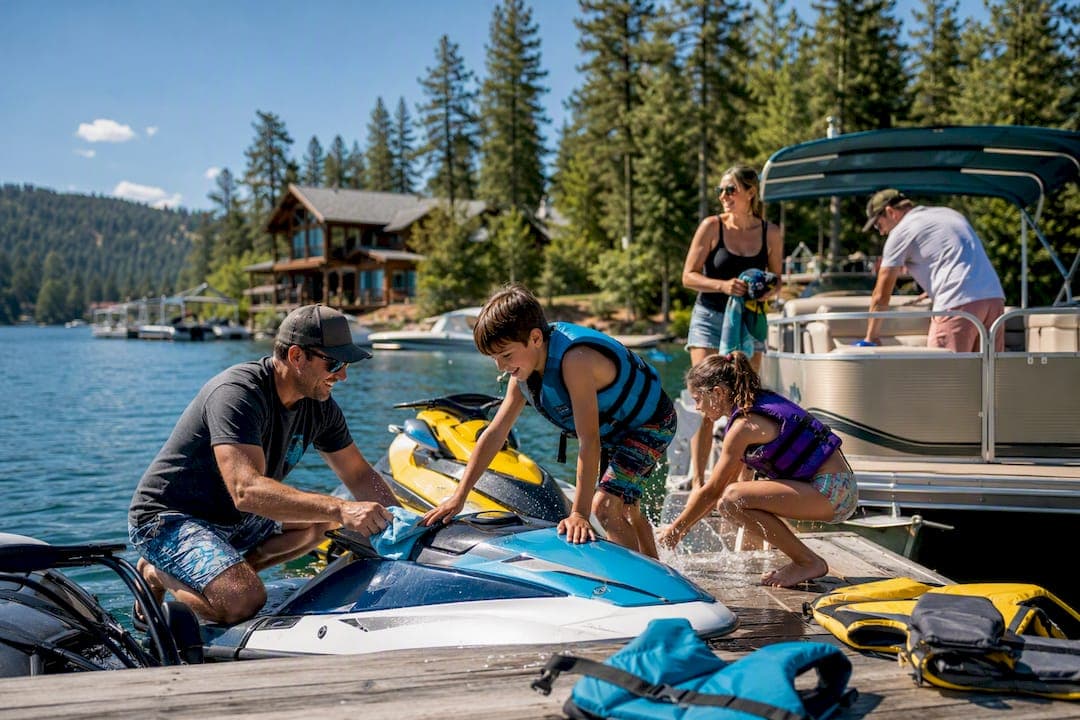
A watercraft rental agreement is a binding contract that spells out who is responsible for the boat or jet ski, who is allowed to operate it, where it can go, and who pays when something breaks. It exists to allocate financial and legal risk before the engine ever starts, not after.
Before you sign anything, or hand a contract to a customer, check that it names these items clearly:
- Both parties, plus the vessel's HIN, make, model, and registration number
- Rental term, pickup and return locations, and an inspection process
- Payment structure, security deposit or damage hold, and refund terms
- Permitted use, geographic limits, and any no-transfer rules
- Operator age, license, or boater-education requirements
- Required safety equipment (life jackets, kill switch, fire extinguisher)
- Insurance coverage and indemnity language
- Steps for reporting accidents, damage, or theft
- Default, early termination, and dispute resolution terms
These clauses touch your insurance coverage and legal exposure the moment you sign, so it is worth checking them against U.S. Coast Guard equipment rules and NASBLA boater-education standards rather than taking a form at face value.
Key Takeaways
A watercraft rental agreement protects both parties only when it clearly names the vessel, defines permitted use, caps liability, and documents the pickup and return inspection in writing.
| Point | Details |
|---|---|
| Verify vessel identity | Match the HIN and registration number on the contract to the plate on the boat before pickup. |
| Read the indemnity clause twice | Confirm whether liability applies regardless of fault or only when the renter caused the damage. |
| Check safety gear against USCG minimums | Life jacket count, kill switch, and fire extinguisher requirements scale with vessel length. |
| Document everything at handoff | Timestamped photos of fuel level, damage, and the safety briefing prevent most disputes. |
| Confirm the deposit cap | Ask for a specific dollar limit on damage and loss-of-use charges before signing. |
Table of Contents
- Clause-by-Clause Breakdown of a Watercraft Rental Contract
- How Does Insurance and Liability Work in a Rental Agreement?
- What Operator and Safety Requirements Should the Agreement Include?
- How Are Rental Rates, Deposits, and Fees Structured?
- What Red Flags Should You Watch for Before Signing?
- How Do You Sign, Store, and Enforce a Rental Agreement?
- Quick Pickup and Return Checklist With Sample Clauses
- What Does a Local Operator's Agreement Typically Include?
- A Fair Contract Protects Everyone on the Water
- Ready to Get on the Water?
- Where to Verify Rules and Templates
- Frequently Asked Questions
- Sources
Clause-by-Clause Breakdown of a Watercraft Rental Contract
A solid watercraft rental contract reads like a checklist wearing legal language. Each section does a specific job, and skipping one usually means someone pays for an argument later instead of a repair.
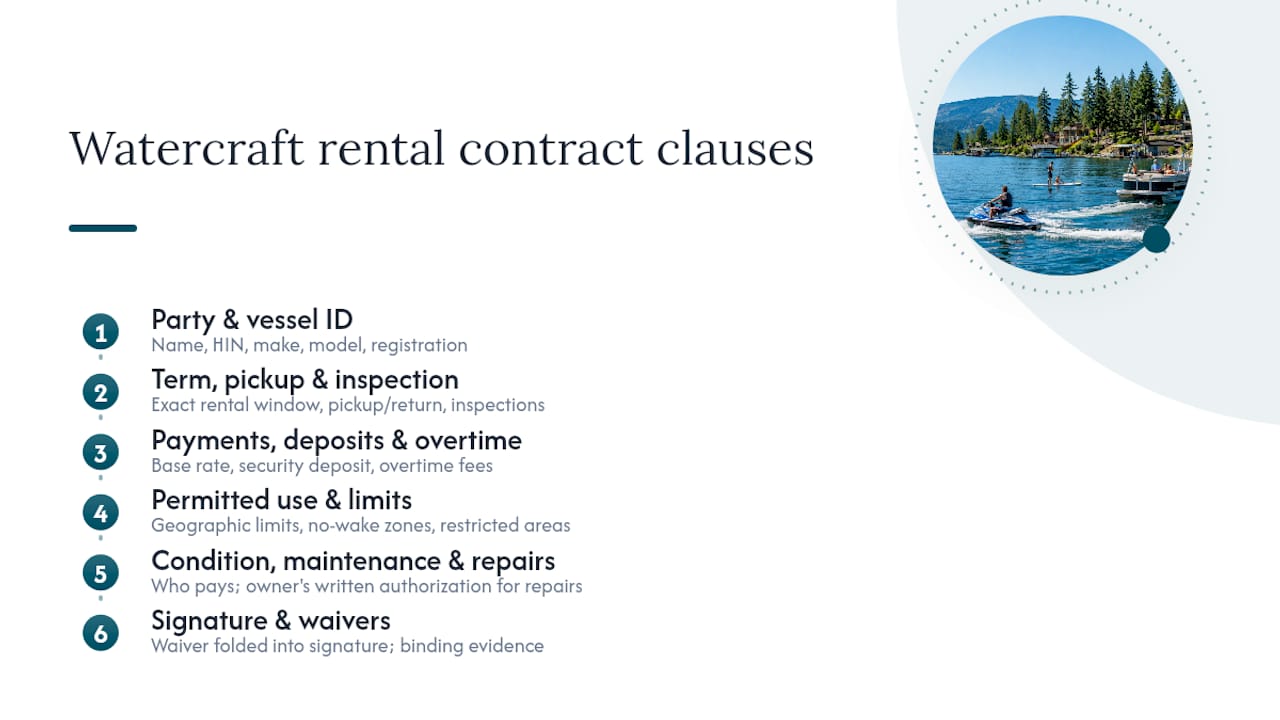
Party and vessel identification. The agreement should name the renter (lessee) and the operator (lessor) in full, along with the vessel's Hull Identification Number, make, model, and state registration. The HIN matters because it is the boat's fingerprint. Confirm it on the contract matches the plate stamped near the transom before you take the keys.
Term, pickup, return, and inspection. Good agreements state the exact rental window, delivery or pickup address, and return deadline down to the hour. They also spell out an inspection protocol at both ends. A blank rental form reviewed by pdfFiller shows how standard templates build this inspection step directly into the signature block, tying the renter's acknowledgment to a specific condition report.
Payments, deposits, and overtime. Expect a base rate, a security deposit or credit card hold, and a defined overtime fee for late returns. One widely used operator form sets a flat $500 security deposit and details exactly how overtime charges accrue past the scheduled return time. Ask for the math in writing: what a half-hour late return costs versus a full day.
Permitted use and geographic limits. Contracts typically restrict where the vessel can travel, sometimes down to specific coves, no-wake zones, or a maximum distance from the launch point. Unauthorized towing to another lake or moving the vessel outside marked boundaries is often grounds for voiding the deposit entirely.
Condition, maintenance, and repair authorization. The agreement should state who pays for what. Normal wear typically falls on the operator; mechanical failure from prior wear usually falls on the owner. Repairs during the rental period generally require the owner's written authorization before work begins, so a renter cannot get billed for a fix they never approved.
Signature and incorporated waivers. Most agreements fold a liability waiver directly into the signature page rather than treating it as a separate document, which is why reading the fine print before signing matters.
A watercraft rental agreement functions as the legal record of who assumed which risks, and courts generally treat a signed waiver as binding evidence of that agreement, not just a formality.
Pro Tip: Photograph the HIN plate and the odometer or hour meter at pickup, and text yourself the image with a timestamp. It costs nothing and settles disputes about hours used or pre-existing damage in seconds.
How Does Insurance and Liability Work in a Rental Agreement?
Most rental operators carry a commercial liability policy, but that policy protects the business, not automatically the renter. Renters often assume they are covered the same way a rental car customer is covered, and that assumption causes real financial pain when a claim comes in.
Indemnity clauses commonly shift the cost of damage, injury, or "loss of use" onto the renter. Loss-of-use language is the one people miss most: it can bill you for the revenue the owner loses while the boat sits in the shop, not just the repair bill itself. According to a legal review of boat rental waivers, these waivers are frequently enforceable and can shift substantial liability onto the signer, including claims that exceed the physical repair cost.
Before signing, look for:
- A clear statement of what the operator's insurance actually covers
- Whether indemnity applies only when you were negligent, or applies regardless of fault
- A defined cap on damage and loss-of-use liability, rather than an open-ended figure
Pro Tip: Ask the operator to show you the insurance policy's declarations page, not just tell you coverage exists. A legitimate operator will not hesitate.
If a clause doesn't say who pays when nobody was clearly at fault, that silence usually favors whoever wrote the contract.
What Operator and Safety Requirements Should the Agreement Include?
The agreement should state minimum operator age and require proof at pickup, such as a photo ID and a boater-education card where applicable. Boater-education reciprocity is inconsistent from state to state, so a NASBLA-approved credential tends to be the most reliable way to satisfy requirements when operating away from home, though verifying it at pickup still matters.
Safety equipment requirements scale with vessel length under U.S. Coast Guard rules, and larger vessels need more life jackets, a working kill switch, and a fire extinguisher aboard. Missing required gear can void insurance coverage and create a federal violation, which is why a rental contract should require the operator to confirm equipment is present and functional before handoff, not just list it as included.
- State the minimum operator age and require ID plus any credential at pickup
- List required safety gear by vessel length, matching USCG minimums
- Document a short safety briefing at handoff, ideally with a signature or timestamp
A documented briefing does more than satisfy a checkbox. It gives the operator something concrete to point to if a renter later claims they were never shown how the kill switch or fire extinguisher worked, which matters far more than a verbal assurance ever does.
How Are Rental Rates, Deposits, and Fees Structured?
Rental agreements typically break costs into a handful of predictable categories: a base hourly or daily rate, a security deposit or damage hold, a fuel policy, and any late or cleaning fees.
- Base rate: hourly, half-day, or full-day pricing tied to the specific vessel type
- Security deposit: either a cash hold or a credit-card pre-authorization, refunded after a clean return inspection
- Fuel policy: pre-purchased fuel or a "return full" requirement, with a per-gallon surcharge if you don't
- Overage fees: a per-minute or per-hour charge for late returns
- Cleaning fees: flat charges for excessive debris, trash, or spills left aboard
Watch for non-refundable deposit language tied to weather cancellations once the vessel has already left the dock. That clause shows up often enough in sample agreements that it is worth asking about before you book.
What Red Flags Should You Watch for Before Signing?
Some clauses are standard risk allocation. Others quietly tilt the entire contract in one direction. Learning to tell the difference takes about five minutes of careful reading.
- One-sided indemnity that applies no matter who caused the damage
- Broad "assumption of risk" language that also waives claims for the owner's own negligence
- Loss-of-use charges with no dollar cap
- No defined inspection process at pickup or return
- Unlimited attorney-fee recovery clauses favoring only the operator
You can usually negotiate a cap on loss-of-use liability, request that indemnity only apply when you're at fault, or ask for a signed pickup checklist as a condition of the deal. If an operator refuses to put operator age limits, geographic restrictions, or insurance proof in writing, that refusal is itself worth walking away from.
Pro Tip: Read the deposit clause twice. If it doesn't state a specific dollar cap on damage, ask for one before you hand over a card.
How Do You Sign, Store, and Enforce a Rental Agreement?
Collect IDs, boater-education cards, and a credit-card imprint at signing. Electronic signatures on integrated waivers carry the same legal weight as pen and paper in most states.
- Photograph the pickup inspection with a timestamp, not just a checklist
- Keep the condition form signed by both parties
- Note that security deposits, repair invoices, and mediation or arbitration clauses are the usual enforcement tools if something goes wrong
Quick Pickup and Return Checklist With Sample Clauses
Before you leave the dock, confirm the HIN, fuel level, visible damage, life jackets, and kill switch, and get the safety briefing logged with a time or photo.
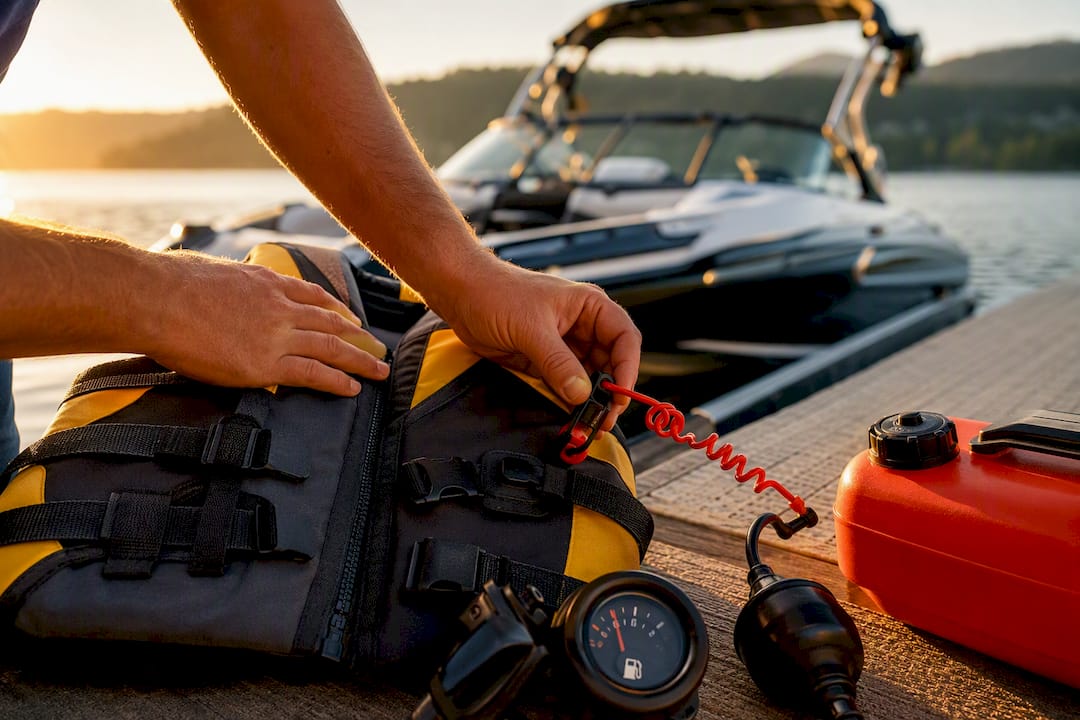
At return, check for new damage, note fuel used, record the return time, and get signatures on the condition form.
Three snippets worth adapting into any agreement:
- Damage hold: "A deposit of $[amount] will be held and applied toward repair costs exceeding normal wear."
- Permitted use: "The vessel may only be operated within [defined boundary] and may not be trailered to another body of water."
- Indemnity cap: "Lessee's liability for damage is limited to $[amount], except in cases of gross negligence."
A rental agreement is only as good as the inspection record behind it. Photo-documented pickup and return steps consistently reduce disputes and speed up insurance claims compared with a verbal handoff.
What Does a Local Operator's Agreement Typically Include?
Local operators around Coeur d'Alene commonly build agreements around age limits by craft type, required Type III life jackets, ID and waiver checks at the ticket desk, and first-come, first-served booking for peak weekends. These operational habits map directly onto contract clauses: the pickup checklist, the safety briefing, and the damage hold all trace back to daily practice on the dock, not just legal boilerplate. Golden Water Sports lists current rental pricing and availability for the lakes it serves.
A Fair Contract Protects Everyone on the Water
Clear rental agreements exist for a simple reason: they keep an honest disagreement about a scratched hull from turning into a legal fight. When every clause states plainly who pays for what and who is qualified to operate the vessel, both the renter and the operator know exactly where they stand before the boat ever leaves the dock. Requiring a documented pickup inspection and a real safety briefing follows budget boat tour best practices for families, so it isn't paperwork for its own sake. It's what keeps claims honest and keeps families safer once they're actually out on the lake.
Ready to Get on the Water?
Understanding a rental agreement is one thing. Actually getting out on Lake Coeur d'Alene is the fun part. Golden Water Sports keeps its agreements straightforward: clear pickup checklists, defined safety equipment, and transparent pricing for jet skis and boats across the Spokane Valley, Liberty Lake, and Coeur d'Alene area. If you're weighing a Yamaha WaveRunner for the weekend, check current jet ski availability at Liberty Lake before booking, since summer weekends fill up fast on a first-come basis. For families planning a first outing, our guide on renter age requirements walks through who can book and who can operate before you arrive at the dock.
Where to Verify Rules and Templates
Cross-check any agreement against official standards rather than relying on the form alone.
- USCG equipment guidance confirms required safety gear by vessel length
- NASBLA reciprocity resources clarify whether a boater-education card transfers across state lines
- Park-specific rules, like those from the National Park Service, matter if you're operating in protected waters
- Sample templates from pdfFiller and operator examples like Liberty Rentals show real clause language worth comparing against any contract you're handed
Frequently Asked Questions
What is a rental agreement for watercraft, in plain terms? It's a signed contract that names the boat or jet ski, the renter, the rental period, and who is financially responsible if something goes wrong. Think of it as the rulebook for the day you're on the water.
Is a watercraft rental waiver actually legally binding? Generally, yes. Courts commonly enforce signed waivers, and legal analysis of these agreements confirms they can shift significant liability, including loss-of-use claims, onto the renter.
Do I need a boater-education card to rent a jet ski or boat? It depends on the state where you're operating, not where you live. A NASBLA-approved credential is the safest bet for cross-state reciprocity, but always confirm with the operator before booking.
What should I photograph before I leave the dock? The HIN plate, fuel gauge, any existing scratches or dents, and the fitted life jackets. A timestamped photo settles most damage disputes without an argument.
Can I negotiate the security deposit or liability terms? Often, yes. Asking for a damage cap, a fault-based indemnity clause, or a signed pickup checklist are all reasonable requests most operators will accommodate.
This article is general information, not a substitute for advice from a qualified lawyer. Consult a qualified legal professional about your own circumstances before acting on anything here.
Sources
- WATER CRAFT AND EQUIPMENT RENTAL AGREEMENT
- Is a boat rental waiver legally binding? (Steinberg Law Firm)
- Lake Crabtree boating and boat rental