
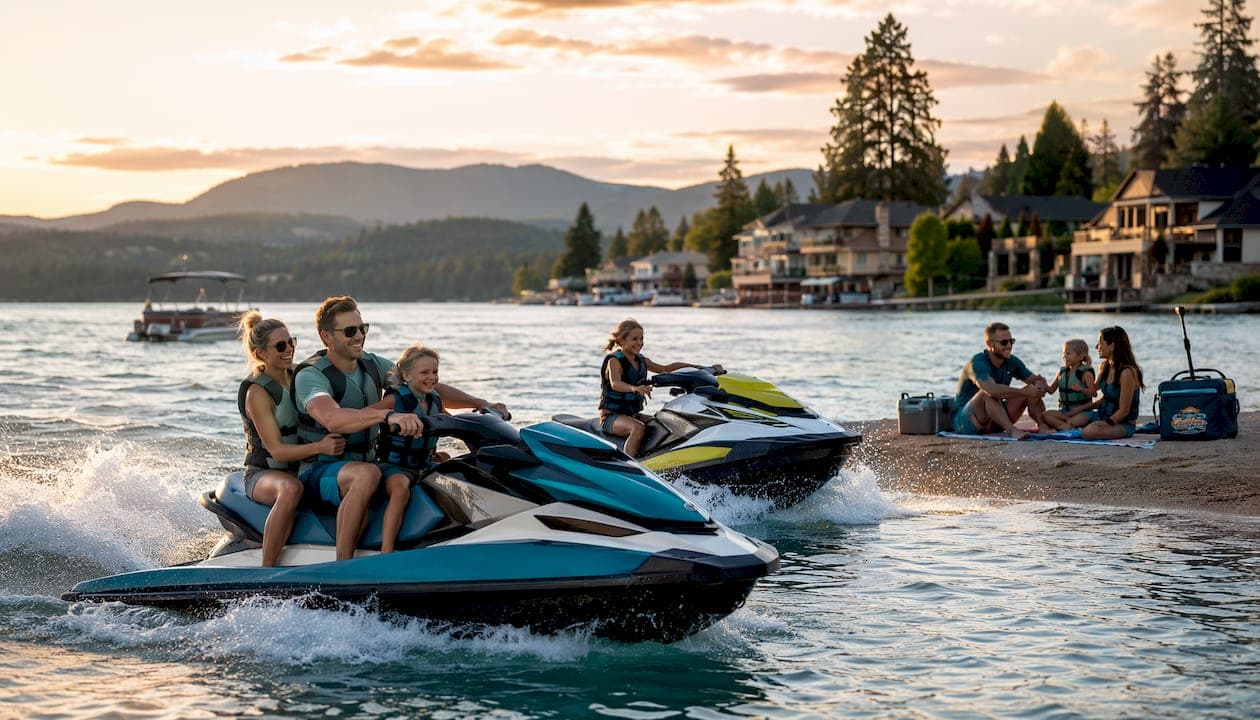
Your first jet ski ride will feel fast, loud, and a little wobbly for the first two minutes — then it clicks. Most first-timers become comfortable shortly after a brief safety session and some low-speed practice drills. You will not be thrown into open water alone. A reputable operator like Goldenwatersports walks you through every control, fits you with a U.S. Coast Guard-approved life jacket (PFD), and keeps an instructor nearby until you demonstrate safe handling. The Yamaha WaveRunner models Goldenwatersports runs are sit-down, stable, and genuinely forgiving for beginners.
TL;DR checklist before you launch:
- Arrive 15 minutes early with a valid photo ID
- Wear a Coast Guard-approved PFD at all times
- Attach the engine safety lanyard to your wrist or life jacket before starting
- Listen to the full safety briefing, including the demo
- Practice at low speed (5–10 mph) before opening the throttle
- Look where you want to go, not at the water in front of you
- If you fall, stay calm, reboard from the rear, and reattach the lanyard
The ride itself is safe, manageable, and genuinely fun. The briefing and the first slow loop are the two things that make the difference between a shaky start and a confident one.
Table of Contents
- What does check-in look like and what does a rental include?
- What will your safety briefing actually cover?
- How do jet ski controls actually work?
- What does your first ride look like, minute by minute?
- What are the most common beginner mistakes and how do you avoid them?
- What are the U.S. safety rules you need to know?
- How long does a first ride take and what does it cost?
- What happens if you fall off, and how do you get back on?
- What to expect when you book with Goldenwatersports
- Key Takeaways
- What nervous first-timers usually get wrong about jet skiing
- Goldenwatersports makes your first ride easy at Lake Coeur d'Alene
- Useful sources and further reading
What does check-in look like and what does a rental include?
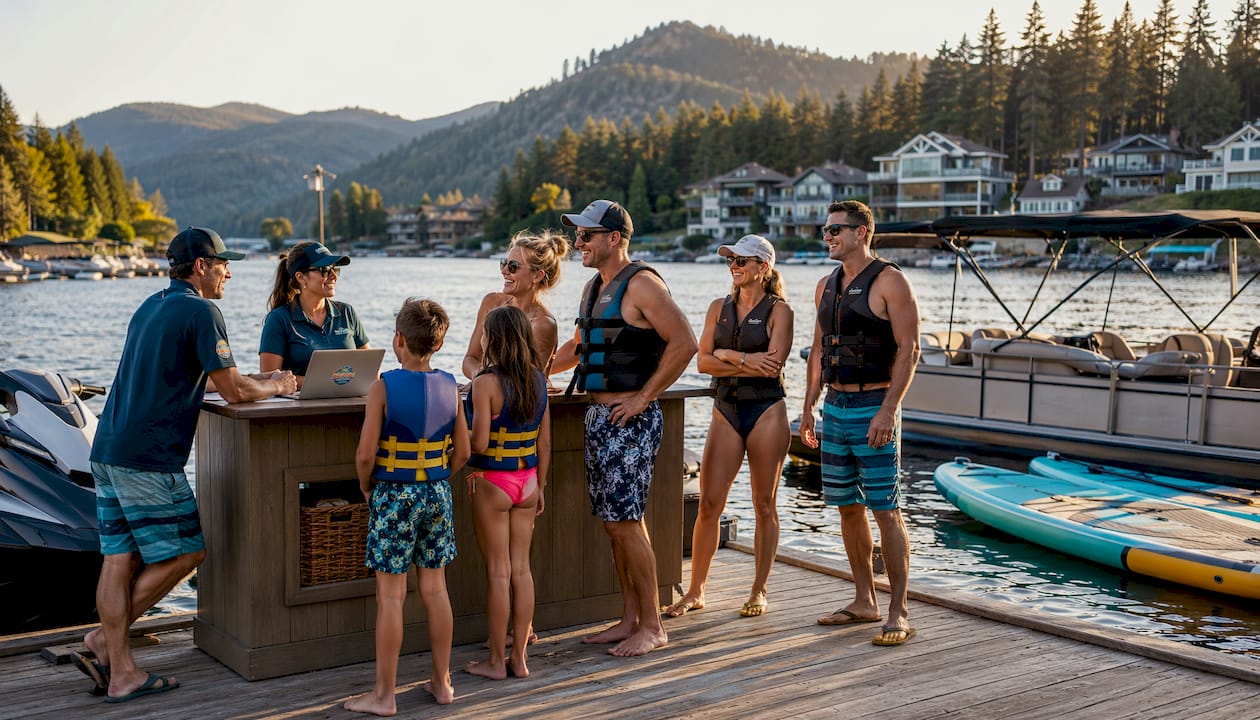
Knowing what to expect first jet ski ride check-in removes most of the pre-ride anxiety. The process is straightforward, but arriving unprepared slows things down for you and the group behind you.
What to bring:
- Valid government-issued photo ID (required to sign the waiver)
- A credit or debit card for the security deposit or pre-authorization
- Water shoes, old trainers, or sandals with a heel strap — flip-flops are a hazard on launch
- Waterproof sunscreen (SPF 30 minimum, applied before you arrive)
- A waterproof phone pouch if you want it, but leave your phone in the car if possible
What to leave behind: jewelry, expensive sunglasses without a strap, loose cover-ups, and anything you cannot afford to lose in the water.
What the rental typically includes:
- A Coast Guard-approved PFD fitted to your size
- Engine kill lanyard
- Fuel (confirm the policy — most operators include it for standard sessions)
- A safety briefing and equipment orientation
- Basic controls demo from a staff member
For a full breakdown of what a rental package covers, Goldenwatersports has a rental inclusions guide worth reading before you book. One practical tip: book a morning slot. Water on Lake Coeur d'Alene is typically calmer before 10 AM, boat traffic is lighter, and you will learn faster without afternoon chop. For a complete packing list, see Goldenwatersports' day-of checklist.
Sit-down models like the Yamaha WaveRunner are the right choice for a first ride. Stand-up PWCs require significantly more balance and physical effort — not where you want to start.
What will your safety briefing actually cover?
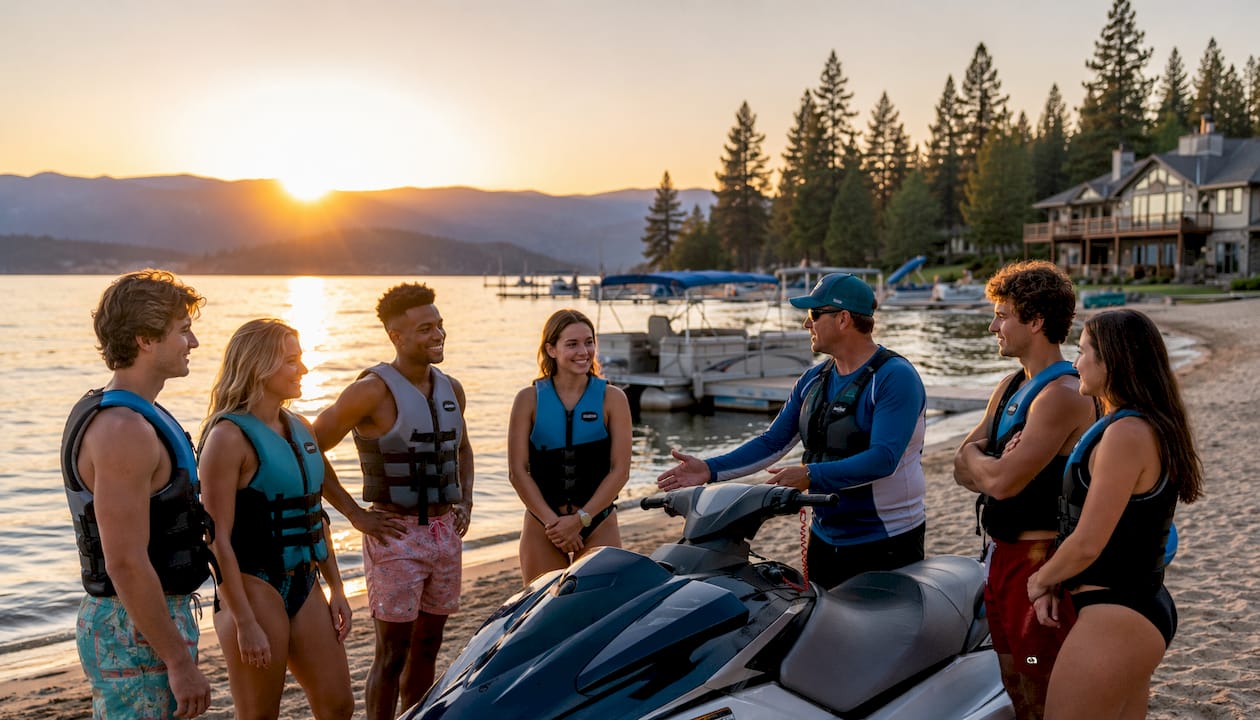
The briefing is not a formality. It is the 10–15 minutes that separates a confident rider from a nervous one, and every reputable operator runs one before anyone touches the throttle.
Standard briefing topics:
- PFD fit and how to check it is secure
- Engine kill lanyard: how to attach it and what happens when it pulls free
- Hand signals between riders and instructor
- Riding zones, no-wake areas, and local boundary markers
- Common local hazards (other watercraft, swimmers, docks)
- What to do if you fall (stay calm, float, reboard from the rear)
- Emergency contact procedure and how to signal for help
The typical sequence runs: instructor demo on a stationary ski, Q&A, then supervised practice in a calm area. Operators keep support staff on the water near beginners until riders demonstrate safe handling. That follow-along phase is where most of the real learning happens.
The briefing also covers the throttle-steering relationship, which is the single most counterintuitive thing about jet skis. You need throttle to steer. Releasing it completely removes your ability to turn. Instructors spend real time on this because beginners instinctively kill the throttle when they get nervous, which is exactly the wrong response near an obstacle. Understanding it in the briefing means you will not be surprised by it on the water. For more on PFD requirements and fit, Goldenwatersports' life jacket safety guide covers the specifics.
How do jet ski controls actually work?
Jet ski controls are simpler than a car's, but two things will surprise you if nobody explains them first.
The main controls:
- Throttle: right-hand squeeze lever. Squeeze to accelerate, release to slow down.
- Steering handlebars: turn left to go left, right to go right — same as a bicycle.
- Ignition/kill switch: usually a key or push-button start; the engine safety lanyard plugs into this.
- Brake lever (some models): newer Yamaha WaveRunners include a brake lever on the left handlebar. Not all models have one. Without a brake lever, slowing down means releasing the throttle and letting water resistance do the work. Start braking well before where you want to stop.
The critical thing beginners miss: steering depends on thrust. A jet ski uses a water jet nozzle, not a rudder. When you release the throttle completely, the nozzle loses pressure and the handlebars do almost nothing. Maintain some throttle while turning — even a light squeeze — and the ski carves cleanly. Let go entirely mid-turn and you will drift straight.
Pro Tip: Place your feet flat on the footwells, keep your knees slightly bent, and hold the handlebars with a firm but relaxed grip. White-knuckling tires your arms out within minutes and makes the ride jerky. Use your core to absorb movement, not your hands.
Body position matters more than most beginners expect. Lean slightly forward when accelerating, lean into turns like you would on a bicycle, and keep your weight centered at all times. The core stabilization approach is what separates riders who feel smooth from those who feel like they are fighting the machine.
What does your first ride look like, minute by minute?
Here is what actually happens from the moment you climb on to the moment you return to the dock.
Step-by-step first ride sequence:
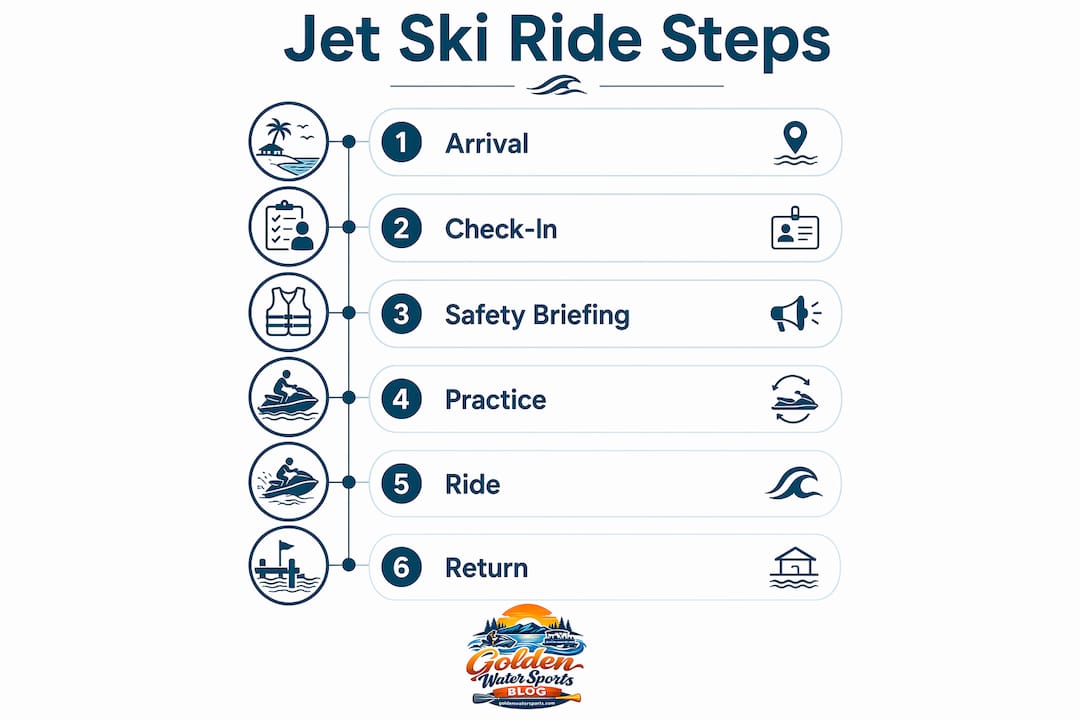
- Pre-launch (0–10 min): Final gear check with the instructor. PFD fitted and clipped, lanyard attached to wrist or life jacket, engine started while still tied to the dock. Instructor walks you through the controls one more time in context.
- Idle zone practice (10–20 min): You idle away from the dock at 5–10 mph in a designated practice area. Gentle acceleration, straight runs, wide turns. The instructor follows close behind or rides alongside. This is the wobbly phase — push through it.
- Confidence-building (20–35 min): Once you are comfortable with steering and basic throttle response, you gradually increase speed. The ski stabilizes as it planes on top of the water, and the ride suddenly feels much more natural. Follow-the-leader drills with the instructor are common here.
- Wrap-up (last 5–10 min): Cool down to idle speed, return to the dock slowly, cut the engine, and hand off the ski to staff. Report any issues — a scrape, a warning light, anything unusual.
What to expect at each stage:
- The first two minutes feel unstable. That is normal. Every beginner goes through it.
- Turns feel wide and slow at first. They tighten up as you add throttle and lean in.
- Speed above roughly 20–25 mph is when the ride smooths out and starts feeling like the videos you have seen.
- The instructor will not let you go far until you demonstrate you can handle a turn and a stop safely.
The follow-the-leader drill at idle speed is the most useful beginner exercise operators run. It teaches throttle-steering without traffic pressure, and most riders find their confidence within one or two loops.
What are the most common beginner mistakes and how do you avoid them?
Most first-ride problems come down to three habits: looking down, gripping too hard, and releasing the throttle at the wrong moment.
Top tips that actually help:
- Look at the horizon, not the handlebars. The ski follows your line of sight. Where your eyes go, the machine goes.
- Relaxed grip. Firm enough to control, loose enough that your arms are not burning after ten minutes.
- Keep some throttle in turns. Releasing it mid-turn removes steering. Light squeeze, lean in, let the ski carve.
- Wear water shoes. Flip-flops come off on launch and create a slip hazard.
- Start slow, progress deliberately. There is no prize for hitting top speed on the first loop.
Common mistakes to avoid:
- Looking down at the water directly in front of you
- Releasing throttle while trying to steer around something
- Gripping the handlebars so tightly your arms fatigue within minutes
- Standing up before you are comfortable with basic handling
- Ignoring no-wake zones near docks and swimmers
Pro Tip: If nerves are hitting hard before you launch, tell the instructor. Ask them to tail you on the first loop and call out corrections. A short buddy ride with someone experienced on a second ski also helps — you focus on following rather than navigating.
If you feel unstable, the fix is almost always the same: slow down, sit back slightly, and look up at the horizon. If you feel like you are about to fall, ease off the throttle gradually rather than dropping it suddenly. For more on avoiding the mistakes first-timers make at Lake Coeur d'Alene specifically, Goldenwatersports' rental mistakes guide is worth a read before you go.
What are the U.S. safety rules you need to know?
Jet skiing in the U.S. falls under boating law in most states, which means the rules are real and enforced on the water.
Mandatory safety gear for every ride:
- Coast Guard-approved PFD worn at all times while the engine runs
- Engine safety lanyard attached to your wrist or life jacket
- Whistle or audible signaling device (required in many states)
Key U.S. rules for first-timers:
- Operating a personal watercraft (PWC) under the influence of alcohol is illegal in all 50 states, treated the same as drunk driving.
- Age and licensing requirements vary by state. Idaho, for example, has specific rules for riders under 18. Check with your operator or the Idaho Department of Parks and Recreation before booking.
- No-wake zones near docks, swimmers, and shorelines are legally enforced, not just courtesy guidelines.
- Many states require a boating safety course or certificate for PWC operators under a certain age.
A reputable operator will walk you through the local rules during the briefing, but it is worth confirming state-specific requirements before you arrive. Goldenwatersports' open-water safety guide covers Idaho-specific considerations in detail.
Environmental awareness: Keep distance from wildlife, stay out of shallow areas where you can disturb the lakebed, and respect marked swimming zones. Lake Coeur d'Alene has designated areas for good reason.
This article is general information, not legal advice. Confirm current Idaho boating regulations with the Idaho Department of Parks and Recreation or your operator before your ride.
How long does a first ride take and what does it cost?
Beginner sessions typically run 30–60 minutes, which includes a 10–15 minute safety briefing and 20–35 minutes of riding and practice time. Your actual ride time varies depending on the session length you book.
What affects the price:
- Session length (30 min vs. 60 min vs. half-day)
- Location and season (summer weekends cost more than weekday mornings)
- Jet ski model and whether the rental is guided or self-guided
- Operator add-ons like guided tours or extended packages
Goldenwatersports' current pricing and session options for Lake Coeur d'Alene, Newman Lake, and Liberty Lake are listed on the rentals and pricing page. Prices vary by season and availability, so checking directly gives you the most accurate figure.
One practical booking tip: if you are nervous, choose the longer session. The extra time is not wasted — it is where the real confidence-building happens. The first 15 minutes are orientation. The second 15 minutes are where it starts to feel natural. Anything beyond that is pure enjoyment.
What happens if you fall off, and how do you get back on?
Falling is common, especially during sharp turns at speed. It is not dangerous when you are wearing a PFD and the lanyard is attached. Here is exactly what happens and what to do.
What happens immediately:
- The safety lanyard pulls free and cuts the engine automatically
- Your life jacket keeps you at the surface
- The jet ski floats nearby — it will not speed away
- The instructor or support staff will move toward you
How to reboard from the rear:
- Swim to the stern (back) of the jet ski
- Locate the rear boarding step or platform
- Grab the rear handles
- Kick your legs to generate upward momentum, then swing them up onto the seat
- Reattach the lanyard before restarting the engine
Never attempt to board from the side. The ski can roll onto you. The rear boarding approach is the safe method, and it is what every operator teaches.
If the jet ski is disabled after a fall:
- Use your whistle to signal for help
- Stay with the ski — it is easier to spot than a swimmer
- Goldenwatersports staff monitor riders on the water and will respond quickly
Falls are most common during sharp turns at speed. Keep your first-ride turns wide and gentle, and the odds of an unplanned swim drop significantly.
What to expect when you book with Goldenwatersports
Goldenwatersports runs a structured check-in process designed specifically for first-timers. When you arrive at Newman Lake or Liberty Lake, staff walk through a safety checklist that covers waiver signing, PFD fitting, lanyard test, and a quick equipment inspection before anyone gets near the water.
The practice area is calm and protected, which matters more than most people realize. Freshwater lakes like Coeur d'Alene, Newman Lake, and Liberty Lake offer predictable conditions without ocean swell or tidal currents — exactly the environment where beginners build confidence fastest. Morning slots on these lakes are particularly good: the water is typically flat before 10 AM and boat traffic is minimal.
What Goldenwatersports instructors focus on with first-timers:
- Throttle-steering relationship explained before launch, not just during the briefing
- Supervised follow-the-leader drills in the practice area until the rider is comfortable
- Staff on the water near beginners throughout the session
- Clear hand signals so you can communicate without stopping
Pro Tip: Ask the instructor to tail you on your first full loop. Having someone behind you removes the pressure of navigation and lets you focus entirely on throttle and steering. Most Goldenwatersports staff do this automatically for first-timers, but asking confirms it.
For local lake-specific tips and timing recommendations, the lake rental tips guide covers what to expect at each location. Booking options for Newman Lake and Liberty Lake are available directly through Goldenwatersports' rental pages.
Key Takeaways
Your first jet ski ride goes smoothly when you arrive prepared, listen to the briefing, and start slow — the controls are simple, the safety systems work, and most first-timers are comfortable within 15 minutes.
| Point | Details |
|---|---|
| Safety briefing duration | Briefings run 10–15 minutes and cover controls, lanyard use, fall recovery, and zone rules. |
| No automobile-style brakes | Most jet skis slow by throttle release; some newer models add a brake lever, so confirm with your operator. |
| Throttle required to steer | Releasing throttle mid-turn removes steering — maintain a light squeeze through every turn. |
| Session length for beginners | Beginner sessions typically run 30–60 minutes, including briefing and 20–35 minutes of ride time. |
| Book with Goldenwatersports | Goldenwatersports offers beginner-friendly Yamaha WaveRunner rentals at Newman Lake and Liberty Lake with instructor-led practice. |
What nervous first-timers usually get wrong about jet skiing
The conventional wisdom says the hard part of a first jet ski ride is the speed. It is not. Speed is the easy part — you control it entirely with one hand. The hard part is the counterintuitive throttle-steering relationship, and almost no beginner guide leads with it clearly enough.
Every nervous first-timer I have seen on the water makes the same move: something surprises them, they release the throttle, and then they wonder why the ski is not turning. The machine did exactly what it was designed to do. The rider just did not know that releasing the throttle removes steering authority. That single piece of knowledge, absorbed before you launch, changes the whole experience.
The other thing people underestimate is how quickly the anxiety dissolves once the ski is moving. The wobble at idle speed feels alarming. Then you hit 20 mph, the hull planes, and suddenly the whole thing feels stable and natural. That transition usually takes under two minutes. The briefing matters not because the rules are complicated, but because it gives you a mental map of what is about to happen. When the ski does exactly what the instructor described, the nervous system relaxes.
Lake Coeur d'Alene and the surrounding lakes Goldenwatersports operates on are genuinely good places to start. Calm freshwater, clear sight lines, and an operator that keeps staff on the water near beginners. If you have been putting off a first ride because it feels intimidating, the environment and the instruction make it far more approachable than open-ocean alternatives.
Goldenwatersports makes your first ride easy at Lake Coeur d'Alene
Ready to get on the water? Goldenwatersports is the straightforward option for first-timers in the Spokane Valley, Liberty Lake, and Coeur d'Alene area. No hunting for equipment, no figuring out launch logistics on your own. You show up, get a proper safety briefing, and ride a reliable Yamaha WaveRunner with an instructor nearby.
Morning slots fill up fast on summer weekends, especially at Newman Lake and Liberty Lake. Goldenwatersports offers flexible session lengths, so you can book a shorter intro ride or go straight to a longer session if you want more practice time. Guided options are available for riders who want an instructor alongside them for the full session.
Check current availability, session lengths, and pricing at the Goldenwatersports rentals page. If you want to book a specific location, the Newman Lake rental page has details on that site. Weekend spots go quickly in summer — check availability now and lock in your session before the best morning slots are gone.
Useful sources and further reading
- How to Drive a Jet Ski | Better Boat — controls, braking, and beginner technique
- Riding a Jet Ski: Mastering Turns and Stops | BoaterExam — U.S. safety equipment requirements and PFD rules
- Jet Ski Tips for First Timers | Miami Watersports — safety briefing content and duration
- First Time on a Jet Ski? | Jetti Blog — throttle-steering relationship, body position, and beginner drills
- First-Time Jet Ski Guide | East Valley Jet Skis — reboarding technique and session length expectations
- Goldenwatersports Rental Inclusions Guide — what your rental package covers
- Goldenwatersports Open-Water Safety Guide — Idaho-specific safety practices
- How Boat Tours Work for First-Timers | Affordable Crab Island Tours — how operators brief and support first-time passengers
- Goldenwatersports Prices and Session Options — current rental pricing for Lake Coeur d'Alene area