
Most boat rentals require a credit card hold or a fixed deposit, usually $150 to $1,500 depending on boat type, and operators keep part or all of it only for documented damage, fuel, cleaning, no-shows, or late returns. The hold itself is not a charge. It is a temporary block on your available credit that gets released once the boat comes back clean, full, and undamaged. Your best protection is simple: read the rental agreement before you sign, and photograph everything before you leave the dock.
TL;DR:
- Deposit amounts vary from $150 for paddlecraft to $1,500 for large, high-power boats, driven mainly by insurance deductibles and replacement costs.
- A credit card hold does not deduct money but temporarily reduces available credit, with release times depending on the bank’s processing, often taking up to 10 days.
- Most disputes over deposits stem from inadequate documentation, emphasizing the importance of photographing the boat before and after use and keeping detailed records.
- Forfeiture usually results from no-shows, damage, low fuel, excessive cleaning, or rule violations, with operators itemizing deductions rather than withholding full deposits.
- Confirm deposit and hold policies in writing before signing, and maintain a detailed, timestamped record of the boat’s condition to support dispute resolution if necessary.
Table of Contents
- Understanding Boat Rental Deposit Rules and Typical Amounts
- Credit Card Holds vs. Actual Charges: What Happens to Your Money
- When Deposits Get Refunded and Why Refunds Sometimes Lag
- Why Deposits Get Forfeited: No-Shows, Damage, Fuel, and Cleaning
- What to Check in the Rental Agreement Before You Sign
- How to Document Condition and Build a Dispute Packet
- How Golden Water Sports Handles Deposits and What Renters Can Learn From It
- What Every Renter Should Remember About Deposits
- Book With Golden Water Sports and Skip the Deposit Guesswork
- Sources
- FAQ
Understanding Boat Rental Deposit Rules and Typical Amounts
Deposit amounts track directly with what an operator stands to lose if something goes wrong. A pontoon boat that seats ten people and tops out at 25 miles per hour carries a different risk profile than a 90 horsepower ski boat capable of pulling a wakeboarder at speed, and deposit rules reflect that gap.
Smaller, lower-power rentals like paddleboards, kayaks, and basic pontoons often carry the lightest deposit requirements, sometimes as low as $100 to $150. Personal watercraft and mid-size powerboats tend to land in the middle, while larger motorboats, wake boats, and anything with serious horsepower or a higher replacement cost climb toward the top of the range. One sample operator agreement shows a flat $1,000 security deposit collected before the boat leaves the dock, held specifically to cover repair costs if damage turns up on return.
Operators generally choose between three deposit structures:
- Flat fee per boat category. A set dollar amount tied to the type of vessel, regardless of how long you rent it. This is the most common approach and the easiest for renters to plan around.
- Percentage of the rental cost. Less common for single-day trips, but it shows up on longer or multi-day charters where the total bill is harder to predict upfront.
- Tiered deposits by risk class. Some companies group boats into risk categories (paddle craft, family pontoons, performance boats) and assign a different deposit to each tier, similar to the $150 to $500 range documented on sample pontoon rental terms.
Why the wide spread? Insurance is the biggest driver. An operator's fleet policy often carries a deductible, and the deposit is designed to cover that deductible if a claim gets filed. A boat with a $2,500 deductible on hull damage will almost always carry a heftier deposit than one insured with a $500 deductible. Replacement cost matters too. A jet ski that costs $12,000 to replace justifies a firmer hold than a stand-up paddleboard that costs $400.
At Golden Water Sports, the Jet Ski Damage Deposit runs $500 per jet ski, and the Boat Damage Deposit is $1,000 per boat, figures that sit squarely inside the ranges you will see across the industry. Knowing the typical spread before you book helps you budget for the hold on your card and avoid a surprise when you check the confirmation email.
Credit Card Holds vs. Actual Charges: What Happens to Your Money
A pre-authorization hold and an actual charge are not the same thing, and confusing the two causes most of the panic renters feel when they check their bank app mid-vacation.
A hold reduces your available credit but does not move any money out of your account. Your bank sets aside the deposit amount as "pending," which means you cannot spend that portion of your limit, but the operator has not been paid it. Boatsetter's renter guidance confirms this is standard across the industry: the hold exists purely to guarantee funds are available if damage or a violation shows up during inspection.
Here is how the timeline usually plays out:
- At check in, the operator places the hold, typically for the full deposit amount, using the card on file.
- During the rental, the funds stay frozen. Nothing gets deducted unless something goes wrong.
- At check out, staff inspect the boat. If everything checks out, they initiate a release, not a refund, since no money changed hands.
- After release, your bank determines how fast the hold disappears from your statement. Some banks clear it same day. Others take 3 to 10 business days, and in rarer cases, up to 21 days depending on the issuing bank's own policies.
A hold converts into an actual charge only when the operator finds a specific, documented reason: damage beyond normal wear, a missing fuel fill, excessive cleaning needs, or a violation of the rental terms. At that point, the operator processes a real transaction for some or all of the held amount, and the remainder (if any) gets released separately.
Pro Tip: Ask the front desk for the exact hold amount and the card's last four digits on your printed or emailed receipt. If a dispute comes up later, that receipt is your proof of what was authorized, which matters far more than your memory of the conversation.
When Deposits Get Refunded and Why Refunds Sometimes Lag
Refund timing depends less on the operator and more on the plumbing between the merchant's payment processor and your bank's posting cycle. An operator can release a hold within minutes of your boat coming back clean, but your bank still has to process that release on its own schedule.
Typical refund windows run anywhere from same day to about a week. A few outliers stretch past two weeks, especially with prepaid cards or smaller regional banks that batch-process pending transactions overnight instead of in real time. This is the single biggest source of renter frustration, since the boat can be sitting safely back at the dock while the hold still shows up as "pending" on a phone screen three days later.
To speed things along and protect yourself if a dispute happens, collect this before you ever leave the rental counter:
- Timestamped photos or video of the boat's exterior, interior, and fuel gauge at pickup and return.
- A signed check in and check out form, if the operator provides one.
- The receipt showing the exact hold amount and authorization date.
- Contact information for the specific staff member who conducted your return inspection.
Sample rental agreements consistently show that clear, itemized post-rental invoices paired with signed check in and check out forms are the strongest evidence a renter can produce when contesting a charge, far more persuasive than a verbal description of "leaving it in good shape."
If a refund runs past the window your operator quoted at booking, escalate in order: contact the operator directly first, since most delays are simple processing lag rather than a dispute. If that stalls, contact your card's payment processor to ask about the release status. Your bank's chargeback process is the last resort, reserved for cases where the operator has gone silent or refuses to release funds it already agreed to release.
Why Deposits Get Forfeited: No-Shows, Damage, Fuel, and Cleaning
Forfeiture is where most renter complaints originate, and nearly all of them trace back to a policy that was written in the agreement but never actually read.
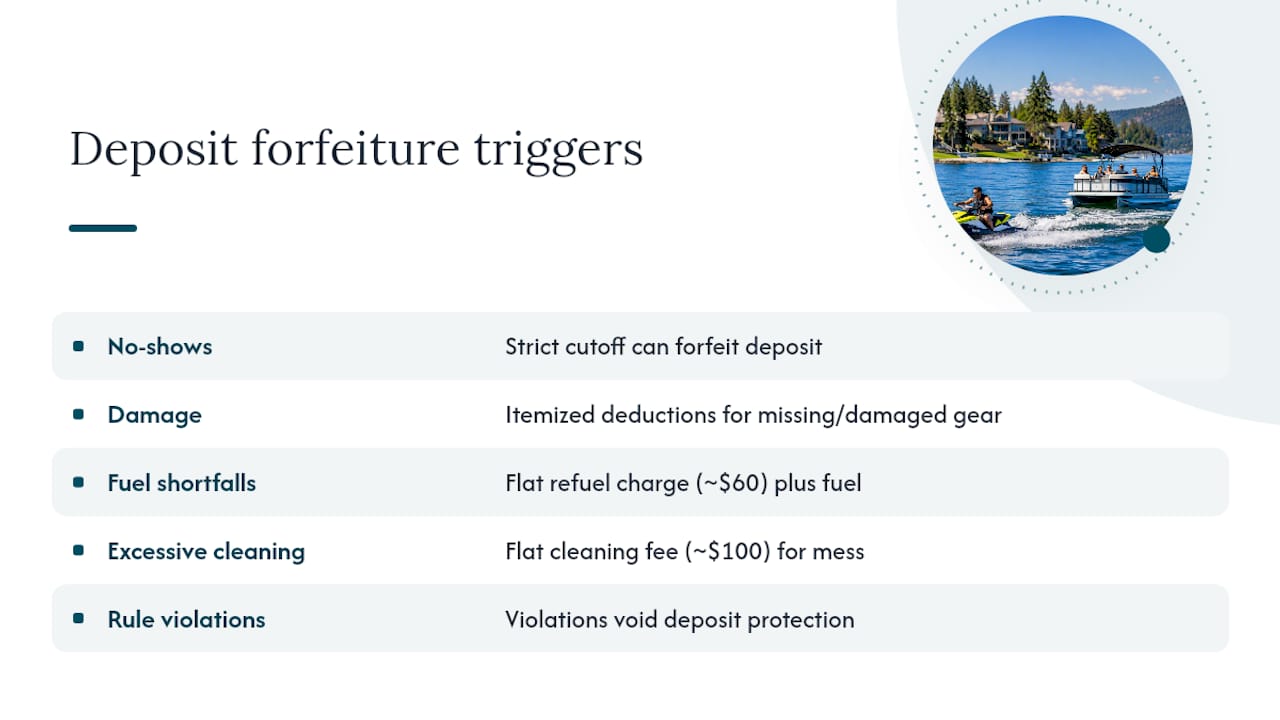
No-shows and late pickups. Many operators set a strict cutoff time, and missing it can mean losing your deposit entirely. Sample terms pages show this is standard practice, not a punitive exception. Weather delays, traffic, or simple lateness beyond the grace period can all trigger this.
Damage and missing equipment. Inspectors compare the boat's return condition against the pickup documentation. Scratches deeper than normal wear, cracked windshields, damaged upholstery, or a missing life jacket or cushion all get itemized against the deposit. Reasonable wear, like a scuffed dock bumper, generally does not count.
Fuel shortfalls. Most rentals go out full and are expected to come back full. If you return low, the operator charges a flat refueling fee rather than sending you to calculate exact gallons. Sample terms list a fuel fee around $60, on top of the fuel cost itself.
Excessive cleaning. Sand tracked through the cabin, spilled drinks, or fish blood on the deck usually trigger a flat cleaning charge rather than an hourly labor bill. The same sample terms list a cleaning fee around $100 for rentals returned in rough shape.
Rule violations. Exceeding the rated passenger capacity, operating outside a marked no-wake zone, or letting an unauthorized driver take the wheel can all void deposit protection outright, since these violate the safety terms baked into the rental agreement itself.
Operators are expected to itemize every deduction rather than simply withholding the full deposit. If your final statement just says "damage" with a flat number and no breakdown, that is your cue to ask for specifics in writing before accepting the charge.
Pro Tip: Take a slow walk-through video of the entire boat, narrating out loud, right before you hand back the keys. It costs you two minutes and gives you a timestamped record that matches exactly what the inspector is about to see.
What to Check in the Rental Agreement Before You Sign
The rental agreement is where deposit rules actually live, and most disputes happen because a renter skimmed it instead of reading the specific clauses that govern their money.
Before you sign anything, confirm these points in writing, either in the printed agreement or a follow-up email:
- Deposit versus hold language. Does the contract say "deposit" (implying cash collected) or "authorization hold" (implying a temporary block)? The wording changes what actually happens to your funds.
- Release timing. Look for a stated window, even a range like "3 to 10 business days." An agreement with no timing language at all is a red flag worth asking about before you book.
- Cancellation and rescheduling terms. Some operators keep a processing fee on refunds or treat deposits as nonrefundable inside a specific cancellation window, often 24 to 48 hours before departure.
- Damage liability limits. Confirm whether your deposit is the maximum you could owe, or whether the operator reserves the right to bill you beyond it for major damage.
- Dispute process. Check for a named contact or a formal written-appeal process. If none exists in the contract, ask who handles disputes before you hand over your card.
If a staff member verbally promises an exception, like a shorter hold time or a waived cleaning fee, get it in an email or text before you leave. Verbal promises rarely survive a dispute, and a written record protects both sides. Reviewing a renter's guide to watercraft rental agreements before your trip can help you spot unfamiliar clauses faster.
How to Document Condition and Build a Dispute Packet
Good documentation is the cheapest insurance you will ever buy, and it takes about ten minutes total across your whole rental.
- Before you leave the dock, photograph or video the hull, interior, upholstery, and fuel gauge from multiple angles, with a timestamp visible if your phone supports it.
- Note the fuel level precisely rather than estimating. "About half" is not defensible; "gauge reads exactly at the half mark" is.
- At return, walk the boat with a staff member if possible, and ask them to sign a joint condition report on the spot rather than relying on a solo inspection after you have left.
- If a charge appears that you dispute, assemble your packet immediately: pickup photos, return photos, the signed condition report, your original receipt, and a short written timeline of events.
- Send the packet to the operator first, in writing, before escalating to your card issuer.
Following a check in process like the one outlined in Golden Water Sports' guide for first-time renters gives you a template even if you rent somewhere else entirely.
Pro Tip: Email your predeparture photos to yourself the moment you take them. A timestamped email is harder to dispute than photos sitting only in your camera roll, which can be edited or have their metadata questioned.

How Golden Water Sports Handles Deposits and What Renters Can Learn From It
Some operators keep a simple deposit structure with fixed amounts for jet skis and boats, collected as card holds rather than cash charges, releasing the hold once the equipment returns in good condition.
The company documents boat and jet ski condition at check-in specifically to avoid the vague "damage" disputes that plague less transparent operators. Its own blog breaks down exactly which damage charges run $25 to $75 and what a fair dispute process looks like, giving renters a real number range instead of a mystery fee.
The practical advice Golden Water Sports gives every renter mirrors the checklist above: photograph the watercraft before pushing off, confirm the fuel level with staff at pickup, and ask any policy questions before you leave the lot rather than after you are back. Renters heading out for a day on the water, whether chasing the best beaches on Lake Coeur d'Alene or exploring family-friendly coves by boat, benefit from the same five minutes of documentation regardless of which company they rent from.
What Every Renter Should Remember About Deposits
The deposit conversation gets treated like fine print, but it is really just risk sharing between you and the operator. Most disputes I have seen described in industry terms and conditions come down to one of two failures: a renter who did not document condition, or an operator who did not itemize a deduction clearly. Neither side comes out looking good in that scenario.
A few things stick out after digging through operator policies across the industry. Fixed fees for fuel and cleaning are more common than percentage-based penalties, which actually favors renters since the cost is predictable. Hold release timing is almost entirely a bank issue, not an operator issue, so patience with your bank matters more than pressuring the rental counter. And the renters who avoid disputes entirely are, without exception, the ones who took thirty seconds of video before handing back the keys.
Read the agreement. Photograph the boat. Ask questions before you sign, not after you get a charge. That is the whole system.
— Life is better on water.
Book With Golden Water Sports and Skip the Deposit Guesswork
Some rental companies post their deposit amounts upfront, allowing renters to budget their trip expenses without surprise hold amounts.

If you are planning a jet ski day, check current availability and pricing for jet ski rental at Liberty Lake, where an additional hour runs $75 if your group wants to stay out longer. Renters looking at Newman Lake can review the jet ski rental options there directly. For pontoons, paddleboards, wakeboards, and full pricing details, the Golden Water Sports homepage covers the full lineup, and the pricing page breaks down what to expect before you book. Reserve your date now and get your deposit questions answered before you ever step on the dock.
Sources
Operator terms pages vary, so it pays to read a few before you commit. Sample agreements from LSC Boat Rentals and CBS Pontoon Boat Rentals show how fixed deposits and refund language typically get written. Boatsetter's security deposit guide explains hold mechanics from a renter's side, while Captain Mannis Boat Rentals lists concrete fuel and cleaning fee examples worth comparing against any quote you receive. For hull cleanliness standards that affect cleaning deductions, Diamondbrite's hull cleaning guide is a useful reference point.
- Security deposit (Renters)
- agreement.html
- Terms of Service
- Captain Mannis Boat Rentals Terms & Conditions
FAQ
How much is a typical boat rental deposit?
Deposits generally run $150 to $1,500 depending on boat type and operator policy. Golden Water Sports charges a $500 damage deposit per jet ski and a $1,000 damage deposit per boat, both handled as a card hold rather than a cash charge.
Do you have to pay for gas when you rent a boat?
Yes, most rentals go out with a full tank and are expected to come back full. If you return the boat low on fuel, operators typically charge a flat refueling fee, often around $60, on top of the actual fuel cost.
What is the number one unspoken rule on a boat?
Respect the boat like it is not yours, because it is not. That means no shoes tracking sand below deck, no drinks without a lid near upholstery, and confirming with your operator before letting anyone else drive.
How long does a deposit hold take to release?
Release timing depends on your bank more than the operator. Some clear the same day, others take 3 to 10 business days, and a small number of banks take up to 21 days to fully clear the pending transaction.
What are the requirements for renting a boat?
Requirements vary by operator and boat type, but most require a valid driver's license, a minimum age (often 21 or 25 for larger vessels), and a credit card for the deposit hold. Some states also require a boating safety certificate for operators born after a certain year, so check your state's specific rule before booking.