

Common jet ski etiquette rules are the set of practices that keep riders, swimmers, anglers, and boaters safe and respected on shared waterways. Personal watercraft (PWC) operation falls under the same maritime framework as any power-driven vessel, meaning federal Coast Guard regulations, COLREGs 2026 guidelines, and state-level rules all apply the moment you leave the dock. Ignoring these standards does not just create conflict. It creates genuine danger. Whether you rent a Yamaha WaveRunner for the afternoon or own your own PWC, knowing these rules before you ride is non-negotiable.
1. Common jet ski etiquette rules start with maintaining a proper lookout
Every rider must maintain a proper lookout by sight and hearing at all times, using all available means appropriate to the conditions. This is not optional advice. It is a COLREGs requirement that applies to every vessel on the water, including jet skis. Scanning ahead, to both sides, and behind you every few seconds is the baseline behavior that prevents collisions before they start. Wearing earplugs or blasting music through a waterproof speaker while riding eliminates half your situational awareness and puts everyone nearby at risk.
2. Operate at a safe speed for current conditions
Safe speed means traveling at a pace that allows you to take proper and effective avoidance action based on visibility, traffic density, and water conditions. On a busy summer afternoon at Liberty Lake or Coeur d'Alene, that speed is far lower than the machine's top capability. A jet ski traveling at full throttle in congested water gives you almost no reaction time if a child on a paddleboard drifts into your path. Throttle down whenever the water around you is crowded, murky, or unfamiliar.
3. Respect no-wake zones without exception
In North Carolina, PWC operators must maintain idle speed within 100 feet of docks, piers, swimmers, anchored vessels, and manually propelled watercraft like kayaks and canoes. Violations carry fines up to $200. Most lake jurisdictions across the country use similar 100-foot thresholds, and the standard applies whether or not a sign is posted. No-wake zones exist because even a moderate wake can capsize a kayak, injure a swimmer, or slam a docked boat against its cleats. Treat every dock approach and every swim area as a no-wake zone by default.
4. Always attach the engine cut-off switch lanyard
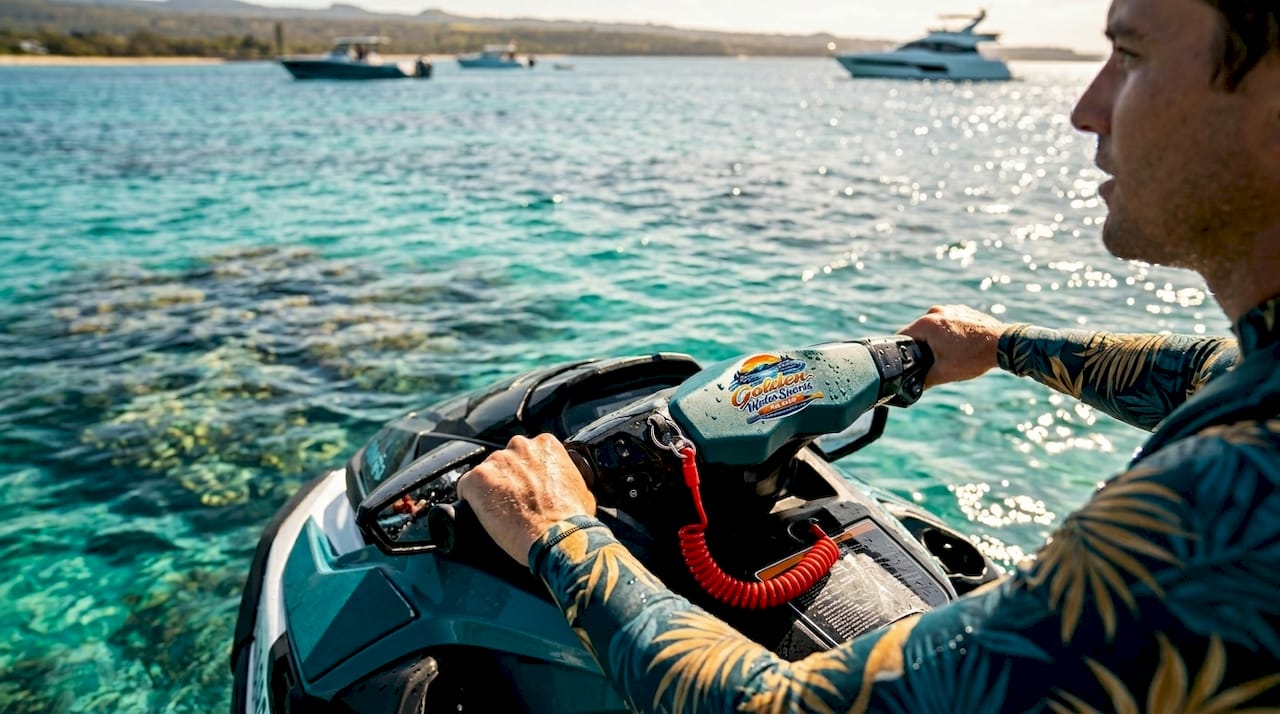
Federal law requires covered recreational vessels to be equipped with an engine cut-off switch (ECOS), with a use requirement that took effect April 1, 2021, under the Coast Guard Authorization Act of 2018. If you fall off your jet ski without the lanyard attached, the engine keeps running and the machine circles back toward you or nearby swimmers at speed. Attaching the lanyard takes three seconds and prevents one of the most catastrophic accident types in PWC riding. Make it the last thing you do before leaving the dock.
Pro Tip: Build the lanyard attachment into your pre-launch checklist alongside your life jacket check. Treat it as a non-negotiable step, not an afterthought.
5. Stay clear of swim areas, divers, and anchored boats
Isle of Man maritime officials issued safety warnings after jet skis were observed operating inside designated swimming and bathing areas, a direct violation of collision regulations. Pennsylvania regulations require operators to maintain at least 100 feet from dive-down flags or vessels displaying alpha flags to protect divers below the surface. These are not suggestions. A diver surfacing unexpectedly or a child swimming outside the buoy line can appear with zero warning. Give swim areas and flagged dive zones the same wide berth you would give a reef.
6. Vary your riding area and avoid repetitive shoreline patterns
Pennsylvania regulations require PWC operators to vary their operating areas, avoid repetitive shoreline tracking, and stay away from anglers and other lake users. Riding the same loop along a shoreline repeatedly is one of the most common complaints filed against jet ski users on inland lakes. It creates constant noise exposure for shoreline residents, disturbs fish and wildlife, and signals to other lake users that you are indifferent to their experience. Rotate your riding area across the open water and change your patterns throughout the session.
7. Keep noise to a minimum and maintain your muffling equipment
Noise control and responsible operation are codified in Pennsylvania's PWC regulations, which require operators to maintain good muffling systems and avoid unnecessary noise near shorelines and other users. A jet ski with a degraded or modified exhaust system is not just annoying. It is a regulatory violation in most states. Beyond the legal angle, excessive noise is the single fastest way to generate complaints from shoreline residents and anglers, which eventually leads to local restrictions that affect every rider on that lake. Maintain your machine properly and throttle down near populated shores.
8. Yield to the correct vessel in every encounter
Jet skis are classified as power-driven vessels under COLREGs, which means specific yield rules apply in overtaking, head-on, and crossing situations. In a crossing scenario, the vessel on your starboard (right) side has the right of way and you must give way. When overtaking another vessel, you must keep clear regardless of which side you pass on. When meeting head-on, both vessels should alter course to starboard. The table below summarizes the three core encounter types every jet ski rider needs to know.
| Encounter type | Your responsibility as a PWC operator |
|---|---|
| Crossing (vessel on your right) | Give way. Alter course early and clearly to pass behind them. |
| Head-on meeting | Both vessels turn to starboard. Do not hold your course. |
| Overtaking another vessel | You are the give-way vessel regardless of which side you pass. |
| Meeting a non-motorized vessel | Always yield to kayaks, canoes, paddleboards, and sailboats. |
9. Make course changes early and unmistakably clear
The COLREGs principle of early, bold action means that when you need to alter course to avoid a collision, you do it decisively and well in advance, not at the last second. A small, hesitant course adjustment communicates nothing to the other operator and can actually cause a collision by creating confusion about your intentions. If you need to turn, turn hard and early so the other vessel sees exactly what you are doing. This applies to every situation from passing a pontoon boat to avoiding a swimmer who drifted into open water.
10. Use signals and communicate your intentions clearly
On a jet ski, verbal communication is nearly impossible at speed. Hand signals, horn signals, and deliberate course changes are your primary communication tools. One short blast on a horn signals you intend to pass on the port (left) side. Two short blasts signal a starboard pass. If you are approaching a blind corner in a cove or inlet, a single long blast warns other operators of your presence. Most novice riders never use horn signals at all, which leaves other boaters guessing at their intentions and increases collision risk significantly.
11. Build a pre-ride checklist into every session
Incorporating the kill-switch lanyard attachment into a pre-launch checklist ensures compliance with federal law and protects both you and bystanders. A complete pre-ride checklist for proper jet ski behavior covers five items: life jacket fitted and fastened, ECOS lanyard attached to your wrist or life jacket, fuel level confirmed, throttle and steering tested at idle, and a visual scan of the launch area for swimmers and other vessels. Riders who skip this checklist are not just cutting corners on safety. They are skipping the habits that make etiquette automatic rather than reactive.
Pro Tip: Check the rental check-in process before your first ride. Rental briefings cover local lake rules, no-wake zones, and safety gear requirements specific to your riding area.
How regional regulations shape jet ski riding etiquette on lakes
Local and state rules are not separate from etiquette. They are the legal floor that etiquette builds on. Understanding what the law requires in your specific riding location is the first step toward riding responsibly.
- Pennsylvania requires PWC operators to vary riding areas, maintain muffling systems, avoid repetitive shoreline tracking, and stay clear of anglers. Violations are treated as nuisance offenses with escalating consequences.
- North Carolina mandates idle speed within 100 feet of docks, swimmers, anchored boats, and manually propelled vessels. Fines reach $200 per violation.
- Federal ECOS law applies to all covered recreational vessels nationwide. The use requirement has been in effect since April 2021, and noncompliance carries federal penalties.
- Dive flag rules in Pennsylvania require 100 feet of clearance from any vessel or marker displaying a dive flag. Most other states use the same standard.
- Bathing area restrictions are enforced at the local level in most lake jurisdictions, often without posted signage. When in doubt, stay out.
"Jet ski operators must avoid swimming and bathing areas and maintain proper lookout and safe speed at all times to comply with collision regulations." — Isle of Man Maritime Authority
Learning the specific rules for Coeur d'Alene and surrounding lakes before you ride is not just good practice. It is the difference between a great day on the water and a fine, a conflict, or worse.
Key takeaways
Responsible jet ski riding requires combining federal safety law, COLREGs right-of-way rules, and local lake regulations into one consistent set of habits practiced on every ride.
| Point | Details |
|---|---|
| Proper lookout is mandatory | Scan by sight and hearing continuously. Never ride distracted or with audio blocking your awareness. |
| ECOS lanyard is federal law | Attach the engine cut-off switch lanyard before every departure. Noncompliance carries federal penalties. |
| No-wake zones protect everyone | Maintain idle speed within 100 feet of docks, swimmers, and non-motorized vessels without exception. |
| Vary your riding area | Avoid repetitive shoreline patterns to reduce noise complaints and preserve community access to the lake. |
| Yield rules apply to jet skis | PWCs are power-driven vessels under COLREGs. Give way in crossing situations and always yield to non-motorized craft. |
Why etiquette is the reputation you build every time you ride
I have watched the same pattern play out on lakes across the Pacific Northwest. A handful of riders who ignore no-wake zones, blast past swim areas, and run the same shoreline loop for three hours straight generate enough complaints to trigger new local ordinances that restrict everyone. The riders who caused the problem are long gone. The restrictions stay.
Etiquette is not about being timid on the water. A Yamaha WaveRunner is a genuinely thrilling machine and there is nothing wrong with using it that way in open water. The point is that your behavior on the water is visible to every angler, every family on a pontoon, every swimmer near a dock. You are building a reputation in real time, and that reputation either supports or erodes access for every other rider on that lake.
New riders often treat etiquette as a list of restrictions. Experienced riders treat it as spatial awareness and anticipation. The difference is that experienced riders are scanning ahead, planning their course changes early, and adjusting their speed before a situation becomes a problem. That mindset is what separates a rider who gets better with every session from one who eventually causes an incident.
My honest recommendation: adopt the pre-ride checklist, learn the specific rules for every lake you ride, and treat the no-wake zones as absolute. The thrill of the ride does not diminish when you follow these rules. It gets better, because you are riding with confidence instead of hoping nothing goes wrong.
— Lex
Ride right with Goldenwatersports

Goldenwatersports provides Yamaha WaveRunner rentals on Coeur d'Alene, Liberty Lake, and surrounding lakes, with every rental including a full safety briefing that covers local no-wake zones, ECOS lanyard requirements, and proper jet ski behavior specific to your riding area. The team walks every guest through the jet ski operation guidelines that matter most before they leave the dock. If you want to get on the water with confidence, knowing you have the rules and the right equipment, book your rental with Goldenwatersports and start your session the right way.
FAQ
What are the most important jet ski etiquette rules?
The most critical rules are maintaining a proper lookout at all times, attaching the ECOS lanyard before every ride, respecting no-wake zones within 100 feet of docks and swimmers, and yielding to non-motorized vessels. These four practices cover the majority of safety and courtesy situations you will encounter on any lake.
How close can a jet ski get to swimmers?
Most state regulations, including North Carolina's no-wake zone rules, require PWC operators to maintain idle speed within 100 feet of swimmers. Many local lake rules extend this to a full no-entry zone around designated swim areas. When in doubt, stay at least 100 feet away and reduce speed to idle.
Is the engine cut-off switch lanyard required by law?
Yes. Federal law under the Coast Guard Authorization Act of 2018 requires covered recreational vessels to be equipped with an engine cut-off switch, with a use requirement effective since April 1, 2021. Failing to attach the lanyard while operating a jet ski is a federal violation.
Do jet ski etiquette rules differ by lake or state?
Yes. While federal rules like the ECOS requirement apply everywhere, state and local regulations vary significantly. Pennsylvania requires noise control and varied riding areas. North Carolina specifies idle speed within 100 feet of vulnerable areas. Always check the specific rules for the lake you plan to ride before launching.
What should a first-time jet ski rider know before getting on the water?
A first-time rider should complete a pre-ride checklist covering life jacket fit, ECOS lanyard attachment, and a visual scan of the launch area. Understanding basic right-of-way rules, no-wake zones, and how to signal intentions to other boaters will cover the majority of situations you will face on your first session.