
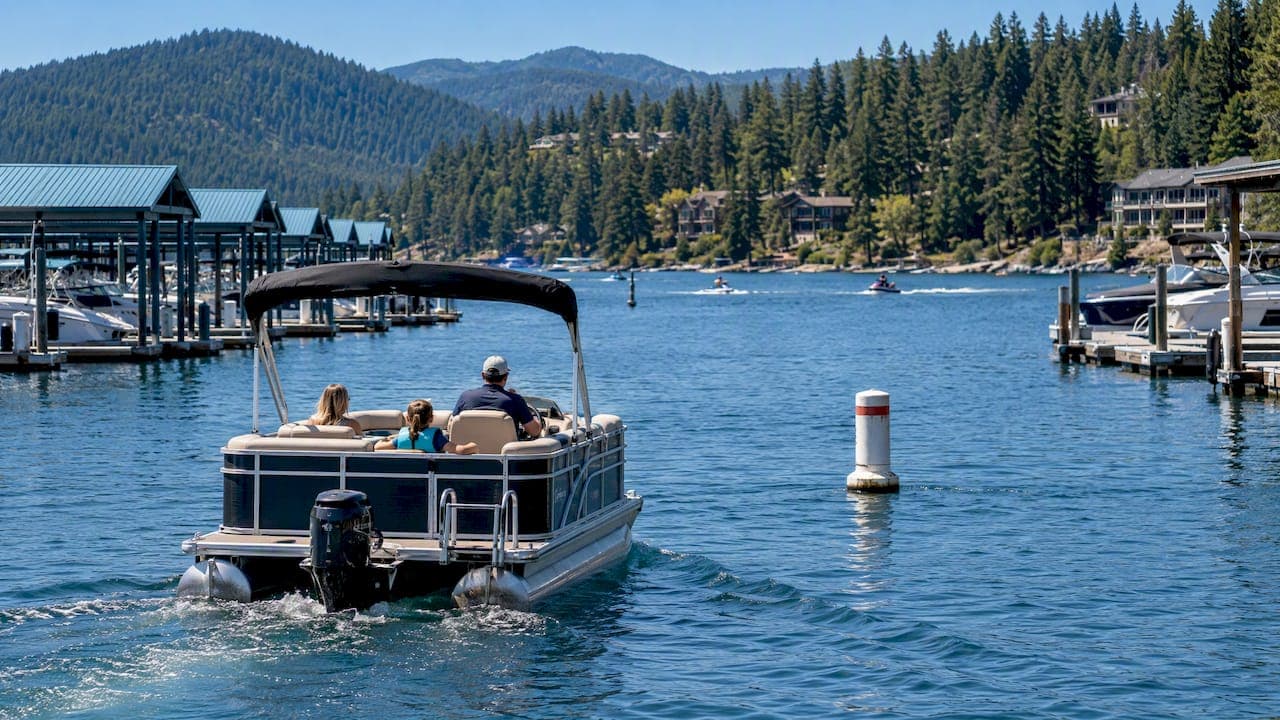
To legally boat on Lake Coeur d'Alene you need current registration with an Invasive Species Fund sticker displayed, a USCG-approved personal flotation device for every person aboard, and a working knowledge of local speed and no-wake zones. County sheriffs, Idaho Department of Parks and Recreation (IDPR) officers, and the U.S. Coast Guard on federally controlled waters all enforce these rules, and penalties start with a stop and inspection.
TL;DR:
- Boaters must display a current registration decal and the invasive species sticker near the bow, away from other registration numbers.
- Speed limits vary from 35 mph on open water to 5 mph in no-wake zones, with automatic no-wake conditions triggered by gauge readings during runoff.
- All motorized vessels require USCG-approved PFDs for each passenger, with children 14 and under mandated to wear them whenever the boat is underway.
- For safety, operating a boat under the influence is prohibited with strict penalties, and accidents involving injury or significant property damage must be reported to law enforcement.
- Out-of-state and USCG-documented vessels must pay a $30 invasive species sticker, and local rules around anchoring, overnight moorage, and environmental protection are critical to follow.
Table of Contents
- Quick compliance checklist: what to have and do before launch
- State law essentials: what the Idaho Safe Boating Act requires
- How fast can you go? Local speed and no-wake zones explained
- Registration, fees, and the invasive species sticker
- PFD rules, cold water risks, and who can operate what
- OUI limits, negligent operation, and what happens after an accident
- When you need a permit: events and federally controlled waters
- What renters and rental operators should each confirm before launch
- Protecting the lake: environmental rules specific to Coeur d'Alene
- Wake surfing, jet skis, and where they can and can't go
- Nighttime boating: lights, visibility, and extra caution
- Anchoring and overnight stays on the water or shoreline
- Staying in touch on the water: radios, signals, and emergency contact
- Why following the rules keeps this lake open for everyone
- How Golden Water Sports helps you boat with confidence
- Sources
- FAQ
Quick compliance checklist: what to have and do before launch
Before you leave the dock, confirm the basics that an officer checks first. Idaho's registration and permit system lets you buy or renew online, at an authorized vendor, or at some county offices, and a digital receipt counts as temporary proof for 60 days.
- Registration decal current and the Invasive Species Fund sticker displayed near the bow, away from other registration numbers.
- One USCG-approved PFD per passenger, sized correctly, with children 14 and under wearing one whenever the boat is underway.
- A fire extinguisher, working navigation lights, and a sound-producing device such as a horn or whistle aboard.
- Photo ID and, for rented vessels, proof of booking in case an officer asks who is responsible for the boat.
- A quick check of posted speed signs and no-wake buoys near your launch point, since local limits change by waterway.
Pro Tip: Keep your registration and ISF sticker receipts on your phone as a backup. Enforcement officers accept a digital copy if the physical sticker is still drying or in transit.
Renters should also read a local boating guide before heading out, since posted rules can shift seasonally depending on lake elevation and river flow.
State law essentials: what the Idaho Safe Boating Act requires
Idaho's statewide boating rules live in the Idaho Safe Boating Act, officially Idaho Code Title 67, Chapter 70. This chapter sets the floor for every lake and river in the state, and Kootenai County's local rules build on top of it rather than replacing it.
The statute requires every motorized vessel to carry a valid registration and display its capacity plate where applicable, along with a working fire extinguisher sized to the boat and a sound device audible over typical engine noise. Navigation lights are mandatory from sunset to sunrise and in any condition of reduced visibility. PFD requirements run throughout the chapter and are detailed further in IDPR's own paddlesports and safety guidance, which spells out quantities and types by vessel length.

Operator competence gets specific attention. Idaho does not require every adult to hold a boater education card, but younger operators and certain rental or livery situations trigger education requirements, and a court can order completion of a state-approved course after certain violations. The law also defines negligent operation broadly: operating in a way that endangers life, limb, or property counts, whether that means weaving through swimmers, ignoring a no-wake buoy, or running a boat loaded well past its rated capacity.
Overloading and overpowering a vessel are both specifically prohibited. A capacity plate lists a maximum number of people and a maximum horsepower rating, and exceeding either is a statutory violation regardless of whether anything goes wrong. Speed itself is not fixed at one statewide number: the act leaves room for local governments, including Kootenai County, to set speed limits suited to their waterways, which is why the next section matters as much as this one.
Fire extinguisher and sound device rules apply even to smaller boats that some owners assume are exempt. A 16-foot fishing boat with a small outboard still needs an extinguisher if it has an enclosed fuel compartment, and a whistle or horn is cheap insurance against a citation that has nothing to do with how the boat actually performs on the water. The statute's intent is straightforward: every vessel capable of causing harm should carry the basic tools to prevent or respond to an emergency, and officers check for exactly that short list during a routine stop.
How fast can you go? Local speed and no-wake zones explained
Kootenai County and the City of Coeur d'Alene layer specific speed limits on top of state law through county waterways resolutions. These limits vary by location, and the differences matter because a speed that's legal mid-lake can be a citation near a dock.
- Open-water stretches of Lake Coeur d'Alene commonly allow up to 35 mph, dropping as conditions or posted signs dictate.
- Within 100 feet of another vessel, a swimmer, or a dock, the limit drops to 15 mph.
- No-wake zones, generally 5 mph, apply near marinas, launch ramps, and designated swimming areas.
- Some narrow channels and the Chain Lakes carry posted limits as low as 5 to 20 mph year-round.
- The Spokane River through town and sections near bridges often sit at reduced speeds regardless of boat traffic.
What catches visitors off guard is the automatic no-wake trigger tied to river and lake gauge readings at Cataldo, Enaville, and Tubbs Hill. When those gauges exceed set thresholds, typically during spring runoff or after heavy rain, a no-wake rule kicks in automatically, whether or not a sign has been physically posted yet. Checking current gauge levels before a spring or early summer trip is worth the two minutes it takes.
Designated no-motor and no-waterski zones protect float homes, swimming beaches, and sensitive shoreline near bridge sections. Overnight mooring is allowed in many areas but carries time limits, and some marinas charge moorage fees for extended stays, so confirm local rules at your specific launch point.
Registration, fees, and the invasive species sticker
Every motorized vessel and sailboat launched in Idaho's public waters needs an Invasive Species Fund sticker, a separate requirement from your boat's registration decal. The fee depends on where your boat is registered.
- Idaho-registered motorized vessels and sailboats pay $10, which is bundled into the standard registration fee.
- Out-of-state or USCG-documented vessels pay $30 for the sticker when launching in Idaho waters.
- Non-motorized craft, including kayaks, canoes, and paddleboards over 10 feet, pay $7.
You can buy stickers and registrations through IDPR's online system, at authorized retail vendors, or at some county offices. If you buy online right before a trip, the email receipt serves as valid temporary proof for 60 days while the physical sticker makes its way to you.
Display rules differ by vessel type: motorized boats show the sticker near the registration numbers on the bow, while non-motorized craft display it on the hull where it's easily visible. If a sticker is lost or damaged, a duplicate can be purchased through the same vendor channels rather than requiring a full new registration.
Registration fees and the invasive species sticker program fund more than paperwork. Boaters who designate Kootenai County as their primary use area during registration help fund marine deputy patrols, ramp maintenance, and local safety programs directly, an approach often called "pay where you play." Visitors planning repeat trips may want to read a step-by-step sticker guide before their first launch.
PFD rules, cold water risks, and who can operate what
Personal flotation devices are the single most enforced safety item on the water, and the rules get specific fast. On any boat 19 feet or shorter, children 14 and under must wear a USCG-approved PFD whenever the vessel is underway, a rule detailed in IDPR's safety guidance.
- Personal watercraft riders and anyone being towed, including wakeboarders, skiers, and tubers, must wear a PFD at all times while on the water.
- PFD type and quantity requirements scale with vessel length, so a 24-foot pontoon needs more devices aboard than a 14-foot skiff.
- Type II and Type III PFDs suit most family recreation, while Type V inflatable vests fit water-skiing and wakeboarding better.
- A properly fitted PFD should not slip over the wearer's head when the straps are pulled up firmly from the shoulders.
Cold water is an underestimated risk even in midsummer, since Lake Coeur d'Alene's depth keeps water temperatures low well into June. Unexpected immersion in cold water can cause rapid loss of coordination, so wearing a PFD at all times, not just keeping one within reach, matters more here than on a shallow warm lake.
Pro Tip: Check that every PFD on board actually fits the person wearing it before you leave the dock, since an adult-sized vest on a child offers little real protection.
Towing has one hard restriction worth remembering: towing skiers, tubers, or wakeboarders is not allowed on the Coeur d'Alene River itself, only on the open lake, and buffer zones near docks and swimmers still apply even where towing is permitted.
OUI limits, negligent operation, and what happens after an accident
Idaho treats operating a boat under the influence with the same seriousness as impaired driving, as explained in this practical article about alcohol and boating enforcement. The state's OUI statute sets the legal limit at 0.08% BAC for operators 21 and older, and 0.02% for operators under 21. Refusing a requested test can lead to prosecution on its own, and a conviction often requires completing a state-approved boating safety course before you're allowed back on the water as an operator.
Negligent operation covers more than obvious recklessness. Running a wake through a no-wake zone, cutting too close to swimmers or anchored boats, or operating in a way that forces another vessel to take evasive action all qualify, and officers don't need an accident to cite it.
Accident reporting thresholds are specific: any accident involving death, disappearance, injury requiring more than basic first aid, or property damage exceeding the statutory threshold must be reported to law enforcement. Smaller bumps and scrapes with no injury and minor damage generally don't require a formal report, but when in doubt, reporting is the safer call.
Sheriffs and IDPR officers can stop and board vessels for safety checks, impound boats tied to serious violations, and issue fines that scale with the offense. Repeat OUI convictions or accidents involving injury can escalate from a misdemeanor to more serious criminal classification. For a closer look at how alcohol rules intersect with rental responsibilities, see this guide to Coeur d'Alene's alcohol rules. Enforcement patterns around boating-under-the-influence laws tend to follow similar logic across states, though Idaho's own thresholds and penalties are what actually govern here.
When you need a permit: events and federally controlled waters
Most recreational boating never touches federal permitting, but organized events change that. A marine event permit from the Kootenai County sheriff is required for regattas, races, or large group outings that might temporarily close sections of the lake or alter normal speed limits for participants.
Some waterways around Coeur d'Alene fall under federal jurisdiction rather than purely state or county control, and IDPR's boating guidance notes that the Coast Guard typically requires permit applications 135 days ahead of major events on those waters. If you're planning anything larger than a family outing, confirming jurisdiction with the sheriff's office, IDPR, and the Coast Guard early avoids a scramble closer to your event date.
What renters and rental operators should each confirm before launch
Compliance splits naturally between what a renter checks and what a rental operator provides. Renters should bring photo ID and proof of booking, confirm the boat's ISF sticker is displayed, verify there's a properly fitted PFD for every passenger, and ask about posted speed zones near the launch point before pulling away from the dock.
Rental operators carry their own responsibilities: supplying USCG-approved PFDs in the right sizes, walking renters through nearby restricted zones and automatic no-wake triggers, and explaining damage deposit and alcohol policies clearly before the keys change hands.
- Ask where the nearest pump-out station is located if you're on a boat with an onboard head.
- Ask which marina or dock to use if weather turns or you need to wait out a storm.
- Ask what the emergency contact procedure is if something goes wrong on the water.
Pro Tip: A good rental orientation takes 5 to 10 minutes and should cover the nearest no-wake buoys by name, not just a general warning to "watch your speed."
Protecting the lake: environmental rules specific to Coeur d'Alene
Lake Coeur d'Alene sits downstream from a historic mining district, and sediment on parts of the lakebed carries legacy heavy metals, which makes shoreline and water protections here stricter in practice than on many comparable lakes. Boaters are expected to avoid disturbing lakebed sediment in shallow, posted areas and to keep engines well maintained to limit fuel and oil discharge.
The invasive species sticker program exists specifically to fund inspection stations and watercraft checks that keep quagga and zebra mussels out of Idaho waters, since an infestation in Lake Coeur d'Alene would affect water quality, boat equipment, and swimming areas for years. Boaters moving between water bodies should clean, drain, and dry their vessel and trailer before launching, a habit that matters even for a quick trip between two local lakes in the same weekend.

Dumping any waste, including gray water or trash, directly into the lake is prohibited, and boats with heads must use designated pump-out stations rather than discharging overboard. Fueling carefully and avoiding spills near the dock protects both the lake's clarity and the swimming beaches that draw so many visitors each summer. None of these rules are unique to large boats: paddleboards, kayaks, and small fishing boats benefit from the same inspection and cleaning habits that keep the lake healthy for the next person launching behind you.
Wake surfing, jet skis, and where they can and can't go
Wake surfing has grown fast on Lake Coeur d'Alene, and it comes with its own set of practical restrictions layered on top of general no-wake rules. Because wake surfing produces a larger, more deliberate wake than typical boating, operators need extra distance from shorelines, docks, and other boats, generally staying well outside the 100-foot buffer that applies to normal towing.
Jet skis and other personal watercraft follow the same core rules as any motorized vessel: registration, an ISF sticker, and a PFD worn by the operator and any passenger at all times, not just kept aboard. Personal watercraft are also subject to the same no-wake zones, posted speed limits, and no-motor areas as larger boats, and riders sometimes assume a smaller craft gets more leeway, which it does not.
Operating a personal watercraft requires attention to minimum age rules in many situations, and renters should expect rental operators to confirm age and experience before handing over the keys. Jumping another vessel's wake with a PWC, weaving through anchored boats, or riding at night without proper lighting are all treated as negligent operation under the same statute that governs larger boats. The practical takeaway for both wake surfers and jet ski riders is the same: assume the strictest nearby rule applies, since the buffer zones around swimmers and docks don't shrink for a smaller or more agile craft.
Nighttime boating: lights, visibility, and extra caution
Boating after sunset on Lake Coeur d'Alene is legal but comes with firm lighting requirements. Every motorized vessel underway between sunset and sunrise must display proper navigation lights, typically a red light on the port side, a green light on the starboard side, and a white light visible from behind, so other boaters can judge your position and direction at a glance.
Anchored vessels after dark need a white all-around light visible to approaching traffic, since an unlit anchored boat is a serious collision hazard in the dark, particularly near busy channels or popular anchorages. Personal watercraft are generally not designed or equipped for nighttime operation and most riders avoid it entirely, both for safety and because many PWC models lack adequate lighting for night use.
Visibility drops fast on the water after dark, and depth perception for distance and speed becomes unreliable even for experienced boaters. Reduced visibility rules that apply during fog or heavy rain, requiring lights and reduced speed, apply with the same force at night. Renters planning an evening cruise should confirm their rental boat is properly equipped with working lights before leaving the dock, since a citation for missing or malfunctioning lights is entirely avoidable with a two-minute check.
Anchoring and overnight stays on the water or shoreline
Anchoring on Lake Coeur d'Alene is common for swimming, fishing, or simply taking a break, but it comes with location limits. Boats should anchor away from marked channels, swimming areas, and other vessels' paths, and anchoring directly in a no-wake zone near a marina or ramp can draw attention from enforcement even if the boat itself isn't moving.
Overnight mooring at public docks and marinas typically carries time limits, and some locations charge moorage fees for extended stays, a detail covered in more depth in this guide to Coeur d'Alene's public docks. Local marinas, including facilities near Third Street, Eleventh Street, Carlin Bay, Harrison, and Conkling Park, handle moorage and pump-out services differently, so confirming rules at your specific stop avoids a surprise fee or a knock on the hull at midnight.
Camping directly on the water, such as sleeping aboard an anchored boat overnight in open water, is generally discouraged outside designated areas, and shoreline camping is restricted to established public campgrounds and park sites rather than any convenient beach. Idaho's state parks and USDA Forest Service land around the lake offer designated camping spots, and checking ahead for site availability beats discovering a "no overnight camping" sign after you've already set up for the night.
Staying in touch on the water: radios, signals, and emergency contact
Cell service around Lake Coeur d'Alene is generally reliable near town but can drop out in coves, narrow channels, and some stretches of the Spokane River, which makes knowing basic on-water communication worthwhile. VHF marine radio, where equipped, uses Channel 16 as the standard hailing and emergency frequency, monitored by the Coast Guard and many marinas, and it's the fastest way to reach help if a phone signal fails.
For routine coordination between boats in your own group, a secondary working channel agreed on before you launch keeps the hailing channel clear for genuine emergencies. Visual signals still matter when radio isn't an option: a raised paddle, a whistle blast, or waving both arms overhead are recognized distress signals that nearby boaters are trained to notice.
Before heading out, especially on a rental boat without a built-in radio, make sure everyone aboard knows the plan if something goes wrong: who calls for help, what number to dial if cell service holds, and where the nearest marina or dock is for returning quickly. Rental operators should cover this as part of a basic safety orientation, since a clear emergency plan costs nothing and matters most exactly when you don't expect to need it.
Why following the rules keeps this lake open for everyone
Every registration fee and invasive species sticker you buy funds the marine deputies, launch ramps, and inspection stations that keep Lake Coeur d'Alene running well. Fewer accidents mean fewer closures, less enforcement friction, and more goodwill from the communities that host boaters every summer. Golden Water Sports builds orientation and local guidance into every rental because an informed boater protects the lake and the people sharing it with them.
— Life is better on water.
How Golden Water Sports helps you boat with confidence
Every rental, whether a jet ski, boat, pontoon, or paddleboard, comes with properly fitted USCG-approved PFDs and a quick orientation to local speed and no-wake zones, so you're not guessing at the rules on launch day.
Browse current jet ski rental options at Liberty Lake or check pricing across our full lineup to plan your next day on the water.
Sources
- Invasive species sticker FAQs
- Idaho Safe Boating Act (Title 67, Chapter 70)
- Kootenai County waterways regulations (Resolution No. 2010-01 / Ordinance 438)
- IDPR registration and permits information
FAQ
What do I need on my boat to be legal in Idaho?
You need current registration, an Invasive Species Fund sticker displayed on the hull, a USCG-approved PFD for every passenger, and a working fire extinguisher, sound device, and navigation lights as required by the Idaho Safe Boating Act. Specific equipment requirements scale with your boat's size and type.
Can I register my boat in Idaho if it is out-of-state?
Out-of-state and USCG-documented vessels don't register in Idaho, but they must purchase an Invasive Species Fund sticker before launching in Idaho public waters, which costs $30 rather than the $10 Idaho-registered vessels pay. You can buy this sticker online or through authorized vendors before your trip.
Do I have to have insurance on my boat in Idaho?
Idaho does not require boat insurance under the Safe Boating Act, though many marinas, lenders, and rental agreements require proof of coverage independently of state law. Checking with your lender or rental provider is the most reliable way to confirm what's actually required for your situation.
What does it cost to license a boat in Idaho?
Boat registration fees in Idaho vary by vessel length, and the Invasive Species Fund sticker is a separate, additional cost: $10 for Idaho-registered vessels, bundled into registration, $30 for out-of-state or USCG-documented boats, and $7 for non-motorized craft like kayaks and paddleboards. Renters booking through Golden Water Sports don't need to buy these separately since rental vessels are already properly registered and stickered.