
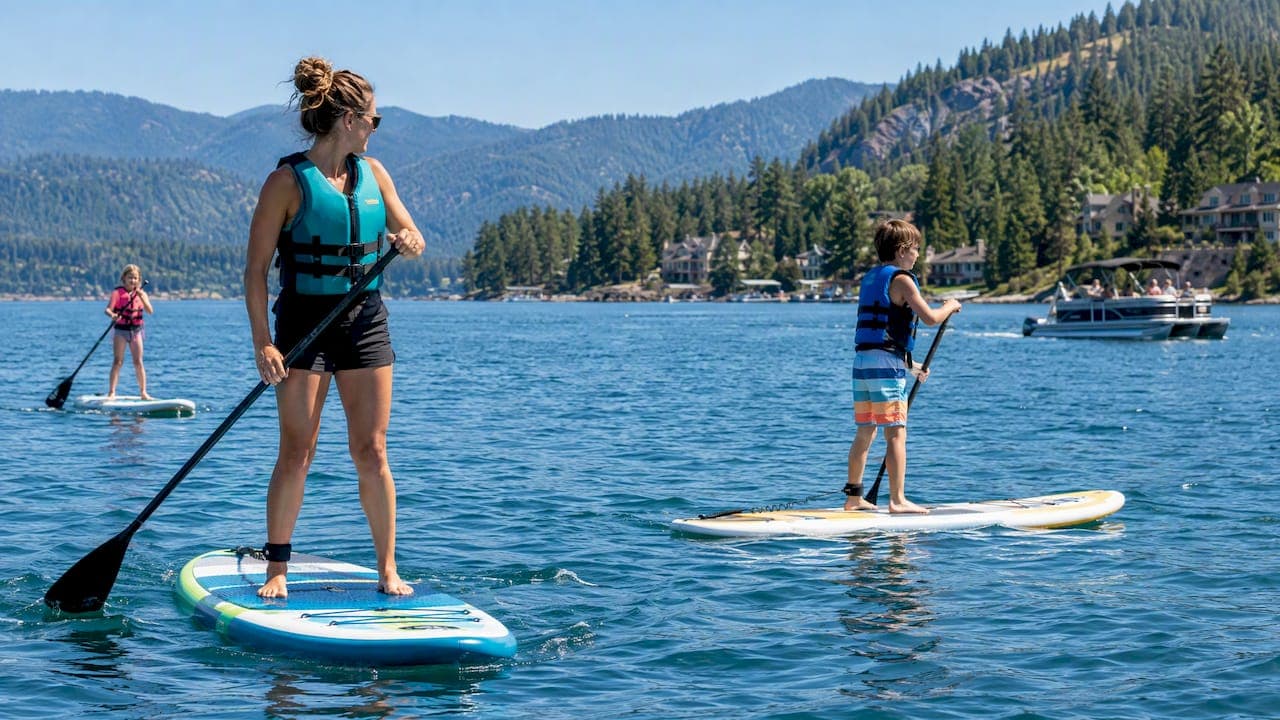
Wear a properly fitted, Coast Guard-approved personal flotation device at all times while underway on a rental paddleboard, and take a few minutes for the safety briefing we give at pickup. That single habit prevents most paddle-sport drownings. Pair it with a float plan and a route on protected water, and a first SUP outing on Lake Coeur d'Alene or Liberty Lake becomes low-risk fun instead of a gamble.
TL;DR:
- Wearing a Coast Guard-approved life jacket at all times vastly increases safety, especially in cold water or unexpected immersion situations.
- Confirm PFD fit, paddle and fin condition, and safety gear like whistles and waterproof cases during pre-launch checks to prevent on-water surprises.
- Stay near protected, wide sections of the lake, avoid motorboat wakes, and practice reboarding in shallow water before heading into open water.
- Always signal promptly with a whistle if you fall off, stay with your board, and call 911 for injuries or missing paddlers to enable quick rescue.
- Use a float plan, rinse gear between lakes, respect wildlife, and monitor weather conditions to reduce environmental impact and adapt to changing conditions.
Table of Contents
- Core safety rules every paddler should follow
- Pre-launch checklist when you pick up your rental
- On-water technique and group rules that prevent falls
- What to do if someone falls in or gets separated
- U.S. rules every renter should know before paddling
- Why our local experience makes this guidance practical
- Currents, rapids, and obstructions near Spokane-area launch points
- Seasonal conditions and weather that change your plan
- Emergency contacts and nearest rescue resources
- Protecting the water you're paddling on
- A short note from the water
- How our rentals support a safer family paddle day
- FAQ
- Sources
Core safety rules every paddler should follow
A life jacket only works when you're wearing it. Where usage was known, 87% of fatal boating victims were not wearing a life jacket, and that gap between owning a PFD and actually having it on is the single biggest factor separating a scare from a tragedy.
Where PFD usage was known, 87% of fatal boating victims were not wearing one. That statistic covers all boating, not paddleboards alone, but it points to the same lesson: a PFD stored in a dry bag does nothing for you in the water.

Cold water raises the stakes further. Regional lakes stay cold well into early summer, and sudden immersion in cold water can trigger a cold-shock response that makes it hard to breathe, swim, or even grab a stowed life jacket. A wearable vest-style PFD, already on your body, removes that problem.
A few more habits matter on every outing:
- Paddle with at least one other person, never alone, especially as a first-time rider.
- Keep well clear of motorboats and their wakes, since a SUP sits low and is easy to miss from a boat.
- Skip alcohol before and during paddling; balance and judgment both suffer fast on an unstable board.
- Keep a whistle, a leash, and a phone in a waterproof case within reach, not packed away.
Pro Tip: Choose a wearable vest PFD over an inflatable waist-belt style for cold-water paddling; manual inflation often fails during the first seconds of cold shock.
Pre-launch checklist when you pick up your rental
A few minutes at pickup prevents most on-water surprises. Work through this before you carry a board to the water:
- Confirm the board size and weight capacity match your group and gear.
- Check the paddle length and the fin for cracks or looseness.
- Fit the PFD by tightening the side straps first, then the shoulder straps, so the jacket can't ride up over your chin in the water.
- Confirm the leash type matches the water: a coiled ankle leash for flat lake water, never a waist leash in moving water.
- Collect the whistle, waterproof phone case, and any other safety extras before you walk to the launch.
- Ask staff to demonstrate a quick reboard and wet exit in shallow water if you've never done one.
- Ask which launch points and routes suit your group's experience level that day.
Pro Tip: Practice climbing back onto the board in waist-deep water near shore before you head out. It takes thirty seconds and removes most of the panic if you fall later.
On-water technique and group rules that prevent falls
Start kneeling or in a low stance until you feel steady, then stand with feet shoulder-width apart, knees slightly bent, and eyes on the horizon rather than your feet. Bent knees absorb small wobbles from wind and wake before they become a fall.
Stick to protected coves and shoreline routes rather than open crossings, and keep a wide distance from any motorized craft. A wake that looks small from a boat can tip an unprepared paddler.
- Turn to face oncoming wind or wake bow-first rather than taking it broadside.
- Agree on a turn-back time before you launch, especially with kids or new paddlers in the group.
- Keep the group within sight and whistle distance of each other at all times.
- If you fall, stay with your board, climb onto the upwind side, and use your whistle to signal the group.
Staying with the board matters more than swimming for shore. A paddleboard floats and is far easier for others to spot than a swimmer alone in open water.
What to do if someone falls in or gets separated
Most falls end the same simple way: wet exit, hold the board, signal, reboard. Work through it in order rather than improvising:
- Let go of the paddle if needed and hold onto the board immediately.
- Climb back on from the upwind side to avoid the board flipping back onto you.
- Blow your whistle three times to alert your group if you're more than a few yards apart.
- If you can't reboard after a couple of tries, signal for help and stay with the board until it arrives.
Call 911 for any injury, a missing paddler, or a medical emergency; flag down our team or nearby staff for equipment issues or a board you can't recover. When you call, give your location, the number of people in your group, and the nature of the problem.
| Emergency item | Why it matters |
|---|---|
| Whistle | Signals your group or nearby boaters when voice carries poorly over water |
| Waterproof phone case | Keeps your phone usable for a 911 call after a fall |
| Float plan left with a contact | Tells rescuers where to look if you don't check in on time |
| Basic first-aid kit | Covers minor cuts and scrapes common around launch rocks |
A float plan filed with the U.S. Coast Guard Auxiliary before you launch gives rescuers your planned route, launch time, and return time, so a search starts fast instead of after hours of uncertainty.
U.S. rules every renter should know before paddling
Under federal guidance, a stand-up paddleboard counts as a vessel once you're outside a narrow swimming or bathing area, which means the same wearable life jacket rules that apply to kayaks and canoes apply to you. The Coast Guard recommends wearing your life jacket at all times while underway, not just carrying one on board.
- Keep a Coast Guard-approved, properly sized PFD on your body the whole time you're paddling.
- Carry a whistle or other sound-signaling device for emergencies.
- Check posted signage at your launch site for local restrictions before you put in.
- Review our local launch permit guide for which rules apply at which lake.
Why our local experience makes this guidance practical
We stock wearable PFDs sized for kids and adults alongside every paddleboard, plus watercraft suitable for lake days. Rentals include a safety briefing and a fit check before you launch.
Our blog covers local launch spots and life jacket laws in more detail, and flexible hourly and multi-day booking options let families choose calmer morning or evening conditions over a crowded midday rush.
Currents, rapids, and obstructions near Spokane-area launch points
Lake paddling on Lake Coeur d'Alene and Liberty Lake stays calm compared to moving river water, but renters should still watch for localized hazards near inlets, narrows, and boat channels. Submerged rocks, dock pilings, and downed trees near shorelines can catch a leash or fin, especially in less-traveled coves.
Where lake water connects to river channels or narrow passages, current can pick up quickly and catch an inexperienced paddler off guard. Staying on open, wide sections of the lake away from channel mouths avoids most of this risk entirely.
Wind-driven swells build fast on open water, especially on Lake Coeur d'Alene's larger bays in the afternoon. A board that felt stable at 9 a.m. can become hard to control by 2 p.m. once afternoon wind kicks up. Checking conditions before you launch and choosing a protected cove over an open crossing removes most of this variable.
Boat traffic near marinas and public launches adds another layer: wakes compound with natural wind swell near busy ramps, so steering a wide path around high-traffic zones keeps a family outing calmer. Our guide to PWC rules and seasonal restrictions covers where motorized traffic is heaviest and when seasonal rules apply.
Seasonal conditions and weather that change your plan
Water temperature swings more than most first-time paddlers expect. Even on a warm, sunny day, regional lakes can stay cold enough in late spring and early summer to trigger cold-shock symptoms on sudden immersion. Dress for the water temperature, not the air temperature, through at least June.
Afternoon wind is the most common weather hazard for flatwater paddlers. Mornings tend to run calmer across the region's lakes, and conditions often build through the afternoon as thermal winds pick up over open water. Planning a launch before midday reduces exposure to the choppiest stretch of the day.
Thunderstorms build quickly in summer afternoons and evenings. Checking a forecast before you leave the house, and watching the sky for darkening clouds while you're out, gives you time to head to shore before lightning becomes a factor. No paddleboard outing is worth waiting out a storm on open water.
Late-season outings into early fall bring cooler water and shorter daylight windows. A float plan with a clear return time matters even more once days get shorter, since a minor delay can turn into paddling back in low light.
Emergency contacts and nearest rescue resources
Call 911 for any injury, missing paddler, or medical emergency on the water; local dispatch coordinates both land and water rescue response for regional lakes. Give your location by landmark or GPS coordinates if you have them, the number of people in your group, and a clear description of the emergency.
For non-emergency equipment issues or a board you can't recover on your own, flag down our staff or any nearby rental operator before trying to swim long distances for help. Keeping your group together and visible makes it far easier for any rescuer, whether a lifeguard, another boater, or emergency responders, to find you quickly.
Saving the nearest marina or ranger station's number in your phone before you launch, alongside 911, gives you a faster non-emergency contact for smaller problems like a lost paddle or a flat tire in the parking lot.
Protecting the water you're paddling on
Regional lakes support fish, waterfowl, and plant life that react poorly to disturbance, litter, or invasive species carried in on gear. A few habits keep your outing low-impact:
Rinse and dry your board, paddle, and leash before moving between different lakes, since invasive aquatic species can hitch a ride on wet gear. Pack out everything you bring, including food wrappers and sunscreen containers, since wind can carry loose trash into the water fast.

Paddle around visible wildlife, nesting areas, and shoreline vegetation rather than through them, and keep a respectful distance from anglers and other paddlers. Our guide to reducing boating impacts covers wake damage, waste, and invasive species in more detail if you want the fuller picture before your trip.
A short note from the water
Wear your PFD, every time, even on a calm day. Ask our team for a quick demo on reboarding before you launch. We'd rather spend five extra minutes with you than have you guess.
— Life is better on water.
How our rentals support a safer family paddle day
We fit every paddleboard rental with a PFD, a leash matched to the water, and a whistle, and our team walks through fit and a quick reboard demo before you launch. Ask for the safety briefing at pickup; it takes five minutes and answers most first-timer questions on the spot.
- Paddleboard, PFD, and safety-extras rental with a staff fit check at pickup.
- Flexible hourly and multi-day booking so you can choose calmer morning or evening conditions.
- Add a jet ski or boat rental to the same outing for the rest of your group.
| What you get | Detail |
|---|---|
| Paddleboard rental | Includes PFD and safety extras, briefing at pickup |
| Jet Ski Rental Liberty Lake | $250 to $425 per rental |
| Additional hour | $75 per hour |
Book your paddleboard and water toy rentals or check current pricing and options before your next lake day.
FAQ
Do I legally need to wear a life jacket on a paddleboard?
Yes. Federal guidance treats a stand-up paddleboard as a vessel once you're beyond a narrow swimming area, and the Coast Guard recommends wearing your life jacket at all times while underway rather than just carrying one on board. Our rentals include a properly sized PFD and a fit check at pickup.
What should I do if I fall off my paddleboard?
Stay with your board, climb back on from the upwind side, and use a whistle to signal your group if you're separated. The National Center for Cold Water Safety notes that cold shock can make it hard to put on a stowed PFD after a fall, which is why wearing one the whole time matters more than reacting afterward.
Is it safe to paddleboard with young kids?
Yes, with the right preparation: a properly fitted kid-sized PFD, calm protected water, and a short planned route work well for family outings. The American Canoe Association recommends beginners and families stick to calm, protected water and paddle with a buddy rather than alone.
How much does a paddleboard rental cost?
Paddleboard rental pricing is available on request through our current pricing page, where you can also compare it against jet ski and boat rental options for the same outing.
What should I bring on a paddleboard outing besides the board itself?
Bring a whistle, a phone in a waterproof case, and a float plan left with a contact who knows your launch time and expected return. These low-cost additions make a real difference if something goes wrong on the water.
Sources
- United States Coast Guard boating safety resources
- Always Wear Your PFD — National Center for Cold Water Safety
- American Canoe Association — Best practices for paddlers