
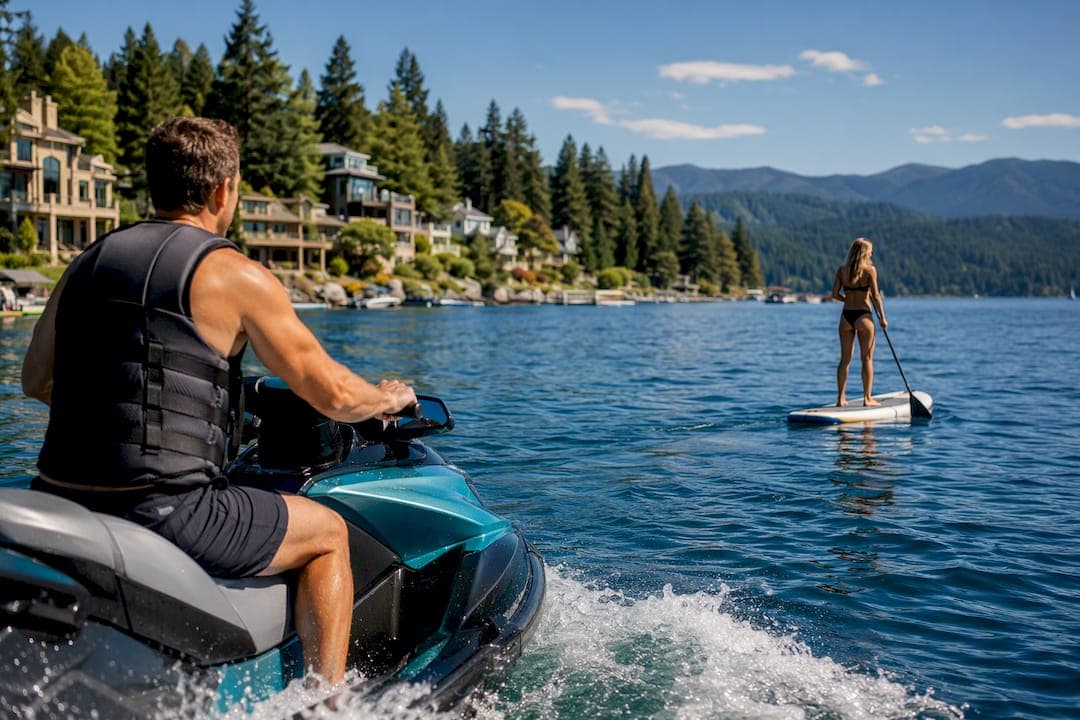
Personal watercraft are allowed on parts of the Spokane River, but not everywhere and not year round. Inside Spokane city limits, PWC and motorboats are banned except east of Upriver Dam, and a stretch between Barker Road Bridge and Centennial Trail Bridge closes to motorized vessels seasonally. Before you launch, know three things: every rider needs a Coast Guard approved PFD, most operators need a Washington Boater Education Card, and wake speed limits apply near docks, ramps, and swimmers.
TL;DR:
- Most of the Spokane River outside Upriver Dam is restricted to non-motorized vessels or is seasonally closed, especially between Barker Road Bridge and Centennial Trail Bridge from April 16 to October 14.
- Every rider on moving water must wear a Coast Guard-approved PFD, with children under 12 requiring it at all times, and unserviceable gear may lead to citations.
- A Washington Boater Education Card is required for anyone born on or after January 1, 1955 operating a PWC over 15 horsepower, and rental companies enforce age and card requirements before use.
- Wake speed limits are approximately 5 mph with a 6-inch wake height and vary from 100 feet buffer in most areas to 200 feet near Lake Roosevelt; slowing down before reaching buffers prevents violations.
- Boating accidents involving more than $500 in damage or any injury must be reported within 10 to 48 hours, and enforcement is shared among local agencies who issue civil fines or misdemeanors for serious violations.
Table of Contents
- Where you can and can't legally ride a PWC on the Spokane River
- PFD and safety equipment rules for PWC on moving water
- Boater education, minimum ages, and rental rules for PWC in Washington
- Speed, wake, and no-wake zone rules that apply to PWCs on the Spokane River
- Reporting accidents and how enforcement actually works
- Practical compliance checklist before launch
- How rental operators help customers stay compliant
- Environmental rules that protect the Spokane River from PWC use
- Safety gear you need beyond a life jacket
- Local permits and registration for PWC on the Spokane River
- Sharing the water with swimmers, anglers, and paddlers
- Why following the rules keeps the river open for everyone
- Renting a PWC the compliant way with Golden Water Sports
- Sources
- FAQ
Where you can and can't legally ride a PWC on the Spokane River
The river's rules change block by block, and the boundaries are tied to specific landmarks rather than mile markers. Inside the City of Spokane, motorboats and personal watercraft are prohibited on nearly the entire river except the section east of Upriver Dam, where the water opens up enough for safe motorized use. Cross a bridge and the rules can shift again.
Spokane County layers on its own seasonal restriction. The stretch running from Barker Road Bridge to Centennial Trail Bridge near Plant's Ferry Park is closed to motorized vessels from April 16 through October 14, which covers most of the boating season. That timing surprises a lot of first-time visitors who assume summer means open water everywhere.
- East of Upriver Dam: motorized use, including PWC, is permitted within city limits.
- Barker Road Bridge to Centennial Trail Bridge: closed to motors from April 16 to October 14 each year.
- Plese Flats and the western city border toward Nine Mile Dam: Treat as no-motor zones unless posted otherwise.
- Crossing into Kootenai County, Idaho: local ordinances differ, so check county signage before assuming Washington rules carry over.
Because the ordinance is genuinely fragmented by bridge and jurisdiction, posted signage on the riverbank is more reliable than any map app. When in doubt, a call to the county sheriff's marine unit clears up ambiguity faster than guessing.
PFD and safety equipment rules for PWC on moving water
Washington's rules here are unambiguous for the Spokane River specifically. Under the City of Spokane's Rules of the River ordinance, every person on the water, regardless of age or vessel type, must wear a Coast Guard approved Type I, II, III, or V personal flotation device while on moving water. This is stricter than the general Washington boating code, which normally only mandates PFDs for children.
- Every rider and passenger on the Spokane River must wear a properly fitted, USCG-approved PFD while the boat or PWC is underway.
- Children 12 and under must wear a PFD any time they are aboard, even in calm water.
- Larger vessels are still required to carry a throwable flotation device in addition to wearable PFDs.
- A PFD that's too loose, torn, or missing a working buckle can be treated the same as not wearing one at all.
Everyone on moving water needs a wearable PFD, full stop. The Spokane County ordinance makes moving water sections of the river stricter than standing lakes, where only children typically must wear one. Officers who spot an unserviceable or missing PFD can issue a citation on the spot, no accident required.
Boater education, minimum ages, and rental rules for PWC in Washington
Washington ties its education requirement to a birth date, not a blanket age cutoff. Anyone born on or after January 1, 1955 must carry a Washington Boater Education Card to legally operate a vessel with 15 horsepower or more, which covers essentially every PWC on the market.
- Check your birth date against the rule. If you were born on or after January 1, 1955, you need the card before operating any PWC over 15 horsepower.
- Confirm the minimum operating age. Washington sets the minimum age to operate a PWC at 14 years old.
- Know the rental age floor. It's illegal for any business to rent or lease a PWC to someone under 16, regardless of who will supervise them.
- Get the card ahead of time. The card is available through an approved boating safety course, and most riders complete it online before their trip.
Rental counters will ask for this card at pickup along with a photo ID, so bring both rather than assuming a verbal confirmation will do.
Speed, wake, and no-wake zone rules that apply to PWCs on the Spokane River
Wake speed on the Spokane River means no faster than about 5 mph, producing a wake no higher than 6 inches, a standard set out in Spokane County's boating ordinance. That speed applies within 100 feet of docks, swimmers, other vessels, and the shoreline in most sections, tightening to 50 feet in narrower parts of the river where a wider buffer isn't physically possible.
Where the river feeds into Lake Roosevelt, the National Park Service applies its own flat-wake rule within 200 feet of launch ramps, marinas, campgrounds, and picnic areas, plus a dedicated flat-wake stretch on the Spokane River Arm between Two Rivers Marina and the Fort Spokane launch ramp.
- Wake speed is capped at roughly 5 mph with a wake height limit of 6 inches.
- Standard buffer distance is 100 feet from docks, swimmers, and other boats; narrow channels drop that to 50 feet.
- Near Lake Roosevelt activity areas, the flat-wake buffer extends to 200 feet.
- Nighttime operation typically carries a 15 mph speed ceiling on open stretches.
- Intentionally enlarging a wake with ballast or hydrofoils to bypass the letter of the speed limit still counts as an excessive wake violation in neighboring Kootenai County, and Spokane enforcement treats it the same way.
Pro Tip: Slow down well before you reach a buffer zone, not at its edge. A PWC needs a few seconds to settle from a planing wake down to a true no-wake speed, and officers measure your wake at the shoreline, not your throttle position.
For a deeper breakdown of exact distances and how they apply across regional lakes, see our guide to Spokane lake speed limits and no-wake zones.

Reporting accidents and how enforcement actually works
Spokane County requires that any boating accident causing more than $500 in damage be reported within 10 days, while any accident involving injury or death must be reported within 48 hours, according to the county's accident reporting page. Skipping this isn't a minor paperwork lapse, it's a separate violation on top of whatever caused the accident.
- Enforcement on the river is shared between the Spokane County Sheriff's Office, Spokane Police, and Washington State Parks.
- Agencies coordinate patrols during peak season, particularly around holiday weekends.
- Violations of wake, PFD, or zone rules are typically handled as civil infractions with set fines.
- More serious violations, like boating under the influence or failing to report a serious accident, can carry misdemeanor penalties.
Practical compliance checklist before launch
Running through a short checklist before you leave the dock catches most of the mistakes that lead to citations.
- Confirm your Boater Education Card is valid and accessible, either physical or digital.
- Fit a USCG-approved PFD to every person on board, checking buckles and sizing rather than just handing one over.
- Verify vessel registration is current and displayed correctly.
- Inspect for invasive species and drain all standing water from the hull, livewell, and bilge before entering the river.
- Pack a signaling device, such as a whistle or horn, in addition to your PFDs.
- Bring your rental agreement or ownership documents in case an officer asks for proof.
- Check the season and segment you plan to ride against posted closures, especially the Barker Road to Centennial Trail stretch.
- Check current water flow and weather before heading out, since spring runoff changes river conditions fast.
Pro Tip: Take a photo of your PFDs and boater card on your phone before you launch. If a strap breaks or a card gets wet, you still have proof you had everything in order.
How rental operators help customers stay compliant
At Golden Water Sports, every rental starts with a verification step: staff check the renter's age, confirm a valid boater card where one is required, and fit each passenger with a properly sized, USCG-approved PFD before anyone touches the water. A short safety briefing covers the specific zone rules for wherever the PWC will be used that day.
The most common mistake we see is renters assuming a section of river is open simply because it was open on a previous trip, without checking whether they've crossed into a seasonal closure window. Staff walk through the current boundaries at pickup so nobody finds out about a closed segment from a patrol boat instead of a rental counter.
Environmental rules that protect the Spokane River from PWC use
Beyond safety, the Spokane River carries specific protections aimed at the noise, fuel, and wildlife impact of motorized watercraft. Two-stroke PWC engines that discharge unburned fuel and oil into the water are a known concern on rivers with fish habitat, and riders are expected to avoid idling or running engines in shallow, vegetated areas where discharge settles rather than dispersing.
Noise restrictions tend to apply near residential shoreline and designated quiet zones, where operators are expected to throttle down rather than run at full power past homes and parks. Wildlife disturbance is a real enforcement concern too: the river supports fish runs and nesting waterfowl in certain stretches, and operating at speed through shallow spawning areas or disturbing nesting sites can draw the same kind of citation as a wake violation, even without a specific numeric threshold attached.
The invasive species inspection step in your pre-launch checklist matters here as much as anywhere. Aquatic invasive species carried on hulls, trailers, or in bilge water can spread between the Spokane River and connected lake systems, which is why draining all standing water and removing visible plant material before you launch isn't just a courtesy, it's part of keeping the waterway usable for everyone. For a broader look at how boaters can reduce their footprint on regional waters, see our guide on reducing wake, sewage, and invasive species impact.
Safety gear you need beyond a life jacket
A PFD covers the baseline requirement, but a fully compliant PWC setup carries more. A functioning horn or whistle is standard equipment for signaling other vessels or requesting help, and it's small enough that there's no excuse to leave it behind. Larger vessels sharing the river, including tow boats and pontoons, are required to carry a fire extinguisher rated for marine use, since fuel fires spread differently on water than on land.

Navigation lights matter if you're anywhere near dusk or dawn on the water, since visibility drops fast on a river with tree cover and bends. A throwable flotation device, separate from your wearable PFDs, is expected aboard any vessel large enough to carry one, giving you a way to help someone without pulling them fully aboard in an emergency.
None of this gear works if it's inaccessible or in poor condition. A fire extinguisher past its inspection date or a whistle buried in a dry bag defeats the purpose, so a quick visual check before you leave the dock takes less time than it does to explain.
Local permits and registration for PWC on the Spokane River
Washington doesn't require a separate river-specific permit to operate a PWC on the Spokane River beyond standard state vessel registration. Every motorized watercraft, including PWC, needs current Washington registration displayed on the hull, the same requirement that applies on any lake or waterway in the state.
What catches visitors off guard is less about a missing permit and more about jurisdiction. Because the river passes through City of Spokane limits, unincorporated Spokane County, and eventually into Idaho near Coeur d'Alene, a single trip can cross three separate regulatory zones without a visible boundary line. There's no single "river permit" that covers all three, so compliance means matching your registration and boater card to whichever jurisdiction you're currently in, and confirming with local signage rather than assuming a Washington-issued document automatically satisfies Idaho requirements once you cross the state line.
Sharing the water with swimmers, anglers, and paddlers
The Spokane River isn't exclusive to motorized traffic, and PWC riders are expected to yield space to non-motorized users rather than the reverse. Swimmers and waders are common in the calmer stretches, particularly near parks and access points, and the standard buffer distance of 100 feet applies whether the person in the water is swimming, wading, or simply standing near the shoreline.
Anglers working from the bank or from drift boats deserve a wide, slow pass rather than a close one, both out of courtesy and because a sudden wake can swamp a small craft or disrupt a line. Kayakers, canoers, and paddleboarders have the same right to the water as any motorized vessel, and a PWC passing too close or too fast creates a real capsize risk for a non-motorized boat with a much lower profile and no engine to correct course quickly.
The practical rule is simple: when you can't be sure whether you're inside a buffer zone around another user, slow to wake speed and give more room rather than less. Citations for wake violations near other boats or swimmers are among the most commonly issued on the river specifically because they're the easiest for an officer to observe and confirm from shore.
Why following the rules keeps the river open for everyone
Every seasonal closure and buffer rule on this river exists because somebody's carelessness forced a fix. Ride clean, wear your PFD, and respect the closures, and you help keep access open for the next rider instead of giving officials a reason to tighten it further.
— Life is better on water.
Renting a PWC the compliant way with Golden Water Sports
Sorting out boater cards, PFD sizing, and seasonal closures on your own takes real effort, especially if you're visiting Spokane Valley, Liberty Lake, or Coeur d'Alene for the first time. Rental operators handle compliance groundwork by including fitted, USCG-approved PFDs for each rider, verifying boater cards and age before launch, and providing briefings on specific zone rules for the rental area.
- Every jet ski rental includes safety gear and a local rules briefing before launch.
- Staff verify boater cards and age requirements at pickup, so there's no guesswork once you're on the water.
- Rental terms, including damage deposit details, are laid out in writing before you sign.
You can book a Jet Ski Rental Liberty Lake or a Jet Ski Rental Newman Lake directly online, or check current prices and availability for jet skis, pontoons, and paddleboards across our full lineup. Bring your ID and boater card to pickup, and confirm the season's open zones before you head out, our staff will walk you through the current rules for your specific route.
This article is general information, not a substitute for advice from a qualified lawyer. Consult a qualified legal professional about your own circumstances before acting on anything here.
Sources
- Getting a Mandatory Boater Education Card — Washington Recreation & Conservation Office
- Boating Safety Ordinance — Spokane County
- Rules of the River — City of Spokane
- Personal watercraft (PWC) — Lake Roosevelt National Recreation Area — National Park Service
FAQ
What are the fishing rules for the Spokane River?
Fishing rules on the Spokane River are set by Washington Department of Fish and Wildlife regulations, which vary by season and by specific river section, so anglers should check current state rules before heading out. PWC riders sharing the water with anglers should stay well clear of fishing lines and give bank or boat anglers a wide, slow pass.
How far must a PWC stay from another vessel?
Spokane County's wake speed buffer requires PWC to slow to roughly 5 mph wake speed within 100 feet of another vessel, dock, or swimmer in most of the river. In narrower channels, that buffer drops to 50 feet because a wider distance isn't physically achievable.
Can I get in trouble for kayaking without a life jacket?
Yes. The City of Spokane's Rules of the River require everyone on moving water, including kayakers and paddleboarders, to wear a USCG-approved PFD, not just motorized boat operators. This is stricter than general Washington boating law and applies specifically to the river's moving water sections.
Can I drink beer while on a boat?
Washington law treats boating under the influence the same as impaired driving, and operating any vessel, including a PWC, while impaired is illegal and enforced on the Spokane River. Passengers who are not operating the vessel face different rules, but any operator should stay well under the legal limit or avoid alcohol entirely before getting behind the controls.
Do I need a boater card to rent a PWC on the Spokane River?
If you were born on or after January 1, 1955, you need a Washington Boater Education Card to operate a PWC over 15 horsepower, and rental staff will check for it at pickup. Renters must also be at least 16 years old, since it's illegal for any business to rent a PWC to someone younger.