
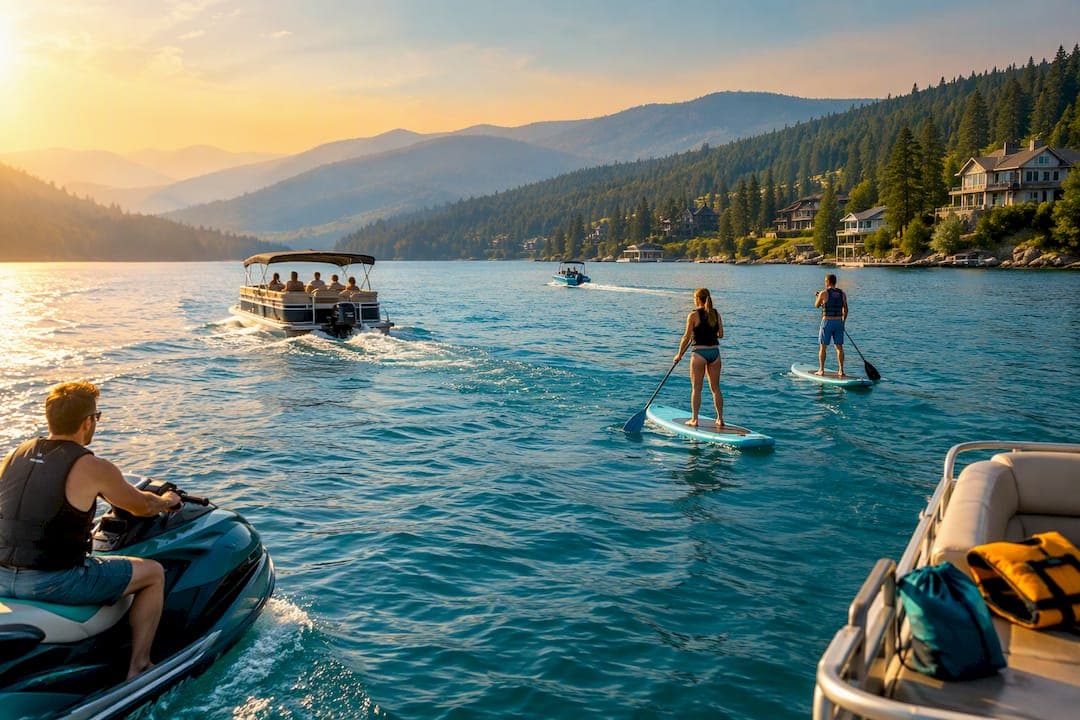
When wildfire smoke settles over the region, the call on whether to boat comes down to two numbers and one status check: the hourly AQI reading, and whether a Dense Smoke Advisory or park closure is posted. If AQI reaches a level considered unhealthy or if an advisory or closure is active, stay off the water. Below that, check the Spokane Regional Clean Air Agency and Washington State Parks alerts one more time, shorten your route, and pack N95 masks just in case.
TL;DR:
- Boaters should cancel trips if the AQI reaches 151 or above or if a Dense Smoke Advisory or park closure is active.
- Accurate, real-time AQI checks are essential because conditions can change rapidly even within a single day.
- Visibility issues caused by smoke mimic fog, requiring reduced speed, extra lookout, and careful navigation; if visibility is less than your safe stopping distance, turn back.
- Strenuous activities increase personal exposure to PM2.5, so wearing correctly fitted N95 masks during brief outdoor exposure can help, but are less effective at higher speeds.
- Planning should involve checking multiple sources, including AQI dashboards, forecast models, and alerts, to determine the safest time and location for boating during wildfire smoke.
Table of Contents
- Action Checklist for Boaters Before Launching
- Where to Check Live Air Quality and Smoke Forecasts for Spokane
- Boating Safety in Smoke: Visibility, Navigation, and Collision Avoidance
- Protecting Your Health on and Near the Water
- Closures, Evacuation Zones, and Why Authorities Restrict Waterways
- Preparing Rentals and Gear for Smoky Conditions
- Should You Wear a Mask While Boating in Smoke?
- Boat Ventilation and Filtration That Actually Help
- Adjusting Your Boating Plans Around Smoke
- What to Do Instead When Boating Isn't Safe
- An Operator's View on When to Call Off a Trip
- Book With Golden Water Sports: Our Smoke and Safety Policies
- Sources
- FAQ
Action Checklist for Boaters Before Launching
Wildfire smoke season in Spokane doesn't follow a calendar. It follows wind patterns and fire behavior hundreds of miles away, which means conditions that looked fine at breakfast can turn hazy by lunch. Run through this checklist every single time before you back the trailer down the ramp.
- Check hourly AQI and advisories. Pull up the Spokane Regional Clean Air Agency dashboard and look for an active Dense Smoke Advisory. If the reading is 151 or above, or an advisory is posted, cancel the trip.
- Confirm the launch site is actually open. A boat ramp that was fine yesterday can close overnight for firefighting access. Don't assume; verify through Washington State Parks alerts or by calling the marina directly.
- Eyeball visibility once you're on-site. If you can't clearly make out channel markers or the far shoreline, that's your answer. Turn around before you launch, not after.
- Build a shorter, shore-hugging route. Assign someone the job of lookout, and set your cruising speed low enough to stop within your visible distance.
- Pack the smoke kit. N95 masks, a waterproof flashlight, a fully charged phone or VHF radio, spare batteries, and a backup plan if you need to bail to an air-conditioned space.
Pro Tip: Screenshot the current AQI reading before you leave the house. Cell service around some of the region's lakes is spotty, and having last-known data beats having none if you need to make a call mid-trip.
Skipping any one of these steps is how people end up stranded near a closed launch, or worse, navigating blind past a buoy they never saw.
Where to Check Live Air Quality and Smoke Forecasts for Spokane
Spokane air quality boating decisions live and die by timing. Smoke concentration can shift by dozens of points in an hour depending on overnight inversions and daytime wind, so a reading from last night tells you almost nothing about this afternoon.
Four sources matter most:
- Spokane Regional Clean Air Agency posts hourly AQI for local monitoring stations and issues Dense Smoke Advisories specific to the Spokane area. This is your first stop, every time.
- AirNow aggregates federal monitoring data into a national AQI map, useful for comparing Spokane's numbers against nearby regions if you're weighing a drive to a different lake.
- National Weather Service smoke products and forecast models track where smoke plumes are headed, which helps you guess whether tomorrow morning looks better or worse than today.
- PurpleAir sensors fill gaps between official monitoring stations and show local trends in near real time, though these low-cost sensors need calibration against official readings and shouldn't be your only source for a go/no-go call.
Reading the AQI scale correctly matters as much as checking it. Anything from 0 to 50 is good air, fine for a full day on the water. Once you cross into the 101 to 150 range, sensitive groups (kids, older adults, anyone with asthma or heart conditions) should already be scaling back exertion. At 151 and above, the guidance shifts from "be careful" to "don't go." That's the operational line most boaters and rental operators use to decide whether a trip happens at all.
Set up alerts so you're not manually refreshing a page every hour. Spokane Regional Clean Air Agency, the Spokane Regional Health District, and Washington State Parks all offer email, text, or push notifications tied to advisories and closures. Sign up once, and the warning finds you instead of the other way around.

Boating Safety in Smoke: Visibility, Navigation, and Collision Avoidance
Dense wildfire smoke behaves almost exactly like fog on the water, and the National Weather Service treats it that way for a reason: both conditions strip away your ability to see other traffic, shoreline hazards, and navigation markers until it's too late to react.
The fog playbook applies directly:
- Slow down to a speed where you can stop within the distance you can actually see.
- Turn on navigation lights even in daytime smoke haze; other boaters need every visual cue they can get.
- Post a dedicated lookout, not just the driver splitting attention between steering and scanning.
- Sound signals at regular intervals if visibility drops sharply, the same way you would in fog.
Small, low-profile craft take on the most risk in these conditions. A jet ski or paddleboard sits low enough that it can vanish into haze from a pontoon boat's vantage point 200 yards away, and the operator has almost no time to react if a larger vessel doesn't see them first. If you're on anything low to the water, stay in protected, near-shore areas, or skip the outing entirely when smoke is thick.
GPS, AIS, and radar all help, but none of them replace a human watching the water. Electronics tell you where hazards were logged or where other equipped vessels are; they don't tell you about the kayak that just paddled into your path or the log floating just under the surface.
Here's a rule of thumb worth memorizing: if you cannot see buoys, shore markers, or your next waypoint within a safe stopping distance, turn back. Don't push forward hoping visibility improves. Wildfire smoke rarely clears on a schedule convenient to your afternoon plans, and turning around ten minutes into a trip costs you a lot less than an on-water collision.
Protecting Your Health on and Near the Water
PM2.5, the fine particulate matter in wildfire smoke, is the primary hazard boaters need to think about, and it gets more dangerous the harder you're working. AirNow and EPA resources describe PM2.5 as small enough to penetrate deep into the lungs, and physical exertion, like wakeboarding, paddleboarding, or even just fighting a strong current at the helm, pulls more of it into your body with every breath. That's why strenuous water sports are the first thing to cut when AQI climbs, even if you're still comfortable being outside at rest.
A few concrete steps make a real difference:
- N95 respirators filter well when fitted correctly, but CDC and NIOSH guidance notes they aren't right for everyone. Kids, people with facial hair that breaks the seal, and some with underlying medical conditions shouldn't rely on them as their main protection.
- The Spokane Regional Health District goes further, recommending N95s only for short outdoor use rather than as the primary defense for the general public. Limiting time outdoors matters more than the mask itself.
- On an enclosed boat, set the HVAC to recirculate cabin air instead of pulling in outside air, and run a portable HEPA unit in the cabin if you have one. Treat the cabin as a small clean-air zone and limit how long anyone spends out on open deck.
- Keep water and any prescribed medication like rescue inhalers within easy reach for the whole trip, not packed away in a dry bag at the bottom of a cooler.
Pro Tip: If anyone on board starts coughing persistently, feels chest tightness, or gets short of breath, head to shore immediately. Don't wait to see if it passes; smoke-related respiratory distress can escalate fast, especially for kids or anyone with asthma.
Statewide, Washington Ecology has warned that prolonged wildfire activity can push air quality to Unhealthy or Hazardous levels across wide regions, not just isolated pockets near a fire. When that's the forecast, staying indoors with a HEPA cleaner running beats any amount of on-water precaution.
Closures, Evacuation Zones, and Why Authorities Restrict Waterways
A posted closure isn't a suggestion. Authorities restrict water access during active fire response specifically to keep channels clear for firefighting aircraft and crews, and boaters who ignore that guidance can put emergency operations at risk along with themselves.
Closures happen for reasons that aren't always visible from the shoreline:
- Firefighting access takes priority; aircraft doing water drops need clear space, and ground crews need unobstructed river or lake access.
- Smoldering hotspots and hazard trees can remain dangerous well after visible flames are gone, and safety assessments take time to complete.
- Debris in the water, from ash to burned material washed in by rain or wind, creates hazards that aren't obvious until a hull or intake hits them.
Washington State Parks has kept sections of Riverside State Park and parts of the Centennial Trail closed during active fire periods specifically because of these lingering hazards, even after the immediate fire danger passed. The closures aren't permanent, but they also don't lift the moment smoke clears. Crews need time to confirm an area is genuinely safe before reopening it.
Before you head anywhere near an active or recently active fire zone, check Washington State Parks alerts and your county's emergency management page. Entering a closed area isn't just a citation risk. It puts you in a zone that may have hazards nobody has had the chance to clear yet.
Preparing Rentals and Gear for Smoky Conditions
Whether you're renting or bringing your own boat, smoke season changes what belongs in your bag. Pack life jackets for everyone aboard, a waterproof flashlight, N95 masks, a fully charged phone or VHF radio, spare batteries, sealed storage for any filters you're bringing, and a printed route map in case electronics fail or service drops.

Rental operators carry their own responsibility here. The strongest ones run pre-trip AQI checks before every booking, maintain a clear AQI-based cancellation policy so customers know exactly where the cutoff sits, and communicate proactively rather than waiting for a customer to call and ask. Some offer a clean-air cabin option on enclosed vessels when smoke is moderate but manageable.
If you're renting, read the operator's smoke and cancellation policy before you arrive, not after you've driven out expecting to launch. A good operator's site will spell out what happens to your booking if AQI spikes or a Dense Smoke Advisory posts the morning of your trip. That policy should tell you what refund or reschedule options look like well before you're standing at the dock wondering why the ramp gate is locked.
Should You Wear a Mask While Boating in Smoke?
Masks help more on land than they do at speed on open water, and the reason comes down to wind. A boat moving at even 15 or 20 miles per hour creates enough airflow across an open deck that smoke concentration around your face can shift constantly, making a snug N95 seal harder to maintain and less predictable in what it's actually filtering.
That doesn't mean skip the mask entirely. It means match the mask to the situation. If you're idling near shore, anchored, or sitting in an enclosed cabin with the windows up, an N95 does real work reducing your PM2.5 exposure, provided it fits correctly. Once you're underway with wind hitting your face directly, the mask's practical value drops, and your better move is reducing exertion and getting off the water sooner rather than trying to boat through thick smoke behind a respirator.
The Spokane Regional Health District's guidance lines up with this: N95s are for short-duration outdoor exposure, not a long-term solution that lets you extend a day on the water you'd otherwise cut short. If AQI has already crossed into unhealthy territory, no mask configuration makes staying out there a good idea. Bring masks for the walk to the dock, the wait at the launch, or moments spent anchored in a cove. Don't treat one as a reason to push through conditions that call for heading in.
Boat Ventilation and Filtration That Actually Help
Enclosed cabins trap smoke just as effectively as they trap warm air, which is exactly why HVAC settings matter more during a smoke event than most boaters realize. Switch the system to recirculate mode instead of pulling fresh outside air. It sounds counterintuitive since you'd normally want fresh air circulating, but on a smoky day that "fresh" air is exactly what you're trying to keep out.
A portable HEPA unit, the kind designed for a small room or RV, can make a real difference in an enclosed cabin if you have room to run one off a battery or shore power adapter. It won't clear a whole boat's worth of air instantly, but over the course of an hour anchored in a cove, it noticeably cuts particulate buildup in that enclosed space.
Open-deck boats don't have the recirculation option, which is part of why exertion matters so much on those vessels specifically. You can't filter open air moving across a bow, so the practical filtration strategy becomes behavioral: stay near the stern where engine airflow patterns often push smoke away from passengers, limit strenuous activity, and treat any cabin or below-deck space as your clean-air refuge for anyone starting to feel the smoke.
None of this substitutes for checking AQI first. Ventilation and filtration reduce exposure at the margins; they don't turn an unhealthy air day into a safe one.
Adjusting Your Boating Plans Around Smoke
Timing your trip around smoke patterns beats fighting through them. Wildfire smoke in the Spokane area often settles overnight in temperature inversions and burns off, at least partially, as the day heats up and mixes the lower atmosphere. That means early morning can look deceptively hazy even on days that clear up by early afternoon, while some evenings see smoke settle back in as temperatures drop. Check the current hour's AQI, not yesterday's reading or a general seasonal assumption, before you decide.
Location matters too. Smaller, more sheltered water bodies near active burn areas tend to hold smoke longer than larger lakes with more open wind exposure. If Spokane's air quality boating conditions look marginal on one lake, a different body of water thirty or forty minutes away, upwind of the fire source, can sometimes offer noticeably cleaner air the same afternoon.
If you had a trip planned and the numbers say no, don't force it. Shifting a booking a day or two, or picking a different launch point entirely, costs you far less than pushing through hazardous air on a schedule that no longer makes sense. Most flexible rental setups, including flexible booking timing, exist precisely so a bad-air day doesn't have to mean a wasted trip.
What to Do Instead When Boating Isn't Safe
Some days the answer is simply not today, and that's fine. Indoor options don't need to be a consolation prize. Spokane has climbing gyms, museums, movie theaters, and shopping areas that keep a family outing intact without anyone breathing hazardous air.
If you want to stay outdoors without the exertion that makes smoke exposure worse, a short, easy walk somewhere shaded, followed by plenty of indoor time, works better than pushing through a full active day. Save the paddleboards, tubes, and wakeboarding for when the air clears; those activities demand heavy breathing exactly when you don't want to be pulling in more particulate matter.
Rescheduling is almost always the better move over canceling outright. Wildfire smoke events in this region typically last days, not weeks, and a rental pushed back 48 to 72 hours frequently lands on noticeably better air. Keep an eye on the same Spokane Regional Clean Air Agency dashboard you checked before, and rebook the moment the numbers turn back in your favor.
An Operator's View on When to Call Off a Trip
We watch the same numbers you do, and the cutoff we use is straightforward: rentals get suspended once AQI crosses 151, or the moment a Dense Smoke Advisory posts, whichever hits first. Customers get notified as early as we know, usually by phone or text, with a straight rebooking or refund option instead of a runaround. Expect the routes we recommend to shrink on marginal air days, and expect that a booking made a week out can still shift at the last minute. Fire season doesn't run on anyone's calendar, ours included.
— Life is better on water.
Book With Golden Water Sports: Our Smoke and Safety Policies
Our smoke policy is based on ensuring no one discovers conditions are unsafe after arrival. Rentals include jet skis, ski boats, pontoon boats, paddleboards, and water toys, with bookings checked against current AQI and closure status before confirmation.
That means fewer surprises and a real plan B when smoke shows up. If conditions turn on short notice, you'll hear from us directly instead of finding out at the dock. Our jet ski rentals at Liberty Lake run $250 to $425, with additional hours available at $75 each, and Newman Lake jet ski rentals run the same range as a nearby alternative if one launch looks better than the other on a given day. Check current air quality and park alerts before you head out, then book your jet ski, boat, or paddleboard for a day when the water and the air both cooperate.
This article is general information, not a substitute for advice from a qualified doctor. Consult a qualified healthcare professional about your own circumstances before acting on anything here.
Sources
- Washington State Parks alerts
- Wildfire smoke – Spokane Regional Clean Air Agency
- Air quality & wildfire FAQ | Spokane Regional Health District
- Explosive wildfire activity spreads smoke across Washington (WA Ecology blog)
FAQ
Why Is It So Smoky in Spokane Right Now?
Smoke settling over Spokane usually comes from a combination of local or regional wildfires and wind patterns pushing smoke plumes from fires burning elsewhere in the Pacific Northwest or even Canada. Overnight temperature inversions often trap that smoke close to the ground until daytime heating mixes it upward, which is why mornings can look hazier than the same afternoon.
Are There Any Active Fires in Spokane Right Now?
Fire activity changes quickly, so the only reliable answer comes from checking current sources directly rather than relying on a static article. Check Washington State Parks alerts and the Spokane Regional Clean Air Agency's wildfire smoke page for the latest confirmed status on fires and any related closures.
Is It Safe to Go to Lake Chelan Right Now?
Safety at any specific lake, including Lake Chelan, depends entirely on that day's AQI reading and whether any advisories or closures are active there, and those conditions can differ significantly from Spokane's. Always check location-specific air quality and official alerts before traveling, since smoke impact varies a lot by region even within Washington State on the same day.
Is There Currently Smoke in Washington State?
Washington experiences wildfire smoke seasonally, typically from mid-summer through early fall, and state agencies have warned that prolonged fire activity can push air quality to Unhealthy or Hazardous levels across wide areas of the state. Whether smoke is present right now depends on current fire activity and wind direction, so check the AirNow map or your local clean air agency for real-time conditions.
What AQI Level Means I Should Cancel My Boating Trip?
An AQI of 151 or higher is the widely used cutoff where rental operators and cautious boaters call off a trip, since both health risk and visibility hazards tend to climb together at that level. Below 151, still check for an active Dense Smoke Advisory, since that alert can apply even when the numeric AQI hasn't yet crossed the threshold.