

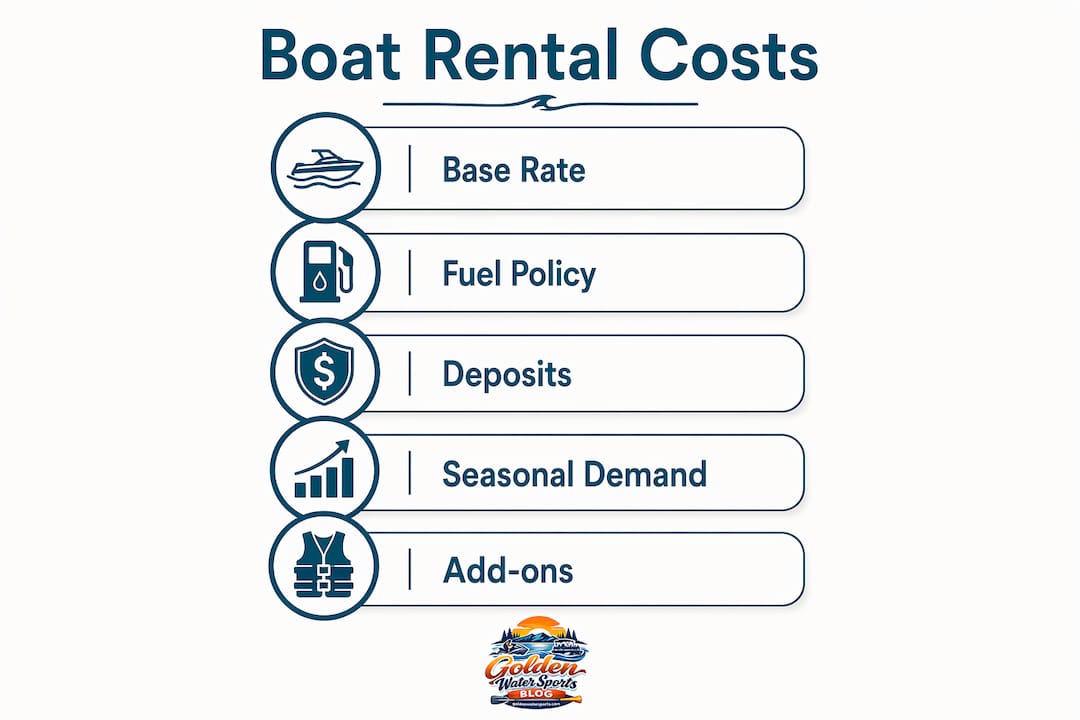
Boat rental pricing works by combining a base hourly or daily rate with fuel charges, security deposits, seasonal demand adjustments, and optional damage waivers to produce the true cost of a day on the water. Most renters focus only on the sticker rate and then feel blindsided at checkout. Understanding the full boat rental cost breakdown before you book puts you in control of your budget and your experience. Whether you’re planning a pontoon afternoon on Liberty Lake or a full day on Coeur d’Alene, every dollar you spend traces back to one of five predictable cost categories.
How boat rental pricing works: base rates by boat type
The base rate is the starting point of any rental quote, and it varies more than most people expect. Pontoons typically run $75 to $150 per hour, with half-day rates between $250 and $500 and full-day rates between $400 and $800. Yachts sit at the opposite end, with hourly rates of $200 to $500 and daily rates reaching $1,000 to $3,000 or more. That spread reflects the cost of the vessel, fuel capacity, insurance obligations, and the operator’s maintenance overhead.
Jet skis and fishing boats fall in the middle of that range. Jet skis typically run $75 to $125 per hour, while fishing boats land between $100 and $250 for a half-day depending on size and motor power. Sailboats occupy their own category, often priced by the day or week rather than the hour, since shorter windows rarely justify rigging time.

Rental duration also shapes the per-hour value significantly. A full-day weekday rental almost always delivers a lower effective hourly rate than two separate half-day bookings. Operators price full-day blocks at a discount because they reduce turnover costs and fill capacity more predictably. If you are planning more than four hours on the water, the full-day rate is almost always the smarter financial choice.
| Boat type | Hourly rate | Half-day rate | Full-day rate |
|---|---|---|---|
| Pontoon | $75–$150 | $250–$500 | $400–$800 |
| Jet ski | $75–$125 | $200–$350 | $350–$600 |
| Fishing boat | $80–$150 | $200–$400 | $350–$700 |
| Yacht | $200–$500+ | N/A | $1,000–$3,000+ |
Pro Tip: Book a full-day slot on a weekday whenever your schedule allows. You get more water time, a lower effective hourly rate, and fewer crowds at the launch.
How do fuel policies affect your total rental cost?
Fuel is the single most common source of surprise charges in boat rentals, and the policy varies by operator. The two dominant models in the industry are full-to-full return and prepaid fuel.
Under the full-to-full model, you receive the boat with a full tank and return it full. If you return it short, the operator charges a refueling fee of $75 to $150 plus a per-gallon surcharge that typically runs $1.50 to $3.00 above the marina pump price. That markup covers handling time and administrative overhead, so the final charge is almost always higher than stopping at a public gas station yourself.
The prepaid fuel model charges a flat fee upfront, typically $50 to $150 for a half-day pontoon rental, based on estimated consumption. This approach removes end-of-day disputes over tank levels and gives you a cleaner total cost before you leave the dock. For renters who want budget certainty, prepaid fuel is usually the better option even when the flat fee looks slightly higher than what you might actually burn.
Key questions to ask before you book:
-
Does the rate include fuel, or is fuel billed separately?
-
What is the per-gallon surcharge if you return the tank below full?
-
Is there a prepaid fuel option, and what does it cover?
-
Are there any marina or pump access fees added to the fuel cost?
Pro Tip: Always ask for the fuel policy in writing before you confirm a booking. A vague verbal answer at the dock is not a policy. Knowing the exact per-gallon rate and any surcharges lets you calculate your realistic total before you spend a dollar.
What role do deposits and damage waivers play in rental fees?
Security deposits are not a fee you pay and lose. They are a temporary hold on your credit card, typically released within 24 to 48 hours after a clean return. The hold amount scales with the vessel. Jet ski deposits commonly run $300 to $500, pontoon deposits sit between $500 and $1,500, and yacht deposits can reach $2,000 to $10,000 or more depending on vessel value.
The deposit protects the operator against fuel shortfalls, cleaning charges, and minor damage. If you return the boat clean and full, the full amount releases. If there is a cleaning fee or a fuel shortfall, the operator bills that amount and releases the remainder. Understanding this process matters because the hold temporarily reduces your available credit, which can affect other travel purchases during your trip.
Damage waivers are a separate and optional cost. These function like a daily insurance add-on, typically priced at $25 to $75 per rental day, and they cap your liability for accidental damage. Without a waiver, you are responsible for repair costs up to the full deposit amount. With a waiver, your exposure is limited or eliminated depending on the operator’s terms.
Key facts about deposits and waivers:
-
Deposits are holds, not charges. They do not cost you money unless damage or shortfalls occur.
-
Damage waivers are worth the daily fee for first-time renters or anyone unfamiliar with the specific vessel.
-
Always photograph the boat before departure to document pre-existing scratches or wear.
-
Ask the operator exactly how long deposit release takes and whether it applies to credit or debit cards differently.
The deposit and waiver details at any reputable operator should be available in writing before you sign anything.
How do seasonality and weekend pricing affect rental rates?
Demand-driven pricing is standard practice across the boat rental industry, and it directly affects what you pay for the same boat on different days. Weekend and holiday premiums typically run 10 to 20% above base rates during peak season. Shoulder season discounts, usually applied in spring and early fall, can reduce rates by 15 to 25% compared to peak summer pricing. That gap is real money on a full-day rental.
Dynamic pricing systems calculate the final rate using a formula: base rate multiplied by a demand adjustment factor tied to the day of week, season, and current availability. The practical implication is that two “full-day” bookings for the same boat can carry different prices depending on when you book and when you go. Dynamic pricing adjustments mean that a Saturday in July and a Tuesday in September are not the same product at the same price, even if the listing looks identical.
Here is how to use this to your advantage:
-
Book weekday rentals whenever your schedule allows. Tuesday through Thursday consistently carry the lowest rates.
-
Target shoulder season windows, typically May, early June, and September, for the best combination of good weather and lower prices.
-
Book early during peak season. Operators using dynamic pricing raise rates as availability tightens, so early booking locks in a lower demand tier.
-
Ask the operator directly whether any midweek or off-peak discounts apply. Many operators offer unpublished rates for longer bookings or repeat customers.
Choosing a full-day weekday rental during shoulder season consistently delivers better per-person value than a half-day on a peak weekend. That is not a minor difference. On a pontoon rental, the savings can easily reach $150 to $200 for the same hours on the water.
What add-on costs should you budget for beyond the base rate?
The base rate covers the boat. Everything else is extra, and those extras add up faster than most renters expect. A realistic boat rental cost breakdown for a full group day includes several line items beyond the hourly or daily rate.
Common add-on costs to budget for:
-
Fuel: $50 to $150 depending on boat size, engine type, and hours run
-
Damage waiver: $25 to $75 per day
-
Water sports equipment: Tubes, skis, and wakeboards often rent for $25 to $75 per item
-
Paddleboards or kayaks: $20 to $50 per board if added to the rental
-
Cooler and ice rental: $10 to $25 at many lakeside operators
-
Cleaning fee: $50 to $150 if the boat is returned in poor condition
Total group day costs including all add-ons commonly range from $300 to $800 for a standard group outing. The per-person share drops significantly as group size increases, which is the core logic behind how group boat rental works as a cost-sharing strategy.
| Group size | Full-day pontoon total (est.) | Per-person cost |
|---|---|---|
| 2 people | $600 | $300 |
| 4 people | $600 | $150 |
| 6 people | $600 | $100 |
| 8 people | $600 | $75 |
Splitting a pontoon rental across six to eight people is one of the most effective ways to rent a boat affordably without sacrificing comfort or experience. The boat cost stays fixed while the per-person share shrinks with every additional person in your group.
Key takeaways
Boat rental pricing is determined by base rate, fuel policy, deposit structure, seasonal demand, and add-on fees. Knowing all five before you book eliminates surprises and gives you real control over your total spend.
| Point | Details |
|---|---|
| Base rates vary by vessel | Pontoons run $75–$150/hour; yachts reach $200–$500+/hour depending on size and market. |
| Fuel policy changes your total | Full-to-full return with surcharges often costs more than a prepaid flat fuel fee. |
| Deposits are holds, not charges | Security holds of $300–$2,000 release within 24–48 hours after a clean return. |
| Timing drives price swings | Weekend and holiday premiums add 10–20%; shoulder season discounts cut 15–25% off peak rates. |
| Group sharing cuts per-person cost | A six-person pontoon split reduces individual cost to around $100 for a full-day rental. |
What I’ve learned about reading a boat rental quote
Most renters compare quotes by looking at the headline number and stopping there. That is the wrong move. Fuel and risk components explain most of the gap between an initial quote and what you actually pay at the end of the day. I have seen renters choose the “cheaper” option and end up paying more because the fuel policy was full-to-full with a steep per-gallon surcharge, and they underestimated how far they would travel.
The questions that actually matter before you book are not “what is the hourly rate?” They are: what is the fuel policy, what is the deposit hold amount, does the damage waiver cap my liability completely, and is this rate the peak or off-peak price? Those four questions give you the real cost of the rental.
Weekday and shoulder season timing is genuinely underused. Most people plan around weekends because that is when everyone is free, but a Tuesday rental in late May or early September on Coeur d’Alene or Liberty Lake is a different experience entirely. Lower rates, fewer boats on the water, and the same quality time with your group. The math and the experience both favor it.
For groups, the vessel choice matters more than most people realize. A pontoon fits eight people comfortably and costs roughly the same as two jet skis. If your group wants to cruise, swim, and relax together, the pontoon is the better value by a significant margin. If your group wants speed and individual rides, jet skis win. Match the boat to the activity, not just the price tag.
— Life is better on water.
Plan your day on the water with Goldenwatersports
Goldenwatersports serves Liberty Lake, Coeur d’Alene, and the surrounding region with pontoon boats, ski boats, Yamaha WaveRunners, paddleboards, and water toys. Every rental comes with transparent pricing that covers the base rate, fuel policy, deposit terms, and optional damage waiver upfront. No surprises at checkout.
Whether you are planning a family outing, a group celebration, or a solo adventure, Goldenwatersports offers flexible rental durations and friendly service to make your day on the water as easy as possible. Browse available boats and check current rental rates and options to find the right fit for your group and your budget. Booking is straightforward, and the team is available to answer any questions about fuel policies, deposits, or equipment add-ons before you commit.
FAQ
How does boat rental pricing work for groups?
Group boat rental works by splitting a fixed rental cost across multiple passengers. A pontoon renting for $600 for the day costs $75 per person for a group of eight, making it one of the most affordable ways to get on the water.
What is typically included in a boat rental fee?
The base rental fee covers the boat and standard safety equipment. Fuel, damage waivers, water sports equipment, and cleaning fees are almost always billed separately and should be confirmed before booking.
How much is a security deposit for a boat rental?
Security deposits typically range from $300 for jet skis to $1,500 or more for pontoons. The hold releases within 24 to 48 hours after a clean return with no fuel shortfall or damage.
When is the cheapest time to rent a boat?
Weekday rentals during shoulder season, typically May, early June, and September, carry the lowest rates. Shoulder season discounts commonly run 15 to 25% below peak summer pricing.
What is a damage waiver on a boat rental?
A damage waiver is an optional daily fee, usually $25 to $75, that limits or eliminates your financial liability for accidental damage during the rental. It is separate from the security deposit and does not replace it.