
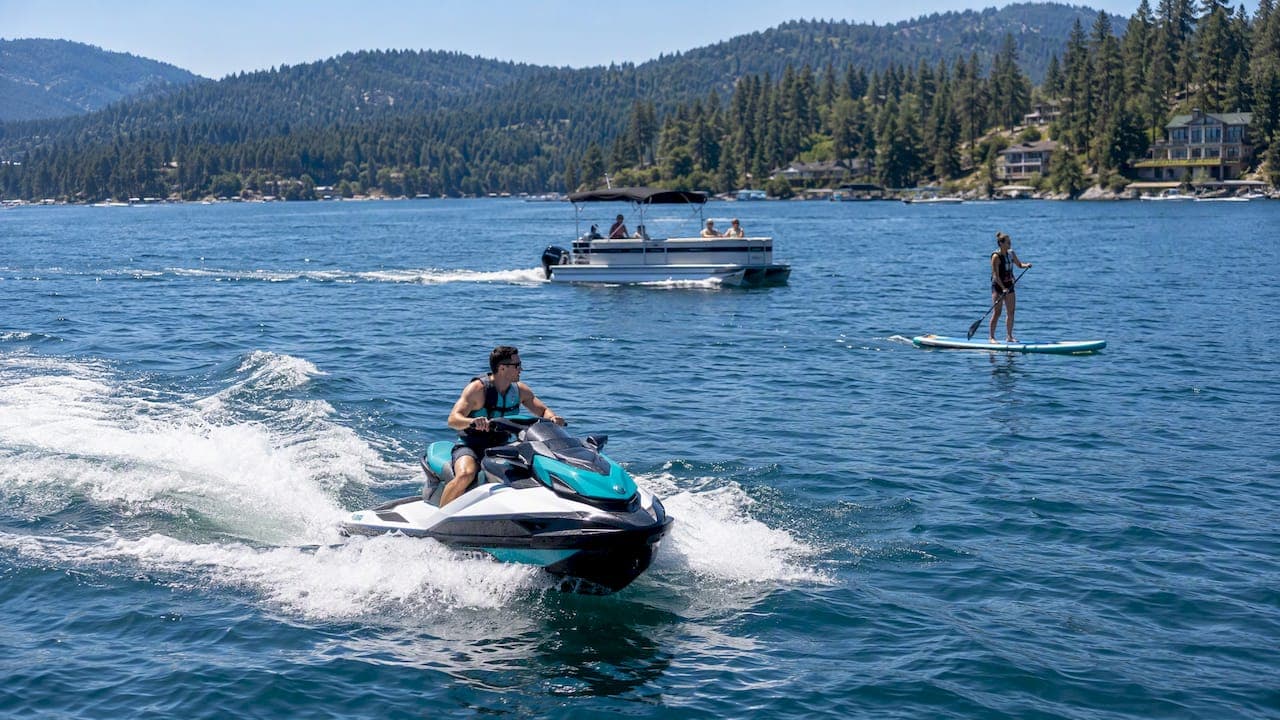
Washington law makes it illegal to operate any vessel while impaired, whether that vessel is a jet ski or a pontoon boat. A boat operator is legally impaired at a blood alcohol concentration of 0.08% or a THC level of 5.0 ng/mL, and these thresholds, along with the penalties and testing rules that back them, come straight from RCW 79A.60.040. Having alcohol on board is not itself illegal. Operating while impaired is.
TL;DR:
- A chemical test taken within two hours of operating can establish impairment, while refusing a lawful test adds a separate class 1 civil infraction.
- Spokane authorities may issue a municipal citation alongside state charges, while marine patrols also enforce local no wake zones and seasonal personal watercraft closures.
- People born since January 1, 1955, need an education card from age 12 for motorized vessels of 15 horsepower or more; rental checklists may qualify.
- Renting does not shift legal responsibility: the person operating the vessel, rather than its owner, answers for a BUI citation.
- A serious injury can lead to felony assault by watercraft charges, while a fatal BUI incident can carry possible life imprisonment.
Table of Contents
- Quick Facts: Washington BUI Rules at a Glance
- Penalties and Legal Consequences for BUI in Washington
- Enforcement and Testing: How Marine Officers Investigate BUI
- Spokane City and County Rules That Affect Drinking and Boating
- Renter and Operator Responsibilities: A Practical Checklist
- If You're Stopped or Charged: Immediate Steps to Protect Yourself
- Boater Education: Who Needs the Card and How Rental Checklists Help
- Guidelines for Passengers Consuming Alcohol on Boats and Restrictions
- Rules Regarding Open Containers of Alcohol on Vessels
- Boating Alcohol Laws Specific to Different Vessel Types
- Recommended Safe Alcohol Consumption Practices While Boating
- Emergency Procedures and Contacts in Case of BUI Incidents
- Local Operator Perspective: Why a Sober Skipper Policy Matters
- How We Help Renters Stay Safe and Legal
- FAQ
- Sources
Quick Facts: Washington BUI Rules at a Glance
Before you leave the dock, these are the numbers and rules that matter most.
- The legal limit is 0.08% BAC or 5.0 ng/mL THC for anyone operating a vessel in Washington, according to Washington State Parks.
- The "two-hour rule" lets law enforcement use a chemical test taken within two hours of operating a vessel to establish impairment, per RCW 79A.60.040.
- Boating under the influence (BUI) rules apply to motorized and non-motorized craft alike, including kayaks and stand-up paddleboards, not just powerboats and jet skis.
- Enforcement on Spokane-area waters falls to state troopers, county sheriff's marine units, and local police depending on the waterway.
Washington's BUI threshold is 0.08% BAC or 5.0 ng/mL THC, the same numeric standard used for driving under the influence on roadways, which means a boater who would fail a roadside sobriety test is equally impaired on the water, according to Washington State Parks.
Penalties and Legal Consequences for BUI in Washington
A first BUI conviction in Washington is a gross misdemeanor, but the penalties escalate fast when someone gets hurt.
- Standard BUI convictions carry significant fines and jail time as a gross misdemeanor as outlined under RCW 79A.60.040.
- Causing serious injury while operating under the influence can be charged as felony assault by watercraft, including substantial fines and prison terms, according to legal statutes.
- A fatal incident while boating under the influence can result in severe fines and possible life imprisonment, reflecting the serious legal consequences.
- Refusing a breath or blood test when lawfully requested carries its own civil consequences separate from any criminal BUI charge.
These numbers are not abstract. A boat moving at speed on Lake Coeur d'Alene or the Spokane River carries the same destructive potential as a car, and the law treats a drunk operator accordingly. Washington State Parks frames staying alcohol-free at the helm as the only way to guarantee compliance, while noting that smaller craft like kayaks and paddleboards are covered by the same BUI standards as powerboats, per Washington State Parks.
Enforcement and Testing: How Marine Officers Investigate BUI
When a marine officer suspects impairment, the process generally follows these steps:
- Initial observation and stop. An officer who sees erratic operation, speeding in a no-wake zone, or other signs of impairment can stop a vessel for a safety check.
- Field sobriety evaluation. Officers may conduct field assessments adapted for a moving deck, checking balance, speech, and responsiveness.
- Implied consent applies. Under Washington's implied consent framework, operating a vessel means you've already agreed to submit to a breath or blood test if lawfully requested, following the same procedural standards referenced in RCW 79A.60.040.
- Blood testing for THC or serious incidents. Suspected cannabis impairment or incidents involving injury typically require a blood draw, which may need a warrant unless exigent circumstances apply.
- Refusal consequences. Declining a test does not avoid penalties. It typically results in a class 1 civil infraction on top of any separate BUI charge.
Spokane City and County Rules That Affect Drinking and Boating
Local rules layer on top of state law rather than replacing it, so boaters on Spokane-area water need to know both.
- Spokane Municipal Code 16A.60.080 explicitly prohibits operating a vessel while under the influence, applying the same intoxication criteria used in state DUI law.
- Spokane County Marine Enforcement patrols local waterways and treats impaired operation as a direct threat to other boaters, swimmers, and paddlers sharing the same water.
- Local no-wake zones, required life jackets, and seasonal personal watercraft closures often overlap with the same stretches of water where marine patrols watch for impairment.
- A Spokane municipal citation can apply alongside a state charge, meaning a single incident may trigger both city and state consequences.
Renter and Operator Responsibilities: A Practical Checklist
Renting a jet ski or pontoon boat for the day comes with real legal obligations, not just a good time on the water.
- Complete the vendor safety checklist. Most rental operators walk you through a safety checklist that functions as a temporary boater education card for the day, covering navigation rules and basic vessel handling.
- Assign a sober skipper before you leave the dock. Decide who is driving and keep that person alcohol-free for the entire outing, not just the first lap around the lake.
- Verify required gear. Check for US Coast Guard approved life jackets for every passenger, a working fire extinguisher, functioning navigation lights, and your rental paperwork before departure.
Renting doesn't shift legal responsibility. The person at the controls, not the vessel's owner, answers for a BUI citation. For more detail on meeting Washington's boater education requirements as a renter, see our guide on boater card and rental checklist requirements.
Pro Tip: Pick your sober skipper before anyone touches a cooler, not after the first round of drinks.
If You're Stopped or Charged: Immediate Steps to Protect Yourself
Getting contacted by a marine patrol officer is stressful, but a calm, methodical response protects both your safety and your legal position.
- Bring the vessel to idle speed safely and make sure every passenger has a life jacket on before the officer approaches.
- Follow the officer's safety instructions, answer basic identification questions, and understand that refusing a lawfully requested test carries its own civil penalty under implied consent rules.
- Stay respectful but avoid volunteering extra details about your evening. Note the officer's name and badge number for your own records.
- Keep your rental agreement and safety checklist on hand. It documents that you received safety instruction and may matter later.
- Contact a Washington attorney experienced in boating cases if you're cited or arrested, since BUI law intersects with both state and local code.
Boater Education: Who Needs the Card and How Rental Checklists Help
Washington requires anyone born on or after January 1, 1955, who is at least 12 years old, to carry a Boater Education Card when operating a motorized vessel of 15 horsepower or greater, according to the Washington boater education program.
- Renters can typically satisfy this requirement with a vendor-issued temporary card completed as part of the rental safety checklist, rather than taking a full course in advance.
- State-approved boater education courses are available online and in person, with costs ranging from free to a modest fee depending on the provider.
- Carrying proof, whether a permanent card or a temporary vendor checklist, matters at the dock: an officer who stops your vessel will ask for it.
Guidelines for Passengers Consuming Alcohol on Boats and Restrictions
Passengers are not held to the same legal standard as the operator, but that doesn't mean anything goes once you're on the water. Washington's BUI law targets the person controlling the vessel, so a passenger sipping a drink while someone else drives is not, by itself, violating the operator impairment statute. That distinction creates real risk, though, when the designated skipper decides to switch seats with a passenger who has been drinking.
A few practical boundaries keep a group outing on the right side of the law. First, agree on who's driving before anyone opens a cooler, and keep that person out of the alcohol entirely for the day. Second, remember that local ordinances, like those enforced on Spokane waters, apply to everyone on board when it comes to behavior that endangers others, including reckless conduct from an intoxicated passenger standing up in a moving boat or jumping off a swim platform. Third, if your plan includes a shore component, such as transport to and from a launch site for a larger group, arrange a sober driver for that leg too; services built around group transportation and alcohol policy, like charter bus options for group outings, can help separate the boating day from the drive home.
The safest approach treats the whole outing, water and land, as one continuous trip where someone stays sober from start to finish.
Rules Regarding Open Containers of Alcohol on Vessels
Washington does not ban open containers of alcohol on recreational vessels the way many states restrict them in vehicles on the road. You can legally have beer, wine, or mixed drinks open and accessible on a boat, jet ski, or pontoon while it's operating, as long as the person running the vessel stays under the 0.08% BAC and 5.0 ng/mL THC thresholds set by RCW 79A.60.040.
That said, local rules and common sense narrow this in practice. Some marinas, boat launches, and public beach areas enforce their own alcohol restrictions separate from on-water rules, so check posted signage before you load coolers at the dock. On a rented jet ski, there's effectively no safe way to drink and operate anyway, since the controls demand constant attention and both hands. On a pontoon boat or larger craft where one person can stay at the helm while others relax, an open container is legal for passengers but still carries the practical risk of a passenger impulsively taking the wheel.
Treat "legal" and "wise" as two different questions here. Just because open containers are permitted doesn't mean a chaotic, alcohol-heavy outing is a good idea when you're sharing the water with swimmers, paddleboarders, and other boats.
Boating Alcohol Laws Specific to Different Vessel Types
Washington's BUI statute doesn't create separate rules for jet skis versus pontoon boats versus kayaks. The 0.08% BAC and 5.0 ng/mL THC thresholds apply uniformly across vessel types under RCW 79A.60.040, and Washington State Parks specifically notes that even non-motorized craft like kayaks and stand-up paddleboards fall under the same impairment standard.
What changes by vessel type is the practical risk profile. A jet ski demands continuous balance and quick reaction time, so even mild impairment shows up fast and often ends in a fall or collision before an officer ever administers a test. A pontoon boat or ski boat is more forgiving at low speed but becomes just as dangerous at higher speeds or in crowded water, and Washington's felony assault-by-watercraft penalties apply regardless of what kind of vessel caused the injury. Personal watercraft also tend to draw closer attention from marine patrols in high-traffic areas precisely because they're harder to control and more prone to sudden maneuvers.
The law treats a jet ski operator and a pontoon captain identically. The practical margin for error just shrinks significantly on a vessel you're straddling at 40 miles an hour.
Recommended Safe Alcohol Consumption Practices While Boating
The simplest safety rule on the water is also the most effective: the person operating the vessel doesn't drink, period, not "just one," not "I'm fine." A sober skipper eliminates the single biggest variable in boating fatalities tied to alcohol.

For groups who want to enjoy drinks on the water, a few habits make the day safer for everyone. Designate your skipper before the cooler comes out and don't rotate driving duties once anyone has started drinking. Pace hydration with water alongside any alcohol, since sun and heat on open water accelerate dehydration and intensify alcohol's effects faster than on land. Keep a close count of how many drinks each passenger has had, since a crowded pontoon boat makes it easy to lose track. Finally, plan your return to the dock with a time buffer, since the two-hour testing window under RCW 79A.60.040 means impairment can still be measured well after you've tied up.
If your outing includes a land-based leg, such as a shuttle to a launch point for a larger party, arrange sober transport for that portion as well so the entire day, not just the hours on the water, stays safe.
Emergency Procedures and Contacts in Case of BUI Incidents
If you witness or are involved in an incident where impairment may be a factor, calling for help comes first, before any conversation about fault or liability. On Spokane-area lakes and rivers, contact 911 for any injury, collision, or vessel in distress, the same as you would for a roadway emergency.
Spokane County Marine Enforcement handles water-based incident response alongside state patrol units, and dispatchers can route your call to the right marine unit once you report a location and the nature of the emergency. Keep your vessel's position as specific as possible, using nearby landmarks, buoy numbers, or GPS coordinates if your phone or device provides them. If you're a passenger and the operator is impaired, get to a safe vessel or shore position if possible and alert other boaters nearby, since a second set of eyes can help emergency responders find you faster.
After any incident involving suspected impairment, cooperate with arriving officers, keep your rental or safety paperwork accessible, and seek medical attention even for injuries that seem minor at first. Documentation from the scene, including the names of any responding officers, matters if the incident leads to a citation or legal proceeding later.

Local Operator Perspective: Why a Sober Skipper Policy Matters
We've watched enough summer afternoons on these lakes to know that one sober skipper prevents more accidents than any amount of safety gear alone. Families come first in that equation. Assign your driver before you leave the dock, keep them alcohol-free all day, and the rest of the outing takes care of itself.
— Life is better on water.
How We Help Renters Stay Safe and Legal
Every rental comes with life jackets, a vendor safety checklist that covers Washington's boater education requirement, and guidance on local rules before you ever leave the dock.
- We supply life jackets for every passenger.
- Our safety checklist helps renters stay compliant with boater education requirements.
- Prior to departure, renters receive information on local no-wake zones, seasonal rules, and BUI expectations.
Ready to plan a safe day on the water? Browse jet ski and boat rentals or check Coeur d'Alene rental pricing to book your outing with a sober skipper in mind.
This article is general information, not a substitute for advice from a qualified lawyer. Consult a qualified legal professional about your own circumstances before acting on anything here.
FAQ
Can you drink alcohol at age 18 while boating in Washington?
Washington law restricts alcohol consumption to legal adults, applying uniformly across all waters, including Spokane-area lakes and rivers.
What is the legal BAC limit to operate a boat?
In Washington, the legal limit to operate any vessel is 0.08% BAC or 5.0 ng/mL THC, the same numeric threshold used for driving a car, according to RCW 79A.60.040. Other states set their own limits, so always confirm the local standard if you're boating outside Washington.
What is the 1/3 rule in boating?
The "1/3 rule" generally refers to a fuel management practice where boaters use a third of their fuel to travel out, a third to return, and keep a third in reserve for emergencies. It is a safety planning guideline rather than a legal requirement tied to alcohol or BUI law.
Do I need a license to operate a boat in Washington?
Washington does not require a boating license, but anyone born on or after January 1, 1955, operating a motorized vessel of 15 horsepower or greater needs a Boater Education Card, according to the Washington boater education program. Renters can typically meet this requirement with a vendor-issued temporary card completed through a rental safety checklist.
Sources
- RCW 79A.60.040 — Operation of vessel in a reckless manner; operation while under the influence; consent to test; penalty
- Recreational boating laws & regulations | Washington State Parks
- Spokane Municipal Code — Operating a Vessel While Under the Influence (16A.60.080)
- Spokane County Marine Enforcement