
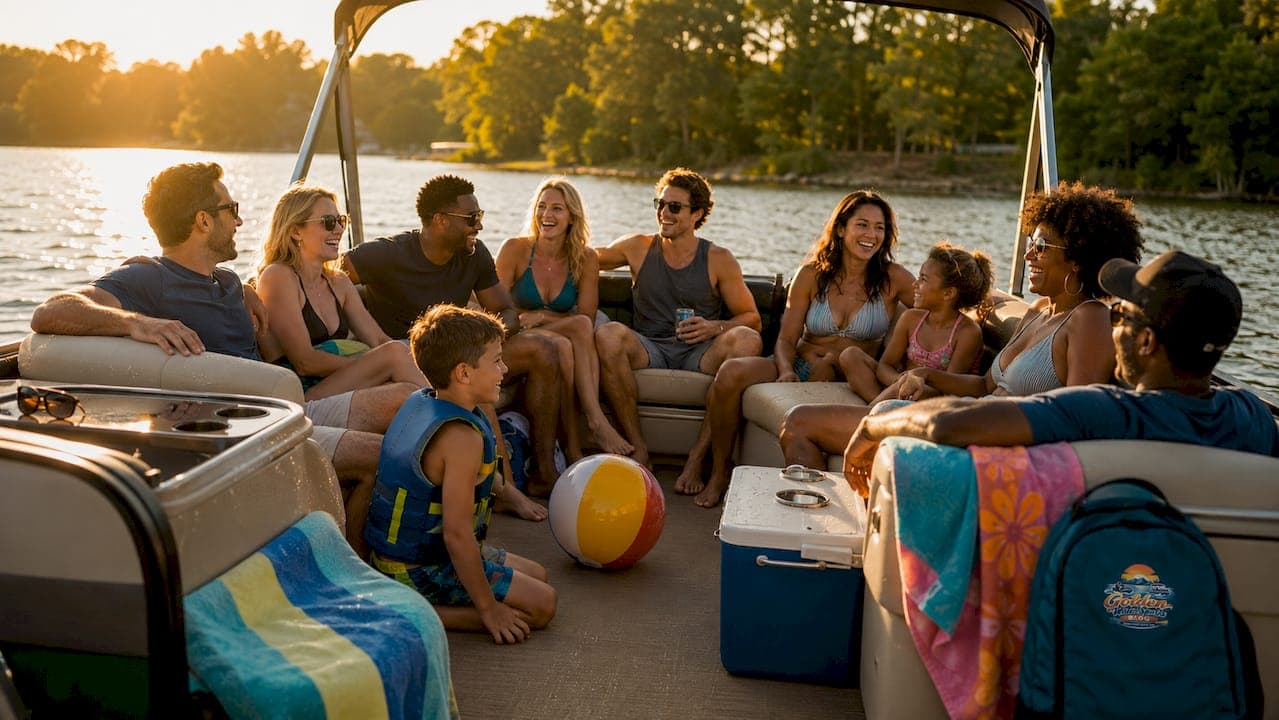
Pontoon boats are the most space-efficient, socially designed watercraft available for groups of eight or more people on a lake. No other recreational boat type combines flat, walkable decks, predictable stability, and multi-activity layouts the way a pontoon does. Whether you are planning a birthday celebration on Liberty Lake, a family reunion on Coeur d'Alene, or a casual Saturday outing with a dozen friends, understanding why pontoon boats suit large groups will help you choose the right vessel and get the most out of your day on the water.
Why pontoon boats suit large groups better than other options
Pontoon boats, sometimes called "party barges" in casual conversation, are formally classified as flat-deck vessels supported by two or three cylindrical aluminum tubes called pontoons or logs. That hull design is the foundation of everything that makes them work for crowds. A flat, wide deck creates more usable standing and lounging space than any comparable V-hull runabout or bowrider, giving groups of 8 to 15 people room to move, eat, and socialize without bumping into each other constantly.
The open center of a pontoon deck functions like a floating patio. Seating lines the perimeter, which keeps the middle clear for movement, games, or a folding table loaded with food. That layout is not accidental. Boat designers specifically arrange pontoon seating around the edges to maximize social flow, so conversations happen naturally across the boat rather than in isolated clusters. No other group-friendly boat option replicates that configuration at the same price point.
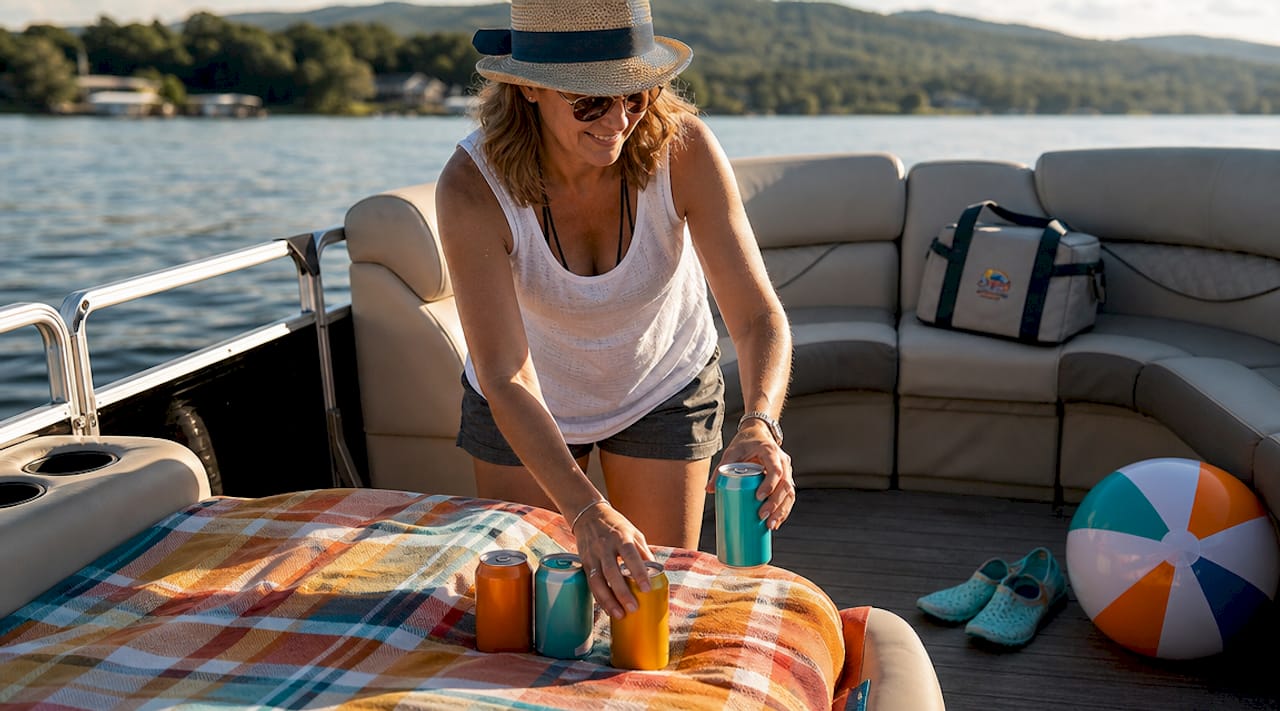
Compared to a ski boat or a bowrider, a pontoon also boards more easily. The low freeboard and wide swim platform mean kids, seniors, and anyone who is not an experienced boater can step on and off without climbing over rails or squeezing through narrow passages. That accessibility alone makes pontoons the default choice for mixed-age gatherings.
How pontoon boats maximize space and seating for large groups
Deck layout and usable square footage
The numbers behind pontoon capacity are straightforward. Family pontoons commonly accommodate 6 to 10 passengers on smaller 18 to 22-foot models, and 12 to 15 or more passengers on 24 to 30-foot configurations. That range covers nearly every group size you would realistically bring to a lake for a day trip. The key is that certified capacity is tied to both seat count and total weight, not just headcount.
| Pontoon length | Typical passenger capacity | Best group size |
|---|---|---|
| 18 to 21 ft | 6 to 10 people | Small family or friend group |
| 22 to 24 ft | 10 to 13 people | Medium group or mixed ages |
| 25 to 28 ft | 12 to 15 people | Large family or party group |
| 28 to 30 ft | Up to 16 people | Large gatherings or events |
Larger pontoons do not just add seats. They add deck real estate, which is the actual differentiator. A 28-foot pontoon gives your group room to set up a cooler station, a seating circle, and a clear path to the swim ladder without any of those zones interfering with each other.
Pro Tip: When comparing pontoon models, look at the total deck square footage listed in the spec sheet, not just the seat count. Two boats with the same seat count can have very different amounts of open floor space depending on how the manufacturer arranged the furniture.
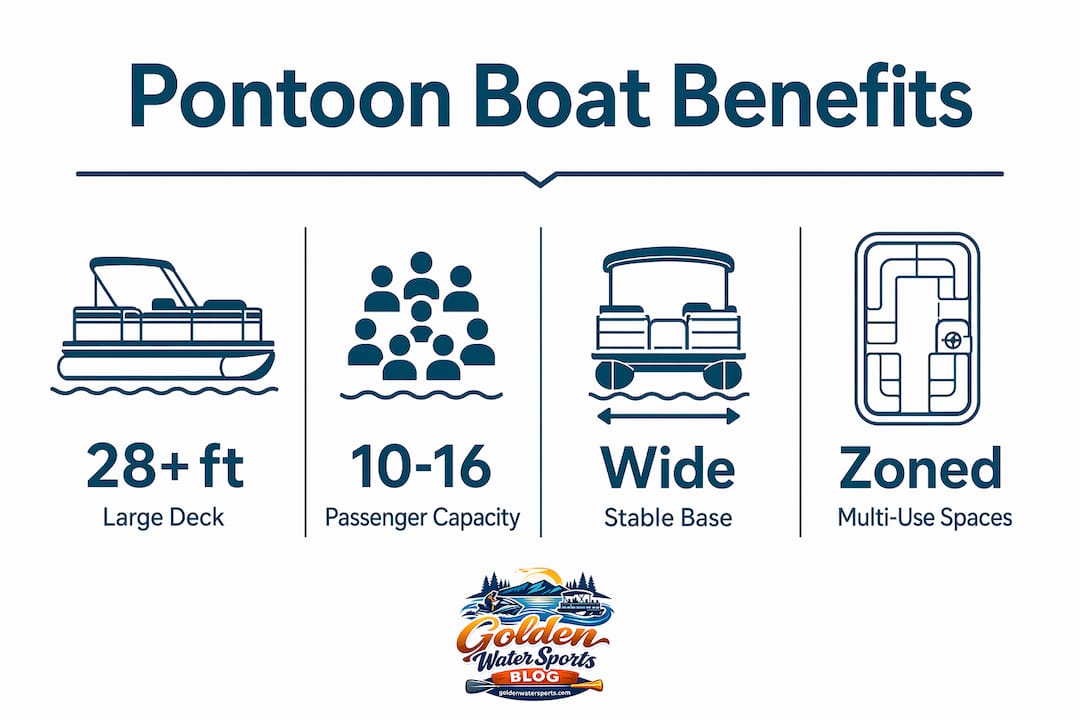
Wraparound lounges and multi-position seats, standard on most modern pontoons, support all-day comfort in a way that fixed bench seating on smaller boats simply cannot. People can shift from sitting upright to reclining without relocating, which matters a lot during a six-hour lake day.
What makes pontoon boats stable and safe for mixed-age groups
Stability is the single most cited reason families and mixed-age groups choose pontoons over other boat types. Wide twin tubes create a balanced platform that stays level when passengers move around, stand up, or lean over the side. That predictable handling is what separates a pontoon from a narrower hull that rocks noticeably when weight shifts.
The practical implications for group safety are significant:
- Children can walk from bow to stern without the boat tilting or requiring adults to redistribute weight.
- Seniors and guests with limited mobility can stand, stretch, and move to the swim ladder without holding on for balance.
- Guests who are not regular boaters feel comfortable immediately, which reduces anxiety and improves the overall experience.
- Swimming ladders on most pontoons are wide and low to the water, making re-boarding easy for all fitness levels.
- Triple-tube tritoon configurations add even more lateral stability, which is worth considering if your group includes young children or anyone prone to motion discomfort.
Pontoons feel more secure for families than narrower hulls precisely because the platform does not punish minor weight shifts with dramatic rocking. That forgiving quality is not just about comfort. It directly reduces the risk of falls and overboard incidents, which are the most common causes of boating injuries in recreational settings. For anyone planning a kid-friendly group outing, that stability margin is not optional. It is the baseline requirement.
How versatile layouts support multiple activities at once
One of the underappreciated benefits of pontoon boats is that a single vessel can serve several different groups within your party simultaneously. Modern pontoons cover a full weekend checklist of varied activities, from swimming and sunbathing to light towing and sandbar stops, without requiring passengers to rearrange the entire boat between activities.
Here is how a well-organized pontoon day typically breaks down for a group of twelve:
- Departure zone. The stern area near the engine handles boarding, gear storage, and swim ladder access. Keeping this zone clear prevents bottlenecks when half the group wants to jump in the water.
- Social zone. The center and forward deck become the conversation and dining area. A folding table, the cooler, and the main seating circle live here. This is where most of the group spends most of the day.
- Activity zone. One side of the boat or the bow area can be designated for fishing rods, water toy storage, or a wakeboard tower attachment if the model supports towing.
- Quiet zone. On larger pontoons, a forward lounge away from the engine noise gives guests who want to read, nap, or watch the scenery a place to decompress without leaving the boat.
Pro Tip: Assign zones before you leave the dock. Tell your group where the cooler lives, where the swim ladder is, and where gear goes. Five minutes of orientation at the start prevents two hours of shuffling and frustration on the water.
Assigning zones on larger pontoons is the single most effective way to improve group comfort. Double-decker party barge configurations take this further by placing lounging and dancing on the upper deck and swim access on the lower, managing guest flow across two levels. You can explore pontoon trip ideas that take full advantage of this zoning approach for everything from fishing mornings to sunset cruises.
Choosing the right pontoon size based on your group
Matching your group to the right pontoon requires looking at three numbers: certified passenger count, maximum weight capacity, and total deck length. Certified max passenger count plus weight should guide every group planning decision, because neglecting weight limits leads to unsafe overloading even when seats are technically available.
The weight calculation catches most groups off guard. A group of twelve adults averaging 185 pounds each equals 2,220 pounds of passenger weight before you add a single item of gear. Add two large coolers, a portable grill, water toys, and safety equipment, and you can easily add another 300 to 500 pounds. Coolers and water toys reduce the safe passenger count significantly on mid-size pontoons, which is why renting one size larger than you think you need is almost always the right call.
Key questions to answer before booking a pontoon for your group:
- How many adults versus children are in your party? Children weigh less but also move around more, which affects stability calculations.
- How much gear are you bringing? Coolers, grills, and water toys all count against the weight limit.
- Will you be towing anyone on a tube or wakeboard? Towing adds stress to the engine and changes how the boat handles with a full load.
- Do any guests have mobility considerations that require specific boarding access or seating placement?
For groups planning how boat rental pricing works and sizing decisions together, the general rule is to target 80 percent of the certified passenger limit as your practical maximum. That buffer accounts for gear weight and gives everyone comfortable personal space rather than shoulder-to-shoulder seating.
Common mistakes groups make on pontoons and how to avoid them
The most frequent mistake large groups make is treating the certified passenger number as a target rather than a ceiling. Overloading risks come primarily from combined people and gear weight, not just seat count. A boat that seats 14 people does not automatically handle 14 adults plus full coolers, a grill, and a pile of inflatables safely.
The second most common mistake is ignoring layout and traffic flow. Groups that pile everything near the stern create a chokepoint around the swim ladder and the cooler, which means half the boat is crowded and the other half is empty. Spreading gear and seating deliberately across the full deck length solves this immediately.
Pro Tip: Place the cooler at the center of the boat, not at the stern. It keeps weight balanced, reduces traffic near the engine area, and makes drinks accessible to everyone without creating a crowd in one corner.
Renting from a reputable operator like Goldenwatersports also eliminates the operator experience problem. Groups that rent from providers with proper safety briefings, well-maintained equipment, and clear capacity guidance have measurably better outings than those who show up underprepared. Group boat tours follow the same principles: clear roles, defined zones, and respect for weight limits produce the best experiences.
Key takeaways
Pontoon boats suit large groups because their flat, stable decks and zoned layouts deliver more usable social space per passenger than any other recreational boat type at a comparable price.
| Point | Details |
|---|---|
| Space advantage | Flat, wide decks on 22 to 30-foot pontoons comfortably seat 10 to 16 passengers with room to move. |
| Stability for all ages | Twin or triple tubes keep the platform level when passengers shift, making pontoons safe for kids and seniors. |
| Zoning improves comfort | Assigning separate areas for food, conversation, and swim access prevents crowding and improves group flow. |
| Weight limits matter | Count passenger weight plus gear against the certified limit, not just the seat count, before booking. |
| Size up when in doubt | Booking one size larger than your minimum need gives every guest comfortable space and a weight buffer for gear. |
Why pontoons have earned their place as the group boat
I have been on the water with groups ranging from six people to twenty, on everything from ski boats to houseboats, and the pattern is consistent. Pontoons produce better group days not because they are the fastest or the most exciting boats on the lake, but because they remove friction. Nobody is fighting for a seat. Nobody is nervous about the boat tipping when someone stands up. The person who wants to fish can fish while the person who wants to sunbathe does exactly that, three feet away, without either activity disrupting the other.
The argument I hear against pontoons is that they are boring. That argument comes from people who have never been on a well-configured 26-footer with a strong engine, a good sound system, and a group that knows how to use the space. A tritoon with a 150-horsepower engine pulls a tube just fine. It also anchors at a sandbar and becomes a floating living room for four hours without anyone feeling cramped. No ski boat does both of those things for twelve people at once.
The social layout is the part that does not get enough credit. When seating faces inward around the perimeter of the deck, conversations happen across the whole group rather than in pairs facing forward. That geometry produces the kind of afternoon where everyone is talking to everyone, not just the person next to them. That is the memory people take home. The boat is just the platform that made it possible.
— Life is better on water.
Plan your group outing with Goldenwatersports
Goldenwatersports offers pontoon boat rentals sized for groups of all kinds, from family lake days to full-scale celebrations on Coeur d'Alene and Liberty Lake. Every rental includes safety equipment, a thorough orientation, and flexible rental periods so your group gets the full day it deserves. The fleet is maintained to a high standard, and the team knows these lakes well enough to point you toward the best sandbars, swimming spots, and anchorages in the region. Visit Goldenwatersports to check availability and book a pontoon that fits your group size, or explore rental options near Coeur d'Alene for details on specific models and pricing.
FAQ
How many people can a pontoon boat hold?
Most pontoon boats hold between 8 and 16 passengers depending on length and certified capacity. Larger 28 to 30-foot models reach the upper end of that range, while 20 to 22-foot models typically cap at 8 to 10 passengers.
Are pontoon boats safe for kids and seniors?
Pontoon boats are among the safest recreational watercraft for mixed-age groups because their wide twin tubes create a stable, level platform that does not rock significantly when passengers move. Wide swim ladders and low freeboard also make boarding and re-boarding easy for all ages.
What size pontoon do I need for a group of 12?
A 24 to 26-foot pontoon with a certified capacity of 13 or more passengers is the practical minimum for a group of 12 adults with gear. Targeting 80 percent of the certified passenger limit as your working maximum accounts for coolers, water toys, and other equipment weight.
Can you do water sports on a pontoon boat?
Many modern pontoons and tritoons support light towing activities like tubing and wakeboarding when equipped with a tow bar and a sufficient engine. Check the horsepower rating and towing capacity of the specific model before planning water sports with a full passenger load.
What is the difference between a pontoon and a tritoon?
A tritoon has three aluminum tubes instead of two, which adds lateral stability and allows for larger engines and higher speeds. Tritoons are the better choice for groups that want both a stable social platform and the power to tow riders or cruise at higher speeds.