
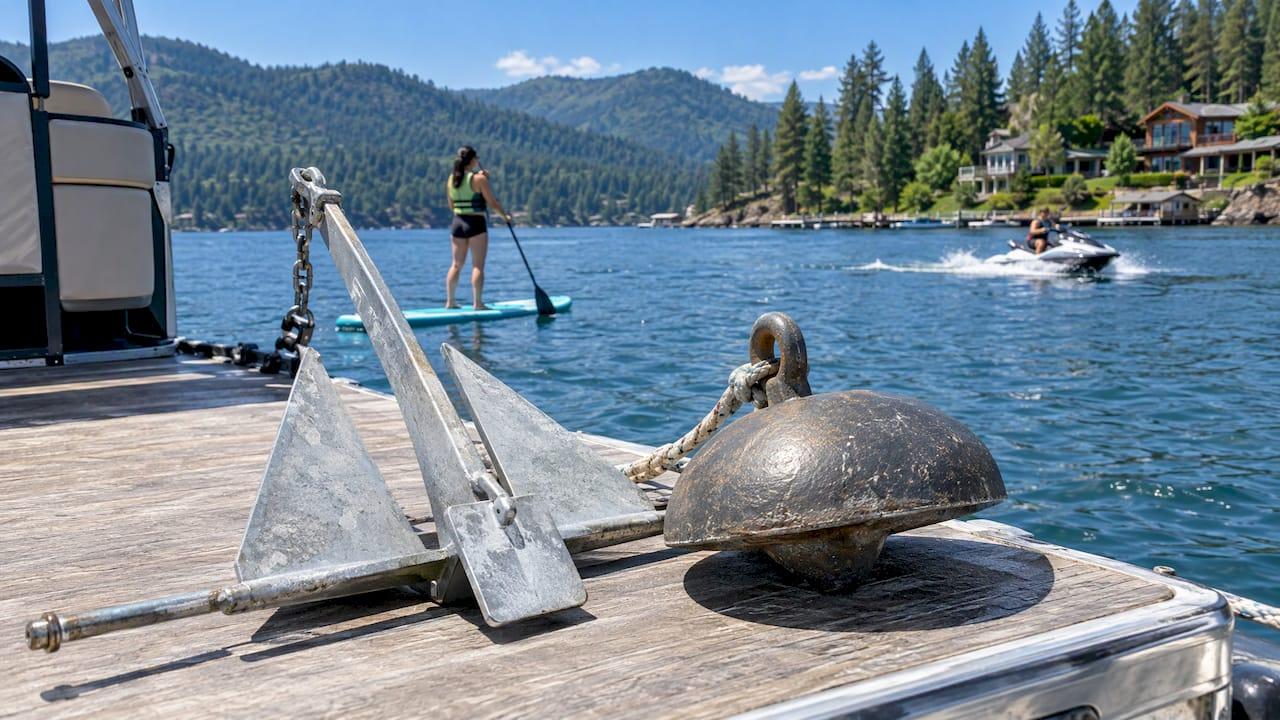
For a pontoon or powerboat on Lake Coeur d'Alene, Liberty Lake or Newman Lake, the Danforth (a fluke anchor) is the better choice. It digs into the sand and mud that make up most lake bottoms and holds far more than its weight. A mushroom anchor only suits very small, light craft on soft bottoms in calm water. If you rent a boat from us, you can spend your day swimming, tubing and relaxing instead of worrying about drift.
TL;DR
- Danforth: light, with two flat flukes that bury themselves. It is the better fit for boats up to about 30 feet on sand or mud.
- Mushroom: an inverted-mushroom head that sinks into soft silt. It is for canoes, small aluminum fishing boats and dinghies, not for pontoons or ski boats.
- Rocks and weeds: a Danforth can skip over them, so pick your spot by bottom type.
- Scope matters as much as the anchor: let out at least 5 feet of line per foot of depth, and add a few feet of chain.
- For a 20-foot boat: aim for about 90 pounds of holding power, not 90 pounds of anchor.
Table of Contents
- How the two anchors work
- Which one for a lake boat
- What the bottom does to your anchor
- Sizing: what a 20-foot boat needs
- Chain and scope: the part people skip
- What about paddleboards and kayaks?
- Renting a boat for your lake day
- Our view
- FAQ
- Sources
How the two anchors work
The two anchors hold in completely different ways.
A Danforth has a hinged crossbar at the top and two large, flat, triangular flukes. When the boat pulls back, tripping palms tip the flukes down into the bottom. Once buried, the harder the pull, the deeper it digs. Richard Danforth, an American, designed it in the 1940s. Its holding power comes from fluke area, not weight, which is why a small one can hold a big boat.
A mushroom anchor is a heavy dome on a short stem. It relies on sinking into silt and being held by suction. According to the same source, it holds at best about twice its weight until it is buried, and only after burying can it reach several times that.

Which one for a lake boat
The Idaho Boater Safety Course says a mushroom anchor should not be used on boats larger than a small canoe, rowboat, small sailboat or inflatable. It also says never to rely on one in rough water or weather.
Mercury Marine's anchor guide puts it plainly. Danforth flukes dig in and grab particularly well in sand and mud. A mushroom anchor has little holding power except in soupy mud, and a gust of wind can pull it loose.
| Danforth (fluke) | Mushroom | |
|---|---|---|
| Holds by | Flukes digging in | Weight and suction |
| Best bottom | Sand, hard mud | Very soft mud or silt |
| Weak spot | Rock, heavy weeds | Wind, current, chop |
| Typical boat | Pontoons, ski boats, runabouts | Canoes, dinghies, small jon boats |
| Handling | Light and flat to stow | Compact but heavy for its grip |
What the bottom does to your anchor
The U.S. Fish & Wildlife Service calls the fluke a mud and sand anchor. It does very well in those bottoms and is not appropriate for rocky or hard ones. Flukes need something to penetrate. Greenfield Products, a maker of fluke anchors, notes that rock, timber and heavy weed stop them from digging.
What this means on a lake day:
- Sandy or hard-mud cove: a good Danforth spot.
- Weedy shallows or rocky points: the anchor may skate. Choose another spot or move out to cleaner bottom.
- A shifting wind: Discover Boating notes that a Danforth can pull free if the wind shifts and the boat drifts over it. Watch your position against a landmark after the first few minutes.
Many lakes have mixed bottoms, so a single anchor is not always enough. Harris Boats points out that some lakes have rock in one area, sand in another and mud elsewhere.
Sizing: what a 20-foot boat needs
Anchors are rated by holding power, not boat weight. Bass Pro Boating Centers says 90 pounds of holding power is enough for a 20-foot boat in winds up to 20 mph. It also says fluke anchors are the top choice for most recreational boats of 30 feet or less.
The same guide says a plastic-coated 10-pound mushroom anchor generates only a little over twice its weight in holding power. A 20-foot boat on a mushroom anchor will drag.
For a concrete Danforth example, the maker's own selection chart lists the S600 model for boats 17 to 27 feet. It weighs 9 pounds and is rated for 600 pounds of holding power, assuming normal wind, average current and at least 5:1 scope.
Boats with a lot of freeboard, like pontoons, catch more wind. Discover Boating advises going larger for heavier boats, high windage or windy areas.

Chain and scope: the part people skip
The anchor is only half the system.
- Chain: a few feet between anchor and rope keeps the pull low so the flukes dig instead of skate. Greenfield recommends 4 feet of 1/4-inch coated chain.
- Scope: this is the ratio of line let out to water depth. Bart's Water Sports says 5:1 is the minimum effective ratio, giving about 75% of maximum holding power, and 10:1 gives full holding power. In 10 feet of water, that means 50 to 100 feet of line.
- Setting it: back the boat down gently until the line snubs firm. A set Danforth stops the boat. A dragging one skips and vibrates through the line.
When you are done, rinse the mud off before stowing, so it doesn't foul your deck. Our guide to anchoring a pontoon boat correctly on a lake walks through the full routine, and pontoon fishing setup and anchoring tips covers longer stays.
Wind decides how comfortable all of this is. Read our boating weather forecast tips before you pick a cove.
What about paddleboards and kayaks?
If you're on a paddleboard or kayak, you won't want a Danforth. A small, light anchor is enough for a quick stop. For a wider look at planning a day on the water by paddle, this kayak rental guide for a lake day covers what to arrange before you go.
Renting a boat for your lake day
On a rental, your priority is a safe, easy day, not a gear project. Golden Water Sports rents ski boats, pontoon boats, jet skis, paddleboards and water toys around Spokane Valley, Liberty Lake and Coeur d'Alene. Our rentals come with safety equipment, and we offer hourly and multi-day options plus pickup and limited delivery. Jet ski rentals at Liberty Lake and Newman Lake run $250 to $425, with additional hours at $75 per hour. Wakeboards and tubes are $50 each.
The damage deposit is $500 per jet ski and $1,000 per boat. You can see all current options on our rental prices page.
If you're ready to book, start at Golden Water Sports and choose your boat. For first-timers, our lake rental tips are a good warm-up.
Our view
We think a good lake day starts with matching the gear to the water. For the pontoons and ski boats our guests take out, the Danforth style is the answer the evidence supports: light to handle, strong in sand and mud, and sized by holding power rather than heft. A mushroom anchor belongs on a canoe, not a family boat.
What matters most is how you use it. Choose a cove with a clean bottom, let out generous scope, and watch your position for the first few minutes. That habit does more for you than any anchor purchase.
Our job is to make the rest easy: clean, well-maintained Yamaha watercraft, flexible booking and friendly help, so your attention stays on the lake.
Life is better on water.
FAQ
Do mushroom anchors work well?
Only in a narrow setting: very soft bottoms, calm water and very small craft. Discover Boating says they suit personal watercraft, small aluminum fishing boats and dinghies. For anything larger, a fluke anchor is the safer pick.
What size anchor do I need for a 20-foot boat?
Look for about 90 pounds of holding power, which covers winds up to 20 mph according to Bass Pro Boating Centers. A 9-pound Danforth S600 is rated well above that on its maker's chart for boats of 17 to 27 feet. Go larger if your boat is tall or heavy for its length, or if it's windy.
What are fluke anchors best for?
Sand and mud bottoms, where the flukes can dig in. The U.S. Fish & Wildlife Service says they are not appropriate for rocky or hard bottoms. Heavy weeds also stop them from setting.
What's the best anchor for a lake boat?
For most pontoons and runabouts on inland lakes, a Danforth-style fluke anchor with a few feet of chain and 5:1 or longer scope. Check your bottom type first, since many lakes mix sand, mud and rock.
Sources
- Anchor (Wikipedia)
- Choosing the Right Anchor, Idaho Boater Safety Course
- Choosing the Best Anchor and Anchoring Your Boat, Mercury Marine
- Anchors, U.S. Fish & Wildlife Service
- Fluke anchors: how they hold and what they need, Greenfield Products
- Types of Anchors, Discover Boating
- Best Anchors for Pontoon Boats on Lakes, Harris Boats
- How to Choose a Boat Anchor, Bass Pro Boating Centers
- Danforth Standard, Danforth Anchors
- How to Pick a Boat Anchor, Bart's Water Sports