
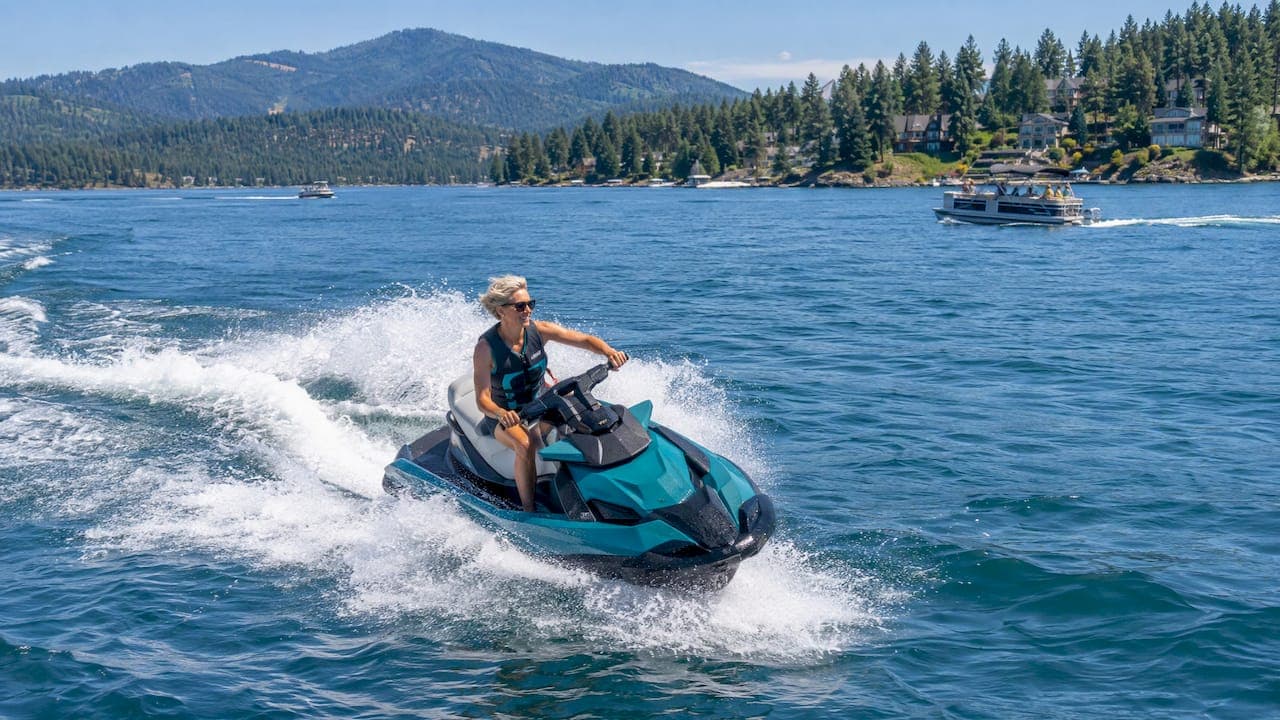
Most jet skis cover roughly 50 to 150 miles on a full tank, according to Boat & Sail Magazine, but the number you will actually see depends on tank size, throttle, passengers and water. On a lake day, a better question than miles is hours: a mid-size jet ski at a relaxed cruise gives you a few hours of riding, and wide-open throttle shortens that fast.
TL;DR
- A full tank typically means 50 to 150 miles of range, and the spread comes from model, engine type and riding style.
- Cruising speed is the most economical way to ride; full throttle burns fuel several times faster.
- Quick math: tank size in gallons × miles per gallon = estimated range. Then subtract a reserve.
- On a lake like Coeur d'Alene, you rarely need long range. Plan in hours, not miles, and refuel safely on shore.
- Renting? Ask what fuel arrangement applies to your rental before you launch.
Table of Contents
- How far a jet ski goes on one tank
- How much gas a jet ski burns per hour
- Estimate your own range in two steps
- What range do you need on Lake Coeur d'Alene?
- Refueling safely
- Stretching a tank
- Rent a jet ski for your lake day
- FAQ
- Sources
How far a jet ski goes on one tank
Published estimates vary because riding conditions vary. One guide puts most jet skis at about 80 to 140 miles per tank, another at 60 to 120 miles. Treat all of these as ranges, not promises.
Tank size is the starting point. Yamaha lists the VX at 18.5 gallons, and its GP HO specification shows a 70-liter tank, which is the same capacity. High-performance supercharged models such as the FX SVHO also carry 70 liters but call for premium unleaded.
The tank is only half the picture. Bigger, supercharged engines carry bigger tanks because they drink more.
How much gas a jet ski burns per hour

The honest answer is a wide band. JetSkiTips estimates 6.5 to 8 gallons per hour at a 35 mph cruise and 20 to 25 gallons per hour at wide-open throttle. Other guides quote lower averages of 3 to 4 gallons per hour, which fits a lot of mixed, idle-and-cruise lake riding.
What moves the number:
- Engine size and supercharging. Displacement and a supercharger are the main drivers of fuel use.
- Speed. Cruising is the economical zone; holding the throttle wide open is the least efficient.
- Weight. The more weight the engine moves, riders and passengers included, the more gas it burns.
- Water and wind. Chop and headwinds make the engine work harder for the same speed.
- Condition. A well-maintained engine and a jet pump free of debris help efficiency.
Estimate your own range in two steps
The simple formula is tank capacity multiplied by fuel economy. A 15-gallon tank at 5 mpg works out to about 75 miles.
Here is the same idea with a rental-style example. These are illustrative numbers, not a spec for any particular machine:
- Take an 18.5-gallon tank and a steady 35 mph cruise burning about 7 gallons an hour. That is 5 miles per gallon (35 ÷ 7).
- 18.5 × 5 is about 92 miles, or roughly 2.6 hours of riding.
Now add a reserve. A common boating habit is to turn back at the halfway mark, so plan to use about half to two-thirds of the tank, not all of it. That turns 92 miles into a comfortable 45 to 60 miles out and back, and that is plenty for most lakes.
To measure your own economy, fill the tank, ride a known distance, refill, and divide miles ridden by gallons added.

What range do you need on Lake Coeur d'Alene?
Less than you think. The big lake is about 25 miles long, and most visitors loop between a launch, a swim spot and lunch rather than running end to end. If you want to see how the lake breaks up by launch point, our guide to picking your launch for 25-mile Lake Coeur d'Alene helps you size the day.
Speed is also limited in places. Kootenai County restricts motorized vessels to 35 mph or less in daylight on the Coeur d'Alene and Spokane Rivers, and a 5-mph no-wake zone applies within 100 feet of shorelines, docks and people in the water on those rivers, Lower Twin Lake and Fernan Lake. Slower travel means better economy and more hours from a tank.
For a rule refresher before you go, read our Coeur d'Alene boating rules guide.
Refueling safely
Idaho's boating handbook treats fueling as a safety task. It says not to fuel at night unless it is an emergency, and to leave room in the tank for expansion. For personal watercraft it also advises against tipping the machine while fueling, avoiding overfilling, and checking for fuel fumes before you start the engine.
Also use the fuel your machine calls for. Most recreational Yamaha models such as the VX run on regular unleaded, while supercharged performance models need premium.
Stretching a tank
- Ride at a steady cruise instead of bursts of full throttle.
- Travel light: leave unneeded gear on shore.
- Head into the wind on the way out, so the tailwind helps on the way back.
- Keep to smoother water when you can.
- Some riders carry an auxiliary tank or a fuel can on the rear platform. On a rental, ask first rather than adding equipment on your own.
Our perspective
We rent Yamaha WaveRunners around Spokane Valley, Liberty Lake and Coeur d'Alene, so fuel questions come up at the dock all the time. Our advice is to stop thinking in miles. On our lakes, a good day is a few hours of cruising, swimming and exploring, not a 90-mile run.
That is why we design our rentals around hours. You pick a rental period that fits your plan, add an extra hour if the day is going well, and spend your time on the water instead of watching a gauge. Our team goes over the machine and safety equipment with you before you leave the dock.
Life is better on water.
Rent a jet ski for your lake day
Our jet ski rentals at Liberty Lake and Newman Lake are priced from $250 to $425, and an additional hour is $75. A damage deposit of $500 per jet ski applies. We also offer boats, paddleboards and water toys, and you can see the full list on our rental prices page.
First time renting? Our post on jet ski rental mistakes tourists make will save you headaches at the launch.
FAQ
How far can a jet ski go on a full tank?
Typically 50 to 150 miles, depending on model, engine and how you ride. For lake trips, plan to use only half to two-thirds of that so you always have a reserve for the return.
How much gas does a jet ski use per hour?
It ranges widely. Light cruising can be a few gallons per hour, while one guide estimates 6.5 to 8 gallons per hour at 35 mph and far more at full throttle. Heavier loads and supercharged engines use more.
What fuel does a jet ski use?
It depends on the engine. Many recreational models run on regular unleaded, while supercharged performance models like the FX SVHO require premium unleaded. Check the owner's manual or ask the rental company.
How do I calculate my jet ski's range?
Multiply tank capacity in gallons by your miles per gallon. A 15-gallon tank at 5 mpg gives roughly 75 miles. Then subtract a safety reserve.
Sources
- Jet Ski Range, Boat & Sail Magazine
- Jet Ski Range: How Far Can You Go?, JetSkiTips
- On One Tank of Gas, How Far Can a Jet Ski Travel?
- Yamaha WaveRunner VX
- Yamaha GP HO specifications
- Yamaha FX SVHO specifications
- Jet Ski Fuel Consumption, Powersports Guide
- What Determines The Fuel Efficiency of a Jet Ski?
- How Far Can A Jet Ski Go On A Tank Of Gas?, SlickBoating
- How Far Can A Jet Ski Go?, Nauti Water Racing
- Kootenai County Safe Boating Brochure
- Idaho Boating Laws handbook