
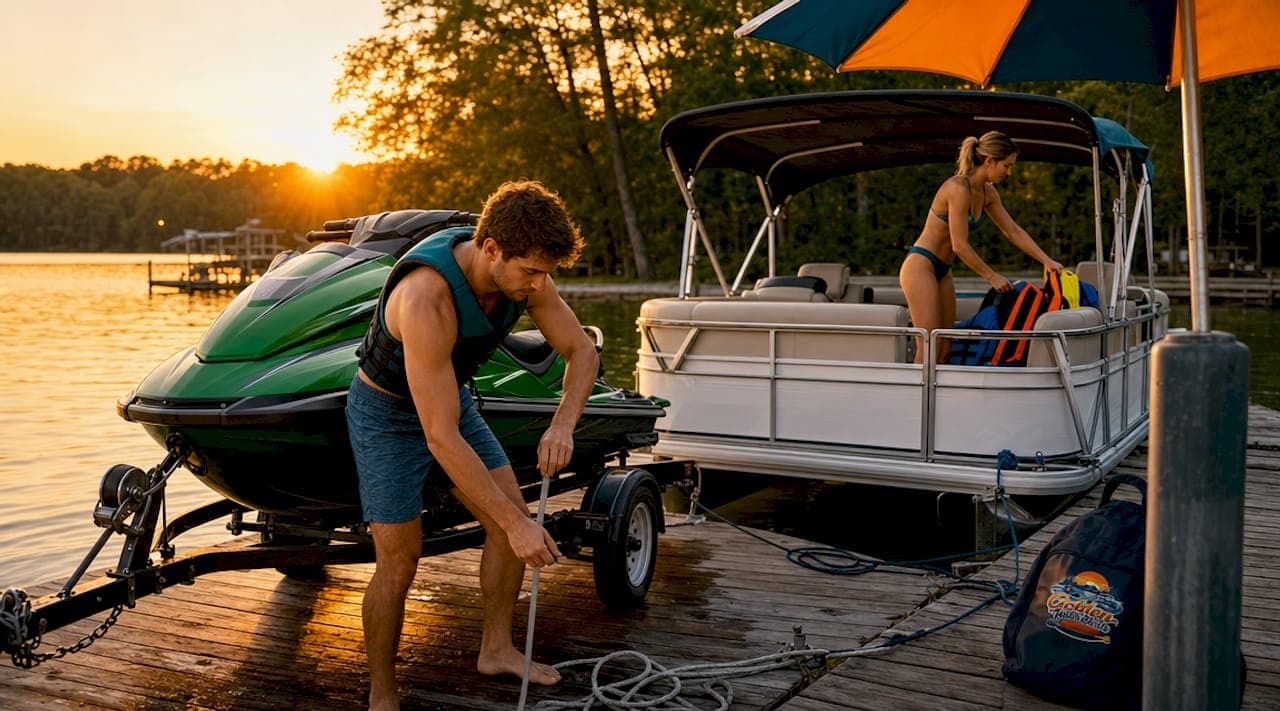
The core difference between a jet ski and a pontoon boat is their intended purpose: jet skis are built for speed and individual thrill, while pontoon boats are designed for group comfort and relaxed cruising. Understanding this distinction matters before you book a rental, plan a group outing, or decide what to haul to Liberty Lake for the weekend. The difference between jet ski and pontoon boat options goes beyond size. It covers design, performance, passenger capacity, cost, and the kind of experience you want on the water. This article breaks down every factor so you can make the right call.
What is the difference between jet ski and pontoon boat design?
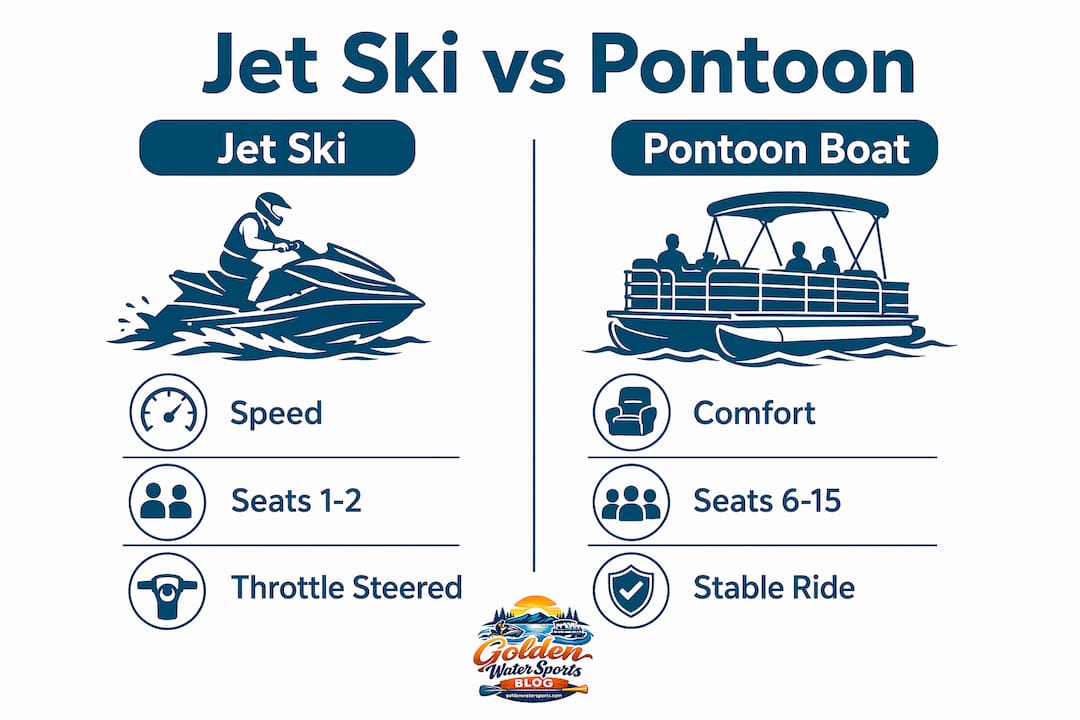
Jet skis are compact, stand-up or sit-down personal watercraft built around a single jet propulsion unit. They seat 1 to 2 passengers and are engineered for agility, acceleration, and quick directional changes. Everything about the design serves speed and responsiveness. There is no storage, no shade, and no room for a cooler.
Pontoon boats take the opposite approach. Their wide, flat decks sit on top of two or three aluminum tubes (the pontoons), which displace water and create a stable, buoyant platform. A standard pontoon seats 6 to 15 passengers and typically includes lounge seating, a Bimini shade top, a built-in cooler, and enough deck space to walk around comfortably. That footprint makes them the go-to choice for families, fishing groups, and anyone who wants to spend a full afternoon on the water without feeling cramped.

The table below captures the key structural differences at a glance.
| Feature | Jet ski | Pontoon boat |
|---|---|---|
| Passenger capacity | 1 to 2 | 6 to 15 |
| Deck space | Minimal | Spacious with lounge seating |
| Storage | Near zero | Coolers, gear, fishing equipment |
| Shade and amenities | None | Bimini top, tables, cup holders |
| Hull design | Fiberglass hull | Aluminum tubes (pontoons) |
| Typical outing length | ~70 minutes | 2 or more hours |
The layout difference has a direct impact on how groups socialize. On a pontoon, everyone faces each other, conversations happen naturally, and you can share food and drinks without anyone getting soaked. On a jet ski, the experience is physical and focused. You are leaning into turns, feeling the spray, and paying attention to the water ahead.
How do performance and handling compare?
Jet skis win on speed and agility without question. Yamaha WaveRunners, for example, can reach speeds well above 60 mph depending on the model. That power-to-weight ratio creates an experience that no pontoon can replicate. Rides typically run about 70 minutes, which is enough time to cover serious distance and still feel the full range of what the machine can do.
Pontoon boats cruise between 20 and 30 mph, which is comfortable for sightseeing, swimming stops, and casual tubing. They are not built for professional-level towing or wake sports. If your group wants to pull a wakeboarder at competition speeds, a dedicated ski boat is the right tool. Pontoons handle recreational tubing fine, but they top out before reaching the power needed for serious water sports.
One handling difference that surprises most first-time jet ski riders: jet ski steering is throttle-dependent. Release the throttle completely and you lose directional control. The jet propulsion system only steers when water is flowing through it. Pontoon boats use a traditional steering wheel and rudder system, so you can steer at any speed, including at idle.
Jet propulsion also gives jet skis a practical edge in shallow water. Jet-driven vessels can safely navigate water under 20 inches deep without risking damage from exposed propellers. That makes them ideal for exploring coves, inlets, and shorelines that a pontoon with a traditional outboard cannot safely reach.
Pontoons are the most stable platform on calm water, but their flat-bottom design creates slapping noise and discomfort in choppy conditions. If your lake gets afternoon wind chop, expect a rougher ride than you would get from a V-hull boat. On flat, calm water, a pontoon is as smooth as it gets.
Pro Tip: If you are renting a jet ski for the first time, practice throttle control in open water before approaching docks or other boats. Cutting the throttle to slow down also cuts your steering, which catches new riders off guard every time.
What are the rental requirements and safety differences?
Most rental companies require no prior boating experience for either jet skis or pontoon boats, but they do require a mandatory safety briefing before you get on the water. That briefing covers throttle control, right-of-way rules, speed zones, and emergency procedures. At Goldenwatersports, every rental starts with this walkthrough so guests feel confident before they leave the dock.
Age requirements differ between the two watercraft. Jet ski rentals typically require the operator to be at least 16 years old, while pontoon boat operators are usually required to be 18 or older. These minimums exist because the handling demands are different. A jet ski requires active physical balance, fast reflexes, and comfort with throttle-dependent steering. A pontoon is more forgiving and easier to dock, making it accessible to a wider range of first-time operators.
Here is what to expect at a standard rental check-in:
- Government-issued ID verification and age confirmation
- A safety briefing covering local speed zones, no-wake areas, and emergency shut-off procedures
- Life jacket fitting and mandatory wear rules for minors
- A walkthrough of the specific watercraft controls
- A review of rental duration, fuel policies, and return procedures
You can get a detailed look at what the jet ski check-in process involves before you arrive, which saves time and removes any first-day uncertainty. Knowing the rules around jet ski etiquette on the lake also makes the experience safer and more enjoyable for everyone sharing the water.
What use cases and group dynamics suit each watercraft?
Choosing between a jet ski and a pontoon boat comes down to who is in your group and what they want to do. Jet skis are the right call for couples, teens, and solo riders who want speed, adrenaline, and the freedom to explore at full throttle. The experience is personal and physical. You feel every wave, every turn, and every burst of acceleration directly.
Pontoon boats serve a completely different social function. They are the platform for family outings, multigenerational groups, and anyone who wants to anchor in a cove, swim off the back, and share a meal on the water. The deck space accommodates grandparents and toddlers equally well, which is something no jet ski can claim.
Many groups rent both simultaneously to satisfy everyone. The thrill-seekers take the jet skis while the rest of the group cruises on the pontoon, and everyone meets up at a swimming spot. This approach works especially well at lakes like Coeur d'Alene, where there is enough open water for both types of watercraft to operate without crowding each other.
Electric outboard motors are increasingly common on pontoon boats in 2026, reducing noise and making conversation on deck noticeably easier. For groups that want a quieter, more relaxed outing, an electric pontoon delivers a noticeably different experience than a gas-powered model. If you are planning a sunset cruise or a fishing trip where noise matters, this is worth asking about when you book.
Pro Tip: If your group has mixed preferences, book a pontoon for the base and add one or two jet skis for the riders who want action. You get the best of both experiences without anyone compromising.
How do costs and maintenance compare?
Jet skis have simpler engines and fewer moving parts, which translates directly into lower maintenance costs and easier cleaning. For rental companies and owners alike, this simplicity keeps upkeep manageable. A jet ski hull can be rinsed and wiped down in minutes. A pontoon with a full deck, upholstered seating, and a Bimini top takes considerably more time and effort.
Pontoon boats consume more fuel per hour than jet skis, particularly with larger outboard engines. However, the per-person cost calculation often favors pontoons for larger groups. Splitting a two-hour pontoon rental among eight people frequently costs less per person than individual jet ski rentals for the same group. The math shifts depending on group size, rental rates, and how long you plan to be on the water.
| Factor | Jet ski | Pontoon boat |
|---|---|---|
| Engine complexity | Simple, fewer parts | More complex, larger engine |
| Maintenance effort | Low | Moderate to high |
| Fuel consumption | Lower per hour | Higher per hour |
| Per-person rental cost | Higher for groups | Lower when split among 6 or more |
| Cleaning time | Minutes | 30 to 60 minutes |
| Resale value | Depreciates faster | Holds value better with upkeep |
Choosing based on activity frequency and group size is the most reliable way to maximize value. If you are on the water solo or with one other person several times a season, a jet ski rental delivers more value per dollar. If you are organizing a group outing twice a summer, a pontoon rental almost always wins on cost per person.
Key takeaways
The right watercraft depends entirely on your group size, activity goals, and how much speed versus comfort you want on the water.
| Point | Details |
|---|---|
| Design and capacity | Jet skis seat 1 to 2 riders; pontoons seat 6 to 15 with full deck amenities. |
| Performance | Jet skis offer high speed and agility; pontoons cruise at 20 to 30 mph with superior stability. |
| Handling differences | Jet ski steering requires constant throttle; pontoons use a traditional wheel at any speed. |
| Rental requirements | Both require safety briefings; jet ski operators must be 16 or older, pontoon operators 18 or older. |
| Cost per person | Pontoons deliver better per-person value for groups of six or more splitting the rental cost. |
Why I think most people overthink this choice
After spending years watching people deliberate over jet ski vs pontoon decisions at the dock, the pattern is clear. People who want to feel the water choose jet skis. People who want to be with their people choose pontoons. The mistake most groups make is treating it as an either/or decision when the best outings almost always involve both.
The emerging electric pontoon trend is genuinely worth paying attention to. Quieter motors change the social dynamic on the water in ways that are hard to describe until you experience it. Conversations flow differently when you are not competing with engine noise. For sunset cruises and fishing mornings, that matters more than most people expect.
My honest recommendation: think about the least adventurous person in your group and the most adventurous. If those two people can both be happy on the same watercraft, you have your answer. If they cannot, rent both. The pontoon trip planning options around Coeur d'Alene and Liberty Lake are genuinely worth exploring before you decide, because the destination shapes the experience as much as the boat does.
— Life is better on water.
Ready to get on the water with Goldenwatersports?
Goldenwatersports operates a full rental fleet covering both high-performance Yamaha WaveRunners and spacious pontoon boats, serving Liberty Lake, Coeur d'Alene, and the surrounding region. Whether your group wants speed or comfort, the booking process is straightforward, safety briefings are included with every rental, and flexible rental durations mean you are not locked into a schedule that does not fit your day.
Every rental comes with safety equipment, a thorough on-site briefing, and a team that knows these lakes well. Explore the full Goldenwatersports rental fleet and find the right watercraft for your next outing. Groups that want to cover all the bases can book a pontoon and jet skis together for a single day on the water.
FAQ
What is the main difference between a jet ski and a pontoon boat?
A jet ski is a compact personal watercraft designed for speed and agility, seating 1 to 2 riders. A pontoon boat is a wide, stable platform seating 6 to 15 passengers, built for relaxed group cruising and social outings.
Can beginners rent a jet ski or pontoon boat without experience?
Most rental companies, including Goldenwatersports, require no prior boating experience. A mandatory safety briefing is provided before every rental to cover controls, local rules, and emergency procedures.
Which is better for families: a jet ski or a pontoon boat?
Pontoon boats are the better choice for families. Their spacious decks, stable ride, and seating capacity accommodate all ages, including young children and older adults, in a way that jet skis cannot.
Is a jet ski or pontoon boat cheaper to rent for a group?
For groups of six or more, a pontoon boat rental typically costs less per person when the total rental fee is split. Jet ski rentals are priced per unit, making them more expensive per person for larger groups.
Do jet skis work in shallow water?
Yes. Jet propulsion systems operate without exposed propellers, allowing jet skis to safely navigate water as shallow as 20 inches without risk of damage to the drive system or underwater obstacles.