
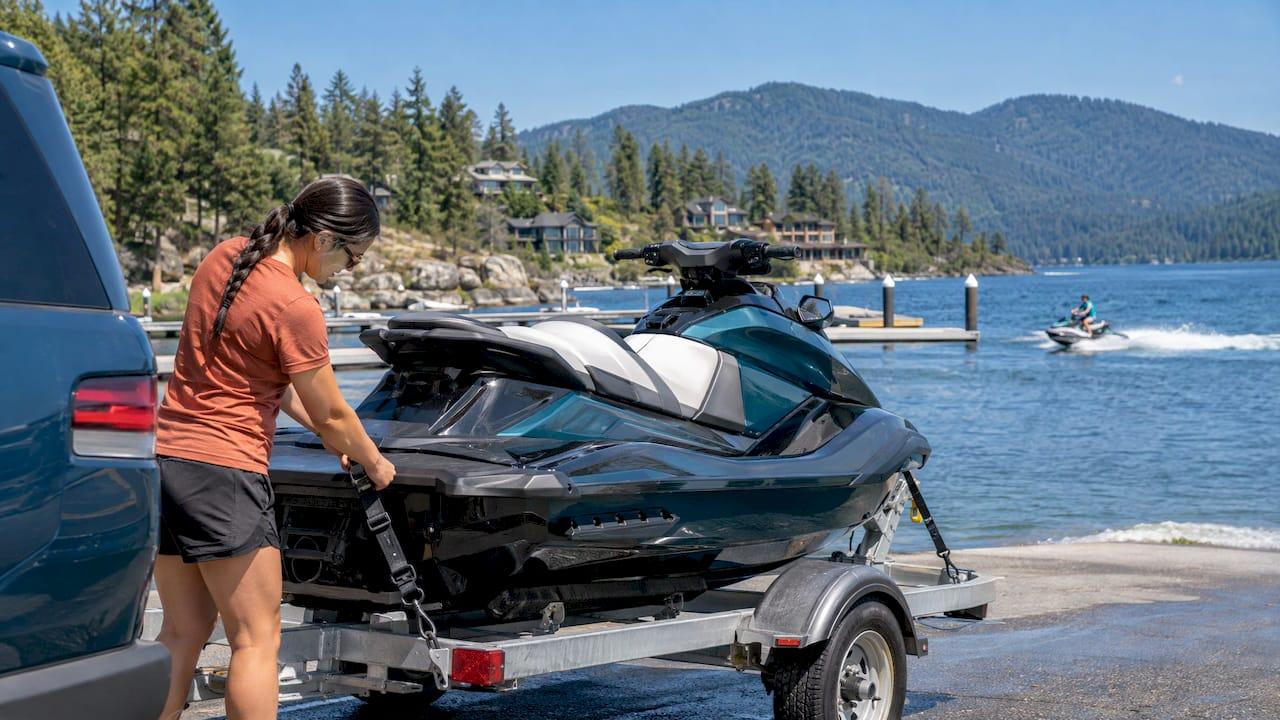
To strap down a jet ski, center it on the trailer and snug the bow eye against the bow stop with the winch strap. Back that up with a safety chain or second strap. Then run one ratchet or cam-buckle strap from each stern eye to a solid anchor on the trailer frame, and pull the hull snug without crushing it. The winch strap alone is never enough. The details below make the difference between a secure ride and a ski that shifts at highway speed.
TL;DR
- Use three tie-down points: the bow (winch strap plus safety chain) and two transom straps, one per side.
- Attach straps only to the bow eye and stern eyes, never to the seat, grab handle or plastic trim.
- Cross the two stern straps in an X for sideways stability, and tighten until there is no bounce, not until the hull flexes.
- Tuck or wrap loose strap ends so they don't flap, and recheck everything after about an hour of driving.
- Going to the lakes around Coeur d'Alene or Spokane? Check launch fees before you load up.
Table of Contents
- What kind of straps hold a jet ski on a trailer
- Choosing strap strength and length
- Step-by-step: tie down a jet ski
- Where straps should and shouldn't go
- Pre-trip and on-the-road checks
- Heading to Coeur d'Alene or Spokane lakes
- Skip the trailer: rent a jet ski near Spokane and Coeur d'Alene
- FAQ
- Sources
What kind of straps hold a jet ski on a trailer
You need a pair of rated transom tie-down straps, tightened with a buckle or a ratchet. They connect the transom eyes at the back of the ski to tie-down points on the trailer, while the bow eye is secured with the winch strap and a safety chain.
Two common styles:
- Cam-buckle straps. Spring-loaded cam buckles pull tight by hand. One typical 1-inch polyester version uses coated S-hooks that are gentle on metal eyes.
- Ratchet straps. A ratchet gives more leverage, and one strap maker says ratchets hold tension better under vibration, while cam buckles suit lighter loads. Retractable versions pull the extra webbing back in, so nothing is left to flap.
If you tow near salt water, look for stainless-steel hardware. Vinyl-coated hooks protect the eyes on your ski.
Choosing strap strength and length
Strap ratings come in two numbers. Breaking strength is the load that snaps the strap. Working load limit (WLL) is the safe load in normal use, and it is generally one third of breaking strength. So a strap with a 1,800 lb break strength has a WLL of roughly 600 lb. Buy by WLL, and choose one that comfortably exceeds the forces a ski sees on the road.
A few real-world examples:
- A 1-inch, 3-point ratchet strap for jet skis comes in 8, 10 and 12 foot lengths at $24.99 to $28.99.
- Stainless ratchet straps rated at 1,800 lb break strength carry a 600 lb WLL.
- For jet skis and small boats, one guide suggests 1.5-inch ratchet straps rated around 4,500 lb.
For length, measure from the stern eye to the trailer anchor, then add enough to work the buckle. Short, near-vertical runs are better than long diagonal ones. Rope is a different job from webbing: if you want to understand fibers and weather resistance for any bow line you carry, this overview of marine rope types and materials is a good place to start.
Step-by-step: tie down a jet ski
- Center the ski. Drive it on straight, so it sits centered on the bunks or rollers.
- Secure the bow. Seat the bow eye snugly against the bow stop, hook the winch strap through the eye, crank it tight and lock the lever. Add a safety chain or second strap on the bow eye. The BoatUS Foundation and trailer makers note that winches are for loading and unloading, not for holding the craft on the road.
- Hook the stern straps. Attach one strap to each stern eye and the other end to a solid anchor on the trailer frame, not plastic or a weak bracket.
- Cross them. Crossing the two rear straps in an X keeps the stern from swaying sideways.
- Tighten evenly. Alternate sides until the hull is snug and there is no vertical bounce. Over-tightening can damage the hull.
- Manage the tails. Wrap or tie off excess webbing so it can't whip against the ski or the road.
- Push test. Press down gently on the rear. The ski should not shift.
Where straps should and shouldn't go
Use only the factory eyes. Sea-Doo's guides, as summarized here, say not to route tie-downs over the seat or attach them to the grab handle. Yamaha's VX manual says to attach ropes or tie-downs only to the bow and stern eyes, or the craft may be damaged.
When you mount transom straps, line up the mounting points as vertically as possible and avoid angling straps more than 30 degrees. Don't pull them across hull corners or accessories. If a strap has to cross the transom, slip a towel under it. With new retractable straps, recheck the mounting hardware after your first trip and retighten if needed.

Pre-trip and on-the-road checks
Before you pull out, confirm the winch strap and transom straps are tight. Check that the trailer is hitched with the safety pin, working lights and connected safety chains, as Sea-Doo's inspection guidance lists.
Then add a two-minute walk-around of the trailer: tires for cracks and dry rot, brake, running and turn lights, and wheel hubs for excess heat. After loading, look underneath for anything the weight may have moved or flattened.
On the road, stop and inspect after about an hour of driving and at every stop after that. Straps settle, and a quick re-pull takes seconds. Our guides on towing a jet ski, including trailer hookup and on jet ski towing capacity cover the tow vehicle side.

Heading to Coeur d'Alene or Spokane lakes
If you trailer your own ski to the region, budget for launch fees. Kootenai County's safe boating brochure (2021) lists $10 per day for an Idaho-registered vessel and $20 out of state, with annual passes at $40 and $100. Check the county's current schedule before you go, since fees change.
Lake roads around Liberty Lake, Newman Lake and Coeur d'Alene mean hills and some rough pavement. That makes the one-hour recheck worth doing.
Our view: strapping is part of the safe lake day
We handle Yamaha WaveRunners every day, and we've learned that a ski that arrives at the water undamaged starts with a calm, methodical load. Three points, factory eyes only, crossed stern straps, tails tucked: it takes a few minutes and prevents the damage that ruins a day.
That is also why we built our rentals around convenience. Our team keeps the watercraft clean and well maintained, with safety equipment included, and we offer pickup and limited delivery to certain lakes so you can spend your time on the water instead of worrying about straps and hitches.
Life is better on water.
Skip the trailer: rent a jet ski near Spokane and Coeur d'Alene
Not everyone wants to own a trailer, buy straps and haul a ski. We rent Yamaha WaveRunners for Liberty Lake and Newman Lake. Jet ski rentals are listed at $250 to $425, additional hours are $75 per hour, and the refundable-style damage deposit is $500 per jet ski. Boats carry a $1,000 deposit, and wakeboards and tubes are $50 each.
We also rent ski boats, pontoons, paddleboards and water toys. See current options on our rental prices page or the Golden Water Sports home page. If it's your first rental, here is how check-in works.
FAQ
How many straps do I need to tie down a jet ski?
Use at least three tie-down points: the bow secured by the winch strap with a safety chain or second strap as backup, plus two transom straps at the stern. The general consensus for smaller vessels is at least three points.
Can I just use the winch strap?
No. Winches are designed for loading and unloading, and trailer makers say not to rely on the winch line alone. Always add stern straps and a bow backup.
Should I cross the rear straps?
Yes, in most setups. Crossing the two stern straps in an X helps prevent the back of the ski from moving side to side, as Watercraft Journal advises.
Ratchet or cam-buckle straps?
Both can work. Ratchets give more tension and hold it under vibration, while cam buckles are quick and easy to snug by hand. Pick straps with a WLL well above what your ski needs, and don't over-tighten.
Sources
- Installing Retractable Transom Straps, Boating Magazine
- Spring-loaded cam buckle jet ski straps, USA Ratchet
- How to Tie Down a Jet Ski on a Trailer, Jetskicover
- Watercraft Ratchet Straps guide, PowerTye
- Use Ratchet Straps and Other Boat Trailering Tips, PartsVu
- 3-Point Tie Down Ratchet Strap, Cajun Tie Downs
- Boat Ratchet Straps, Get Tight Gear
- Watercraft Tie-Downs: Secure PWC & Jet Ski Safely, PowerTye
- The Watercraft Journal's 2025 Long Distance Trailering Tips
- How to inspect your Personal Watercraft, Sea-Doo
- Marine Rope: Types, Materials & How to Choose