
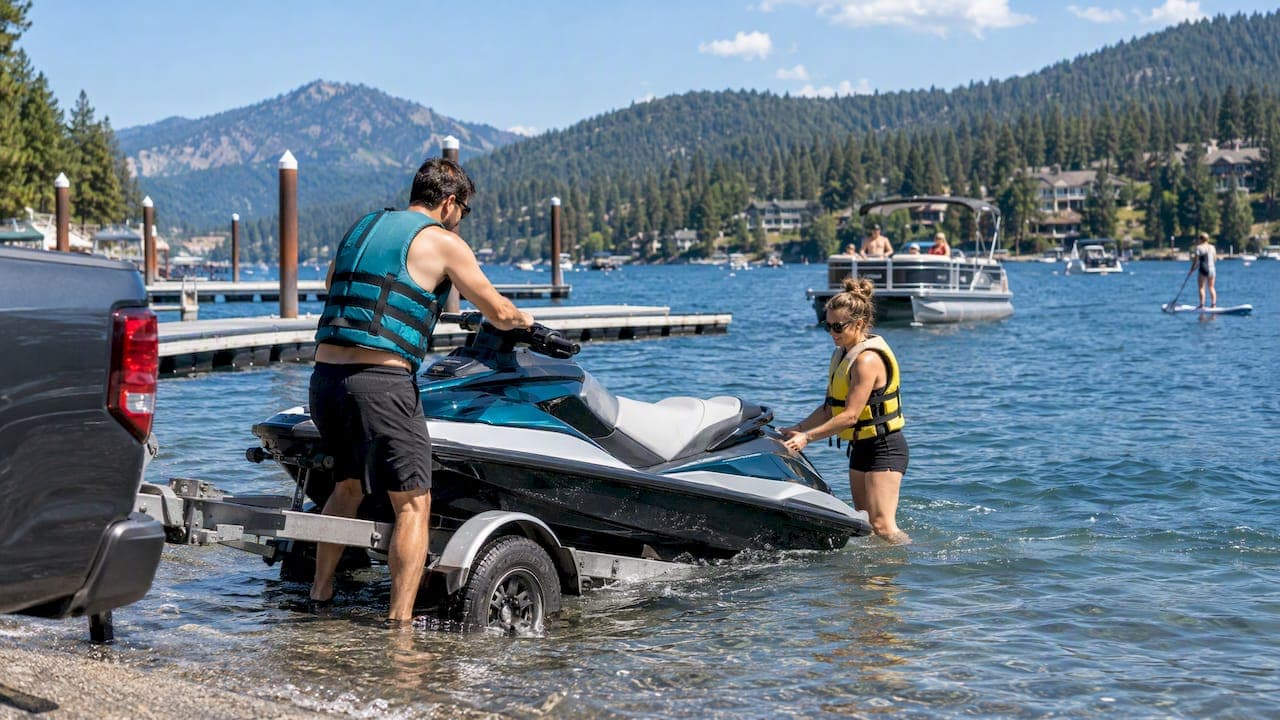
To launch a jet ski, do all your prep in the parking lot, back the trailer down until the craft floats, release the winch strap, and guide the ski off into water at least 3 feet deep before you start the engine. Most launch trouble comes from doing the prep on the ramp instead of before it. This guide walks through each step, then covers docking when you come back in, and the Lake Coeur d'Alene rules that catch visitors off guard.
TL;DR
- Finish every task in the staging area: drain plug in, rear straps off, life jackets on, gear loaded.
- Back down until the ski floats, then release the winch strap and move it off the trailer by hand.
- Start the engine only in water at least 3 feet deep so the intake does not pull in sand or rocks.
- Near docks and shorelines on Lake Coeur d'Alene, keep to 5 mph, and never power load onto a trailer at county facilities.
- Renting instead? Skip the trailer work and spend the day riding.
Table of Contents
- Before you reach the ramp
- Launching step by step
- Docking a jet ski when you come back
- Lake Coeur d'Alene rules that affect your launch
- Safety on the water after launch
- Our perspective: is owning and launching right for a short visit?
- Skip the ramp: rent a jet ski
- FAQ
- Sources
Before you reach the ramp
The most common mistake is working on the ramp itself. Experienced riders do the pre-launch tasks in a parking lot, never in the launch lane, because a ramp is a shared public resource and a blocked lane builds frustration fast.
Use this checklist in the staging area:
- Install the drain plug. Forgetting it is the classic launch error, so make it the first thing you touch.
- Remove the rear tie-downs (transom straps) but leave the winch strap attached to the bow.
- Load your gear. Fuel, lines, bumpers, keys, registration and anything else that rides with you.
- Put on life jackets. Everyone, before the ski touches water.
- Check that the engine starts. A brief run of about five seconds in the lot confirms it will fire before you hold up the lane, according to JetDrift's launch guide. Run it only briefly out of water, and follow your owner's manual on flushing or water supply.
- Attach a bow line and a stern line so you can control the ski at the dock or ramp edge.
Launching step by step
Once you are ready, pull up to the ramp and move with purpose.
- Back the trailer down until the jet ski begins to float. You do not need to submerge the tow vehicle's rear tires more than necessary.
- Secure the vehicle. Set the parking brake, put it in park, and chock the wheels if the ramp is steep.
- Release the winch strap while holding the bow line or having a helper do so.
- Guide the ski off the trailer by hand. Do not start it while it is still in shallow water.
- Walk it to a dock or hold it clear of the lane, then pull the vehicle and trailer out and park.
- Start the engine in at least 3 feet of water. Sea-Doo's guidance is clear: shallower water risks sucking sand or rocks into the intake and damaging the impeller.
Solo launching works with a bow line tied to a dock cleat or a helper on shore. Some riders tow the ski back to the dock and tie it loosely before parking. Whatever method you choose, keep the ski out of the ramp lane.
Good ramp manners
Be fast by being prepared, not by rushing. Do not stop in the lane to load coolers or untangle ropes. Move your rig aside when you are done, and give the next group the same room you wanted.
Docking a jet ski when you come back

Docking is often more stressful than launching. Hulls are lower than the dock bumpers built for larger boats, and hard contact scuffs or cracks fiberglass.
A few habits make it easy:
- Study the approach first. Look at wind, current and nearby traffic, then plan to come in into the wind or current if possible, and decide where your line will tie off.
- Never come in faster than you would be willing to hit the dock. That is the rule experienced riders repeat.
- Use your own fenders. Permanent dock bumpers are often mounted too high for a jet ski, so carry bumpers and hang them before you arrive.
- Know your controls. If your craft has no neutral or reverse, shut the engine off at a safe distance and let momentum carry you in, which takes practice.
- Consider the alternatives. Because docking can cause hull damage, many owners prefer to anchor or beach the ski instead of tying it to a dock.
Practice in open water away from other boats before you try a crowded marina.
Lake Coeur d'Alene rules that affect your launch
Rules vary by place, so check them before you go. In Kootenai County, which includes Lake Coeur d'Alene, power loading a vessel onto a trailer is unlawful at county facilities. Slowly drive or winch it on instead. The same county code sets a 5 mph no-wake speed within 200 feet of shorelines, docks or people in the water, so leave the ramp area slowly.

Life jackets are required for personal watercraft operators and passengers under the county code, and children 14 and under must wear one on vessels 19 feet or less while underway. The state's boating handbook covers towing and equipment requirements in more detail. For a local summary, see our guides on avoiding fines and launch delays and the Lake Coeur d'Alene boating rules.
If you cross into Washington waters, note that operators aged 12 and older of vessels with motors of 15 horsepower or more need a Washington Boater Education Card, and failing to carry it can bring a minimum fine of $99.
Safety on the water after launch
The U.S. Coast Guard's 2024 data counts 556 boating deaths nationally, with 87% of victims not wearing life jackets. Most accidents happen in good weather and calm conditions, often from inattention, poor lookout or inexperience, and boating under the influence remains a leading factor. Wear the jacket, assign a lookout, and keep alcohol for the dock. For the day itself, boat day outfit ideas can help you pick clothes that work around a life jacket.
Our perspective: is owning and launching right for a short visit?
We rent Yamaha WaveRunners around Spokane Valley, Liberty Lake and Coeur d'Alene, and we see the same pattern with visitors. People who bring their own ski spend the first hour at a crowded ramp and worry about the trailer all day. People who rent keep their attention on the lake.
Launching is a skill worth learning if you own a ski. If you only have a weekend, it is a lot of gear, towing and storage for a few hours of riding. Our job is to make the lake day hassle-free: clean, well-maintained watercraft, safety equipment, flexible rental periods, and pickup or limited delivery service. Ask us which lake and logistics suit your group before you book.
— Life is better on water.
Skip the ramp: rent a jet ski
Our published jet ski rentals run from 250 to 425 USD, depending on the rental you choose, and each additional hour is 75 USD. A damage deposit of 500 USD per jet ski applies. You can see lake-specific details on our Liberty Lake jet ski rental and Newman Lake jet ski rental pages, or check our current prices. Wakeboards and tubes are 50 USD each, and boats carry a 1000 USD damage deposit. First time on a rental? Read about the mistakes tourists make so your day goes smoothly.
FAQ
How deep should the water be before I start a jet ski?
At least 3 feet. Starting in shallower water can pull sand or rocks into the intake and damage the impeller. Walk the ski out past the ramp edge before you start it.
Can I launch a jet ski by myself?
Yes, with a bow line and a plan. Back down until the ski floats, release the winch strap, and tie the line to a dock cleat or hold it as you move the ski clear of the lane. Park the trailer, then return to the ski. Keep the ski out of the way of other ramp users.
What is the safest way to dock a jet ski?
Approach slowly, ideally into the wind or current, with your own fenders hung and a line ready. Never come in faster than you would be willing to hit the dock. If your ski lacks neutral or reverse, shut off the engine at a safe distance and coast in.
Is it legal to power load a jet ski onto a trailer on Lake Coeur d'Alene?
Not at county facilities. Kootenai County code makes power loading unlawful there, so drive the ski on slowly or use the winch. Check posted signs at the ramp you use.
Sources
- Sea-Doo: how to launch and load a personal watercraft
- JetDrift: how to launch a jet ski
- JetDrift: how to dock a jet ski
- Discover Boating: how to dock a PWC
- Kootenai County Title 6, Public Properties and Waterways
- Idaho Boating Laws handbook
- Washington State Parks: boater education cards
- U.S. Coast Guard: boating safety