
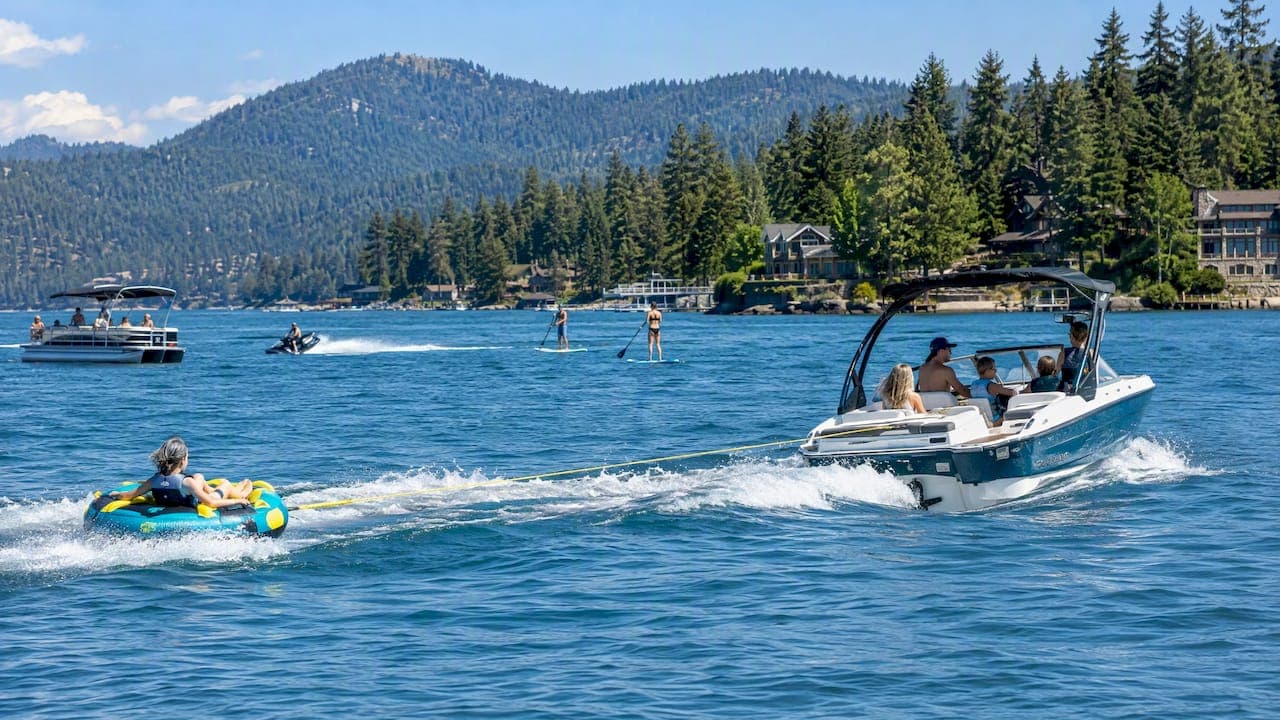
Safe tubing comes down to five things: a life jacket that fits, a slow and smooth pull, a spotter who only watches the riders, a sound rope and tube, and a driver who stays in charge. Most speed guidance lands between 10 and 20 mph, and slower for kids and first rides. Here is how to set all of it up on Lake Coeur d'Alene, Liberty Lake or Newman Lake.
TL;DR
- Keep the pull gentle: 10 to 15 mph for children, and slower still on a first ride. Adults can go faster, but more speed is not more fun if it unseats the rider.
- Every rider wears a properly fitted, Coast Guard-approved life jacket with a leg or crotch strap. Idaho requires one on anyone towed behind a vessel (see the state page for details).
- Assign a spotter whose only job is to watch the riders, and agree on hand signals before leaving the dock.
- Inspect the tube and tow rope every outing, and never tow from a wake tower.
- Accelerate gradually, turn wide and stay clear of other boats, docks and shoreline.
Table of Contents
- How fast to pull a tube
- Life jackets: fit matters more than the label
- The spotter and the hand signals
- Check the gear before every outing
- Driving for the rider
- Our perspective: slow is what keeps people coming back
- Renting a boat and tube with us
- FAQ
- Sources
How fast to pull a tube
There is no single magic number, because it depends on who is riding, the tube, and the water. Published guidance gives a useful range:
| Rider | Starting speed | Notes |
|---|---|---|
| Children | 10 to 15 mph | Slower for a first ride |
| First-time adults | Low end of the range | Build up only if the rider asks |
| Experienced adults | Up to roughly 15 to 20 mph | Many tube makers cap speed in this range; read your tube's label |
A tube has several times the drag of skis or a wakeboard, so it responds sharply to throttle. Start slow, take out the slack in the rope, then add speed in small steps. If the rider tells you to slow down, you slow down.
Chop matters as much as the number on the speedometer. On a busy summer weekend, wakes from other boats can launch a tube at speeds that feel gentle on flat water. Ease off when crossing wakes.
Life jackets: fit matters more than the label
The numbers are blunt. In 2024, 76% of fatal boating victims with a known cause of death drowned, and 87% of those with recorded life jacket use were not wearing one.
For tubing, check three things:
- Coast Guard approval. Look for the approval label inside the jacket.
- A leg or crotch strap. Without one, a hard fall can make the jacket ride up over the rider's head.
- The lift test. Buckle the jacket on dry land, have the rider raise their arms, and pull up on the shoulders. If it slides past the chin or ears, size down or switch jackets.
In Idaho, kids 14 and under must wear an approved, properly fitting jacket on boats 19 feet or less while underway, per the Idaho Department of Parks and Recreation. For the full picture on fines, stickers and PFD rules on our home lake, see our guide to Coeur d'Alene boating rules.
The spotter and the hand signals
The driver watches the water ahead. Nobody can do that and also watch a tube behind them. That is why you need a second person facing backward whose sole job is to watch the action and talk to the driver.

Many states require an observer for towed sports, so read Idaho's rules in the state boating handbook before you go. Whatever the law says, bring one.
Agree on signals at the dock, not on the water:
- Thumb up: faster
- Thumb down: slower
- Palm flat, cutting motion across the throat: stop or cut the engine
- Circling finger: turn around
- Both hands clasped overhead: rider down or fallen off
When a rider falls, the spotter keeps pointing at them until the boat is back. Idaho also requires a skier-down flag when a towed person is in the water, so keep a red or orange one aboard.
Check the gear before every outing
A few minutes on the dock prevent the failures that cause real injuries.
- The tube: look for cracks, tears, loose seams and a soft valve. Check the handles.
- The rope: look for fraying and sun damage. A failure during a fast turn can launch riders violently. Use a rope rated for the tube's rider count, and keep it roughly 50 to 65 feet so riders sit clear of the propeller and the worst of the wake.
- The tow point: use a low transom tow eye or a harness between the transom rings. Wake towers are built for the vertical pull of wakeboarding. A submarining tube can load one far beyond its design.
- Capacity: respect the tube's rider count and weight limit, printed on it.
Driving for the rider
- Check that the rope is clear of arms, legs and the prop before you move.
- Idle forward until the slack is gone, then roll on the throttle smoothly. A hard "hole shot" is unnecessary and can throw riders off or into each other.
- Make wide, gradual turns. Tight turns whip the tube out at the end of the rope.
- Stay well away from docks, swim areas, anchored boats and shoreline. Everyone on the water is responsible for avoiding collisions.
- Never tow anyone while drinking. Our guide to Idaho rules, including the 0.08% BAC limit applies to the driver.
- When someone falls, stop the engine before approaching them, then bring the boat alongside slowly.
Pontoon boats have their own quirks, such as lower power and a heavier feel in turns. We cover them in our pontoon tubing checklist.
Our perspective: slow is what keeps people coming back
We rent boats, jet skis, paddleboards and tubes around Spokane Valley, Liberty Lake and Coeur d'Alene, and the pattern is consistent. The tube days that go wrong are rarely about bad luck. They are about a driver trying to give the thrill-seeker in the back a bigger ride, with no spotter and a jacket that does not fit.
Our advice to first-time renters is simple. Make the first pull the gentlest one. Let kids and nervous riders set the pace, and let confident riders ask for more. Keep the tube behind a boat that is well maintained and sized for the group. A good lake day ends with everyone wanting another turn.
If you are planning your first rental, our lake rental tips for first timers cover the basics, and if you are building a longer getaway, this Italian-language guide to common seaside holiday mistakes is a handy planning read.
— Life is better on water.
Renting a boat and tube with us
We offer boat rentals, wakeboards and tubes at $50 each, paddleboards and other water toys, with safety equipment and flexible hourly and multi-day options. Boats carry a $1,000 damage deposit. If you would rather ride yourself, jet ski rentals run $250 to $425 with additional hours at $75 per hour and a $500 damage deposit per jet ski. Check current rates and availability or book your lake day. Renter rules are in our age requirements guide.

FAQ
Is it safe to pull two tubes behind a boat?
We advise against it. Two tubes can collide or tangle when they swing wide in a turn, and the driver has twice as much to watch. Tow one tube at a time, with a spotter, and use the rider capacity printed on the tube.
What is a safe speed for tubing?
For children, stay around 10 to 15 mph, slower on a first ride. Adults can go faster, but many tube manufacturers recommend staying under about 15 to 20 mph. Rider comfort and water conditions should set the final speed.
Can I tow a tube from a wake tower?
No. Wake towers are designed for wakeboarding's vertical pull, and a tube's drag can overload them. Use a low transom tow eye or a transom-ring harness.
Does every rider need a life jacket?
Yes. Idaho requires approved life jackets on people being towed, and kids 14 and under on boats 19 feet or less. Choose one with a leg strap and run the lift test before you leave the dock.
Sources
- Towing Tubes Safely, Water Sports Foundation
- Towable Tube Safety, Lap & Lake
- 10 Water Tubing Safety Tips, Bennington
- Tips for Towing Tubers, Mercury Marine
- Boating, Idaho Department of Parks and Recreation
- Idaho Boating Laws handbook
- 2025 Life Jacket Wear Rate Observation Study