
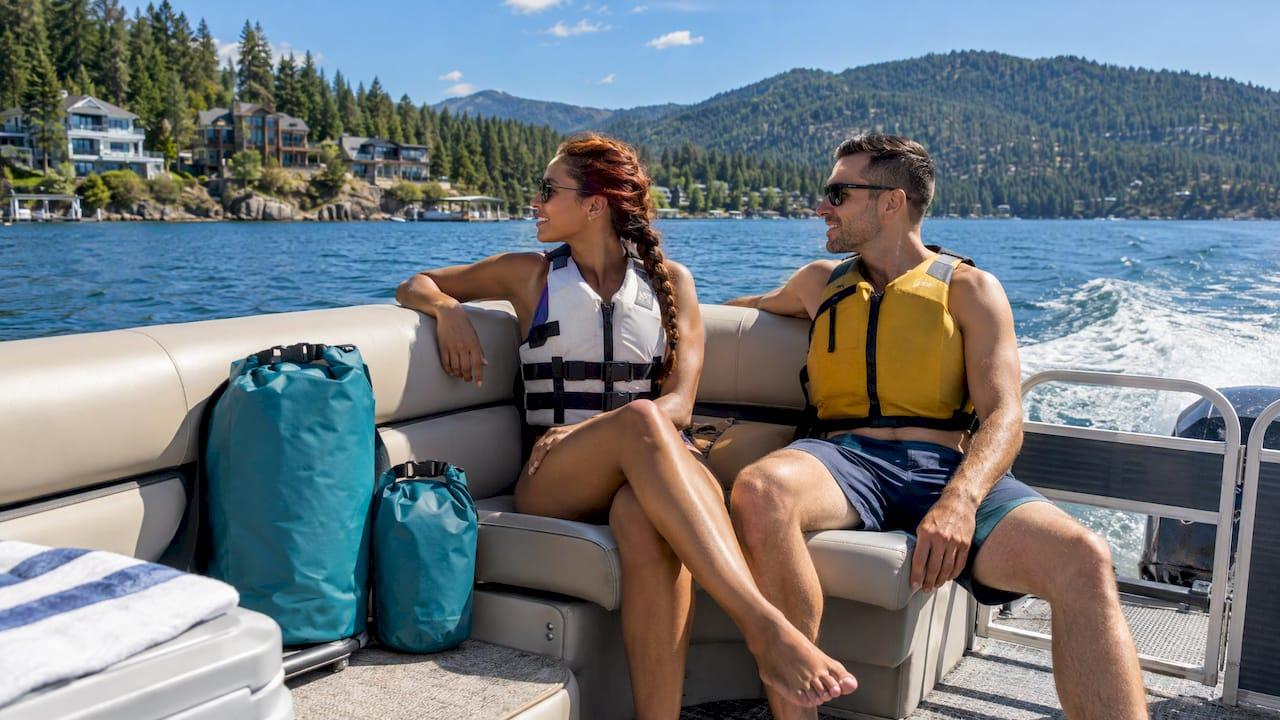
For a day on a lake like Coeur d'Alene, Liberty Lake or Newman Lake, a 10 to 20 liter roll-top dry bag is the right size for most people. Go to 5 liters if you only carry a phone, keys and a wallet. Go to 30 liters or more only for overnight trips. If you are renting a boat, pontoon or jet ski for the day, two medium bags will serve you better than one big one.
Below, each size is matched to what it holds, so you can pack once and not think about it again.
TL;DR
- 5 liters: phone, keys, wallet, sunscreen. Clip it to your life jacket or boat rail.
- 10 liters: adds a packable jacket or a small first-aid kit.
- 20 liters: the all-round lake-day size, with a full change of clothes, a towel, lunch and a layer.
- 30 liters and up: overnight or multi-day trips only.
- Two medium bags beat one large one, and leave a little air in the bag so it floats.
Table of Contents
- How dry bag sizes work
- Size chart for a day on the water
- Which size for which kind of lake day
- Two medium bags beat one large bag
- How waterproof does it need to be?
- Closing and floating: get the roll right
- What a dry bag does not replace
- Renting for the day near Coeur d'Alene or Spokane
- Our perspective
- FAQ
- Sources
How dry bag sizes work
Dry bags are sized in liters, which is simply the volume inside. A small bag suits essentials like a phone, wallet or compact first-aid kit. A medium bag suits clothing, a camera and day-trip gear. Large and extra-large bags are for multi-day trips and bulky items like sleeping bags.
To picture it, a 5 liter bag is roughly the size of a loaf of bread. One review measured a 5 liter bag at about 4 by 7 by 10 inches, and it held a towel, a couple of shirts and a few oranges. A 20 liter bag is closer to a small daypack.
The roll-top closure uses up a few liters at the top, so buy a little larger than the list of items suggests. A slightly roomy bag is easy to seal. A jammed-full bag is not.
Size chart for a day on the water
| Size | What fits | Best for |
|---|---|---|
| 1 to 3 L | Phone, keys, wallet, fob | Jet ski or paddleboard, clipped to you |
| 5 L | Valuables, snacks, sunscreen, a light layer | Short outings of a few hours |
| 10 L | Packable jacket, small first-aid kit | Half-day trips |
| 20 L | Full change of clothes, towel, lunch, layers | Full boat or pontoon day |
| 30 to 40 L | Sleeping bag and pad, weekend clothing | Overnight trips |
| 55 L and up | Tent, sleeping system, a week of clothes | Extended trips |
The loads in this chart follow a typical dry bag sizing guide. Other guides land in the same place. One recommends 10 to 20 L for day trips and 20 to 30 L for overnights. Another puts 5 to 15 L at a few hours inshore and 20 to 30 L at a full day.
Which size for which kind of lake day
A few hours on a jet ski
You carry very little on a jet ski, so a 1 to 5 liter bag is plenty: phone, keys, a card. Keep it on you rather than loose. Our jet ski day checklist covers what else to bring and what to leave on shore.
A full day on a ski boat or pontoon
This is where 20 liters earns its place. It holds a dry change of clothes, a towel, a warm layer, lunch and sunscreen. Pack a full change including socks, since that is the item people most often wish they had. Add one more warm layer than you expect to need, because wind on the water feels colder than the forecast says. If you are packing food too, see how to pack your cooler for a boat day and our boat picnic ideas.
A group or family
Give each adult a 5 to 10 liter bag for personal items, and add one shared 20 liter bag for towels and spare clothes. Different colors, or clear bags, make it easy to see whose is whose without opening everything.
Multi-day boat trips
For an overnight or a four-day rental, 30 to 60 liters is the range, split across several bags. Our multi-day boat rental tips walk through the gear checks that go with a longer trip.
Two medium bags beat one large bag
On a boat, space is oddly shaped. Two 15 to 20 liter bags wedge into lockers and under seats where one 40 liter bag will not go. They also let you keep wet gear apart from dry clothes without relying on an internal divider. This is the advice from a boating gear guide.
A common first-timer mistake is overbuying. One sizing guide notes that buyers often pick 30 L and then use it as a half-empty 20 L.
How waterproof does it need to be?
For a calm lake day, you mostly need protection from splashes and the odd dunk. Buying advice breaks bags into submergible, water-resistant and splashproof, and says most activities only need water-resistant or splashproof protection. Total waterproofing usually means more weight and a higher price.
If you carry a good camera or a phone you cannot afford to lose, add a second layer. Testing of waterproof duffels found that large roll-top bags may let water through when fully immersed, so electronics belong in a small dry bag inside the larger one.

Closing and floating: get the roll right
Most leaks come from the closure, not the fabric. Roll the top down at least three tight, even turns, then buckle it. In one review, a bag rolled only twice leaked after a few drops.
For floating, leave a little air inside. One manufacturer's instructions say to roll the top 3 to 4 times and leave some air so the bag floats if it goes overboard, and not to hold it underwater for more than a few seconds. Another guide suggests leaving 10 to 20 percent of the volume empty for that reason. Clip it to a D-ring on your life jacket or a boat rail so it stays with you either way.

What a dry bag does not replace
A dry bag keeps your belongings dry. It does not keep you safe. Required life jackets, a throwable device and other gear are separate, and the rules differ slightly between lakes. Check our required boat safety equipment list for Idaho and Washington lakes before you launch. Also check the wind: our forecast guidance for boaters explains why 15 to 20 knots is a reason to stay ashore. For the full bring-along list beyond bags, use our lake day packing list.
Renting for the day near Coeur d'Alene or Spokane
If you are visiting and do not want to haul a boat or jet ski, we rent them for the day. We offer jet skis, ski boats, pontoon boats, paddleboards and water toys around Spokane Valley, Liberty Lake and Coeur d'Alene, with safety equipment included. Jet ski rentals at Liberty Lake and Newman Lake are $250 to $425, and each additional hour is $75. Wakeboards and tubes are $50 each. A jet ski damage deposit is $500 per jet ski, and a boat damage deposit is $1,000 per boat. You can see the current options on our prices page or book a Liberty Lake jet ski.
Bring your bags, your sunscreen and a change of clothes, and we will take care of the rest of the equipment.
Our perspective
When guests ask what to bring, we tell them to pack for the water they will actually be on. A rental day is a short, simple outing, and it does not need a mountain of gear. One 20 liter bag for the group's dry clothes and towels, plus a small bag for each person's phone and keys, covers nearly every lake day.
We built our rentals around that kind of easy day: flexible hours, hourly and multi-day options, safety equipment included, and pickup or limited delivery to certain lakes. That means you spend your packing effort on comfort, not on hauling heavy equipment.
Pack light, roll the top three times, and keep the bag clipped on. Then the only thing left to decide is which lake.
Life is better on water.
FAQ
What size dry bag do I need for a day on a boat?
A 10 to 20 liter bag fits most day trips. Choose 20 liters if you want a full change of clothes, a towel, lunch and a layer. Choose 5 to 10 liters if you only carry valuables and a light jacket.
Is a 10 liter dry bag big enough?
It holds a packable jacket, a small first-aid kit or a few snacks and valuables. It is not enough for a full change of clothes plus a towel. For a family, a 10 liter bag per person works well alongside one shared larger bag.
Will a dry bag float?
Usually, yes, if you leave a little air inside and roll the top down properly. A bag packed completely full with heavy items may not float. Clip it to your life jacket or the boat so it cannot drift away.
Can I put my phone in a dry bag and drop it in the lake?
A dry bag handles splashes and a brief dunk when it is rolled correctly. Roll-top bags are not designed for extended submersion. For a phone or camera, use a small bag or case inside your main bag for a second layer.
Sources
- Discover Boating: dry bags for boating
- Dry bag guide: sizes, roll-tops and packing
- What size dry bag do I need
- What to pack in a boat bag
- Dry bag sizing guide
- How to choose a dry bag, GearLab
- Discovery View dry bags, Small Boats
- Waterproof duffels, Small Boats
- Original waterproof dry bag instructions