
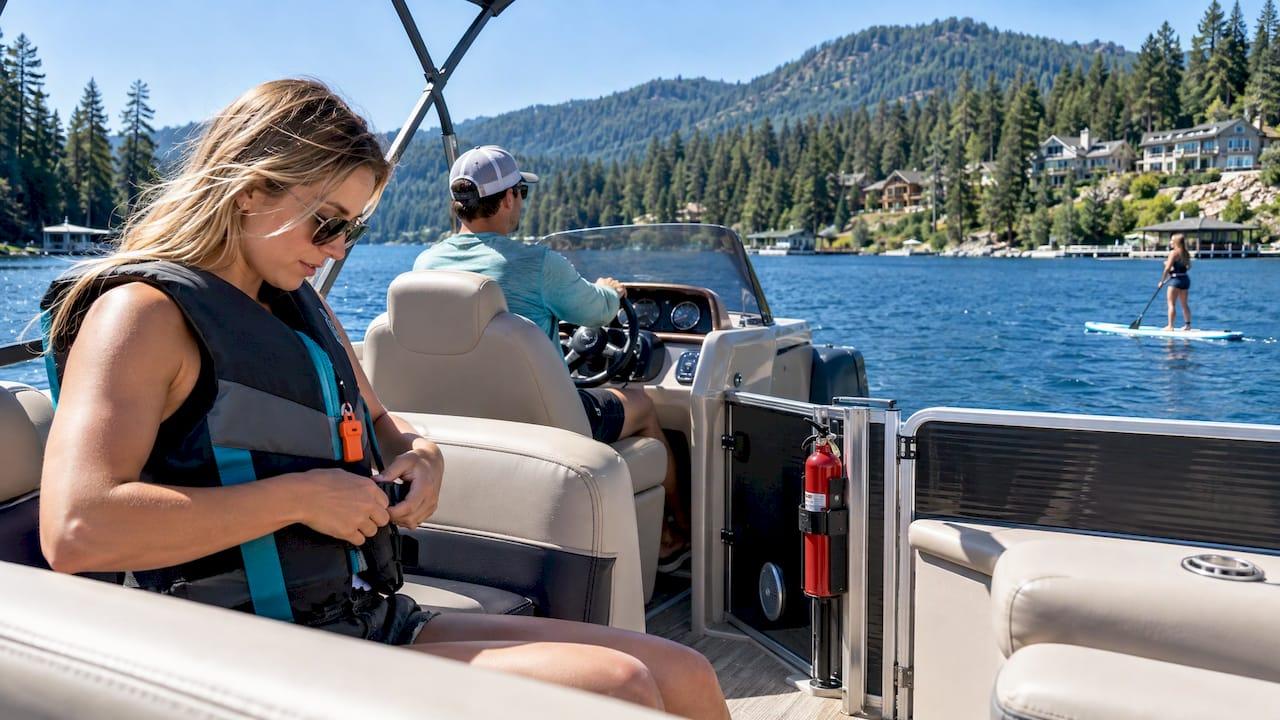
Every recreational boat in the U.S. must carry a Coast Guard-approved, properly fitted life jacket for each person aboard. Boats 16 feet or longer also need a throwable flotation device. Beyond that, you need fire extinguishers where a fire hazard exists, sound signals, navigation lights after dark and, on small boats, a working engine cutoff switch. Idaho and Washington add their own rules on top, so this guide covers the federal baseline first and then the two states around Coeur d'Alene and Spokane.
TL;DR
- Carry one approved, correctly sized wearable life jacket per person, plus a throwable device on boats 16 feet or longer (canoes and kayaks excepted).
- Federal law requires children under 13 to wear a life jacket underway. Idaho requires it up to age 14 on vessels 19 feet or less. Washington requires it up to age 12 on vessels under 19 feet.
- Everyone on a personal watercraft (PWC) and anyone being towed must wear an approved life jacket.
- Fire extinguishers, a sound-making device and lights depend on boat length and conditions, and state rules can be stricter than federal ones.
- Pack a few extras the law does not demand, such as two ways to call for help, a bailer and a first aid kit.
Table of Contents
- The federal baseline: what every boat needs
- Life jackets: who wears one and who just carries one
- Fire extinguishers, sound signals and lights
- Idaho vs. Washington at a glance
- Extra gear worth packing
- Lake etiquette that doubles as safety
- Ready to get on the water?
- Before you leave the dock: a quick check
- FAQ
- Sources
The federal baseline: what every boat needs
The U.S. Coast Guard's Boater's Guide to the Federal Requirements treats its carriage rules as minimums. Required gear must be Coast Guard approved or certified, and state or local rules may add to the list.
| Equipment | Federal baseline |
|---|---|
| Wearable life jackets | One per person, approved, in good condition, correct size, readily accessible |
| Throwable device (Type IV) | Boats 16 feet or longer, except canoes and kayaks |
| Fire extinguisher | Approved marine Class B where a fire hazard is expected |
| Sound signal | Required in specified circumstances |
| Navigation lights | Required for the conditions you operate in |
| Engine cutoff switch | Use the installed switch on vessels under 26 feet when on plane or above displacement speed |
The Coast Guard also recommends wearing a life jacket whenever you are underway, even where the law does not demand it. A life jacket you can reach under a seat is not much use in the first seconds of a fall.
Life jackets: who wears one and who just carries one
Federal rules say every person aboard needs a wearable life jacket that is approved, serviceable, correctly sized and easy to reach. Boats longer than 16 feet must add a throwable device. Canoes and kayaks are exempt from that throwable requirement regardless of length.
When must people actually wear them? Federal regulation says a child under 13 on an underway recreational vessel must wear an approved PFD unless below decks or in an enclosed cabin. States can be stricter, and the two states here are:
- Idaho: children 14 and younger on vessels 19 feet or less must wear one underway. Idaho also requires at least one Type I, II or III jacket of proper size for each person aboard or being towed, and a readily accessible Type IV device on vessels 16 feet or longer, except canoes and kayaks.
- Washington: children 12 and younger on vessels under 19 feet must wear one underway unless fully enclosed, per the Idaho handbook's summary of neighboring rules. Washington State Parks adds that every vessel, including kayaks, canoes and stand-up paddleboards, needs a fitted life jacket for each person.
On a jet ski the rule is simple: every rider wears one, and so does anyone being towed on a tube or wakeboard. Idaho's guidance says everyone aboard a PWC must wear a life jacket.
Fire extinguishers, sound signals and lights
Fire extinguishers. Federal rules call for approved marine Class B extinguishers where a fire hazard is expected. Without a fixed system in the engine space, the federal table in 33 CFR 175.320 lists one 5-B extinguisher for vessels under 26 feet, two for 26 to under 40 feet and three for 40 to 65 feet. A fixed system reduces the portable count by one on vessels 26 feet and longer.

Idaho's handbook says motorboats generally need approved B-I extinguishers, with exemptions for qualifying open outboard boats under 26 feet. Washington's WAC 352-60-080 follows the same pattern, with the same open-construction outboard exemption under 26 feet.
Sound signals. Idaho requires vessels under 39.4 feet to carry a whistle or horn audible for at least half a nautical mile. Vessels 39.4 feet or longer need a whistle or horn and a bell. Washington's rule for boats under 39.4 feet is looser: some efficient means of making a sound signal. A cheap pealess whistle on the life jacket zipper covers both.
Lights. Washington State Parks says every vessel needs a white navigation light for low visibility. Most rental days end at sunset, but a late return or evening haze changes that quickly.
Visual distress signals. Federal VDS requirements apply to coastal waters, the Great Lakes, territorial seas and directly connected waters. Washington State Parks notes that nighttime signals are required on federal waterways. Check the state page for the water you plan to use.
Idaho vs. Washington at a glance
| Item | Idaho | Washington |
|---|---|---|
| Child must wear a jacket underway | 14 and younger, vessels 19 ft or less | 12 and younger, vessels under 19 ft |
| Throwable device | Vessels 16 ft or longer, except canoes and kayaks | Required on motorized vessels where applicable |
| Sound device under 39.4 ft | Whistle or horn, half nautical mile | Some efficient means of sound signal |
| Extinguisher under 26 ft | One B-I, with open-outboard exemption | One, with open-outboard exemption |
Washington also ties motorized boating to registration, decals and a boater-education card. Our guide on whether you need a Washington boating license walks through that side. If you plan to ride the river, read the Spokane River PWC rules first.
Extra gear worth packing
The law sets a floor. Washington State Parks recommends two forms of communication, kept on your person in case you are separated from the boat. It also suggests bailing gear, an anchor and rope, a first aid kit, a flashlight, paddles, sun protection, a rescue throw bag, a strobe, dry clothes, water and snacks.
For a day on Lake Coeur d'Alene or Liberty Lake, our short list is:
- A charged phone in a waterproof pouch, plus a whistle as the second signal.
- A first aid kit and sunscreen.
- Drinking water for every rider.
- A dry towel and change of clothes for kids.
- A throw rope or bag within reach of the driver.
Our lake day packing list and jet ski day checklist go item by item.
Lake etiquette that doubles as safety

The Coast Guard's guidance is to follow the Navigation Rules and markers, keep a lookout, operate sober, keep swimmers visible on the operator's side and shut off the engine when approaching people in the water.
In Kootenai County, the sheriff's brochure sets a 5 mph no-wake limit within 200 feet on public waterways other than the listed rivers and lakes, with a no-excessive-wake zone within 300 feet. On the Coeur d'Alene River, Lower Twin Lakes and Fernan Lake the no-wake distance is 100 feet, and towing is prohibited on the Coeur d'Alene River. In practice: slow down near docks, swimmers, anchored boats and the shoreline, and keep tube rides in open water.
Our take: safety gear is part of the rental
We rent Yamaha WaveRunners, ski boats and pontoons around Spokane Valley, Liberty Lake and Coeur d'Alene, and our rentals come with safety equipment. We built our service around a hassle-free lake day, and that starts before you touch the throttle.
Our advice is to treat the life jacket as the first thing you fit, not the last. Fit everyone at the dock, adjust the kids' straps, agree who drives and brief the group on signals and no-wake areas. A ten-minute briefing makes the rest of the day easier.
Flexible hourly and multi-day options mean you never need to rush to squeeze in one more lap. Take the extra time, keep the group together and head in with daylight to spare.
Life is better on water.
Ready to get on the water?
We rent jet skis, boats, pontoons, paddleboards and water toys with safety equipment included. Jet ski rentals at Liberty Lake and Newman Lake run $250 to $425, and each additional hour is $75. A refundable-style damage deposit applies: $500 per jet ski and $1,000 per boat. Wakeboards and tubes are $50 each.
See every option and current rates on our prices page, or start from our home page to book boats, paddleboards and toys. Tell us your group size and ages when you book so we can help you plan.
Before you leave the dock: a quick check
- Count life jackets against the head count, and check sizes for children.
- Confirm the throwable device is within reach if the boat is 16 feet or longer.
- Locate the fire extinguisher and make sure the engine cutoff lanyard is clipped to the driver.
- Check your whistle or horn, and your light if you may be out near dusk.
- Review lake rules for your location, including no-wake zones.
First time renting? Our first-timer lake tips and Liberty Lake safety checklist help you prepare.
FAQ
What safety equipment is required on a boat?
At minimum, an approved, properly fitted life jacket for each person and a throwable device on boats 16 feet or longer. Add fire extinguishers where a fire hazard exists, a sound-making device and navigation lights as conditions require. State rules in Idaho and Washington can add to this.
Do kids have to wear life jackets on a boat?
Federal law requires children under 13 to wear an approved life jacket underway, unless below decks or in an enclosed cabin. Idaho extends this to age 14 on vessels 19 feet or less. Washington requires it for children 12 and younger on vessels under 19 feet.
Do I need a life jacket on a jet ski?
Yes. Every PWC rider, and any person being towed, must wear an appropriate approved life jacket. Wearing it is also the simplest way to stay safe if you fall off at speed.
Does a paddleboard need safety equipment?
In Washington, stand-up paddleboards count as vessels, so each person needs a fitted life jacket and a sound-producing device. Carry a white light if visibility may drop. Check Idaho's current handbook for the lake you are visiting.
Sources
- A Boater's Guide to the Federal Requirements for Recreational Boats (U.S. Coast Guard)
- Frequently Asked Questions (U.S. Coast Guard)
- 33 CFR Part 175 Subpart B, Personal Flotation Devices
- 33 CFR 175.320, Fire extinguishing equipment required
- Idaho Boating Laws handbook
- 2021 Idaho Administrative Code Archive
- Chapter 352-60 WAC, Recreational Vessel Equipment
- Boating Equipment (Washington State Parks)
- Safe Boating Brochure (Kootenai County)