
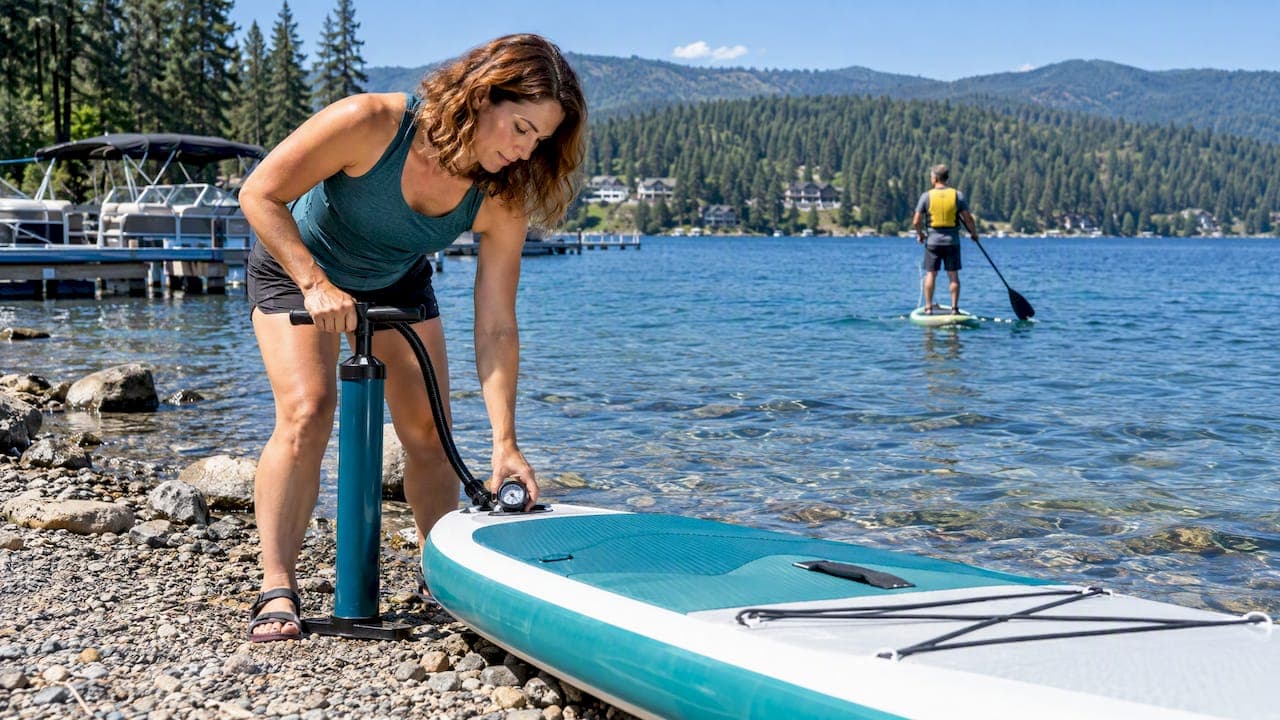
Most inflatable paddleboards perform best at 12 to 15 PSI, though some premium touring and racing boards are rated higher. The number that counts is the one printed on your board near the valve. Inflate to that rating, never past it, and ease off a little when the sun is beating down on the board.
TL;DR
- Typical inflatable SUPs: 12 to 15 PSI; premium touring and racing boards can be rated up to 20 PSI.
- Your board's maximum rating is printed on the graphic around the valve. Never exceed it.
- Too soft and the board sags and flexes underfoot. Too hard and you risk stressing the seams, especially in heat.
- Skip tire inflators and compressors. Use a hand pump with a gauge or an electric SUP pump with auto-shutoff.
- Hot lake day? Inflate a bit lower, then check the gauge again before you launch.
Table of Contents
- What PSI actually means for your board
- The PSI range to aim for
- How to inflate a SUP step by step
- Can you use a tire inflator?
- Heat, sun and pressure
- Perspective
- Before you launch on a local lake
- Rent a ready-to-paddle setup
- FAQ
- Sources
What PSI actually means for your board
PSI is pounds per square inch, the air pressure inside the board. That pressure is what turns a folded sheet of drop-stitch fabric into a rigid platform. Enough pressure and the board holds its shape, tracks straight and feels stable. Too little and it bends in the middle like a banana when you stand on it.
Under-inflation is the most common beginner problem. Starboard notes that a soft board sags and flexes when you step on it, which hurts tracking, slows you down and feels unstable. If your first paddle felt wobbly, check the pressure before blaming your balance.
The PSI range to aim for
The range varies by board, so treat these as guideposts and not rules.
| Board type | Typical pressure |
|---|---|
| Most all-around inflatable SUPs | 12 to 15 PSI |
| Premium touring and racing boards | Up to 20 PSI rated |
| Single-chamber boards (one manufacturer's guidance) | 15 to 18 PSI |
| Double-chamber boards (same maker) | 15 to 18 PSI outer chamber, 10 PSI inner chamber |
The differences come from construction. A board built for 20 PSI is a different animal from a budget all-rounder rated to 15. Find the rating first, then choose a number inside it.
Where to find your board's rating
Look at the graphic surrounding the valve. NRS says the maximum pressure rating is listed there. If the sticker has worn off, check the owner's manual or the maker's website. On a rental board, ask the staff what the board is rated for and where the pressure should sit.

Does heavier mean higher?
Often a heavier rider or a choppy day feels better on a firmer board, but only up to the rated maximum. A larger board with more volume also tends to be rated for the same pressure as a smaller one, so don't assume bigger means more air. Stay inside the printed range.
How to inflate a SUP step by step
- Unroll the board on a flat, clean surface away from sharp rocks, sticks or hot pavement.
- Set the valve. On a Leafield-style valve, push the stem down and turn it clockwise. The stem pops up when it is in the right position for inflating.
- Attach the pump hose and pump steadily. The first stretch is easy, then each stroke gets harder.
- Watch the gauge. Many pumps and some boards have an integrated gauge. Stop at your target, never above the board's maximum.
- Remove the hose quickly and close the valve cap so little air escapes.
- Press down with your hand. The deck should feel firm, not squishy. Step on gently and see if it holds its shape.
A full hand-pump inflation is a decent warm-up. If you rent paddleboards for a lake weekend, you'll often have the board ready to go, which saves the effort. Our guide to what to know before you rent a paddleboard covers what to expect at pickup.
Can you use a tire inflator?
It's tempting, especially if a compressor is in the trunk. Earth River SUP advises against tire pumps and air compressors because they can overinflate a SUP in seconds, while a dedicated SUP electric pump with auto-shutoff removes that risk. Car tires run at pressures several times higher than a paddleboard, so one distracted moment can do real damage.

If you go electric, choose a pump made for SUPs. One example, the EP-T20, shuts off automatically at its preset pressure and needs a 12V DC power supply, so check what you have in the vehicle first.
Heat, sun and pressure
Air expands when it warms. A board lying on a sunny dock or a dark car roof will gain pressure. Earth River SUP says heat can push a board up by more than 2 PSI. Starboard goes further and recommends inflating its boards only to 15 PSI when temperatures exceed 25°C (77°F).
Practical habits for a hot Inland Northwest summer day:
- Inflate in the shade when you can, or stop a pound or two under your target.
- Keep the board out of direct sun between paddles. Slide it into the water or cover it.
- Recheck the pressure before you launch, and again after a long lunch on the beach.
- Never leave a fully pumped board in a closed, hot vehicle.
One paddler's rule of thumb is to drop to 13 or 14 PSI when heat has already pushed the pressure up. That's a personal habit, not a manufacturer spec, so keep it under your board's printed maximum.
Perspective
We see the same pattern every summer: first-timers who fight a wobbly board and blame themselves, when the real issue is a soft deck. A firm board makes the first ten minutes far easier, and that's what hooks people on paddling.
That's why we like to get new paddlers on a properly set-up board and talk them through the basics before they push off. Pair a stable, well-inflated board with calm morning water and a fitted life jacket, and a beginner's day on Lake Coeur d'Alene or Liberty Lake goes from stressful to relaxed.
Our approach is simple: keep the gear clean and ready, keep the process easy, and let you spend your time on the water instead of wrestling with a pump.
Life is better on water.
Before you launch on a local lake
Pressure is only half the prep. Carry at least one properly fitted U.S. Coast Guard-approved life jacket for each person aboard. In Washington, children 12 and younger must wear one underway on vessels under 19 feet unless they're in a fully enclosed area. The same state agency recommends carrying two forms of communication, such as a phone in a waterproof pouch.
Sizing matters as much as having one, so read our life jacket fitting guide for adults and kids. Wind is the other variable. Our paddleboard wind limits article explains why beginners do best at 0 to 5 mph. If you're choosing a board, start with a 10 to 11 ft inflatable.
Rent a ready-to-paddle setup
Don't own a board or a pump? We rent paddleboards alongside jet skis, boats and water toys for lakes around Spokane Valley, Liberty Lake and Coeur d'Alene. Paddleboard pricing isn't published online, so see the Golden Water Sports homepage to ask about availability and rates.
Want to see what else fits your group? Our rental prices page lays out the options for lakes in the area.
FAQ
What PSI should an inflatable paddleboard be?
Most inflatable SUPs sit at 12 to 15 PSI, and some premium boards are rated up to 20 PSI. Always follow the rating printed near your valve or in the manual. Pick a number within that range and stay at or below the maximum.
How much should I inflate my SUP on a hot day?
A little less than usual. Heat can add more than 2 PSI inside the board, and Starboard advises 15 PSI for its boards above 25°C (77°F). Pump in the shade if possible, then check the gauge again before you launch.
Can I use a tire inflator or air compressor?
It's not recommended, because these tools can overinflate a board quickly. A hand pump with a gauge or an electric SUP pump with auto-shutoff is the safer choice.
How do I know my board is firm enough?
Check the gauge first, then press down on the deck with your hand. It should feel rigid, with no sag when you kneel on it. If it flexes under your weight, add air in small amounts without passing the rated maximum.
Sources
- What PSI Should You Inflate a SUP To
- How to Inflate & Set Up Your Inflatable SUP Board, NRS
- SUP FAQ, Starboard
- SUP Inflation Tips, Earth River SUP
- EP-T20 electric pump manual
- Wear a Life Jacket, Washington State Parks