
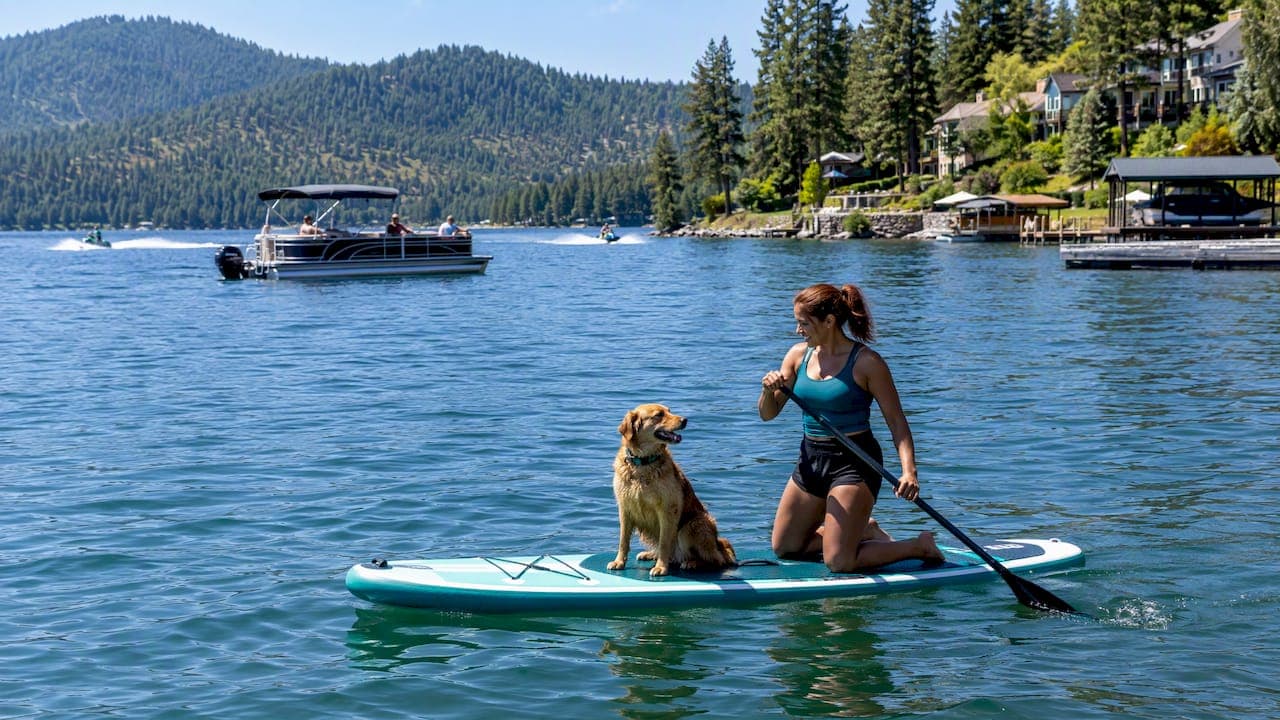
Yes, you can paddleboard with your dog. A fit dog that swims well and can climb back onto the board with your help can join you. The trip goes well when you pick a stable board, put life jackets on both of you, and do the training on land before you ever launch. Below is how to do it, plus what to check around Spokane, Liberty Lake and Coeur d'Alene.
TL;DR
- Your dog should swim, know sit, down, come and stay, and be able to get back on the board with your help.
- Use a wide, grippy board. Both of you wear a life jacket, and the dog's should have a handle.
- Start in shallow, calm water. Keep the dog in the middle of the board, sitting or lying down.
- Lift a dog back aboard by the life jacket handle, never the collar.
- Check where dogs and paddleboards are allowed before you go, and bring water and a way to call for help.
Table of Contents
- Is your dog a good fit for the board?
- Choosing a board and gear
- Training your dog before the first paddle
- On the water: positioning and falls
- Paddleboarding with kids too
- Planning a safe trip around Spokane and Coeur d'Alene
- What we think
- Try a paddleboard rental first
- FAQ
- Sources
Is your dog a good fit for the board?
The American Kennel Club says a fit dog that can swim and climb back onto the board with assistance can come along. It also tells owners to weigh the dog's personality, training, breed and the weather.
Some honest questions to ask before you start:
- Does your dog like water, or only tolerate it?
- Does it stay calm on unstable surfaces, like a wobbly dock or a boat?
- Can it hold a sit or down while you move around it?
- Is it comfortable wearing a life jacket?
If the answer to most is no, spend a few weeks building those skills first. A nervous dog on a moving board is a fast way to a swim for both of you.
Choosing a board and gear
The AKC recommends a wide, sturdy board with good grip, a personal flotation device for you, and a dog life jacket, preferably one with a handle. Bring drinking water and treats that will not fall apart when wet.
A few practical notes:
- Width and volume. More width means more stability when your dog shifts its weight. A bigger board also leaves room for you to stand and the dog to sit in front of your feet.
- Traction. Inflatable boards are popular with dog owners because the surface gives paws more grip than a hard board, according to Ruffwear's guide. A traction pad helps on any board.
- Nails. Trim them before you go. Sharp nails and an inflatable board are not friends.
- Dog life jacket. It should fit snugly and have a sturdy handle on the back. Our guide to boating with dogs covers fit and safety on the water in more detail.
Your own gear matters too. Washington State Parks says every vessel, including a stand-up paddleboard, must carry properly sized Coast Guard-approved life jackets and a sounding device such as a whistle. That is Washington's rule, so check Idaho's requirements if you plan to paddle at Lake Coeur d'Alene.
Training your dog before the first paddle
Do this in stages, over several short sessions. Both the AKC and Paddling Magazine's expert guide describe the same basic order.
- Basic cues. The AKC recommends your dog know sit, down, come and stay before any SUP outing.
- Get used to the life jacket. Let the dog wear it around the house and on walks with treats, so it becomes normal.
- Meet the board on land. Set it on the grass. Reward the dog for sniffing, stepping on and sitting on it. Add the paddle once the board is boring.
- Teach a release cue. Paddling Magazine suggests rewarding the dog for getting on, building a stay, and giving a clear word for when it may hop off.
- Practice the motion. Ruffwear suggests rehearsing paddle strokes on dry land, with you standing or kneeling beside the dog.
- Move to shallow water. The AKC says to begin in shallow water, sit before standing, and keep your movements calm and steady. Use a quiet voice and lots of praise.
Keep early sessions short and end them on a good note.
On the water: positioning and falls
Keep your dog in the middle of the board, sitting or lying down. Your own stance should stay centered too. If the dog stands and shifts a lot, kneel until it settles.
Falls happen, so rehearse them. Practice helping the dog back aboard in shallow water, lifting by the life jacket handle, not the collar. Ruffwear recommends rehearsing this technique while you stay centered on the board so you do not tip it as you pull.

Take shore breaks. Dogs need water, shade and a chance to move around, especially on warm days. Bring more water than you think you need, because lake water is not a good drinking option for a dog.
Paddleboarding with kids too
Family trips add a second set of rules. The Washington Department of Health advises close supervision of young children near water and properly fitted life jackets. In Washington, children 12 and under must wear a Coast Guard-approved life jacket whenever underway in a vessel shorter than 19 feet, unless they are in a fully enclosed area.
Practical tips for a kid-and-dog outing:
- Start with one child, one adult, calm water and a short route along the shore.
- Check the fit before every trip. Our life jacket fitting guide for adults and kids shows how.
- Let the child and dog practice sitting on the board on land first. Never leave the pair alone on the water.
- Keep outings short. Kids and dogs both tire, and cold water adds up quickly.
If your group is large, split into boards with one adult each rather than loading everybody onto one. A dry-land day between paddles can be a nice break, and open air group activities are one way to fill it.
Planning a safe trip around Spokane and Coeur d'Alene
The Department of Health recommends checking conditions and beach advisories before you go, being ready for cold water and sudden weather changes, and telling someone your route and expected return time. Carry life jackets, a rescue device and a cell phone.
Local reporting from The Spokesman-Review adds a waterproof phone case, a flashlight and a whistle. It also recommends that beginners avoid storms and gusty wind, paddle with a buddy and stay visible near shore. Afternoon wind can pick up on big lakes, so paddle early.
Rules on where dogs can go vary by site:
- The Bureau of Land Management says dogs at Mica Bay Boater Park, in the Coeur d'Alene area, must be leashed or under control. That page does not set a rule for the whole lake.
- Washington State Parks' Riverside State Park brochure says the Little Spokane River is limited to kayaks, canoes, rafts and paddleboards, and that pets are not allowed in that natural area.
So a dog-friendly lake day starts with a call or a look at the managing agency's page. For launch ideas near Spokane, see our list of Spokane paddleboard launches.
What we think
Most dog-and-paddleboard trouble we hear about comes from skipping the boring parts. People launch a first-time dog straight into open water, or give the dog a jacket five minutes before the trip. The dogs that love paddleboarding are the ones that had weeks of calm, treat-filled practice on a board in the yard.
We also think the first trip should be small: a calm morning, shallow water, one dog, one adult, and a plan for what happens if you both end up swimming. Lake water around here can be cold even in summer, and a plan beats improvising.
— Life is better on water.
Try a paddleboard rental first
Not sure which board suits you and your dog? Renting lets you test before you buy. We rent paddleboards alongside jet skis, boats and water toys for lakes around Spokane Valley, Liberty Lake and Coeur d'Alene. See our rental options or read what to know before you rent a paddleboard. Ask about dog-friendly use when you book, and bring your dog's own life jacket.
FAQ
Can I put my dog on my paddleboard?
Yes, if your dog is fit, can swim and can get back on the board with your help. Train on land first, then start in shallow water. Check that the place you plan to paddle allows both paddleboards and dogs.
Can I bring my dog on an inflatable paddleboard?
Yes, and many owners prefer it. Inflatables tend to give more grip for paws and a bit more stability than hard boards. Trim your dog's nails and add a traction pad to protect the board and help your dog stay put.
How do I get my dog back on the board after a fall?
Stay centered on the board and lift your dog by the handle on its life jacket, never by the collar. Practice this in shallow water before you need it. A dog that has rehearsed it is much calmer when it happens for real.
Do kids need life jackets on a paddleboard?
In Washington, children 12 and under must wear a Coast Guard-approved life jacket whenever underway in a vessel shorter than 19 feet, unless they are in a fully enclosed area. Check Idaho's rules if you paddle at Lake Coeur d'Alene. Younger children also need close adult supervision around water.
Sources
- How to Stand-Up Paddle Board With Your Dog, American Kennel Club
- Expert Tips On How To Standup Paddleboard With Your Dog, Paddling Magazine
- SUP Pup 101: How to Paddleboard with Your Dog, Ruffwear
- Boating Equipment, Washington State Parks
- Wear a Life Jacket, Washington State Parks
- Water Safety for Lakes, Rivers, and Beaches, Washington State Department of Health
- Standing up for paddling safety, The Spokesman-Review
- Mica Bay Boater Park, Bureau of Land Management
- Riverside State Park brochure, Washington State Parks