
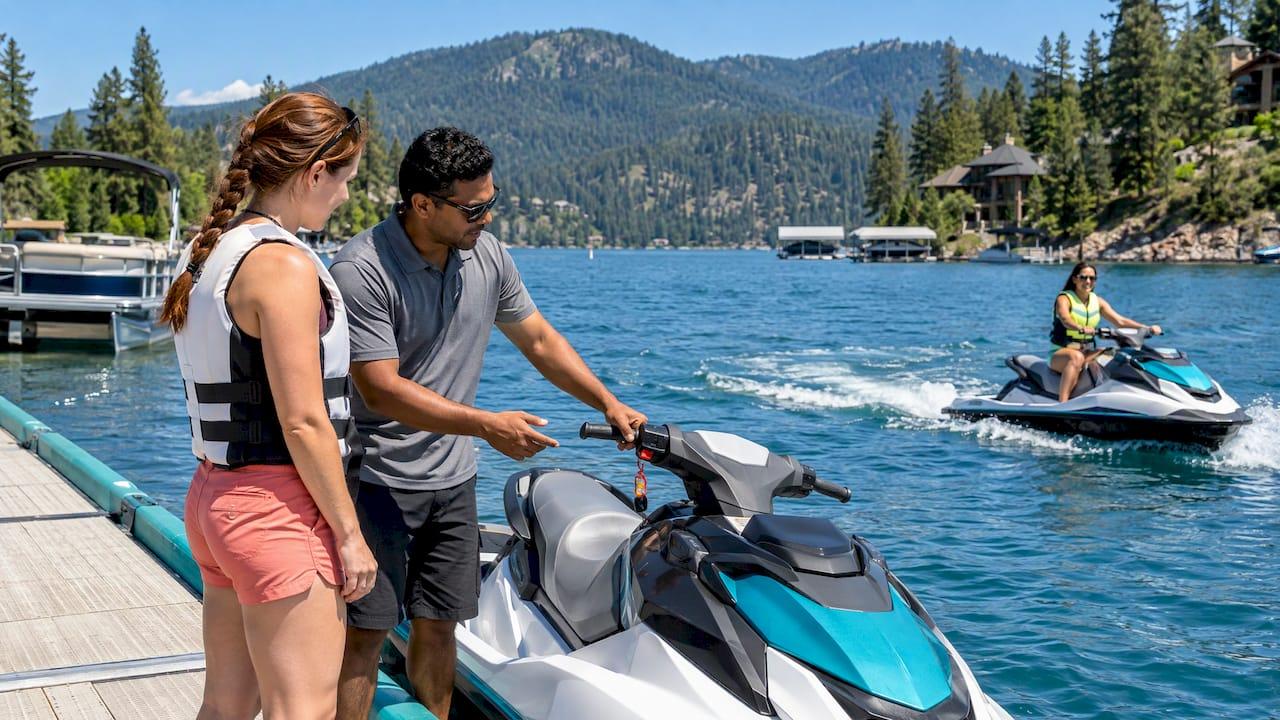
A good jet ski day starts on the dock, not on the water. Check the craft, put on the right gear, learn the local speed rules, and know what to do if you fall off. When you rent from us at Golden Water Sports, you get Yamaha WaveRunners with safety equipment included, and this checklist shows what to confirm before you leave the dock.
TL;DR
- Wear a USCG-approved life jacket the whole time you are on the jet ski, and attach the cut-off lanyard to your wrist or life jacket before you start the engine.
- Before launch, check the hull, the controls, fuel and oil leaks, the drain plug, and vent the engine compartment of fumes.
- Stay at no-wake speed (5 mph) near shore, docks, swimmers and structures. Kootenai County sets the distance at 200 feet on most waters.
- Releasing the throttle takes away your steering, so plan your turns and stops early.
- If you fall off, reboard from the back, knees first, then reattach the lanyard before restarting.
Table of Contents
- Before you launch: the pre-ride check
- What to wear and carry
- Local rules that matter on the lake
- Riding habits that prevent accidents
- If you fall off or the jet ski flips
- Rent with the checklist built in
- Our view
- FAQ
- Sources
Before you launch: the pre-ride check
Idaho's boating handbook lists a pre-departure checklist that applies to any powerboat or PWC (personal watercraft, the official term for a jet ski). In plain terms, run through these:
- Weather. Check the forecast. Afternoon wind builds chop quickly on big water like Lake Coeur d'Alene.
- Controls. Steering and throttle should move freely, and lights should work.
- Leaks. Look for fuel leaks at the tank and lines, and oil in the engine compartment.
- Hoses and clamps. Connections should be tight.
- Drain plug and bilge. Water drained from the engine compartment and the plug secured.
- Battery and extinguisher. The battery is charged and a fire extinguisher is on board.
- Cut-off switch and lanyard. Both in good order.
- Life jackets. Required jackets are on hand and in good condition.
- Float plan. Tell a friend or relative where you are going and when you expect to be back.
One step is easy to skip. Jet skis have no active ventilation in the engine compartment, so fumes can build up and a spark from the starter or battery cables can ignite them. Jetdrift's checklist says to open the seat and let the compartment vent for a couple of minutes before starting. It also says to check the hull for damage, look for debris at the pump intake, and secure the seat and storage lids.
If you refuel, the Idaho handbook says to dock securely with all passengers off, allow no smoking or flames, keep the nozzle touching the tank opening, and never fill to the brim. Afterward, sniff the engine compartment for fuel vapors before you start.
On a rental, we hand you a craft that is ready to go and walk you through the controls. Our rental page covers what to bring on a jet ski rental day.
What to wear and carry
Idaho's PWC law summary sets out the basics:
- Everyone aboard, or being towed, wears a serviceable USCG-approved life jacket. Idaho Code 67-7015 says a jacket counts as readily accessible on a PWC only when it is worn.
- A whistle or horn audible for at least half a mile.
- An approved fire extinguisher.
- Proof of boating education on board.
- The cut-off lanyard attached, if the craft has one.
The stakes are real. Washington's boating handbook notes that almost 85% of those who drowned were not wearing a PFD, the term for a personal flotation device, or life jacket.
Beyond the legal minimum, Arnold & Itkin recommends neoprene wetsuit bottoms or PWC shorts, because falling off the back can send high-pressure water into the body, plus snug eyewear with a strap, gloves, and non-slip water shoes. Loose swimwear is the wrong choice. For a full gear list, see our guide to required boat safety equipment on Idaho and Washington lakes.
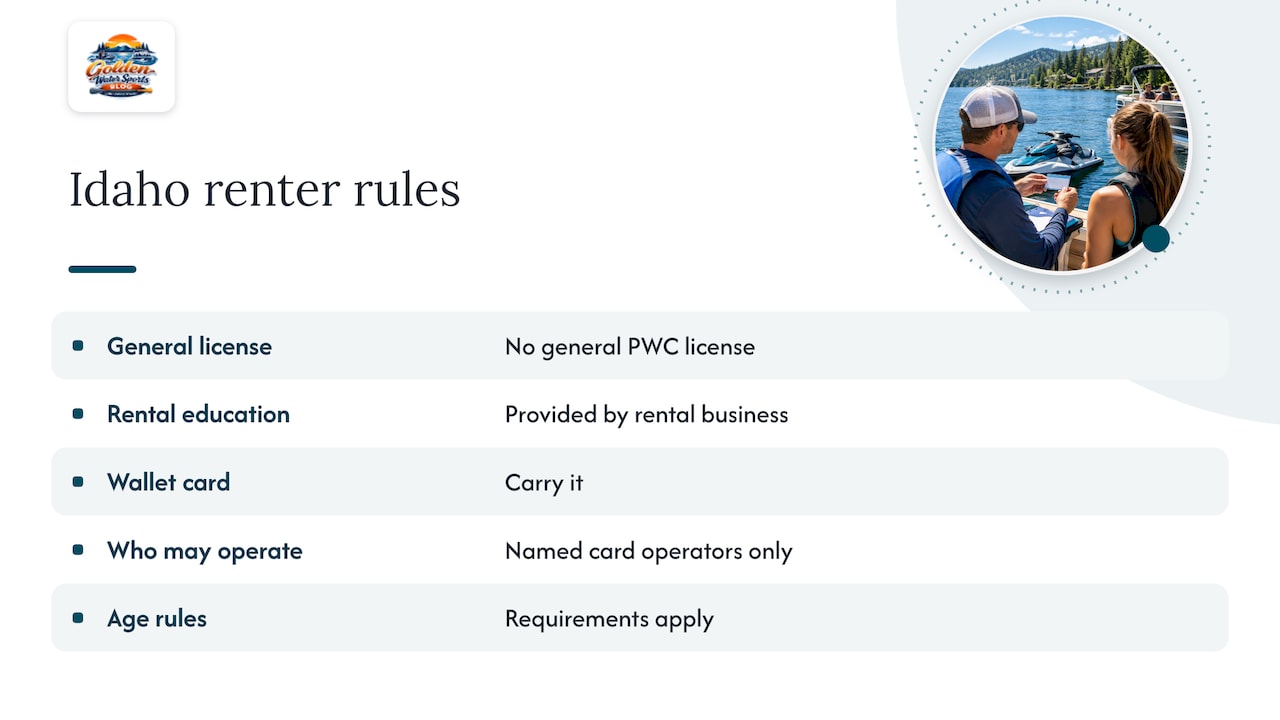
Education card for renters
Idaho has no general PWC license, but renters must receive Idaho Parks and Recreation education from the rental business and carry the wallet card, according to one state-by-state guide. The Idaho PWC summary adds that nobody whose name is not on the acknowledgment card may operate a rented PWC. Age rules also apply: see our page on renter age requirements.
Local rules that matter on the lake
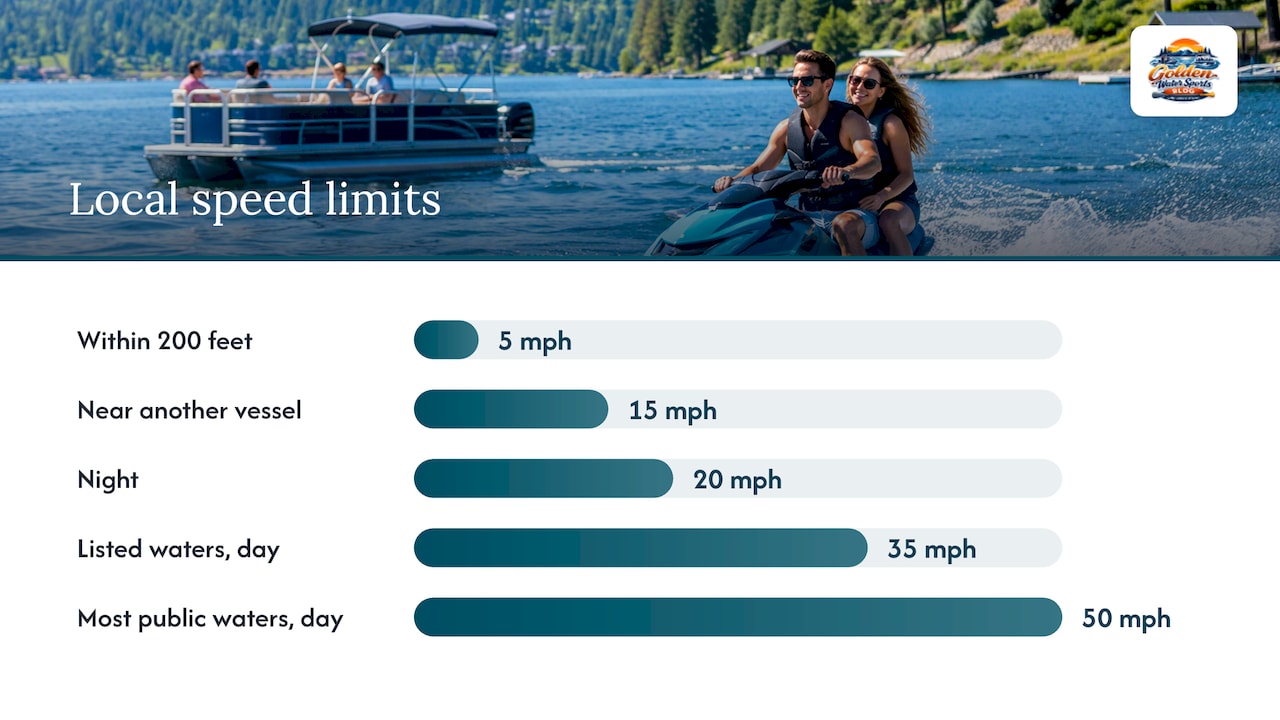
Kootenai County's waterway code covers Lake Coeur d'Alene waters in the county. The numbers to remember:
| Situation | Limit |
|---|---|
| Within 200 feet of shore, docks, piers, structures or people in the water | 5 mph, no wake |
| Within 100 feet of another vessel | 15 mph |
| Night | 20 mph |
| Daytime on most public waters | Reasonable speed, no more than 50 mph |
| Spokane River to Post Falls Dam, Coeur d'Alene River, Lower Twin Lake | 35 mph by day; 5 mph within 100 feet of shore |
The code also requires a working muffler and prohibits anyone under 10 from operating a motor-driven watercraft except under direct adult supervision. Idaho law bars PWC operation between sunset and sunrise without manufacturer-installed navigation lights, and a towed skier counts as a passenger toward the craft's rated capacity. Never jump another boat's wake at close range.
Riding the Spokane River? Seasonal PWC closures apply, so read our Spokane River PWC rules guide before you go.
Riding habits that prevent accidents
The NTSB's personal watercraft safety study found vessel collisions were the most common accident type, at 46% of the 814 accidents it reviewed, followed by falls overboard at 11%. The takeaway: keep your distance, look ahead, and expect to fall off at some point.
- Steering needs power. The Texas boater safety manual explains that steering depends on water flow through the jet, so releasing the throttle can cost you control. It also notes the reverse bucket slows the craft rather than braking like a car. Learn more in our guide to jet ski braking techniques.
- Smooth throttle, gentle turns. The Watercraft Journal advises progressive throttle, no sharp turns with a passenger, and telling passengers to lean into turns.
- Mind the load. Most PWCs safely carry about 500 pounds in total, including riders, fuel and gear, per the Texas manual. Our passenger rules and riding tips cover seating.
- Never ride after drinking. Alcohol impairs judgment and balance, and boating under the influence is a legal offense.
If you fall off or the jet ski flips
Falling off is normal on a PWC. What matters is the routine:
- The lanyard stops the engine when you separate from the craft.
- Swim to the back. Per the Texas manual, climb aboard knees first and pull yourself onto the seat.
- Reattach the lanyard to your wrist or life jacket, then restart.
- If it flipped, turn it upright in the direction marked on the hull or in the owner's manual, so the engine does not take on water. BoatUS Foundation gives the same instruction.
After a collision or injury, Arnold & Itkin advises shutting the engine off, counting everyone, keeping anyone unconscious or reporting neck or back pain still, and calling for help with your exact location. In an emergency, call 911.
Rent with the checklist built in
We rent Yamaha WaveRunners for Liberty Lake and Newman Lake, with safety equipment and flexible hours. Jet ski rentals run $250-$425, extra hours are $75 each, and there is a $500 damage deposit per jet ski. See Liberty Lake jet ski rentals or Newman Lake rentals, or check all current prices.
First time out? Our list of common tourist rental mistakes is a quick read before you book.
Our view
Most jet ski trouble comes from skipped basics: a jacket not worn, a lanyard left clipped to the seat, a rider who lets go of the throttle in a turn.
That is why our WaveRunners come with safety equipment and a clear briefing, and why we want every guest to treat the checklist as part of the fun. A rider who knows the 5 mph zones and how to reboard spends the day enjoying the lake.
Life is better on water.
FAQ
Do I need a license to rent a jet ski in Idaho?
Idaho has no general PWC license. Renters must receive education from the rental business and carry the acknowledgment card, and only people named on it may operate the craft.
Do I have to wear a life jacket on a jet ski?
Yes. Idaho law requires every person on a PWC, or being towed, to wear a USCG-approved life jacket in serviceable condition. Carrying one is not enough.
Do jet skis flip easily?
They can capsize, mostly with a passenger or aggressive riding, per the Watercraft Journal. Ride smoothly, turn gently, and if it flips, follow the hull's righting instructions.
How fast can I go near the shore?
On most Kootenai County waters, no faster than 5 mph within 200 feet of shore, docks, piers, structures or people in the water. Some waters, such as the Spokane River section, use 100 feet.
Sources
- Idaho Boating Laws handbook
- Personal Watercraft Laws and Safe Operation, Idaho Parks and Recreation
- Idaho Code 67-7015
- Washington State boating handbook
- Kootenai County Title 6 waterways code
- NTSB Personal Watercraft Safety study
- Texas Boater Safety Course manual
- Watercraft Journal on riding and righting a PWC
- BoatUS Foundation personal watercraft guide
- Arnold & Itkin jet ski safety for families
- Jetdrift pre-ride checklist
- Boating by State PWC license guide