
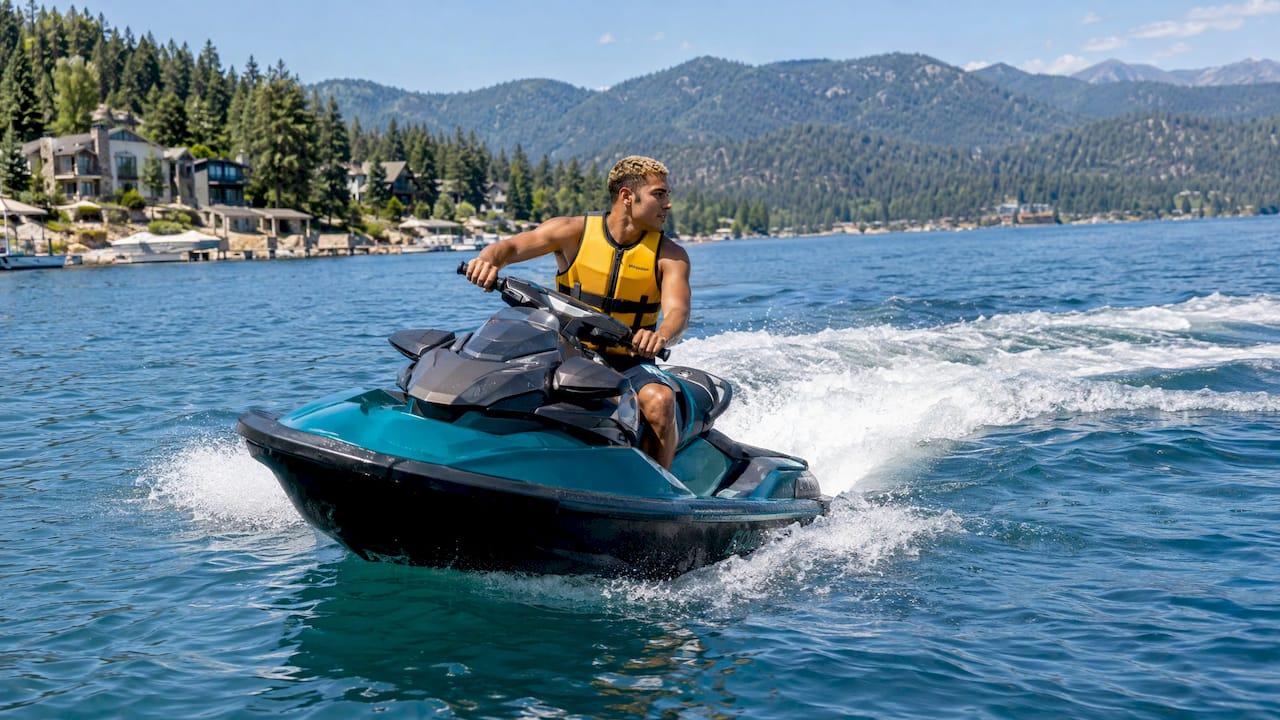
A jet ski does not stop like a car. Release the throttle and it keeps gliding for several seconds, and with the throttle off you lose most of your steering. Safe stopping is about planning early: look ahead, ease off in open water, leave generous room, and use any reverse or deceleration lever only the way the manufacturer says. If you are renting a Yamaha WaveRunner for a day on Lake Coeur d'Alene, Liberty Lake or Newman Lake, here is what to do and why.
TL;DR
- Releasing the throttle does not mean you stop right away. A PWC safety course says you keep moving forward for several seconds, depending on your speed.
- You need power to steer. Do not let go of the throttle when you are trying to turn away from something.
- Some newer models have a left-hand lever for slowing and reverse. Use it as the owner's manual directs, and never as a last-second emergency brake.
- Look ahead, slow down early and keep far from swimmers, docks and other boats.
- Wear your life jacket and attach the engine cut-off lanyard before you start.
Table of Contents
- Why a jet ski stops differently than a boat or car
- Does your jet ski have a brake?
- How to stop a jet ski: step by step
- The mistake that causes most close calls
- Adjusting for passengers, waves and crowded water
- Gear that matters when you stop or fall
- Practice before you go fast
- Ride a Yamaha WaveRunner with us
- Our view: slow early, steer with power
- FAQ
- Sources
Why a jet ski stops differently than a boat or car
A jet ski moves by shooting a stream of water out of a nozzle at the back. That nozzle also does the steering. Idaho's state boating handbook explains that turning the handlebars swings the nozzle, and with no power there is no steering control. Many personal watercraft keep going in their original direction after the throttle is released, although newer ones allow some off-throttle steering.
There is also no transmission to disengage. A mechanical bucket redirects the water stream, straight down for neutral or forward for reverse, and even without brakes a jet ski slows quickly once you release the throttle. Quickly is not the same as instantly, and that gap is where first-time riders get into trouble. The PWC safety course ties most accidents to inattention and inexperience, and warns that speed plus no brakes is a dangerous mix because stopping takes time and distance.
Does your jet ski have a brake?
It depends on the model. The Idaho handbook says most personal watercraft have no brakes, and that even those with a braking system do not stop immediately.
Older machines rely on water resistance alone. BOATERexam's guide says older models usually lack brakes, so you release the throttle and let the water slow you down.
Newer Yamaha WaveRunners may have the RiDE system, short for Reverse with Intuitive Deceleration Electronics. According to Yamaha's 2024 product guide, it electronically controls engine speed and a reverse gate near the jet nozzle, and the left-hand lever slows, reverses or selects neutral. The right-hand lever is your throttle, and the left-grip lever slows or reverses, as Yamaha's WaveRunner brochure describes.

Yamaha is careful with wording. Its guide tells staff not to call RiDE a brake. Its riding-rules sheet adds: early action prevents collisions, because RiDE is not a braking device for dangerous situations. For a deeper look at the controls, see our guide to the Yamaha RiDE system.
How to stop a jet ski: step by step
- Check your surroundings first. Look ahead and behind. Stopping distance and steering response vary by model, so plan on more room than you think you need.
- Ease off the throttle gradually in open water. Do this well before your stopping point. Keep the handlebars straight while you slow.
- Let the craft settle. Wait until it has slowed to idle speed before you turn sharply or approach anything. Steering is weak with the throttle off.
- If your model has a left-hand lever, use it as the manual directs. The owner's manual for the Yamaha VX/VX Sport says it has no separate braking system, and that on VX Deluxe and VX Cruiser models reverse is for slow-speed maneuvering such as docking, not for slowing or stopping in general. Your rental briefing should cover the exact controls on the machine you ride.
- Never shift into reverse at speed. The Washington boater-safety course warns that using reverse to stop a PWC can throw you or your passengers off.
- Stay in neutral or idle at the dock. Approach at the lowest speed you can still control, hang fenders before arrival, tie up before stepping off, and remove the lanyard only after the engine is off, as the docking advice puts it.
The mistake that causes most close calls
The natural reaction when something appears in front of you is to let go of the throttle. On a jet ski, that is exactly what takes away your steering. Yamaha's checklist poster says plainly: you need throttle to steer. It also notes that most PWC injuries and deaths result from collisions.
The fix is a habit rather than a trick. If you are about to pass close to a swimmer, a dock or a boat's wake, steer away early while you still have power, then ease off once you are clear. Squeezing the throttle gently while you turn gives you the steering you need. In a tight situation, turning is usually more reliable than trying to stop.
Adjusting for passengers, waves and crowded water
Passengers. Extra weight means more momentum, so give yourself extra distance. Tell your passenger to hold on before you slow down, so a sudden change does not catch them off guard.
Waves and chop. Slow down gradually and keep the nose pointed into or at a slight angle to the waves. Avoid turning broadside while slowing.
Crowded shoreline areas. Busy beaches and marinas on the lakes around Coeur d'Alene and Spokane are where you spend the most time near idle speed. Bonner County, Idaho defines no-wake zones as areas where boats must go no faster than 5 miles per hour and make no more than a 6-inch wake. Slow down well before the marker, not at it.
Pre-ride briefing. Before you leave the dock, ask how the controls on your machine work and where the lanyard attaches. A short boat rental checklist helps you walk through safety gear and questions to cover.
Gear that matters when you stop or fall
Idaho requires a USCG-approved life jacket of the right size for every person on board or being towed, and a throwable Type IV device on the vessel. The handbook also says an engine cut-off lanyard should be attached to your wrist or life jacket so the engine shuts off if you fall. Attach it before you leave the dock. Our guide to why you should wear a life jacket covers fit, and our open-water safety guide covers what to do if something goes wrong. Good manners help, too: see jet ski etiquette for right-of-way habits that keep distances comfortable.
Practice before you go fast
Spend your first ten minutes in open water, away from other boats. Pick a spot, accelerate to a moderate speed, ease off, and note how far you glide. Repeat a couple of times, then practice a gentle turn with a little throttle. You will quickly learn how much room your machine needs, which is more useful than any rule of thumb.

Ride a Yamaha WaveRunner with us
Golden Water Sports rents Yamaha WaveRunners with safety equipment for lake days near Spokane Valley, Liberty Lake and Coeur d'Alene. Jet ski rentals at Liberty Lake and Newman Lake run $250 to $425 per rental, an additional hour is $75, and there is a $500 damage deposit per jet ski. You can also add wakeboards or tubes for $50 each. Pickup and limited delivery are available, and you can see all options on our rental and pricing page or book the Liberty Lake jet ski rental.
First-timers should also check our jet ski age restrictions before booking, and parents can read how to teach kids jet ski basics.
Our view: slow early, steer with power
We want every guest to head home with a great story and no close calls. The best braking technique on a jet ski is the one you start a long way before you need it: scan ahead, ease off early, keep the handlebars straight, and keep the throttle alive whenever you need to steer.
That is why we put the basics first when you pick up a WaveRunner: life jacket, lanyard, how the controls respond, and how much room to leave. Our Yamaha WaveRunners come with safety equipment, and you can book by the hour or for multiple days, so you can start with calm water and a short ride and build confidence at your own pace.
Whether you ride Liberty Lake, Newman Lake or Coeur d'Alene, give yourself space, respect no-wake zones, and enjoy the water.
Life is better on water.
FAQ
How do you stop a jet ski?
Release the throttle gradually in open water, with the handlebars straight, and let the craft slow down. If your model has a left-hand lever, use it only as the owner's manual says. Always leave plenty of room, because releasing the throttle does not stop you immediately.
Can I steer a jet ski with the throttle off?
Very little, and on many models not at all. The steering nozzle needs thrust to work, so Yamaha's guidance is not to release the throttle when trying to steer. Squeeze gently while turning away from an obstacle.
Is it safe to use reverse to stop quickly?
No. Reverse is for slow-speed maneuvering such as docking. Using it at speed can throw riders off, so slow down first and follow the owner's manual.
What should I do if I fall off?
The lanyard should shut off the engine when it pulls free. Stay with the craft, keep your life jacket on and signal for help if needed. Our open-water safety guide walks through the steps.
Sources
- Personal Watercraft Safety Course
- Idaho Boating Laws handbook
- How Does a Jet Ski Work? | UTI
- Basics of Riding a Jet Ski: Turns and Stops | BOATERexam
- Yamaha 2024 product information guide
- Yamaha WaveRunner 2017 brochure
- Yamaha WaveRunner riding rules
- Yamaha VX/VX Sport owner's manual
- How to Drive a Jet Ski for Beginners | Better Boat
- Steering and Stopping a PWC | Boat-Ed
- Yamaha WaveRunner owner checklist poster
- Bonner County Waterways