
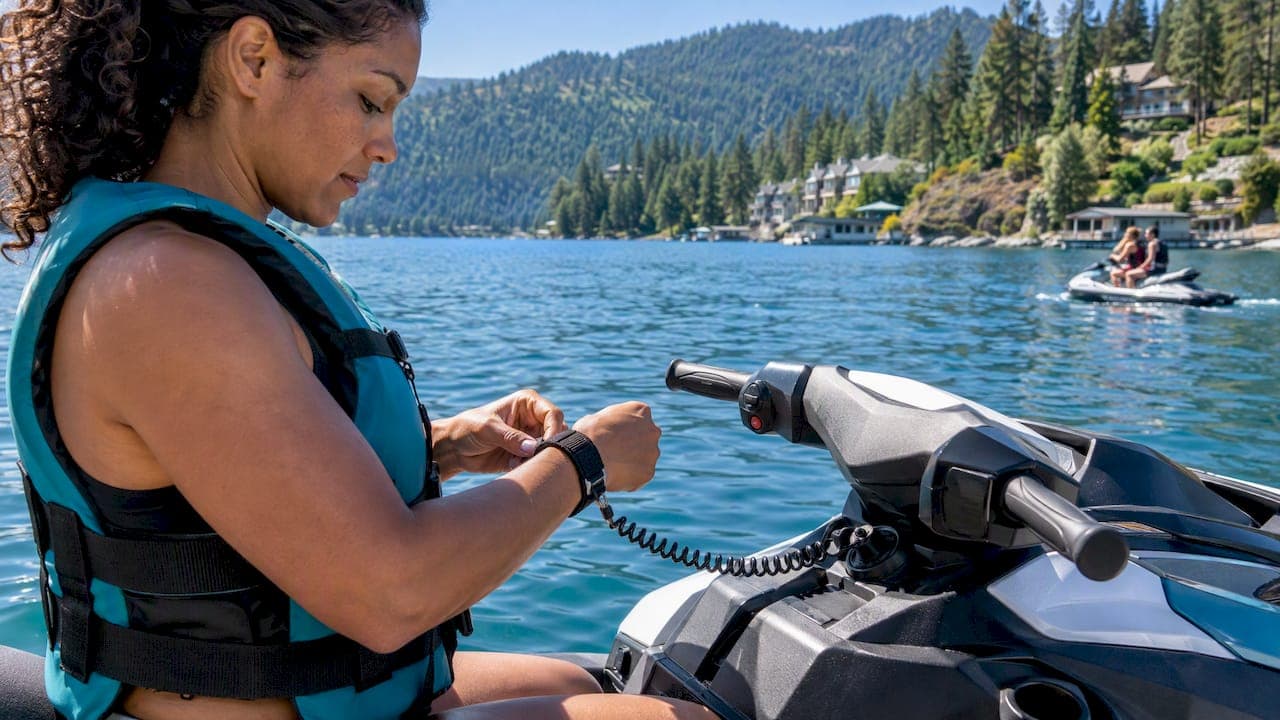
A kill switch lanyard is the cord that connects you to your engine's stop switch. If you fall or get thrown from the helm, the cord pulls the key out and the engine shuts off. On a jet ski, you clip it to your wrist or life jacket before you start the engine, and you keep it attached every time you ride.
We rent Yamaha WaveRunners on Liberty Lake and Newman Lake, so we walk first-time riders through this cord every day. Here is what it is, what the law says, and how to use it correctly.
TL;DR
- The lanyard links you to the engine stop switch. If you leave the helm, it pulls free and the engine cuts off.
- Federal law requires the operator of a covered boat under 26 feet to wear the link while the boat is on plane or above displacement speed, if the boat has an engine cut-off switch.
- Attach it to your person, clothing or life jacket, never to the seat or the handlebars.
- Test it before you ride: the engine should stop when the lanyard comes off.
- The lanyard does not replace a life jacket. Wear both.
Table of Contents
- What a kill switch lanyard does
- What the law says
- How to attach it correctly
- Lanyard habits that save trouble
- What the lanyard does not do
- Our perspective: the lanyard is the first thing we check
- Ride with us on Liberty Lake or Newman Lake
- FAQ
- Sources
What a kill switch lanyard does
The U.S. Coast Guard describes an engine cut-off switch as a safety mechanism that shuts off propulsion when the operator is displaced from the helm. The lanyard, also called the ECOS link, kill cord or safety tether, is the physical connection. It is usually a coiled cord with a clip on one end and a plastic key or cap on the other.
The reason is simple. Boats and jet skis can turn sharply and throw a rider off. Without a cut-off, the Coast Guard warns, the craft can become a runaway vessel that circles back toward the person in the water and toward other boats. The lanyard turns that into a stalled machine you can swim to.
A spinning propeller is a serious hazard too. The Coast Guard notes that a prop turning at 3,200 rpm can strike 160 times in one second. That is why they ask boaters to keep passengers clear of the prop area and to watch children closely.

What the law says
The federal rule took effect April 1, 2021. The operator of a covered recreational vessel with an installed cut-off switch must use the link while the vessel is on plane or above displacement speed. Covered vessels are motorized boats under 26 feet with 3 horsepower or more. Idling and docking are exempt. The rule applies on all federally navigable waters.
A few points people get wrong:
| Question | Answer |
|---|---|
| Does my 2020 boat need one? | It depends on build date and hull identification number, not model year. A covered boat built on or after January 1, 2020 must have a switch, and the owner must keep it working. |
| Must I add one to an older boat? | No federal law requires a retrofit on an older boat that came without one. The Coast Guard still strongly recommends it. |
| Is the lanyard optional on a jet ski? | Jet skis come with a stop switch and lanyard as standard equipment, and the manual treats using it as part of normal operation. |
Both the retrofit and build-date points come from the Coast Guard's ECOS FAQ. State rules can add more, so check your state's boating agency. Idaho's parks department, for example, requires children 14 and under to wear a life jacket on boats 19 feet or less while underway, and that includes personal watercraft.
How to attach it correctly
A lanyard that is clipped to the wrong thing will not help you. The Yamaha owner's manual says the link should go on your person, clothing or life jacket, so it pulls free if you are ejected.
- Put on your life jacket first.
- Clip or loop the lanyard to your wrist or the jacket, so it can't snag on the seat when you stand or shift.
- Insert the other end in the stop switch until it seats.
- Start the engine.
- Pull the cord off briefly and confirm the engine stops, then reattach it. Maryland's boating safety brochure also tells riders to check that the engine shuts off when the lanyard is removed.
If the engine does not stop, do not ride. Tell the rental staff or the owner right away.
Lanyard habits that save trouble
- Never tie it off. Don't loop it around a seat or handlebar, and don't let a passenger hold it.
- Keep it untangled. The manual points out that if it isn't attached correctly, it may fail to pull free in a fall. Storing it knotted in life jacket straps or in a damp compartment can wear the cord and clip over time.
- Match the key to the machine. Aftermarket keys are sold for specific brands, such as Yamaha and Kawasaki jet ski lanyards. If you own a jet ski, buy the one made for your model, and carry a spare.
- Know what happens next. When the engine cuts, a jet ski also loses steering thrust. The Yamaha manual stresses that a water-jet pump needs thrust to steer, so don't release the throttle while turning to avoid something. Plan your distance from other craft instead.
What the lanyard does not do
The Coast Guard calls these rules a minimum standard, not a guarantee. Drowning is the leading cause of boating deaths, and the safest practice is to wear a Coast Guard-approved life jacket as well as the lanyard, as the Coast Guard notes. If the engine shuts off while you're in the water, you can still drift toward hazards, and a life jacket keeps you afloat while you swim back.

For more on this, read our guides on why to wear a life jacket while jet skiing and the types of life jackets for water sports. If you've never ridden, boater safety courses and PWC training cover lanyard use, PFDs and operator awareness before your first rental.
Our perspective: the lanyard is the first thing we check
When a first-timer arrives at the dock, the lanyard is the first thing we show them, before throttle or turning. We explain why it goes on the wrist or life jacket, then have them start the engine and pull it off so they hear the engine stop. It takes under a minute, and that one test changes how people ride: they stop treating the cord as a nuisance and start treating it as part of the machine.
Our Yamaha WaveRunners are kept clean and well maintained, and we provide safety equipment with every rental. Our job is a safe, fun and hassle-free lake day, and that starts with the basics being done right every time.
— Life is better on water.
Ride with us on Liberty Lake or Newman Lake
We offer jet ski rentals at both lakes, with prices published at $250 to $425 per rental and extra time at $75 per additional hour on our Liberty Lake jet ski page. A refundable-style deposit is listed too: $500 per jet ski, and $1,000 per boat. You can also see our Newman Lake jet ski rentals or the full list of boat and jet ski rental prices. Before you book, our beginner's guide to driving a Yamaha WaveRunner is worth a read.
FAQ
What size boat requires a kill switch?
Federal law covers motorized recreational boats under 26 feet with 3 horsepower or more, when they have an installed cut-off switch. Boats built on or after January 1, 2020 must come with one. Larger boats aren't covered by the federal link requirement, though the Coast Guard recommends using one on any powerboat.
Will a boat or jet ski keep running if the lanyard is off?
No. With the key removed, the engine will not start or run. That is why you must attach the lanyard before starting, and why the engine should stop the moment the cord pulls free.
Where should the lanyard attach?
To you: your wrist, clothing or life jacket. The Yamaha manual advises this so the cord triggers during an ejection. Never attach it to the craft itself.
Do I have to retrofit an older boat?
No federal law requires it for boats built before 2020 that didn't come with one. The Coast Guard still strongly recommends installing one, because it prevents runaway boats and propeller strikes.
Sources
- U.S. Coast Guard: Engine Cut-Off Switch FAQ
- U.S. Coast Guard: Engine/Propulsion Cut-Off Devices
- Yamaha WaveRunner FX SVHO 2025 owner's manual
- Maryland DNR: Personal Watercraft Regulations
- Idaho Parks and Recreation: Water Safety
- JSP Manufacturing Yamaha and Kawasaki jet ski lanyard