
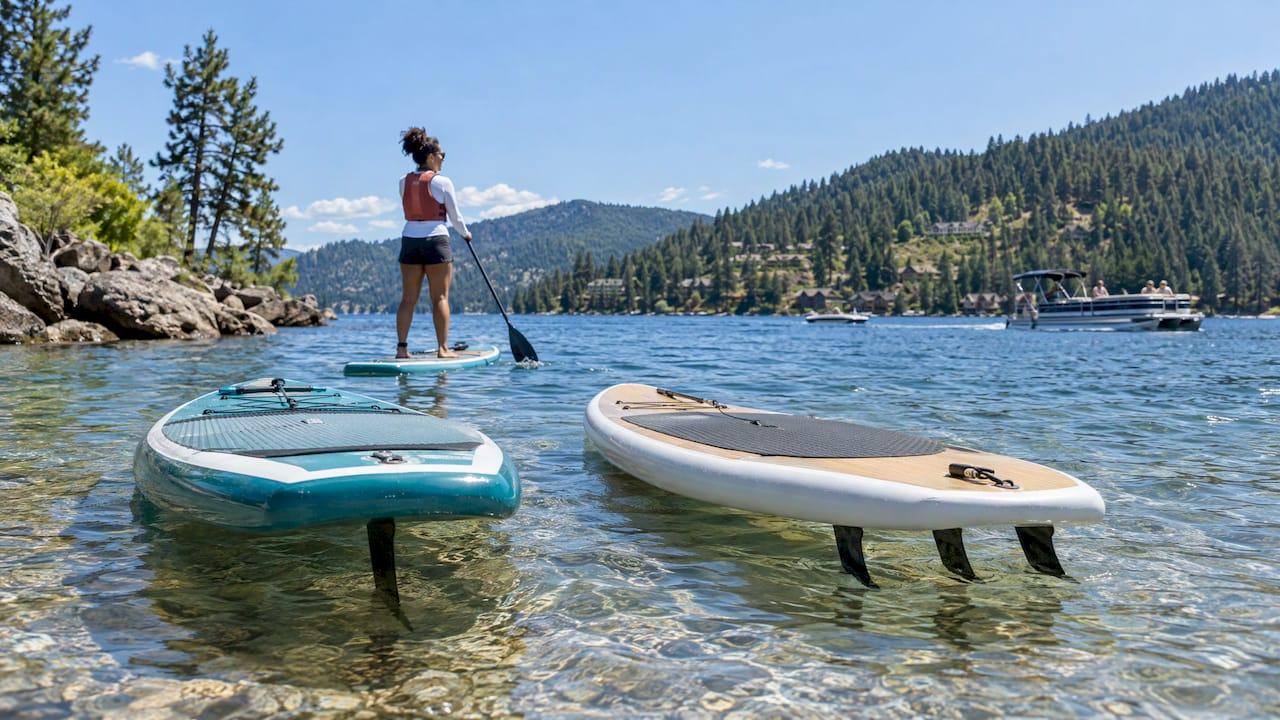
For most days on Lake Coeur d'Alene, Liberty Lake or Newman Lake, a single fin is the setup to look for. It glides farther per stroke and tracks straight on calm water. A thruster (three equal small fins) earns its place when wind and chop push your tail around, or when the water is too shallow for one long fin. If you are renting a board for a lake day, this is the whole decision in one paragraph. The rest of this guide shows how to read the water and pick with confidence.
TL;DR
- Calm morning on a big lake: pick a single fin for speed, glide and straight tracking.
- Breezy afternoon or boat wake: three fins hold the tail and stop it sliding sideways.
- Shallow, weedy or rocky shoreline: shorter fins or a thruster keep you off the bottom.
- More fins in the water means more drag and more effort per stroke.
- Tell the rental team where you plan to paddle so you start on the right board.
Table of Contents
- What the two setups actually are
- Flat lakes: why a single fin usually wins
- Wind, boat wake and chop: when three fins help
- Shallow water, weeds and rocks
- Quick chooser for lake paddlers
- Can you ride a thruster as a single fin?
- Renting means you can match the board to the day
- Our perspective
- FAQ
- Sources
What the two setups actually are
A single fin is one long fin in the center fin box near the tail. Its job is simple: keep the board going straight. Without a center fin, a board tends to spin around instead of tracking.
A thruster is three fins of similar size arranged in a triangle: one in the center and one on each side near the rails (the edges of the board). Surfers borrowed the idea from surfboards. The side fins add grip so the tail does not skid sideways. You will also see a 2+1 setup, which is one larger center fin with two smaller side fins. Many all-around boards use it because you can often remove the side fins and run it as a single.

The tradeoff is physical. Paddling Magazine explains that touring and race boards use one long fin because every extra fin in the water means more effort to paddle. Side fins, in turn, add traction that keeps the tail from spinning or sliding.
Flat lakes: why a single fin usually wins
Coeur d'Alene and the surrounding lakes have long been a favorite for flat-water boarding. A North Idaho newspaper piece on local paddleboarding noted that three fins on flat water give more stability with only very slight drag, while a single fin gives faster turning and speed, which is why it shows up on longer racing boards.
What that means for a visitor:
- Distance paddles. Heading from a beach toward a cove across open water? One fin means less resistance, so the same effort carries you farther.
- Straight lines. A single fin set toward the tail of its box tracks straighter. Slid forward, it turns more easily. Flat-water paddlers usually want it back.
- Easy pivots. With fewer fins gripping the water, you can swing the nose around with a simple sweep stroke.
If you are new, do not assume three fins are automatically safer. On glassy water a single fin is just as forgiving, and the board feels lighter and quicker under you. What actually keeps a first-timer upright is calm water. Our guide to beginner paddleboard wind limits explains when to launch and when to wait.
Wind, boat wake and chop: when three fins help
Lake Coeur d'Alene is big enough to build a real chop when the afternoon breeze comes up, and summer boat traffic adds wake on top. In those conditions a single fin can let the tail slide sideways under the pressure of each stroke, and the board feels loose.
This is where a thruster shines. The side fins bite into the water and hold the tail, so the board pushes forward instead of skating. You pay for it with a little speed, but on a bumpy afternoon most people happily trade speed for control.
A practical rule for visitors:
- Check the wind before you leave the beach. Early morning is usually the calmest window, which suits a single fin.
- If you will be out through the afternoon, or paddling near busy boat lanes, lean toward three fins.
- If you cannot decide, a 2+1 board lets you choose on the spot.
The same Paddling Magazine guide shares a tip from a paddler who splits it by water type: one fin on lakes, three smaller fins on rivers. For a trip that includes both a big lake and the Spokane River, removable fins are the flexible answer. Our Spokane-area paddleboard safety checklist covers the river side.
Shallow water, weeds and rocks
This is the part people miss. A long center fin sits well below the board. Launch from a gentle beach and you may be in knee-deep water before it clears the bottom. Shorelines around the Inland Northwest also bring logs, rocks and weed beds.

The Professional Stand Up Paddle Association's fundamentals guide warns that fins can run aground or scrape over logs and rocks, which can damage the fin or fin box and even cause injury. For shallow or murky water it suggests probing the depth with the paddle blade.
So for shallow coves and cobbly launches:
- Walk the board out until the water is deep enough, then step on and kneel or stand.
- Keep the board pointed straight out so the fin does not drag sideways along the bottom.
- Choose shorter fins. A thruster spreads the fin area across three shorter fins, so none of them reaches as deep as one long center fin.
- Watch your first and last few yards. That is where most fin strikes happen, right when you are stepping on or off.
Weedy bays are the other reason to think twice about a very long fin: a deep fin tracks well but snags plants more easily. Paddle a bit farther from shore where it is deeper and the weeds thin out.
Quick chooser for lake paddlers
| Your lake day | Best setup | Why |
|---|---|---|
| Calm morning, open-water cruise | Single fin | Fastest glide, straight tracking, least effort |
| Afternoon wind or boat wake | Thruster or 2+1 with side fins | Side fins hold the tail against sideways slip |
| Shallow beach, rocky or weedy launch | Thruster or a short fin | Shorter fins stay off the bottom |
| Mixed day, unsure of conditions | 2+1 | Run it as a single or add side fins as needed |
| Lake and river in one trip | Removable fins | Swap setups between water types |
Can you ride a thruster as a single fin?
Often yes. On boards with removable fins, you can take out the side fins and run only the center one on calm water, which cuts drag. Some paddlers go the other way and take out the center fin, leaving the two side fins to help tracking in flat conditions. Fin boxes come in different standards, though, so fins are not always interchangeable between boards. Look at the box before you plan a swap, and do not force a fin that does not slide in cleanly.
Renting means you can match the board to the day
As a visitor you do not need to buy a board to find out which setup you like. Our paddleboard rentals are offered for lakes near Spokane Valley, Liberty Lake and Coeur d'Alene, with flexible rental periods and safety equipment. Our paddleboard rental guide walks through what to know before you go, and the list of Spokane paddleboard launches helps you choose a put-in.
Ready to get on the water? See our paddleboard, boat and water toy rentals and book online or by phone.
Rental periods are hourly or multi-day, so you can take a morning paddle and keep the afternoon free for a boat or jet ski day. Our rental page for area lakes lists what is available.
Our perspective
We spend our summers on the lakes around Spokane Valley, Liberty Lake and Coeur d'Alene, and the question behind fin choice is really a question about the day you want. Most visitors want an easy, relaxed hour or two on calm water, and a clean-gliding paddleboard is the simplest way to get that.
The best thing about renting is flexibility. You are not locked into one setup for years. Try a paddle in the calm of the morning, then come back when the breeze picks up and see how the water feels different. Hourly and multi-day options mean the plan can change with the weather.
Pair your paddle with a safe plan: wear your life jacket, check the wind, and ask us about the lake you are heading to. We want every guest to have a safe, fun and hassle-free day, whether that is on a board, a pontoon or a Yamaha WaveRunner.
Life is better on water.
FAQ
Is it better to paddleboard with one fin or three?
On calm lakes, one fin is usually better because it is faster and takes less effort to paddle. Three fins add grip and are better when wind, chop or boat wake push the tail around. Many all-around boards use a 2+1 setup so you can choose.
What fin works best in shallow water?
A shorter fin or a thruster, since the fin area is split across three shorter fins. Walk the board out until the water is deep enough, and probe doubtful spots with your paddle blade. A long fin dragged over rocks or logs can be damaged.
Does a thruster make a SUP more stable?
It adds lateral grip, so the tail resists sliding sideways, which feels steadier in chop. It does not replace calm conditions for a beginner. Choose a still morning and keep to the wind limits in our beginner guide.
What fin setup should I use for lakes near Coeur d'Alene?
Start with a single fin for calm, open water, since local flat-water paddling suits it. Move to three fins or a 2+1 if the afternoon wind picks up or you plan to paddle near busy boat lanes. Removable fins let you adjust to the day.
Sources
- Below Board: Everything You Should Know About Paddleboard Fins, Paddling Magazine
- What's up with paddleboarding, Hagadone News Network
- Fundamentals guide, Professional Stand Up Paddle Association