
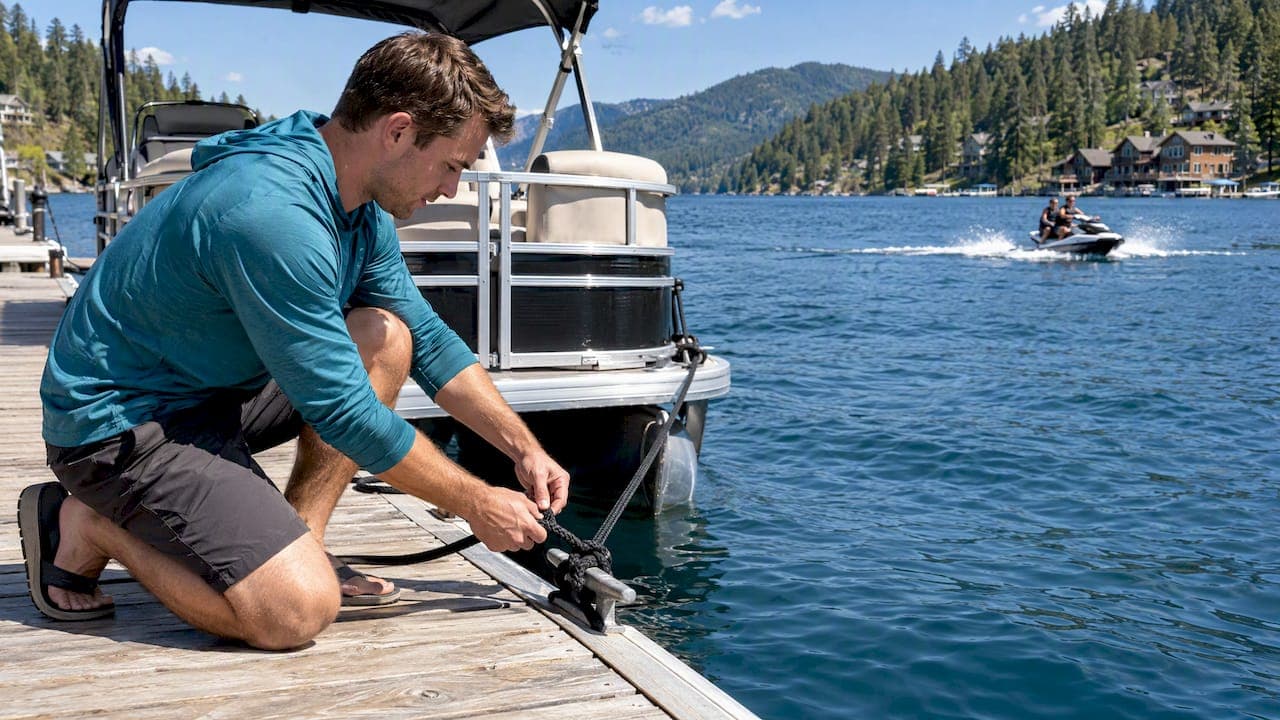
To tie up a boat, run a bow line and a stern line from your boat's cleats to cleats on the dock, add a spring line to stop the boat sliding forward and back, and secure each end with a cleat hitch. Set your fenders and attach your lines before you reach the dock. That one habit does more for a smooth landing than any knot.
We rent ski boats, pontoons and jet skis around Coeur d'Alene, Liberty Lake and Spokane Valley. Many of our guests have never docked a boat before. This guide covers what we show them.
TL;DR
- Use three basic lines: bow, stern and spring. Add breast lines only for short stops like loading.
- Tie each line to the dock with a cleat hitch: around the base, a figure eight over the horns, then a locking hitch.
- Nylon dock lines are the best choice because they stretch and absorb wakes. Avoid polypropylene.
- Rig lines and fenders before you approach, and come in with the wind pushing you away from the dock if you can.
- On Lake Coeur d'Alene, stay at idle speed near docks. The county's no-wake rule covers the area within 200 feet of shore, docks and piers.
Table of Contents
- Get ready before you reach the dock
- The lines you need to tie up a boat
- How to tie a cleat hitch
- Step by step: tying a boat to a dock
- Tying up on Lake Coeur d'Alene
- Our perspective: simple knots, calm approach
- Rent a boat and practice on calm water
- FAQ
- Sources
Get ready before you reach the dock
Most docking trouble starts before the boat touches anything. BOATERexam's docking guide stresses planning: check wind and current, hang fenders at the right height, and have lines already made fast to the boat's cleats.
Here is a quick pre-dock routine:
- Tell everyone aboard which side you are docking on.
- Hang two or three fenders on that side, at about the height of the dock edge.
- Attach a bow line and a stern line to your cleats, with the free ends coiled and ready.
- Give one passenger a clear job, such as stepping off with the bow line. Nobody should reach out to fend off with a hand or foot.
- Come in slowly. If the boat feels too fast, back off and go around again.
Wind matters more than most beginners expect. Mercury Marine's boating basics say tying up goes hand in hand with learning to approach the dock. Where you can, come in so the wind pushes you away from the dock rather than onto it. On a lake as big as Coeur d'Alene, afternoon wind can build fast. A live look at conditions helps, and marina webcams are one way to check before you head to the dock.
The lines you need to tie up a boat
You don't need a tangle of rope. The simplest setup that holds the boat is the best one, because extra lines are harder to release in a hurry.
| Line | Where it runs | What it does |
|---|---|---|
| Bow line | Bow cleat to a dock cleat ahead of or beside the bow | Keeps the front of the boat from swinging out |
| Stern line | Stern cleat to a dock cleat behind or beside the stern | Keeps the back of the boat in |
| Spring line | Runs at a shallow angle, from near the middle of the boat toward the bow or stern | Stops the boat moving forward and back |
| Breast line | Straight across, perpendicular to the dock | Holds the boat snug for short stops |
This breakdown follows Discover Boating's guide, which says spring lines matter for longer stays or changing conditions, and breast lines suit short loading stops.
Choosing dock lines
Nylon is the usual pick. Rope.com's dock line page notes that nylon stretches to absorb shock from waves, wakes and wind, and that double-braided nylon is the everyday standard. Polypropylene is slippery and breaks down in sunlight, so skip it for lines you will use again and again.
For size, Discover Boating gives a rule of thumb: about 1/8 inch of rope diameter for every 9 feet of boat length. Lines are typically 1.5 to 2 times the boat's length. A 24-foot ski boat therefore needs roughly 3/8 inch line.

How to tie a cleat hitch
The cleat hitch is the knot that most people mean by a boat cleat knot. It works by friction, so it holds firmly and still comes undone quickly.
- Take a turn of the line around the base of the cleat, under both horns.
- Bring the line over the top and around the far horn first. Animated Knots warns that starting at the wrong horn raises the risk of jamming.
- Cross the line diagonally over the middle of the cleat and around the other horn, making a figure eight.
- Repeat the figure eight once more.
- Finish with a locking hitch: a loop turned so the free end lies parallel to the line it crosses. On a short stop, a plain figure eight can be enough.
- Check that the pile of turns is neat, not a ball of rope.
More turns do not mean more security. BoatUS calls a clean, proper cleat hitch the key to quick, easy tying up. Practice at home on a chair leg or a cleat screwed to a board. You should be able to tie it without looking and untie it with a hard pull on the end.
Step by step: tying a boat to a dock
- Land gently. Come alongside at idle speed, with fenders down.
- Secure the first line. Discover Boating suggests starting with a spring line handed to someone on the dock. If you are alone, step off with a pre-tied loop and drop it over a dock cleat near the middle of the boat. It becomes a pivot point and stops the boat drifting while you do the rest.
- Tie the bow line from your bow cleat to a dock cleat forward of the boat.
- Tie the stern line from your stern cleat to a dock cleat behind the boat.
- Add spring lines if you are staying more than a few minutes or the wind is up.
- Adjust the slack. Leave enough that the boat can ride small wakes without snapping the lines, but not so much that it bangs the dock.
- Shut down and check fenders once everything is tight.
Never try to hold a boat to the dock by its railings. You can be hurt, and you cannot stop a heavy boat by hand.
Tying up on Lake Coeur d'Alene
Lake Coeur d'Alene has no tides, so you can tie off with short, snug lines. Wakes from other boats are the real force on your lines, especially at busy city docks on summer weekends.
A few local points:
- Speed near docks. The county rule sets a 5 mph no-wake zone within 200 feet of a shoreline, dock or pier. It also forbids interfering with others approaching or leaving docks. Read the text of Kootenai County's vessel rules.
- Where to stop. Our guide to Coeur d'Alene public docks lists where you can tie up, and our anchor spots guide covers bays where you can anchor instead.
- Going farther. If you are planning a longer run, see CDA to Harrison by boat for dock stops and wind.
- Rules and fines. Before you launch, read the Coeur d'Alene boating rules.
Share the dock. Leave the end clear for others, and don't leave your boat tied to a busy public dock longer than you need to.
Our perspective: simple knots, calm approach
We hand over boats and jet skis to people every week, and the same pattern shows up. Guests who struggle at the dock rarely have a knot problem. They arrive too fast, with lines in the bottom of the boat and fenders still stowed.

So we tell first-timers three things. Slow down more than feels natural. Get the lines and fenders ready while you are still on open water. And ask a passenger to take on one clear job, not shout instructions from five directions. A boat that touches the dock gently is easy to tie up, whatever knot you use.
Our rentals come with safety equipment and a walkthrough, so you will not be guessing at the basics on your first outing.
— Life is better on water.
Rent a boat and practice on calm water
If you would rather learn on a boat that is clean and ready to go, we rent Yamaha WaveRunners, ski boats, pontoons, paddleboards and water toys around Coeur d'Alene, Liberty Lake and Newman Lake. Jet ski rentals are listed at 250-425 USD, with additional hours at 75 USD per hour. A damage deposit applies: 500 USD per jet ski and 1,000 USD per boat. See our Liberty Lake jet ski rentals, the full rental list, or book through our home page.
FAQ
What do you tie a boat with?
Use dock lines made for the job, ideally double-braided nylon, because it stretches to absorb wakes and wind. Size them by boat length, about 1/8 inch of diameter per 9 feet of boat. Avoid polypropylene, which is slippery and degrades in sunlight.
What is the best knot for tying a boat to a dock?
The cleat hitch is the standard for a dock cleat. It is quick to tie, holds by friction and releases easily. Finish with a locking hitch if you will leave the boat for a while.
How many lines do I need to tie up a boat?
For most stops, a bow line and a stern line are enough. Add a spring line for longer stays or when wind and wakes push the boat around. Use as few lines as will hold the boat, so you can cast off fast in an emergency.
How tight should dock lines be?
Leave a little slack so the boat can move with small waves without jerking the lines. Too tight transfers shock to the cleats, and too loose lets the boat hit the dock. Adjust spring lines so the boat sits still alongside.
Sources
- Discover Boating: How to Tie a Boat to a Dock
- BOATERexam: Boat Docking Tips After a Day on the Water
- Mercury Marine: Boating Basics, Tying Up Your Boat
- Rope.com: Dock Lines
- Animated Knots: Cleat Hitch (Dock Line)
- Kootenai County vessel rules (Idaho Parks and Recreation)