
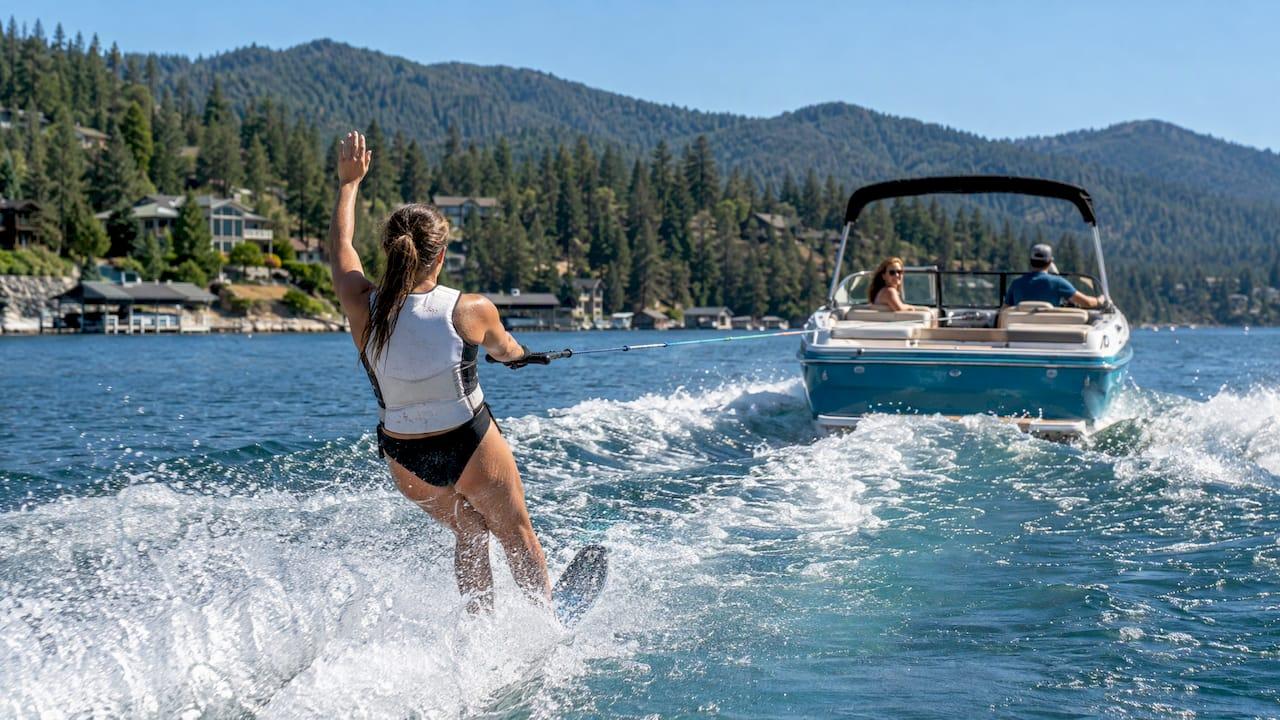
Once the rope goes tight, the engine is too loud for anyone to hear you, so the rider talks with their hands. The core set is short: thumbs up for faster, thumbs down for slower, a circling finger for a turn, a pat on the head to return to the dock, a slash across the neck to cut the engine, and both hands clasped overhead for "I'm OK" after a fall. Agree on them at the dock, before anyone gets in the water. If you're renting a boat or tubes for a day on Coeur d'Alene or Liberty Lake, our boat and water toy rentals come with safety equipment, and this guide covers the rest of the plan.
TL;DR
- Thumbs up means faster, thumbs down means slower, and a flat hand palm down means hold your speed.
- Clasped hands overhead after every fall tells the boat you are fine. No signal means the boat comes back fast.
- A slash across the neck means stop the engine. A pat on the head means take me back to the dock.
- Review every signal with the driver and observer before the first pull, because meanings vary slightly by region.
- Tubing, skiing and wakeboarding all use the same basic set.
Table of Contents
- Why you agree on signals before the ride
- The signals that matter most
- Tubing hand signals
- Waterski and wakeboard signals
- After a fall: the signal that matters most
- Rules on Idaho and Spokane-area lakes
- Do signals differ from lake to lake?
- Renting for a tow sports day
- Our perspective
- FAQ
- Sources
Why you agree on signals before the ride
The driver faces forward, the rider is behind the boat, and wind, water and engine noise cover any shouting. Scouting America's water sports pamphlet notes that boat noise makes instructions hard to hear once the skier is underway, so the skier gives directions by hand and the observer acts as the eyes and ears for both driver and skier.
The Water Sports Industry Association handbook says the driver, observer and rider should settle their signals in advance, including ready, stop, speed up and slow down. It also warns that spoken words like "go" and "no" are easy to confuse over wind and engine noise. That is the whole reason hand signals exist: they cannot be misheard.
The observer is a second person in the boat whose only job is watching the rider. They relay signals to the driver and keep eyes on the rider the whole time, so the driver can keep eyes on the water ahead.
The signals that matter most
Standard waterskiing signals were originally developed by the American Water Ski Association and have been written into law in many states, according to Scouting America. Tubers and wakeboarders borrow the same vocabulary. Here is the set a first-timer should learn, drawing on the Sacramento State Aquatic Center guide and Discover Boating's safety tips.
| Signal | What it means | Who gives it |
|---|---|---|
| Thumb up | Speed up | Rider |
| Thumb down | Slow down | Rider |
| OK sign (thumb and finger circle) | Speed and path are good | Rider |
| Circling motion overhead, then pointing | Turn, in the direction pointed | Rider |
| Pat on top of head | Return to the dock | Rider |
| Slash across the neck | Cut the engine | Rider, driver or observer |
| Both hands clasped overhead | I'm OK after a fall | Rider |
Two more come from Connecticut Boating Certificates: a flat hand held palm down means maintain the current speed, and a waving arm overhead means the skier has fallen or needs help.
What does a thumb down mean?
A single hand held out with the thumb down means slow down. It does not mean the rider is hurt or wants to quit. If a tuber wants to end the ride, the head pat or the neck slash is the clearer message.
Tubing hand signals
Tubing has no separate code. The rider holds the handles with both hands, so signals are given one hand at a time, and a tuber should let go with only one hand to signal. Keep the other hand locked on the handle. The thumbs up and down for speed are the most used, because tubers mostly care about going faster or slower. Add the head pat for "take me in" and the neck slash for an emergency stop.
A good habit with kids on a tube is to practice each signal on the dock first, with the driver answering each one. Children often give a thumbs up when they mean "stop" out of excitement. Teach them that one open hand waving overhead is the "I need help" signal, and that the boat will stop when it sees it.

Waterski and wakeboard signals
Skiers and wakeboarders add a few steps around the start. The WSIA handbook warns that accelerating before the rope is fully tight, and before the rider gives the "hit it" signal, can entangle people in the rope and cause severe injury or death. So the start routine is simple:
- The rider floats with the rope slack removed and the handle in both hands.
- The rider says or signals "ready" and the driver confirms.
- The driver takes up the slack gradually and only accelerates after the rider's "hit it."
Discover Boating notes that skiers typically prefer 25 to 36 mph, and that board riders should be pulled more gradually from a deepwater start, while skiing typically needs a more aggressive pull. That is why the thumbs up and down matter so much in the first minute: every rider settles on their own speed. If you are new to boards, our beginner's guide to wakeboarding behind a ski boat explains the first pulls, and the guide to how a tow rope works covers the rope itself.
After a fall: the signal that matters most
Every fall ends with the same move. The rider clasps both hands high overhead so the observer can see it. Scouting America also suggests holding one ski upright above the head to make the rider easier for nearby boats to spot. The WSIA handbook adds that riders should let go of the handle as soon as they feel a fall coming, since falling is better than being dragged.
Here is what the boat does in response, per Scouting America:
- Rider signals OK: the driver idles back, leaving time for the rider to get skis back on.
- No signal: the observer tells the driver at once, and the driver returns to the rider as quickly as safety allows.
Discover Boating recommends approaching so the downed rider stays on the driver's side, keeping them in view the whole way, and shutting off the engine before anyone gets in or out of the water. That last one matters for kids climbing up a ladder.
Rules on Idaho and Spokane-area lakes
Signals are part of a bigger safety routine. Idaho's boating handbook says everyone being towed must wear a US Coast Guard-approved life jacket, and towing a skier is illegal between one hour after sunset and one hour before sunrise. It also requires a competent observer in addition to the driver, plus a red or orange skier-down flag displayed whenever a rider is in the water. The details are in the Idaho boating handbook.
In Kootenai County, the county's safe boating brochure sets a 5 mph no-wake zone within 200 feet of shoreline, docks, piers, breakwaters or anyone in the water on most public waterways. Exceptions include the Coeur d'Alene and Spokane Rivers, Fernan Lake and Lower Twin Lakes. It also prohibits towing on the Coeur d'Alene River. Check the brochure for the lake you plan to use, and see our note on lake depth for water skiing when choosing where to ride.

Do signals differ from lake to lake?
Mostly no, but there are small regional variations. Scouting America notes that some people signal turns with the straight and bent arm signals used in bicycling. Its advice is to agree on signals for skier in water, OK, stop, faster, slower, right turn, left turn, cut motor and back to dock before the rider enters the water. Run through that list on the dock with your whole group, and ask the observer to repeat each signal back.
Renting for a tow sports day
If you are visiting and want to tow friends or family, we rent boats, paddleboards and water toys, with wakeboards and tubes at $50 each. Our rentals include safety equipment, with hourly and multi-day options and pickup or limited delivery for lakes near Spokane Valley, Liberty Lake and Coeur d'Alene. Boat rentals carry a $1,000 damage deposit. See the rental options and prices or book on our homepage.
If you would rather ride a jet ski, our Liberty Lake jet ski rentals range from $250 to $425, with additional hours at $75 each. Our jet ski damage deposit is $500 per jet ski.
Our perspective
A signal is only useful if everyone in the boat knows it. On rental days we see the same pattern in what makes a lake day go well: a short briefing on the dock, a driver who watches the rope, and an observer who never looks away.
That is why we care about a hassle-free day on the water. Our mission is a safe, fun experience for every guest, and our rentals come with safety equipment so your group can focus on the ride. Take five minutes before the first pull, walk through thumbs up, thumbs down, the head pat and the clasped-hands OK, and let the kids practice them.
Our Yamaha watercraft and our boats are there so your group can spend the day on the water with confidence.
Life is better on water.
FAQ
What is the signal for stop in tow sports?
A slash across the neck with a flat hand means cut the engine. The rider, driver or observer can give it. Use it when someone is hurt, the rope is tangled or another boat is too close.
What does it mean if the rider pats their head?
A pat on top of the head asks the driver to return to the dock. It is the clean way to end a ride, for tubers as well as skiers.
What should I do if a skier falls and does not signal?
The observer tells the driver immediately, and the driver returns to the rider as quickly as safety allows. A fallen rider who is fine should clasp both hands overhead every time, so that silence always means a problem.
Are tubing and waterski hand signals the same?
Yes, the basic set is shared. Tubers signal with one hand while holding on with the other. Agree on the list before the ride, since some regions vary slightly, for example in how turns are shown.
Sources
- Towed Water Sports Boating, WSIA handbook
- Water Sports, Scouting America pamphlet
- Learn to Slalom, Sacramento State Aquatic Center
- Watersports Safety Tips, Discover Boating
- Waterskiing Hand Signals, Connecticut Boating Certificates
- Idaho boating handbook
- Kootenai County Safe Boating Brochure