
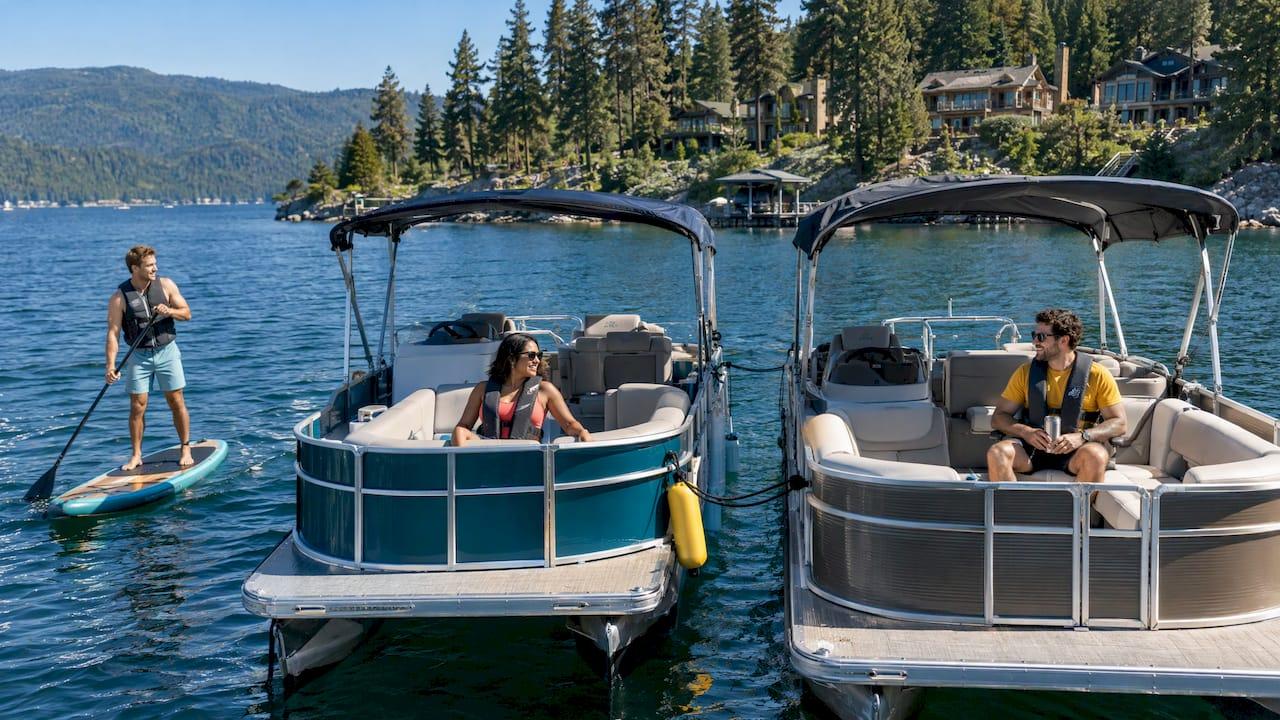
To tie boats together, anchor the largest boat first, hang fenders on both boats, and bring the second boat alongside slowly. Then secure it to cleats only, with bow, stern and crossing lines pulled tight. That arrangement is called a raft-up. It is the usual way to turn a few boats into one floating party on a calm afternoon. Below you will find the steps, the gear, the etiquette, how to leave, and the local rules around Coeur d'Alene.
TL;DR
- Anchor the biggest, heaviest boat first and build the raft along its sides, with boats of similar size next to each other.
- Tie to cleats only, never handrails, and keep every line tight. Loose lines are the most common mistake.
- Hang at least one fender per 10 feet of boat length, and more if you can.
- Rafting vessels together is prohibited at Kootenai County docks and ramps, so raft up on open water only.
- Release spring lines first when leaving, then bow and stern lines, and motor away slowly.
Table of Contents
- What a raft-up is and when it makes sense
- Gear to have before you pull alongside
- How to raft up boats, step by step
- Raft-up etiquette
- Rules around Coeur d'Alene and Spokane lakes
- How to leave a raft-up
- Our perspective
- Plan your next lake day with us
- FAQ
- Sources
What a raft-up is and when it makes sense
A raft-up ties two or more anchored boats side by side so people can step between them, share food and swim together. On a lake like Coeur d'Alene, it suits a calm cove on a light-wind day. Check the forecast first: we explain why 15 to 20 knot winds mean staying ashore. A raft that works in still air can turn into a hazard once wind and wakes build.
The person who organizes the raft is often called the raft captain. Pentagon Sailing Club describes that role as a series of judgment calls about depth, current, swinging room, wind, bottom type, boat sizes, and whether fenders and lines are adequate. On a family lake day, that person is whoever owns the anchor boat.
Gear to have before you pull alongside
Every boat joining the raft should carry its own gear. By custom, the arriving boat uses its own lines and fenders, which makes it easier to sort things out when the raft breaks up.
- Lines: Pentagon Sailing Club recommends each boat have a bow line, a stern line, a forward spring line and an after spring line. The anchor boat also needs a long passing line if it sets the anchor.
- Fenders: Plan on at least one fender for every 10 feet of length. Boat Trader says two fenders is the minimum up to about 20 feet, with a third added for roughly every five more feet.
- Knots: The cleat hitch is the most used knot in boating, including for rafting up. The same source says clove and rolling hitches suit fenders because they hold under load and release easily. If you need a refresher, start with our guide to the cleat hitch and dock line basics.
Fenders also protect the finish from scuffs. For owners who also boat on salt water, this guide to saltwater protection for boats covers the rest of the care routine.
How to raft up boats, step by step
- Pick the anchor boat. The largest, heaviest boat should drop its anchor first and act as the building block for the others.
- Set the anchor firmly. Grady-White advises a scope of at least 7:1: seven feet of rode for every foot of water depth. Consider a stern anchor too, since it adds stability to the raft. If your boat is a pontoon, see how to anchor a pontoon correctly on a lake.
- Hang fenders in advance. Put them in position before you approach, and keep the lines coiled and ready to hand to someone on the other boat.
- Approach slowly. Unless wind, current or the raft captain say otherwise, approach from the stern of the boats already anchored. If you are unsure which side to take, call the raft captain on VHF and ask.
- Tie to cleats. Hold the boats in place, then tie bow to bow and stern to stern. Add crossing lines in an X, from the bow of one boat to the stern or spring cleat of the other, as Boat Trader describes.
- Tighten everything. Pull the boats close, then go back and take up slack once the lines have settled.
- Add boats evenly. Pentagon Sailing Club's guidance is to alternate sides so the load stays balanced on the anchor.
Why cleats and tight lines matter
Handrails and other accessories can break or rip out of the fiberglass, which is why cleats are the only safe tie-off point. Kingman Yacht Center adds a second reason: lines made fast only to cleats mean the raft can break up quickly if it has to.

Tight lines keep the boats from slamming as they roll. Lines that are too loose are what Discover Boating calls the biggest rafting mistake.
Matching sizes and lining boats up
Boats of similar size sit at similar gunwale heights, which makes stepping across easier and keeps fenders from squeezing out. Face every boat the same direction, with transoms close, so guests can walk from swim platform to swim platform. Grady-White says the largest boats typically go in the middle with smaller boats on either side.
Raft-up etiquette
- Ask permission before crossing someone else's boat, and take your time doing it.
- Wear boat shoes or other non-marking, non-slip footwear.
- Bring plenty of your own lines and fenders.
- Keep music and noise at a level neighboring boats will not mind.
- Expect the party to gather on the larger boats in the center of the raft.
These all come from Grady-White's raft-up etiquette tips. Most of it is plain courtesy, and it keeps a crowded cove friendly.
Rules around Coeur d'Alene and Spokane lakes
Kootenai County's safe boating brochure (July 2021) states that rafting vessels together is prohibited at County docks and ramps. Raft up in open water, away from launch areas. Our boat ramp etiquette guide covers the ramp side.
The same brochure sets speed limits that matter when you approach a raft:
| Waterway | Slow zone | Daytime maximum |
|---|---|---|
| Most public waters in the county | 5 MPH within 200 feet of shore, dock, pier, breakwater or a person in the water | 50 MPH |
| Coeur d'Alene and Spokane Rivers, Lower Twin Lake, Fernan Lake | 5 MPH within 100 feet | 35 MPH or less |
It also lists one approved flotation device per person, plus at least one Type IV throwable device on vessels over 16 feet. Crashes must be reported to the Sheriff's Department immediately when property damage exceeds $1,500 or anyone is hurt or missing. On the Washington side, Washington State Parks advises checking with the local sheriff's office or police department for local rules before you go.
If you are on a rental boat, ask us about rafting up before you go. We are happy to talk through your plans.
How to leave a raft-up
Boats on the outside leave first when they can. Release the spring lines first, then the bow and stern lines. Drift gently back, then motor away slowly.

Before starting the engine, do one last visual check. As you retrieve your anchor, watch for swimmers and other boaters. If you are buried in the middle with boats ahead and astern, you cannot drive out. Warping out with angled lines lets you move in a controlled way where engine power would not.
Our perspective
We see a lot of groups plan a lake day around one idea: everyone together, kids and friends hopping between boats. That is a great picture, and it works when the basics are handled before anyone touches a line.
For us, a good day starts with clean, well-maintained watercraft, the right safety equipment and a plan that fits the lake. Pick the boat that suits your group, check the wind, and decide who anchors and who joins before you leave the dock.
Our Yamaha WaveRunners, ski boats and pontoons are set up so first-timers and families can enjoy the water without hassle. If you plan to share the water with other boats, talk to us first and we will help you do it safely.
Life is better on water.
Plan your next lake day with us
If you want to be on the water with friends, we rent jet skis, ski boats, pontoon boats, paddleboards and water toys around Spokane Valley, Liberty Lake and Coeur d'Alene. Jet ski rentals are listed at $250 to $425, extra hours are $75 per hour, and wakeboards and tubes are $50 each. Damage deposits are $500 per jet ski and $1,000 per boat.
See all our rentals and current prices, or start with the Liberty Lake jet ski rentals. You can also browse boats, paddleboards and water toys. Before you tie up at a sandy cove, read how to beach a boat safely.
FAQ
What do you tie boats to when rafting them together?
Tie to cleats only. Handrails and other accessories may break or rip free of the fiberglass. Use bow and stern lines, plus crossing lines in an X, and keep them tight.
How many fenders do you need to raft up?
Plan on at least one fender for every 10 feet of boat length, and more never hurts. Boat Trader's guide puts the minimum at two fenders up to about 20 feet.
Which boat should anchor the raft?
The largest, heaviest boat. It sets the anchor first, with plenty of scope, and the other boats build along its sides. Boats of similar size should sit next to each other.
Can you raft up at a dock or boat ramp in Kootenai County?
No. According to Kootenai County's safe boating brochure, rafting vessels together is prohibited at County docks and ramps. Raft up on open water instead.
Sources
- Rafting Up 101: Safe Tips for Tying Up | Discover Boating
- How to Properly Raft Up: Tying Boats Together Safely | Boat Trader
- Raft Up Guidelines | Pentagon Sailing Club
- Raft-up 101 | Grady-White
- Tips on Rafting with Other Boats | Kingman Yacht Center
- Essential Knots and How To Tie Them | Practical Sailor
- How to Raft up Boats Correctly | Hauraki Fenders
- Leaving A Raft Of Boats | Fernhurst Books
- Safe Boating Brochure | Kootenai County
- Recreational Boating Laws and Regulations | Washington State Parks
- Saltwater Protection for Your Boat