
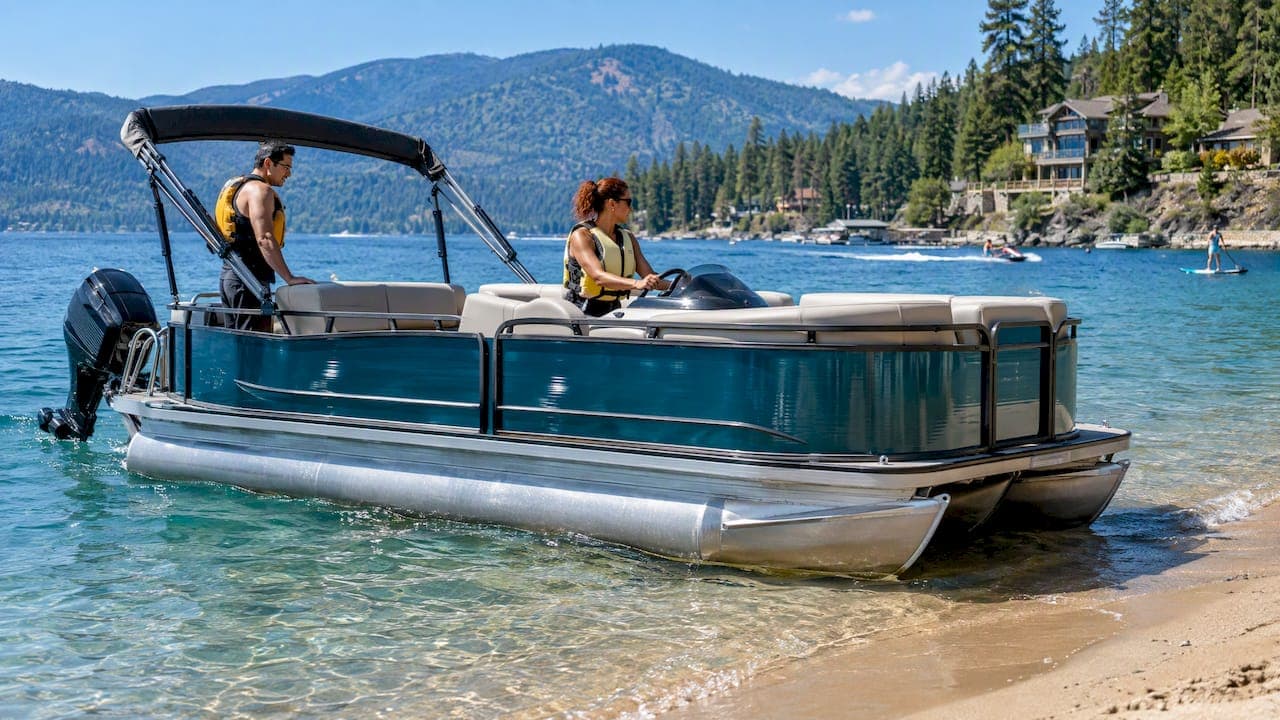
To beach a boat, pick a soft, gently sloping shore, approach slowly, shut down or trim up the engine in waist-deep water, guide the bow in by hand and secure the boat with an anchor in the water and a line or anchor ashore. Done right, it is the easiest way to get a group onto a sandy cove. Done carelessly, it chews up a hull, a prop or a deposit. Here is how to do it on lakes like Coeur d'Alene, Liberty Lake and Newman Lake.
TL;DR
- Choose sand, mud or flat stones with a gentle slope. Avoid gravel, jagged rock and steep banks.
- Wade the shallows first, then approach slowly, tilt the engine up and have a crew member guide the bow.
- Set an anchor off the stern or side in the water, then a second anchor or line ashore, so the boat floats instead of grinding on the beach.
- Use roughly five to seven times the water depth in line, more when it's windy.
- Check local rules and swimming areas first, and read your rental agreement before you beach a rental.
Table of Contents
- Pick the right shoreline
- Beaching step by step
- Shore anchoring: keep the boat floating
- Pontoon, ski boat or jet ski?
- Rules and places to check first
- Our perspective
- Planning a beach day with us
- FAQ
- Sources
Pick the right shoreline
The spot matters more than the technique. Discover Boating advises examining the shoreline for obstacles and knowing the bottom before you approach, because rocks, gravel and branches can damage the hull or propeller. For pontoons, one guide recommends flat land, a low, gentle incline and a smooth bottom, and says to steer clear of steep banks, jagged rocks, large stones and uneven ground.
Pontoon tubes are fairly tough, but unseen rocks, trees or debris can still dent or puncture them. A marina's pontoon guide also warns that beaching can't remove the risk of hull damage, and suggests wading in first to look for large rocks.
On the lakes around Coeur d'Alene, that means:
- Sandy coves and shallow beaches are your friend. Rocky points and old pilings are not.
- Look at the water color and watch for weeds, swimmers and wildlife, which Sea-Doo's U.S. guidance lists among the things to inspect.
- Lake levels and bottoms change through the season, so a beach that worked in July may look different in September.
Beaching step by step
- Scout. Idle along the shore and look at the bottom. If you can't see it, send a strong swimmer or wade in.
- Brief the crew. Decide who guides the bow, who handles the anchor and who stays aboard.
- Approach slowly. No hard throttle. Watch waves, current and your draft.
- Shut down in about waist-deep water. Sea-Doo's guidance gives roughly 3 feet as a practical point to shut down, which also keeps an impeller from stirring up debris. On an outboard boat, trimming the engine up reduces draft and helps keep it from sucking up mud or sand.
- Guide the bow in. A crew member holds the bow in waist-deep water and walks the boat toward the beach.
- Anchor and unload. Set the anchor in the sand, unload passengers and gear first, then ease the boat a little farther if you need to.
Powerboat owners often use a variation: anchor 30 to 40 feet out, then back toward shore is a common forum-style approach, but the cleaner version is to drop the anchor first and let line out as you approach, so you can pull yourself off later. Keep a hand on the bow line, not your foot under the hull.
Shore anchoring: keep the boat floating
A beached boat that rubs the sand all afternoon takes wear and can swing into other people. The fix is two points of hold. Discover Boating describes running the bow anchor and line aft to a crew member, setting a stern anchor on the opposite side, and tying both lines so the boat floats rather than rubs on the beach.
Two cautions:
- Lower the anchor, don't throw it, and set it by backing down gently. Broward County's official boating guide also says never to anchor from the stern while underway in current or waves, because it can swamp the boat or foul the propeller. Do your stern anchoring only after the boat is stopped and the engine is off.
- Route lines clear of the props, and keep kids and swimmers away from taut lines.
How much line do you need?
Anchoring.com's rule of thumb is five to seven times the water depth plus the height from the water to your bow cleat. In 8 feet of water with the cleat 2 feet above the surface, that is 50 to 70 feet of line. A Pacific Northwest boating guide recommends 5:1 in calm conditions and 7:1 or more in wind. Afternoon wind on Lake Coeur d'Alene can build fast, so plan for the longer end.

For a natural shore anchor, a boulder or tree works, as do a spike, sand screw or a second anchor. Protect the tree with a wide strap, and never wrap a line around something that could pull loose.
Pontoon, ski boat or jet ski?
| Craft | Beaching notes |
|---|---|
| Pontoon | Gentle approach, tilt the engine, guide the bow in by hand. Tubes are resilient but not puncture-proof. |
| Ski boat | Keep the drive and prop clear of the bottom. Anchor off and wade or walk a line ashore. |
| Jet ski | Shallow draft makes it easy, but the intake pulls up sand and weeds. Shut down in about 3 feet and walk it in. |
| Paddleboard | Simplest: step off in shallow water and carry it up. |
Rules and places to check first
Beaching is not allowed everywhere. Shorelines can be private, tribal or part of a posted swimming area. The Coeur d'Alene Tribe states that it exercises sovereignty over submerged lands and waters within the Reservation and regulates their use, which matters on the southern end of the lake. Over in Washington, state park rules generally prohibit large floating objects in designated swimming areas, so stay clear of swim buoys.
For the Idaho basics, our guides cover boating rules, stickers and PFD requirements, public docks and which launch to pick. Alcohol rules matter on the beach too: see our note on alcohol rules and your deposit.
Our perspective
We rent Yamaha WaveRunners, ski boats, pontoons, paddleboards and water toys around Spokane Valley, Liberty Lake and Coeur d'Alene, and the beach stop is where most guests want to spend the day. Our advice is simple: slow down, look before you land, and treat the bottom as the hazard. Most damage comes from rushing the last 20 feet. First-timers should read our lake rental tips and ask us about good coves for the lake they've chosen. Cold water also changes how long anyone should wade, so check the current water temperature.
— Life is better on water.
Planning a beach day with us
If you want the sandbar without owning the boat, we offer boat, pontoon, paddleboard and water toy rentals, plus Yamaha jet skis. Jet ski rentals are listed at $250-$425 with additional hours at $75 per hour, wakeboards and tubes are $50 each, and damage deposits are $500 per jet ski and $1,000 per boat. See Liberty Lake jet ski rentals, Newman Lake or our full price list.
Before you plan to beach a rental, read your agreement and ask us about shoreline spots we'd suggest, since the deposit covers damage.
FAQ
How do you anchor a boat at the beach?
Set an anchor in the water off the bow, run its line to shore, then set a second anchor or tie to a secure natural point on the opposite side. Both lines should hold the boat floating just off the sand. Use five to seven times the depth in line.
Can you beach a pontoon boat?
Yes, on a soft, gently sloping shore of sand, mud or flat stones. Go slowly, trim the engine up and guide the bow by hand. Avoid gravel and sharp objects, which can damage the tubes.
Can you beach a fiberglass boat?
It is riskier, because a gritty or rocky bottom can scratch or gouge the hull. Anchoring just off the beach and wading in is the safer choice for most fiberglass hulls.
How deep should the water be when I shut off the engine?
About waist-deep, or around 3 feet, is a practical guide. That keeps the drive off the bottom and reduces the chance of sucking up debris.
Sources
- Beaching a Boat: 10 Tips for Success, Discover Boating
- How to Anchor a Pontoon Boat, Sea-Doo
- Pontoon Boat Beaching Guide, Trexler's Marina
- Beaching a pontoon boat, Better Boat
- How to Beach a Pontoon Boat Smoothly
- How To Beach A Pontoon Boat, Life of Sailing
- Broward County Safe Boating Guide
- Shore Anchoring or Beaching Your Boat, Anchoring.com
- Mastering Anchoring Techniques for PNW Boaters
- Clothesline Mooring, Boating Safety
- Coeur d'Alene Tribe Code, Chapter 44 Encroachments
- Washington State Parks Rules