
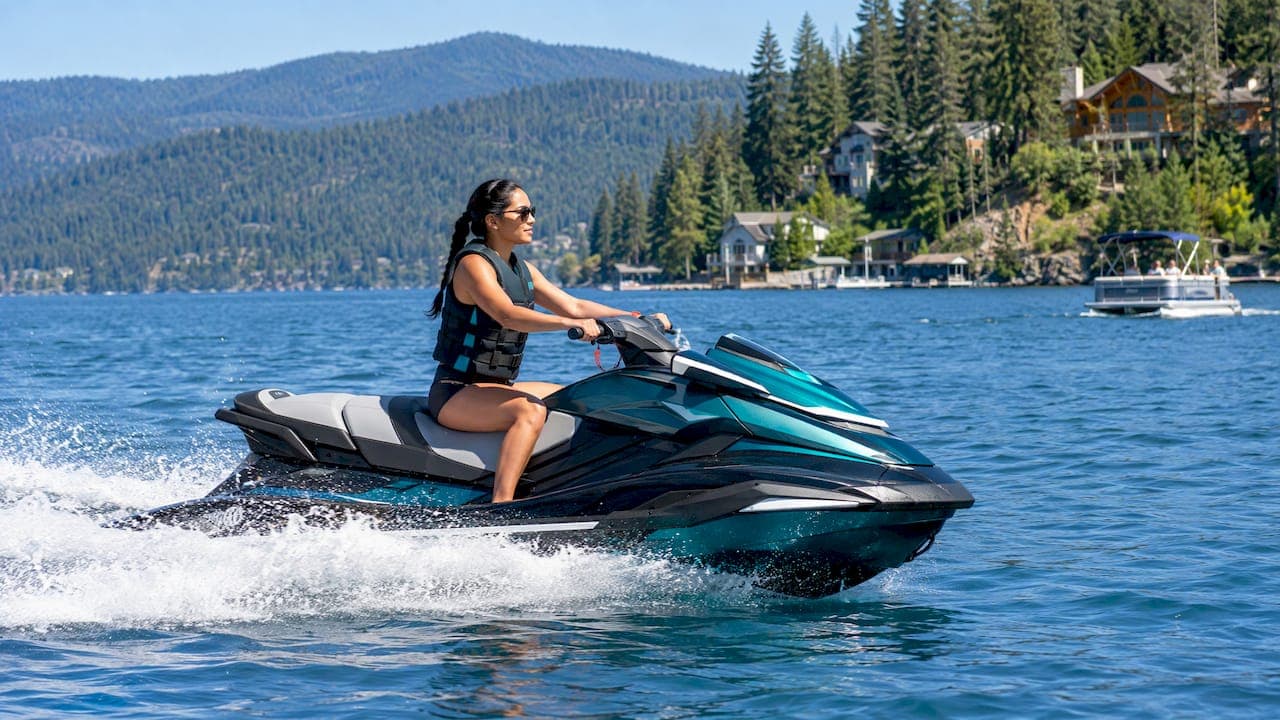
Yamaha's RiDE system gives a WaveRunner two levers on the handlebar instead of one. The right lever drives you forward. The left lever slows you down and puts you in reverse. You can steer the whole time. For a first-time rider on Lake Coeur d'Alene, Liberty Lake or Newman Lake, that makes docking, slow turns and backing away from a swim area much easier to learn.
TL;DR
- RiDE is a dual-lever handlebar control: right lever for forward thrust, left lever for slowing and reverse, according to Yamaha.
- You can keep steering while you slow down, which helps in tight spots like marinas and docks.
- It is not a brake. Yamaha says riders must act early to avoid collisions.
- On Kootenai County waters, no-wake and speed rules still apply however easy the controls feel.
- Our Yamaha WaveRunner rentals start at $250 and top out at $425 (see the rental details below).
Table of Contents
- What the RiDE system is
- How the two levers work
- Why it helps first-time riders
- RiDE is not a brake
- Local rules that matter more than the controls
- Riding with friends and family: pairing it with other lake fun
- Rent a Yamaha WaveRunner near Spokane and Coeur d'Alene
- A simple first-ride routine
- FAQ
- Sources
What the RiDE system is
RiDE is Yamaha's handlebar control system for running, turning, decelerating and reversing a personal watercraft. Yamaha describes it as an intuitive setup meant to give stress-free control and a more stable ride when you slow down (Yamaha Motor).
Before systems like this, reversing on a jet ski often meant a separate manual lever and a good deal of guesswork. With RiDE, both hands stay on the bars and each lever has one clear job.
How the two levers work
Think of it as a gas lever and a slow-and-reverse lever.
| Control | What it does |
|---|---|
| Right lever | Acceleration and forward movement |
| Left lever | Deceleration and reverse thrust |
| Steering | Stays active while you slow down |
The two levers work independently. Yamaha notes that the onboard ECU sets the timing of the reverse gate based on engine RPM and how you are squeezing the lever (Yamaha Motor). In practice, you don't have to time anything yourself. Squeeze the left lever gently to slow, and keep squeezing to move into reverse.
What happens at the back of the craft
When you pull the left lever, a reverse gate drops over the jet nozzle. Yamaha says this gate sends thrust out of both sides of the bucket rather than pushing it downward. The company states this helps the rider keep a steady posture and reduces nose-diving while slowing (Yamaha Motor). A side-discharge design also works like a virtual rudder, which is why the craft keeps tracking and responding to steering input as you slow (Marine Education).

Why it helps first-time riders
Most new riders are comfortable at cruising speed. The tricky moments come when they are going slowly: leaving a dock, pulling up to a beach, or avoiding a buoy. RiDE helps in three ways:
- Slowing down feels natural. Letting go of the right lever and squeezing the left one is easier to remember than hunting for a separate reverse control.
- You can steer while slowing. That matters when a boat crosses your path or you are lining up with a dock.
- Reverse is a single squeeze away. Backing out of a crowded swim cove no longer needs a special routine.
If you are new to jet skis, our guide on what a WaveRunner is and how it rides covers the basics before you get on the water.
RiDE is not a brake
This is the most important thing to understand. Yamaha states that RiDE is not a braking device for avoiding dangerous situations, and riders should act early to avoid collisions (Yamaha Motor). The craft does not stop on a dime. It slows and moves into reverse by redirecting thrust, and a WaveRunner coasting at speed still needs room.
Safe habits that follow from that:
- Start slowing well before a dock, another boat or a swimmer.
- Keep a wide gap between you and other riders so you never rely on a last-second stop.
- Practice the left lever in open water first, at low speed, until squeezing it is automatic.
- Yamaha also advises avoiding aggressive maneuvers and jumping waves or wakes, which raise the risk of losing control, being thrown off or colliding (Yamaha Motor).
For a first ride, treat the left lever as a tool for gentle slowing and docking, not for emergency stopping.
Local rules that matter more than the controls
The handlebar tech will not change the law. In Kootenai County, the sheriff's marine safety brochure sets a 5 mph no-wake zone within 100 feet of shorelines, docks, piers, breakwaters or people in the water on the Coeur d'Alene River, Spokane River, Lower Twin Lakes and Fernan Lake. It also prohibits power loading at public launches (Kootenai County).

The same document limits speed to 15 mph within 100 feet of another vessel on most public waterways, and within 50 feet on those four waters (Kootenai County). Dual-lever control makes it easier to slow down and hold those limits. It does not excuse you from them.
Before you head out, read our breakdown of Lake Coeur d'Alene boating rules, stickers and life jacket requirements. If you plan to bring drinks along, our page on Idaho alcohol rules on the water is worth a minute.
Our perspective
We put guests on Yamaha WaveRunners every season, and the first ten minutes tell us a lot. Riders who get comfortable with slowing down and steering at low speed enjoy the rest of their day far more than riders who only learned how to go fast.
That is why we like handlebar systems built around simple, separate controls. Our job is to make a lake day hassle-free: clean, well-maintained Yamaha watercraft, a clear walkthrough before you leave the dock, and friendly people to answer questions.
Our advice is the same for everyone. Take your first few minutes at an easy pace, practice slowing and turning in open water, keep your distance from others, and then enjoy the lake.
Life is better on water.
Riding with friends and family: pairing it with other lake fun
A jet ski is one part of a good lake day. Many groups rent a pontoon or ski boat for the family and add a WaveRunner for the riders who want a little speed. Others bring along wakeboards and tubes for the boat. For calmer moments near shore, stand-up paddleboards are an easy add-on, and if you are curious how paddle sessions work for younger kids, you can look at family stand up paddle rentals for ideas.
On a trip with children, remember that safety gear and supervision matter as much as the equipment. Our guide on jet ski rental benefits for a lake vacation helps you plan who rides and when.
Rent a Yamaha WaveRunner near Spokane and Coeur d'Alene
We rent Yamaha WaveRunners for Liberty Lake and Newman Lake, with safety equipment included and flexible rental periods. Jet ski rentals run $250 to $425. An additional hour is $75. A refundable-style damage deposit of $500 per jet ski applies, and boats carry a $1,000 deposit per boat. Wakeboards and tubes are $50 each.
See options for Liberty Lake jet ski rentals or Newman Lake jet ski rentals. To browse boats, paddleboards and water toys, visit our rental homepage or check the current price list.
A simple first-ride routine
Here is the order we suggest for anyone trying a dual-lever WaveRunner for the first time:
- Put on your life jacket and attach the safety lanyard.
- In open water away from other craft, ease on the right lever and get a feel for forward motion.
- Release the right lever and squeeze the left lever gently to feel the craft slow while you steer.
- Practice a slow turn, then a short reverse, so you know what to expect at a dock.
- Pick your route, stay clear of swimmers and docks, and keep to posted speed limits.
Most people feel at ease after just a few minutes of this practice.
FAQ
What does RiDE stand for on a Yamaha WaveRunner?
It stands for Reverse with Intuitive Deceleration Electronics. It is Yamaha's dual-lever handlebar system for forward thrust, slowing down and reverse. The right lever handles forward movement, and the left lever handles deceleration and reverse.
Is the RiDE system a brake?
No. Yamaha says it is not a braking device for avoiding dangerous situations. It slows the craft by redirecting thrust, so you should start slowing early and keep a safe distance from docks, boats and swimmers.
Can I steer while using the left lever?
Yes. Yamaha designed the side-discharge reverse gate so the rider can keep steering while decelerating. This helps with docking and slow maneuvering around other craft.
Do I need experience to use RiDE?
No. The controls are meant to be simple, and most first-time riders pick them up quickly in open water. Practice slowing and reversing at low speed before you head toward other people or a dock.
Sources
- RiDE - WaveRunner (PWC), Yamaha Motor Co., Ltd.
- Yamaha WaveRunner guidance on using WaveRunners appropriately
- Yamaha Waverunner RiDE system, Marine Education