
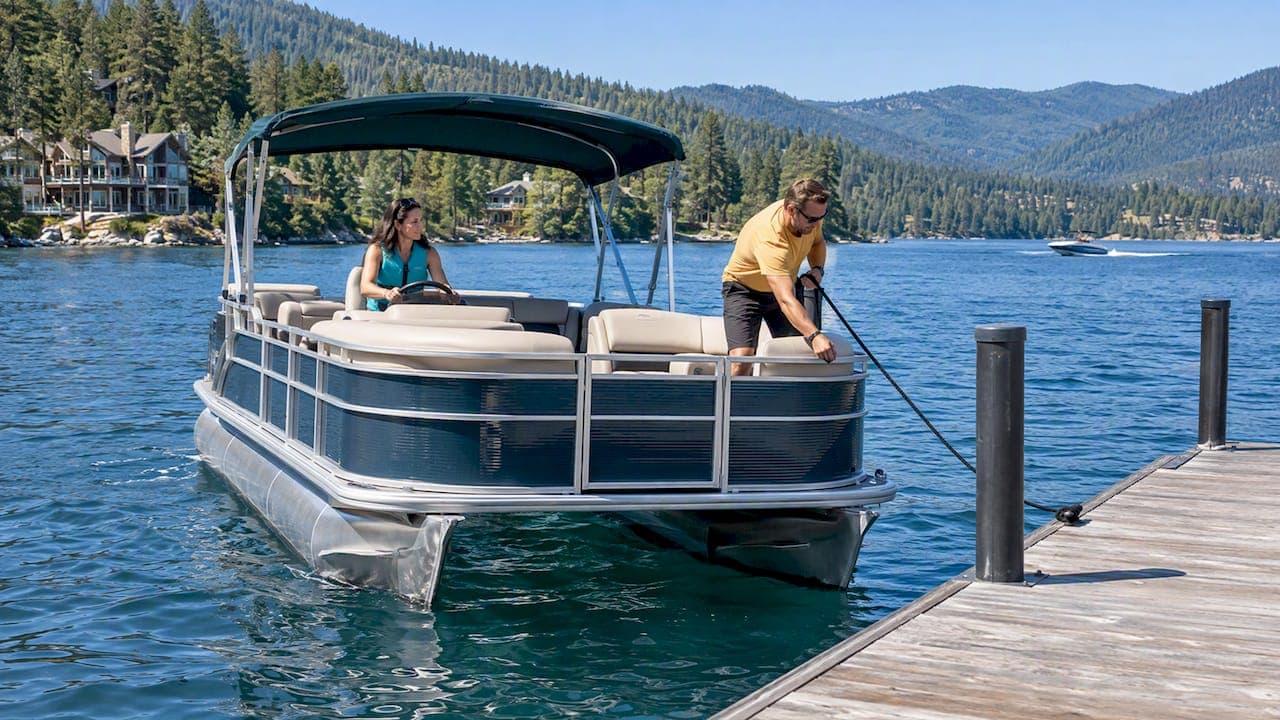
Docking a boat comes down to three habits: go slower than feels natural, get your lines and fenders ready before you arrive, and let the wind and current tell you where to aim. Do those and most landings are boring, which is what you want. Below is the full sequence, from prep to cleat, plus what changes when you're alone, in a slip, or on a pontoon.
TL;DR
- Rig fenders and dock lines before you get near the dock, on the side you'll tie up.
- Approach at idle or the lowest speed that still lets you steer, and use short bursts of forward and reverse instead of momentum.
- Check wind and current first, then pick your angle. If it goes wrong, back out and try again.
- Never let a passenger jump to the dock or stop the boat with hands or legs.
- On Idaho lakes, stay at no-wake speed within 100 feet of a dock, shore or swimmer.
Table of Contents
- What docking really involves
- Prepare before you approach
- Read the wind and current
- The approach, step by step
- Lines, springs and cleats
- Docking in a slip
- Docking alone
- Docking on lakes around Coeur d'Alene and Spokane
- Our perspective
- Rent with us and practice on the lake
- FAQ
- Sources
What docking really involves
Docking is a decision before it is a maneuver. The Oregon State Marine Board says to start by identifying where you'll tie up, the boats around it, your room to maneuver, and the wind and current. It also notes that a long open pier is generally easier than a narrow slip, so if you have a choice, take the easy one on your first few trips.
Then brief your crew. America's Boating Compass recommends that everyone knows the approach direction, the wind and current, the order of lines, who does what, and what you'll do if the first try fails. A thirty-second talk beats shouting from the helm.

Prepare before you approach
Do all of this while you're still in open water:
- Fenders. Hang them on the side that will touch the dock or pilings. The Oregon State Marine Board suggests at least two fenders, plus two or three spare dock lines for odd dockside conditions.
- Lines. America's Boating Club advises having dock lines ready before entering the docking area. Attach one to a bow cleat and one to a stern cleat on the dock side.
- Crew jobs. Decide who handles the bow line, who handles the stern line, and who watches for other boats.
- Loose gear. Stow anything that can trip someone or go overboard.
If you're renting, this is also the moment to confirm where the cleats are and how long the lines are. Our guide to tying up a boat, from cleat hitch to dock lines covers the knots in detail.
Read the wind and current
Wind is usually the thing that makes a docking go wrong, so spend a moment on it. America's Boating Compass suggests looking at flags, ripples around buoys and pilings, and the way nearby moored boats are pointing. You can also stop briefly in neutral and watch which way you drift.
A headwind slows the boat and can improve control. A following wind adds push, so counter it with less power or a touch of reverse, according to the same source.
Wind or current pushing you onto the dock
This is the friendly case. The Kentucky boating safety manual says to approach slowly and parallel, let the force carry you in, then secure the bow and stern lines.
Wind or current pushing you away
This takes more finesse. The same manual describes a slow approach at about 40 degrees, using reverse to stop, securing the bow, then a brief burst forward with the wheel turned away from the dock to swing the stern in. Keep the bow line tight while you do it.
Wind on the bow or stern at a pier
The Oregon State Marine Board describes it this way: with wind in your face, approach at a steep angle and turn sharply at the last moment. With wind at your stern, come in at a narrow angle and let it push you against the dock.
If the wind forecast looks rough, the best docking is the one you postpone. Our note on why not to launch in 15 to 20 knot winds explains where we draw that line.
The approach, step by step
- Slow down early. Stay at no more than steerage speed, the slowest speed at which the boat still responds to the wheel, as BoatUS Foundation puts it.
- Come in at a shallow angle. America's Boating Club recommends idle speed and a shallow angle.
- Use short bursts. Tap forward, tap reverse, then return to neutral. Don't carry momentum toward a solid dock.
- Pivot the stern as the bow nears. A small turn of the wheel and a brief bump of throttle swings the back end alongside.
- Get lines on. Bow line first in most cases, then the stern line. Once alongside, secure both.
- Shut down and adjust. Set the fenders where the boat actually touches, and tighten or ease the lines.
If the approach gets sloppy, stop, back away and go around. The Kentucky manual is clear that aborting and retrying beats forcing it. Also never stop a moving boat with your arms or legs.
Lines, springs and cleats
Bow and stern lines hold the ends of the boat. Spring lines run at an angle and limit fore-and-aft movement. The South Australian boating handbook describes bow, bow-spring, stern and stern-spring lines, and notes that springs work best used together. America's Boating Club adds that a spring line can help slow and align the boat as you come alongside.
The working principle from BoatUS Foundation is simple: let the lines do the work, not speed, force or a crew member's body.
Docking in a slip
A slip leaves less room for error, so the rules above matter more. Fenders go on both sides. Approach slowly, aim down the center, and keep the boat straight with small throttle inputs. Have a crew member ready to step off carefully or hand lines to someone ashore. If you misjudge the entry, reverse out in a straight line rather than turning inside the slip.
Pontoons catch wind like a billboard and turn differently from a V-hull. We wrote a separate walkthrough on docking a pontoon boat for the first time.
Docking alone
Solo docking is mostly preparation. America's Boating Compass says that if no one is on the dock to help, be ready to position the boat and deploy the lines yourself. Practical moves:
- Rig both lines and fenders ahead of time, and keep the lines where you can reach them from the helm.
- Come in slowly enough that you can step to the dock with a line in hand at idle.
- Let wind or current push you toward the dock when possible.
- In a crowded area with little room, move aside and wait for other boats to pass.
With passengers aboard, tell them not to jump. BoatUS Foundation warns against large jumps to the dock, suggests handing lines to someone ashore, and says to keep fingers and limbs inboard.
Docking on lakes around Coeur d'Alene and Spokane
Lake docks vary: public floats, private piers, marina slips and ramp docks. Courtesy matters at all of them. Ramp docks are for loading and unloading, not parking, so move your boat promptly. Our boat ramp etiquette tips cover that routine.
The key rule for Idaho is speed near structures. Idaho Parks and Recreation's personal watercraft guidance says to travel at slow, no-wake speed, under 5 miles per hour, within 100 feet of a dock, shore or swimmer. That is a good habit for any boat. Marinas and local lakes can post their own rules, so read the signs at each dock and ask the marina if unsure.
Visibility helps, too. A boat that other captains can see easily is easier to share a busy dock area with, and this overview of boat graphics and safety visibility is worth a look if you own a boat.
Our perspective
Most of the dock trouble we see isn't about skill. It's speed. First-time renters come in a little hot because they're nervous, and then a small mistake has momentum behind it. We tell guests to treat idle as the default and to treat the dock like it's made of glass.
We also encourage a practice pass. Idle past the dock once, see how the wind moves the boat, then come back for the real landing. Nobody at a dock minds a second attempt. They mind a crunch.
Our Yamaha WaveRunners, ski boats and pontoons are kept clean and well maintained, and we'd rather spend five minutes walking you through the controls than see you rush. Ask us anything before you head out.
— Life is better on water.
Rent with us and practice on the lake
If you want to get comfortable around docks, a calm morning on the water is the best teacher. We rent jet skis, ski boats, pontoon boats, paddleboards and water toys around Spokane Valley, Liberty Lake and Coeur d'Alene. Jet ski rentals are listed at $250–$425, an additional hour is $75, and wakeboards and tubes are $50 each. The damage deposit is $500 per jet ski and $1,000 per boat. See our rental prices or book a jet ski at Liberty Lake. New to renting? Our first-timer lake rental tips help you plan.

FAQ
What is the best way to dock a boat?
Go slow, prepare lines and fenders in advance, and use the wind and current to your advantage. Approach at a shallow angle at idle speed, use short bursts of power, and secure the bow and stern lines once alongside. If it feels out of control, back off and try again.
Is docking a boat stressful?
It can be at first, mostly because of an audience and the fear of hitting something. Preparation takes most of the stress out: a crew briefing, ready fenders and lines, and a plan if the first approach fails. Practicing at quiet times helps a lot.
Should I dock into the wind or with it?
With wind or current pushing you toward the dock, approach slowly and let it carry you in. With it pushing away, come in at a steeper angle, secure the bow first and swing the stern in. Check the wind before you commit to an angle.
Can a beginner dock a boat alone?
Yes, with preparation. Set up bow and stern lines and fenders early, approach at idle, and pick a dock with the wind pushing you in. If no one is there to help, be ready to place the lines yourself and wait out crowded conditions.
Sources
- Oregon State Marine Board: Docking Etiquette
- Kentucky Boating Safety Manual
- BoatUS Foundation: Docking
- America's Boating Club: Preparing to Dock Your Boat
- America's Boating Compass: How to dock a boat safely
- South Australian Recreational Boating Safety Handbook, Anchoring, Mooring and Berthing
- Idaho Parks and Recreation: Personal Watercraft Laws and Safe Operation