
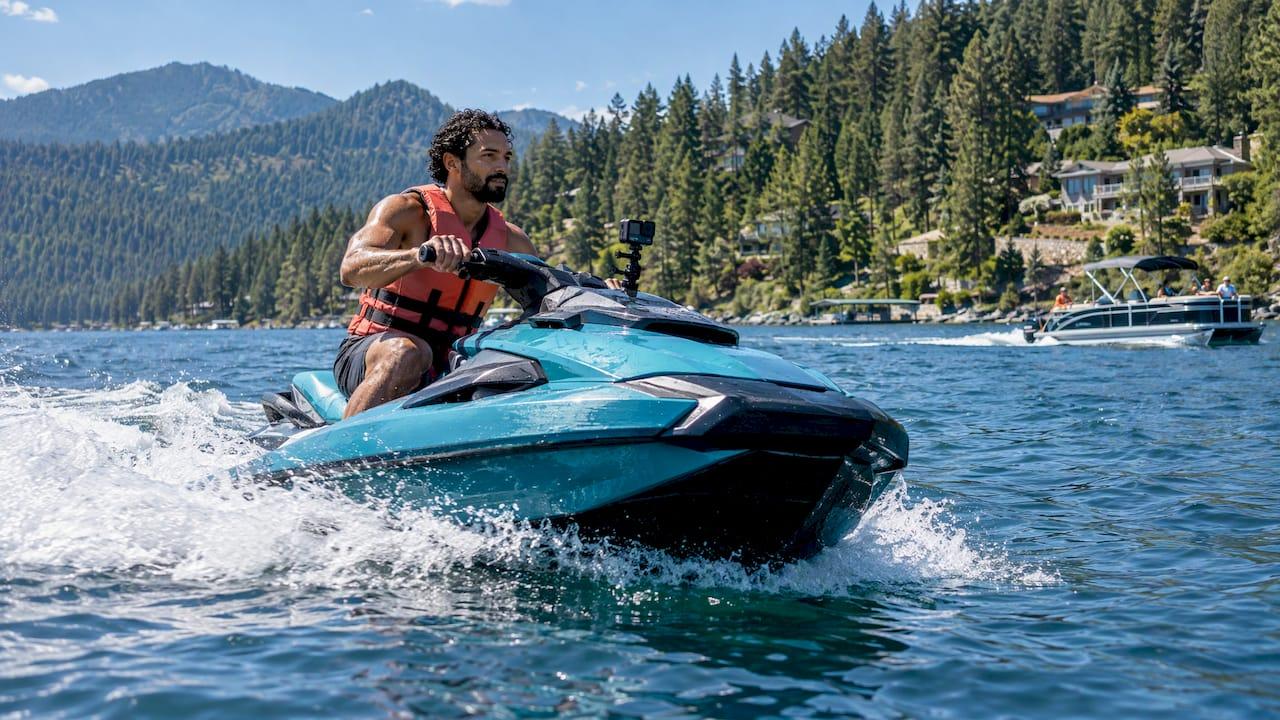
For a rented jet ski, the best GoPro setup is a chest mount plus a floating case and a short tether. It needs no drilling and no adhesive on the ski. If the ski is yours, a clamp or base mount on the handlebar or deck gives you a steady forward shot. Either way, the mount has to fit your camera, fit the ski, and never be your only line of defense against losing the camera.
This guide covers the mount types and their trade-offs, where each angle works, how to secure everything before you launch, and what to do differently on a rental.
TL;DR
- A chest mount is the safest first choice on a rental. It gives a rider's-eye view, and your body absorbs the bounce that ruins hull-mounted footage.
- Handlebar clamps suit skis you own. Check the bar diameter first: GoPro's own pole mount clamps tubes from 0.35 to 1.4 inches.
- Adhesive mounts need 24 hours to cure and are a poor fit for a ski that isn't yours.
- Always add a floating case and a short tether so a failed mount doesn't mean a lost camera.
- Ask us before attaching anything to one of our skis, and wear your life jacket for every ride.
Table of Contents
- The mount types and their trade-offs
- Where to put the camera
- Make sure the mount fits the camera and the ski
- Secure it before you launch
- Floaty and tether: your backup plan
- Filming on a rental jet ski
- Plan the ride you'll film
- FAQ
- Sources
The mount types and their trade-offs
Most jet ski setups come down to five choices. Each trades stability, cost and risk to the ski differently.
| Mount type | Best for | Main drawback |
|---|---|---|
| Chest mount | Rider's-eye view, rentals | Fixed angle, you must wear it |
| Handlebar clamp | Forward view on a ski you own | Can shift or flex at speed |
| Adhesive mount | Cheap, almost anywhere | Cure time, removal, one use |
| Suction cup | Hull or rear platform shots | Loses grip on textured or damp surfaces |
| Base and arm (RAM style) | Permanent, solid setup | Often needs drilling or ski-specific hardware |
Chest and helmet mounts. The Watercraft Journal's guide to action cameras lists helmet mounts for head-level footage and chest or shoulder mounts for more stable footage. One test-driven roundup explains the reason: your body absorbs shocks at speeds above 40 knots, while a mount on the hull picks up every bounce of a choppy day.
Handlebar clamps. GoPro's official Handlebar / Seatpost / Pole Mount fits tubes from 0.35 to 1.4 inches (9 to 35 mm) and comes with two rubber inserts. Flexible gooseneck clamps are convenient, but reviewers note that a flexible clamp can bounce at high speed and that jumping wakes may shift a clamp's position. Keep any arm as short as the shot allows.
Adhesive mounts. These are the most common choice because they are cheap and stick almost anywhere. GoPro's manual says to attach adhesive mounts at least 24 hours before use, and only to smooth, clean, dry surfaces at room temperature. One mount guide points out that adhesive stickers need heat to remove, which is why they are a poor idea on a ski you don't own.
Base and arm systems. A hard-mounted base, a short arm and a GoPro adapter make the sturdiest permanent setup, according to one mounting guide. The catch is hardware. Some systems need holes drilled in the ski, and many are built for one brand. One Sea-Doo GTX mount, for example, is not compatible with Yamaha WaveRunners.
Where to put the camera
The angle matters as much as the mount. These are the placements riders use most.
- Chest, facing forward. The most natural rider's-eye view. It keeps the camera clear of the handlebars and works on any ski.
- Front of the deck, tilted slightly up. One guide suggests tilting the camera slightly upward to catch the horizon, so you aren't filming only spray.
- Rear of the ski, angled toward the wake. Good for showing friends riding behind you and your own wake.
- Back of the seat facing forward, or the nose facing back at the rider. Both are placements the Watercraft Journal describes for studying body position and getting dynamic shots.
- Helmet. A true first-person view, but not every rider wears a helmet on a lake ride, and GoPro advises against using a tether on a helmet mount.
One placement to skip: hand grips and telescopic poles. One placement guide notes they get in the way because you need both hands to operate the ski properly.
Make sure the mount fits the camera and the ski
Buying a mount is easy. Buying the right one takes two checks.
The camera. The two-prong GoPro finger interface is close to a standard, and almost every action camera has it built in or ships an adapter. Anything that touches the camera body, such as housings, floats and doors, is model-specific, so buy those by model number. If you add an adapter, remember it adds height and a flex point.
The ski. Measure the handlebar before you order. A mount that clamps a 22 mm bar won't fit a 28 mm bar, and an adhesive pad made for a flat surface may not hold on a contoured one. Some skis ship with universal hardware: the RAM system on Yamaha WaveRunners is one of the best-known examples, with attachment points in front of the handlebars on some models.
If you are coming to ride a Yamaha WaveRunner, a chest mount skips both checks. It fits every rider and every ski.
Secure it before you launch
Do this on the dock or in the driveway, not on the water.
- Prepare the surface. For adhesive mounts, follow GoPro's guidance: clean, dry, smooth, pressed firmly, and attached a day early.
- Assemble the mount. For a base and arm, attach the base, connect the arm, add the camera adapter, then lock the camera with the quick-release lever.
- Check the controls. Turn the bars fully both ways. The camera must never touch the steering, throttle or kill-switch lanyard.
- Shake it. One mounting guide recommends gently shaking the handlebar and watching for movement, then doing a short ride to check for rattling.
- Add a float and a tether. This is the step that saves the camera.
Floaty and tether: your backup plan
GoPro's Floaty case keeps a HERO camera afloat if you lose it, has a tether point and is high-visibility orange. It is only compatible with HERO cameras, so confirm your model. GoPro's manual also recommends a camera tether and Floaty in case the camera detaches.
Keep the tether short. A long loose leash around a rider is an entanglement hazard, so one mounting guide advises attaching to a solid point on the craft with minimal slack, and never in a way that interferes with a helmet's release. Redundancy is the principle: a secure mount plus an independent tether.

Filming on a rental jet ski
Renting changes the rules. You don't own the plastics, you can't drill, and a sticky residue is someone else's problem. A chest mount, a floating case and a tether leave the ski exactly as you found it. If you want something on the ski itself, ask us first rather than sticking anything down.

Renting also means you can focus on riding. Our guides on driving a Yamaha WaveRunner and staying safe in open water are worth reading before you worry about angles. Footage is a bonus. A life jacket is not optional, and here is why.
Two practical habits help. Charge the camera and clear the memory card the night before. Then keep passengers' and other riders' privacy in mind, and follow the lake etiquette every rider should know.
Plan the ride you'll film
We rent Yamaha WaveRunners for lake days at Liberty Lake, Newman Lake and the Coeur d'Alene area. Jet ski rentals at Liberty Lake and Newman Lake run $250 to $425, and each additional hour is $75. A refundable-style damage deposit of $500 per jet ski applies. Wakeboards and tubes are $50 each if your group wants more to film. See the full rental list and prices or book from our home page.
Bring your chest mount, Floaty and charged camera, and ask us any mounting questions when you pick up.
Our view from the dock
We want your lake day to end with great footage and a camera that came home with you. On a rental, we think the answer is simple: wear the camera, float it and tether it. That way the ski stays clean and you stay free to ride.
Our Yamaha WaveRunners are kept clean and well maintained, and our booking is flexible, so you can add an hour when the light is good and the water is calm. Spend your effort on the ride and the angle, not on fighting a clamp.
Life is better on water.
FAQ
What is the best GoPro mount for a jet ski?
For most riders, a chest mount, because your body absorbs the bounce and the view is the rider's own. On a ski you own, a handlebar clamp that fits the bar diameter or a base-and-arm mount on the deck gives a steady front view.
Can I use a suction cup mount on a jet ski?
Yes, on smooth, clean, dry surfaces such as the hull or rear platform. Suction cups lose grip on textured or damp surfaces, so add a tether as backup.
Will a GoPro float if it falls in the lake?
Not by itself. GoPro's Floaty case is designed to keep a HERO camera afloat and is bright orange so you can spot it. Pair it with a short tether to the mount or your vest.
Does the mount have to match my ski brand?
Only if it is a ski-specific base. Handlebar clamps depend on bar diameter, and brand-specific mounts, like Sea-Doo-only ones, will not fit a Yamaha WaveRunner.
Sources
- GoPro Handlebar / Seatpost / Pole Mount
- GoPro Floaty
- GoPro HERO11 Black manual: Mounting Your GoPro
- Watercraft Journal: Getting the Shot
- Watercraft Journal: Best Camera Placement
- Jet Ski Advice: GoPro Jet Ski Mounts
- TheSweetCamera: GoPro Mounts for Jet Ski
- JetSkiTips: GoPro Jet Ski Mounts
- Action Cam Gear HQ: Watersports Mounts Guide
- Action Camera Expert: GOTOTOP Seadoo GTX Mount Review
- Action Camera Expert: RAM Handlebar Mount
- WinterSportElite: Jet Ski Mounting Locations
- JetDrift: Where to Attach a GoPro Mount
- Lens & Lake: Are GoPro Mounts Universal?
- Nashville Performance: Choosing a Mount