
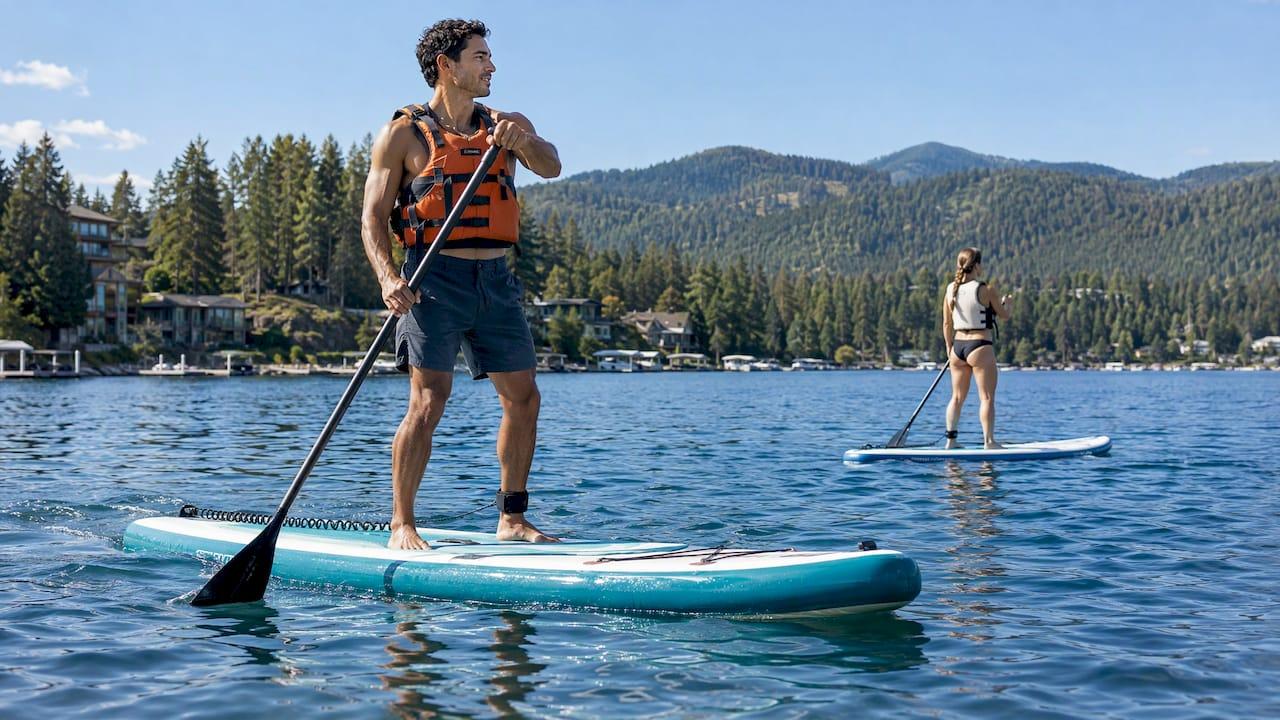
For paddling on the lakes around Coeur d'Alene, Liberty Lake and Newman Lake, a coiled ankle or calf leash is the standard choice. Straight leashes are built for ocean surf, and moving rivers call for a waist-mounted quick-release leash or none at all. Below is how each type works, how to size one, and where leashes fit in the Idaho and Washington safety picture. We rent paddleboards on these lakes, so this is the question we hear before most first trips.
TL;DR
- Coiled leash: the lake and flatwater pick. The coils stay short and out of the water, so less drags and snags.
- Straight leash: made for surf. It lets the board travel away from you in breaking waves. On calm lakes the extra cord drags and tangles.
- Hybrid leash: coiled and straight sections combined, a flexible option for calm water.
- Length: roughly equal to your board, or a little longer. Most adult SUP leashes are 8 to 10 feet.
- Moving water: on a river like the Spokane, use a waist-mounted quick-release leash, never an ankle leash. A leash never replaces a life jacket.
Table of Contents
- The three leash types
- Coiled vs. straight: what actually changes on the water
- Choosing length and attachment point
- Rivers are different
- Leash rules in Idaho and Washington
- A leash is not a life jacket
- Our perspective
- Ready for the lake
- FAQ
- Sources
The three leash types
A SUP leash is a cord that connects you to your board. One end attaches to a leash plug on the board's tail, and the other end is a cuff worn around your ankle or calf. That is the whole idea: after a fall, the board stays within reach instead of drifting away in the wind.
Utah's outdoor recreation division describes three types of SUP leash: coiled, straight and hybrid. Here is how they differ.
| Type | How it works | Best for | Watch for |
|---|---|---|---|
| Coiled | Permanently coiled cord that stretches as you move and contracts to stay out of the way | Lakes, flatwater, touring | Pulls the board back toward you quickly after a fall |
| Straight | One long cord with little or no stretch | Ocean surfing | Drags and snags in shallow flatwater |
| Hybrid | Coiled and straight sections together | Calm water, mixed use | Less common in rental and entry-level setups |
Coiled vs. straight: what actually changes on the water
A coiled leash is a tidy bundle that rests near the back of the board, so it stays out of the water. A coil that is relaxed is only about two feet long, and it stretches to roughly nine feet. The trade-off is rebound: when you fall, the coil can pull the board back toward you quickly.
A straight leash lies flat and extends to its full length. That is useful where waves break, because the board can travel away from you while you clear the wave. The same trait works against it on a lake, where a long cord trails behind you and can catch on your feet or the fin.
The American Canoe Association's SUP safety guidance puts it simply: use a straight leash for ocean SUP surfing, and in flat lakes, tidal areas or slow rivers a coiled or hybrid leash can keep you from being separated from your board.

On Lake Coeur d'Alene, Liberty Lake or Newman Lake you are not dealing with surf. Wind chop and passing wakes are the real challenges, and a board that blows away faster than you can swim is the risk a leash solves. That points to coiled.
Choosing length and attachment point
Length. A common rule is a leash about equal to your board's length or a little longer. A table of manufacturer length guidance says 9 to 10'6" boards take a 10-foot leash, and touring boards of 11'6" or more take 11 feet or longer. Most adult SUP leashes run 8 to 10 feet. Use a leash rated for a SUP rather than a surfboard leash, which may not be strong enough for the extra board weight.
Ankle or calf. The ankle is the default and works on flat water. The calf moves the cord higher and away from the fin, and is a comfort preference rather than a safety upgrade. Put the cuff on your dominant leg, which for most people is the back foot when standing on the board.
Waist. A waist belt with a quick-release is the only setup that belongs on moving water. More on that below.
Fitting it. The leash string ties to the board's leash plug with a stopper knot, and the rail saver wraps over the tail with Velcro to protect the rails. Check the knot, the Velcro and the cuff before you push off, every time.
Rivers are different
The Spokane River and other moving water change the rule. In a July 2024 release, Oregon's Marine Board said paddlers who were well outfitted died when an ankle leash tangled in river brush or debris. It urged SUP users on moving water to wear a life jacket and never wear an ankle or leg leash designed for flatwater. A quick-release leash worn at the waist or attached to the life jacket is the moving-water option.
Paddling Magazine adds that a moving-water leash needs to be at or above the waist and reachable with both hands, and that you should practice the release until you can find it with your eyes closed. We cover local river conditions in our Spokane River paddleboard safety guide.

Leash rules in Idaho and Washington
Neither state's published boating rules list a leash requirement for paddleboards. What they do require matters more for a visiting paddler:
- Idaho: the USCG classes paddleboards as vessels. Outside swimming areas, each person needs a life jacket, and you need a whistle, plus a white light between sunset and sunrise.
- Out-of-state boards: Idaho requires an Invasive Species Fund sticker on watercraft from out of state, with an exemption only for vessels under 10 feet that are non-motorized and inflatable.
- Washington: state parks say SUPs are subject to boating laws, and paddlers must carry a sound-producing device such as a whistle. Free Life Jacket Loaner Stations exist if you do not own one.
We list the full gear picture in our required boat safety equipment checklist for Idaho and Washington lakes.
A leash is not a life jacket
Idaho notes that in the past ten years nearly 67% of fatal boating accidents involved people entering the water involuntarily from small boats, and that Idaho's water averages 52 degrees even in summer. Cold water saps strength fast, which is why a life jacket matters as much as the leash. Children 14 and under on boats 19 feet or less must wear an approved life jacket when underway.
Utah's guidance says it plainly: a leash does not prevent drowning and is not a substitute for a life jacket. Instructor training materials also note a leash can break or spring back, so check the cord for wear and keep it clear of your fingers, toes and neck (NSSIA manual). If you do fall, our paddleboard self-rescue guide shows how to get back on.
Our perspective
Most first-time lake paddlers ask whether they need a leash before they ask anything else. Our answer is to match the leash to the water: coiled on a lake, waist quick-release on a river, and a life jacket in every case.
Our rentals come with safety equipment because a good day on Liberty Lake or Coeur d'Alene starts with being prepared. Our team is happy to walk you through the basics before you head out, so the first paddle is relaxed instead of rushed.
If you are new to this, our paddleboard rental guide explains what to expect from start to finish.
Life is better on water.
Ready for the lake
If you are visiting Coeur d'Alene or the Spokane lakes and want a paddleboard without hauling gear across the country, we offer paddleboard rentals, along with boats, jet skis and water toys. See our rentals and book online or by phone.
Traveling with a pup? Our paddleboarding with a dog guide covers a first trip.
FAQ
Do I need a leash to paddleboard on Lake Coeur d'Alene?
Idaho's published boating rules do not list a leash requirement for paddleboards. Idaho does require a life jacket for each person, a whistle, and a light after dark. A coiled leash is a sensible add-on for staying connected to your board on wind-blown lakes.
Is a coiled or straight leash better for flatwater?
Coiled. The coils keep the cord short and out of the water, which cuts drag and snags. A straight leash is designed for surf, where the board needs to travel away from you.
What length leash do I need?
Choose one about as long as your board, or slightly longer. Most adult SUP leashes are 8 to 10 feet, and a 10-foot leash suits boards of about 9 to 10'6".
Should I wear an ankle leash on the Spokane River?
No. On moving water, officials advise a waist-mounted quick-release leash or going without, along with a life jacket. An ankle leash can snag on submerged brush while the current pushes you.
Sources
- Life Jackets, Utah Outdoor Recreation
- SUP Leashes: the Good, the Bad, and the Ugly
- American Canoe Association, SUP Leashes
- Best Paddle Board Leashes: Coiled, Straight and Hybrid
- Oregon State Marine Board, Leash Type Is Critical
- Paddling Magazine, SUP Leashes On The River
- Idaho Boating Laws handbook
- Idaho Parks and Recreation, Boating
- Washington State Parks, Paddlesports
- NSSIA, Teaching Surf/SUP Instructors to Teach