
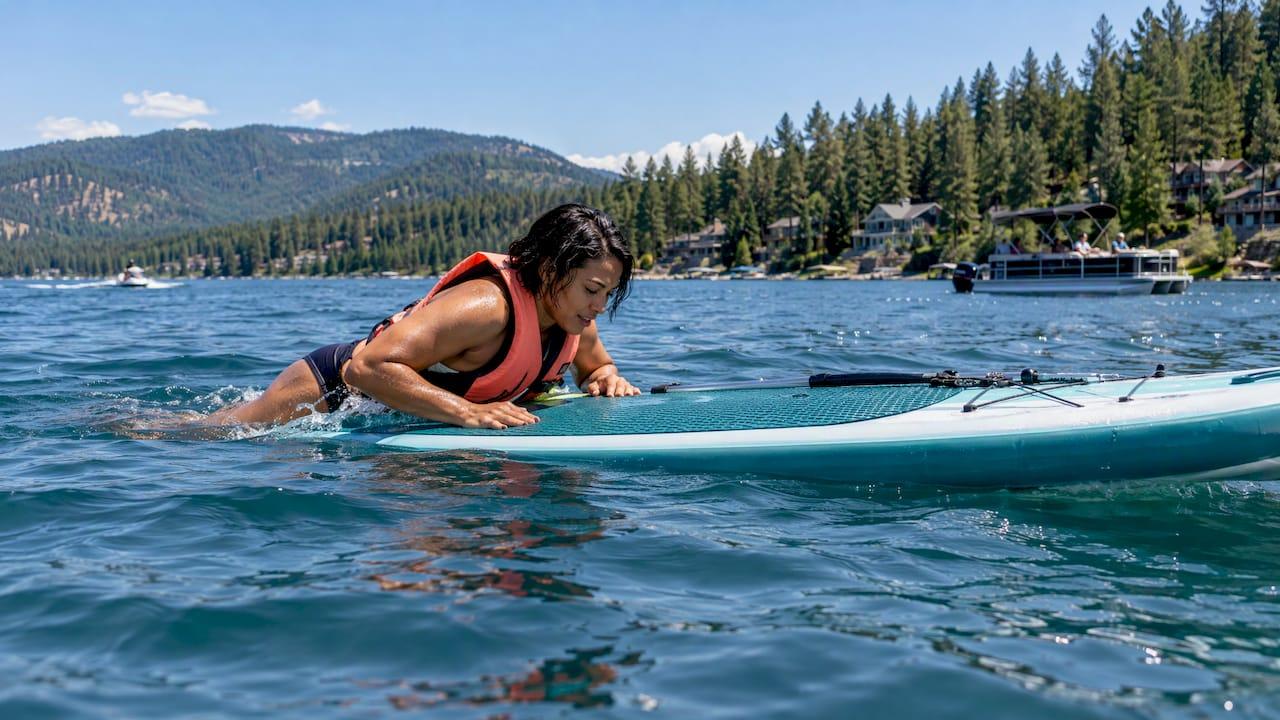
Self-rescue on a paddleboard means getting yourself back on the board after a fall, without anyone's help. The core method is simple: stay with the board, kick while you pull your chest across the deck from the side or tail, then work up to your knees and stand. Practice it in shallow, calm water before you paddle anywhere you can't touch bottom, whether that's Lake Coeur d'Alene, Liberty Lake or Newman Lake.
TL;DR
- Hold on to your board, wear a leash and a life jacket, and pull yourself on stomach-first. The board floats, so it is your flotation.
- Practice reboarding in shallow, calm water first, then again in choppier conditions. Skills that only work in perfect conditions fail when you need them.
- In wind or waves, reboard from the upwind or wave side. In cold water, expect your strength to drop fast.
- If you can't climb back on, stay with the board. You are easier to spot next to it than swimming away.
- Idaho and Washington both have life jacket rules for paddleboards. Know the one for your lake before you launch.
Table of Contents
- What self-rescue means and why to practice before you go out
- How to get back on a SUP, step by step
- Practice plan for a first-timer
- Wind, waves and cold water
- If you can't get back on
- Life jacket rules on Idaho and Washington lakes
- Where this leaves families and groups
- Our view: practice is part of the rental
- Rent a paddleboard near Coeur d'Alene and Spokane
- FAQ
- Sources
What self-rescue means and why to practice before you go out
Self-rescue is the ability to get back onto your board after an unexpected fall. It sounds easy in the shallows, where you can stand up and climb on. In deep water you can't push off the bottom, so you pull yourself onto the board stomach-first, then work up to your knees and feet.
That is harder than it looks when you're tired, in a wetsuit or heavy clothing, or on a board that sits high out of the water. USA SUP points out that exhaustion, water conditions, board shape, clothing and gear all make reboarding harder when you need it most. It also warns that practicing only in perfect conditions can leave you in a far more dangerous situation when a real emergency arrives.
A magazine report on capsize recovery says many paddlers never think about it until they are in the water, and some cannot reboard without help. The fix is cheap: ten minutes of practice. The Oregon State Marine Board tells new paddlers to start on calm, flat water with minimal wind and to keep practicing reboarding.
How to get back on a SUP, step by step

1. Fall away from the board
When you feel yourself going, drop to the side, front or back, and fall flat so you stay shallow and avoid anything under the surface. Kayak Angler advises jumping in feet-first rather than grabbing the board. Hang on to your paddle if you can. If it slips away, get the board first, climb on, then hand-paddle over to the paddle.
2. Find the board and bring it to you
The leash does this job. A standard SUP leash connects you to the board, so the board can't float away and you can climb back on. Wind can push a board away faster than you can swim, and chasing it is how small falls turn into bad situations. Once it's back, keep your hands up in front of your face while it returns.
3. Position yourself at the middle of the board
Swim to the side of the board, level with the center carry handle. Standing at the tail or nose tips it the wrong way. Grab the handle with one hand and reach for the far rail with the other.
4. Kick and slide on
Let your legs float up behind you. Kick steadily while you pull on the handle and slide your chest onto the deck. Paddling.com describes a second route: push down on the tail and slide your chest on. Whichever you use, go stomach-first and keep your weight centered.
5. Stay prone, then come up to your knees
Lie flat and catch your breath. If the water is rough, stay on your belly and hand-paddle toward calmer water. When you're ready, pull up onto your knees, tuck your toes, bring your feet up one at a time and stand with the paddle for balance. Look ahead instead of down.
If you struggle: the flip-over and stirrup backups
Some paddlers find the standard method hard. One option is to flip the board upside-down, climb onto the underside, then flip it back or paddle to shore. A stirrup works too: a rope loop tied at the tail that you step into, but it is a backup, not your primary method. Practice either one in shallow water before you rely on it.
Practice plan for a first-timer
- Shallows first. Practice controlled falls and reboarding in water where you can stand, until falling away from the board becomes automatic.
- Add the real gear. Wear your life jacket and leash exactly as you'll wear them on the lake.
- Go deeper with a buddy. A partner can hold the opposite side of the board steady while you climb on.
- Repeat in chop. Try it on a breezy day, close to shore.
If you're renting, do this at the start of your session within sight of the launch. Our guide to what to know before a paddleboard rental walks through what to expect, and five minutes of rental safety for Spokane-area families covers the basics.
Wind, waves and cold water
Wind is the main reason paddlers end up in the water, according to Colorado Parks and Wildlife. Once you're in, wind can blow the board away, and waves make swimming difficult. When it's windy, get on from the upwind or wave-facing side so the board doesn't flip or fly over your head. Wind matters in every board sport, kitesurfing at Ameland's official spots included, so check the forecast before you launch. Our beginners' wind limits for paddleboarding give a simple threshold: learn at 0 to 5 mph and avoid 11 to 12 mph.
Cold water is the other big factor. Colorado Parks and Wildlife treats water under 70°F as cold and warns that cold-water shock can cause drowning even in strong swimmers. Mountain lakes around Spokane and Coeur d'Alene can feel much colder than the air in early summer, so dress for the water, not the weather. Read more in our cold water boating guide.

If you can't get back on
Stay with the board. Rhode Island's Department of Environmental Management advises that people in the water stay with the boat even if they can't get back in, because a person next to the craft is far easier for rescuers to see. Swim for shore only if you're wearing a life jacket and rescue is unlikely, or you're close to shore and can't climb back on. Keep the board between you and the wind, signal with a whistle, and rest on it as it floats.
The U.S. Army's safety magazine notes that the Coast Guard treats paddleboards as vessels beyond swimming and bathing areas, and lists knowing how to self-rescue among its SUP safety tips alongside wearing a life jacket and carrying a whistle.
Life jacket rules on Idaho and Washington lakes
A paddleboard's buoyancy can lull you into skipping a life jacket. Paddling Magazine's writer notes that the board won't sink but accidents still happen, so wear a PFD and keep the leash on.
- Idaho (Lake Coeur d'Alene): Idaho Code § 67-7015 requires a USCG-approved wearable life jacket of suitable size for each person on a vessel under 16 feet, and canoes and kayaks of any length. Children 14 and younger on vessels 19 feet or less must wear one while underway. Life jackets must be readily accessible.
- Washington (Liberty Lake, Spokane Valley): Washington State Parks says all vessels, stand-up paddleboards included, must carry one properly fitted USCG-approved life jacket per person. Children 12 and younger must wear one at all times when underway in a vessel under 19 feet. It also advises checking local rules, which can vary by body of water.
Some states are moving toward mandatory wear for everyone on paddle craft. Rhode Island now requires all paddleboard users to wear a life jacket regardless of age. Wearing yours is the safest habit wherever you paddle, and it helps your self-rescue too.
Where this leaves families and groups
If you're bringing kids or a dog, practice on your own first. Reboarding with another body on the board is harder, and the dog may panic. Our first-trip guide to paddleboarding with a dog covers that setup.
Our view: practice is part of the rental
At Golden Water Sports, we want every guest to leave the dock confident, not just equipped. A paddleboard day goes best when the first thing you do on the water is fall in on purpose, in shallow water, and climb back on.
That is why we pair our paddleboard rentals with safety equipment and friendly guidance for first-timers. Our mission is a safe, fun and hassle-free experience, and a quick reboarding drill is the simplest way to deliver on all three.
We'd rather you spend ten minutes practicing at the start than ten minutes struggling in deep water later.
Life is better on water.
Rent a paddleboard near Coeur d'Alene and Spokane
We rent paddleboards, along with boats, jet skis and water toys, for lakes around Spokane Valley, Liberty Lake and Coeur d'Alene, with safety equipment included in our rentals. Paddleboard pricing isn't listed online, so check the rentals page or our price page for details, and book online or by phone.
Want to pick a launch spot first? Our list of Spokane paddleboard launches shows where to start.
FAQ
How do I get back on a SUP in deep water?
Swim to the side of the board at the center handle, hold the handle, kick, and pull your chest across the deck. Stay on your belly, then rise to your knees, tuck your toes and stand one foot at a time. Practice in shallow water first.
Do paddle boarders wear life jackets?
They should. Idaho and Washington both require a USCG-approved life jacket for each person on board, and children must wear one at all times under set ages (14 and younger in Idaho, 12 and younger in Washington). Adults are safest wearing theirs, since a board can drift away from you quickly.
What should I do if my board floats away?
The leash is what prevents that, so wear one every time. If you lose both leash and board in deep water, signal for help and stay put while you wait if you are wearing a life jacket. Rescuers can spot you more easily than someone swimming off.
Is a paddleboard self-rescue different in cold or windy conditions?
Yes. In wind, climb on from the upwind or wave side. In cold water, move fast, since cold drains the energy you need to pull yourself up. Dress for the water temperature and stay close to shore.
Sources
- USA SUP: How Are Your Rescue Skills?
- Oregon State Marine Board: Paddlecraft
- Paddling Magazine: How To Standup Paddleboard
- The Ensign: Capsize Recovery
- Kayak Angler: Fall Off Your SUP (And Get Back On)
- Paddling.com: How to Fall Off and Get Back On Your SUP
- Colorado Parks and Wildlife: Water Safety
- Rhode Island DEM: Boating Safety Regulations
- U.S. Army Safety: What's SUP?
- Idaho Code § 67-7015
- Washington State Parks: Wear a Life Jacket