
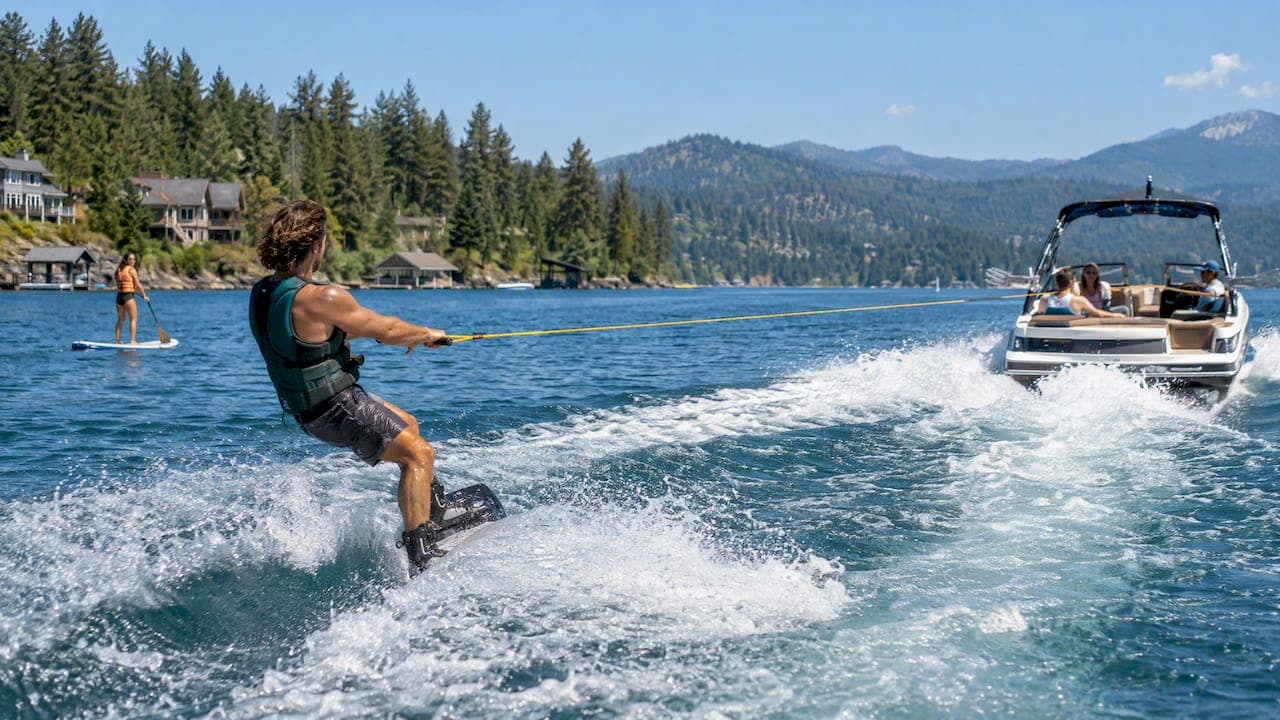
Most beginners should start with a wakeboard rope between 50 and 65 feet, and experienced riders move out to about 75 to 80 feet. The WSIA towed water sports handbook says many riders start around 50 feet to get up, calls 65 feet a good beginner length, and puts experienced riders at roughly 75 to 80 feet. The exact number depends on your boat speed and your wake, so treat it as a starting point and adjust from there.
TL;DR
- Beginners: start around 55 to 65 feet. A shorter rope puts you closer to the boat, where the wake is narrower and easier to cross.
- Intermediate riders: 65 to 75 feet. Advanced riders: 75 to 85 feet.
- Your rope should put you just in front of the spot where the wake turns from a clean ramp into mushy whitewater.
- Change length in 5-foot steps, and only after you have settled on a comfortable boat speed.
- Use a low-stretch, wakeboard-specific rope. Inspect it before every ride.
Table of Contents
- Rope length by skill level
- Why length changes everything
- Find your sweet spot on the water
- Boat speed and rope length work together
- Our perspective: start short, stay patient
- Rope safety checks before you ride
- Get on the water with the right gear
- FAQ
- Sources
Rope length by skill level
Published guidance varies a little, because brands and instructors set their own ranges. The sources agree on the pattern: shorter for new riders, longer as you improve.
| Source | Beginner | Intermediate | Advanced |
|---|---|---|---|
| WSIA handbook | 50 to 65 ft | n/a | 75 to 80 ft |
| Liquid Force FAQ | about 55 ft | n/a | 75 to 80 ft |
| Evo wakeboarding guide | about 65 ft | 65 to 75 ft | 75 to 85 ft |
Sea-Doo's towing guidance for personal watercraft gives a wider overall range of 45 to 70 feet for wakeboard ropes and says shorter lengths usually suit less experienced boarders.
If you are riding for the first time, 55 to 65 feet is a safe place to begin. Many riders get up more easily on the shorter end, then add rope once they are comfortable on the board.

Why length changes everything
A wake is not one smooth hill. Close to the boat it is narrow and steep. Farther back it widens and softens, and behind that it breaks down into whitewater.
The WSIA handbook explains that beginners ride farther back where wakes are softer and spread wider apart, while a 75 to 80 foot rope reaches more defined, wider wakes. Evo notes that a shorter rope puts you at a narrower wake section closer to the boat, which makes the wake easier to clear. A longer rope builds more speed into the wake and gives you more airtime, which is why riders lengthen the line as they progress.

So the question is less "what is the right length?" and more "where on the wake do I want to be?"
Find your sweet spot on the water
The goal is to ride just in front of the place where the wake turns from a clean ramp into mushy whitewater, as Evo's towing guide puts it. Here is how to dial it in:
- Set your speed first. Wakeboarding Magazine says to establish a comfortable boat speed, then let the rope in or out to match the wake's sweet spot.
- Start with the beginner length for your level, around 55 to 65 feet.
- Watch where you land. If you land in the flats, let the rope out. If you come up short, pull it in a few feet.
- Move in 5-foot increments. The same magazine recommends gradual changes so you can adapt to the wider approach and extra airtime.
- Shorten for new tricks. Evo suggests taking 5 to 10 feet off when learning a difficult toeside wake jump, since it reduces the distance you have to clear.
Wakesports Unlimited's 2021 rope guide agrees: shorten the rope if you cannot clear the wake, and lengthen it with experience.
Boat speed and rope length work together
Speed and length are linked. A faster boat stretches the wake out, so riders typically need a different line length as speed changes. Wakeboarding Magazine lists these starting combinations:
| Rope length | Boat speed |
|---|---|
| 50 to 55 ft | 20 to 21 mph |
| 60 to 70 ft | 22 to 23 mph |
| 75 to 80 ft | 23.5 to 24.5 mph |
Those are starting points for experienced riders, though. For true first-timers, Evo suggests about 12 to 15 mph, moving to 18 to 19 mph as comfort grows and 21 to 23 mph once you begin jumping. Tigé's wakeboarding FAQ says beginners and kids commonly ride at 10 to 16 mph and adults often use 16 to 22 mph. It stresses choosing a speed that feels comfortable to the rider.
Tigé also says beginners do not need a big wake, and that modest ballast makes the ride more forgiving. If you are renting a boat for a family day, a smaller wake is a feature, not a flaw. Our guide to wakeboarding behind a ski boat covers the first-day setup in more detail.
Our perspective: start short, stay patient
Most first-timers who rent from us are adults and families spending a day on a lake like Liberty Lake or Lake Coeur d'Alene, not athletes dialing in a competition wake. For that day, we think the rope matters more than people expect.
Our advice is simple. Start on the short side of the beginner range. Keep the boat speed gentle. Let each rider get up a few times before changing anything, then add a few feet at a time. A rider who gets up on the first or second try stays motivated, and a rider who spends 40 minutes face-planting behind a rope that is too long usually quits.
We also ask renters about the rope itself. A wakeboard rope and a ski rope are not the same thing, and it is worth knowing which you have. We wrote a short explainer on wakeboard rope versus ski rope for exactly this reason.
— Life is better on water.
Rope safety checks before you ride
Length is only half of a good rope setup. The WSIA handbook says to inspect all equipment, including the tow rope, before riding and to skip any damaged gear. Use a rope made for skiing or riding with proper tensile strength, and never one with elastic or bungee material. Attach it with approved towing hardware.
Replace a rope that is frayed, knotted, unraveling, or discolored from wear or sun. Our post on how a tow rope works behind a ski boat shows how the pieces fit together.
A few more habits keep the day safe:
- Choose low-stretch line. Watersports Supply recommends a wakeboard-specific rope because ski ropes stretch and a stretchy line snaps back.
- Agree on signals. Decide hand signals before leaving the dock. The same source reports that WSIA recommends an agreed start call such as "hit it" rather than "go."
- Take slack out slowly. The driver accelerates smoothly and straight only after the rider calls the start and the rope is tight.
- Keep the rope clear. Keep it away from body parts and the propeller. If it tangles in the propeller, the WSIA handbook says to turn off the engine and remove the key before retrieving it.
For wider boating habits, see our jet ski open water safety guide, and if you are thinking about towing behind a personal watercraft, read our setup rules for wakeboarding behind a jet ski first.
Get on the water with the right gear
If you want to try wakeboarding without buying a boat, we rent boats, paddleboards and water toys around Spokane Valley, Liberty Lake and Coeur d'Alene. Wakeboards and tubes are $50 each. A boat rental carries a $1,000 damage deposit.
Jet skis are a separate option for riders who would rather not tow. Rentals run $250 to $425, extra hours are $75, and there is a $500 damage deposit per jet ski. You can see current options on our rental prices page. If you are comparing vessels, our guide to ski boat rental for families explains what to expect.
FAQ
What is the best wakeboard rope length for beginners?
About 55 to 65 feet is the common range. Liquid Force suggests about 55 feet, and the WSIA handbook and Evo both call 65 feet a good beginner length. Start shorter if you are struggling to get up, since you will sit closer to the boat where the wake is narrower.
How long is a standard wakeboard rope?
Wakeboard ropes generally run from about 55 to 75 feet or more, depending on the manufacturer. Most are built in 5-foot sections so you can adjust the length. Evo lists 65 to 85 feet as a typical range.
Does a longer rope make wakeboarding harder?
Usually, yes at first. A longer rope places you farther back and gives you a wider approach, which means more speed into the wake and more airtime. That helps advanced riders but can feel uncontrolled for beginners, so add length gradually.
How fast should the boat go when I am learning?
Evo suggests roughly 12 to 15 mph for true first-timers. Tigé says beginners and kids commonly ride at 10 to 16 mph. Pick the speed where the rider feels stable, then adjust the rope.
Can I use a ski rope for wakeboarding?
It is not ideal. Ski ropes stretch, and a stretchy line can snap back, so a low-stretch wakeboard rope is the better choice. Any rope should be intended for skiing or riding, with no elastic or bungee material.
Sources
- Towed Water Sports Boating, WSIA handbook (2023)
- Towing a tube or skier with a Personal Watercraft, Sea-Doo
- More FAQ, Liquid Force Wakeboards
- Wakeboarding Tips: Towing Speed, Rope Length, Ballast, Evo
- How to Choose Wakeboard Ropes and Handles, Evo
- How To Dial In Your Perfect Wakeboard Rope Length, Wakeboarding Magazine
- Wakeboarding FAQs, Tigé
- How to Choose Wakeboard Ropes and Handles, Wakesports Unlimited
- Wakeboarding for Beginners: The Deep-Water Start, Watersports Supply